The psyche of a healthy person resists any acts of violence against anyone. This is a defense mechanism inherent in human nature. Therefore, the individual and society as a whole protest against violence and injustice.
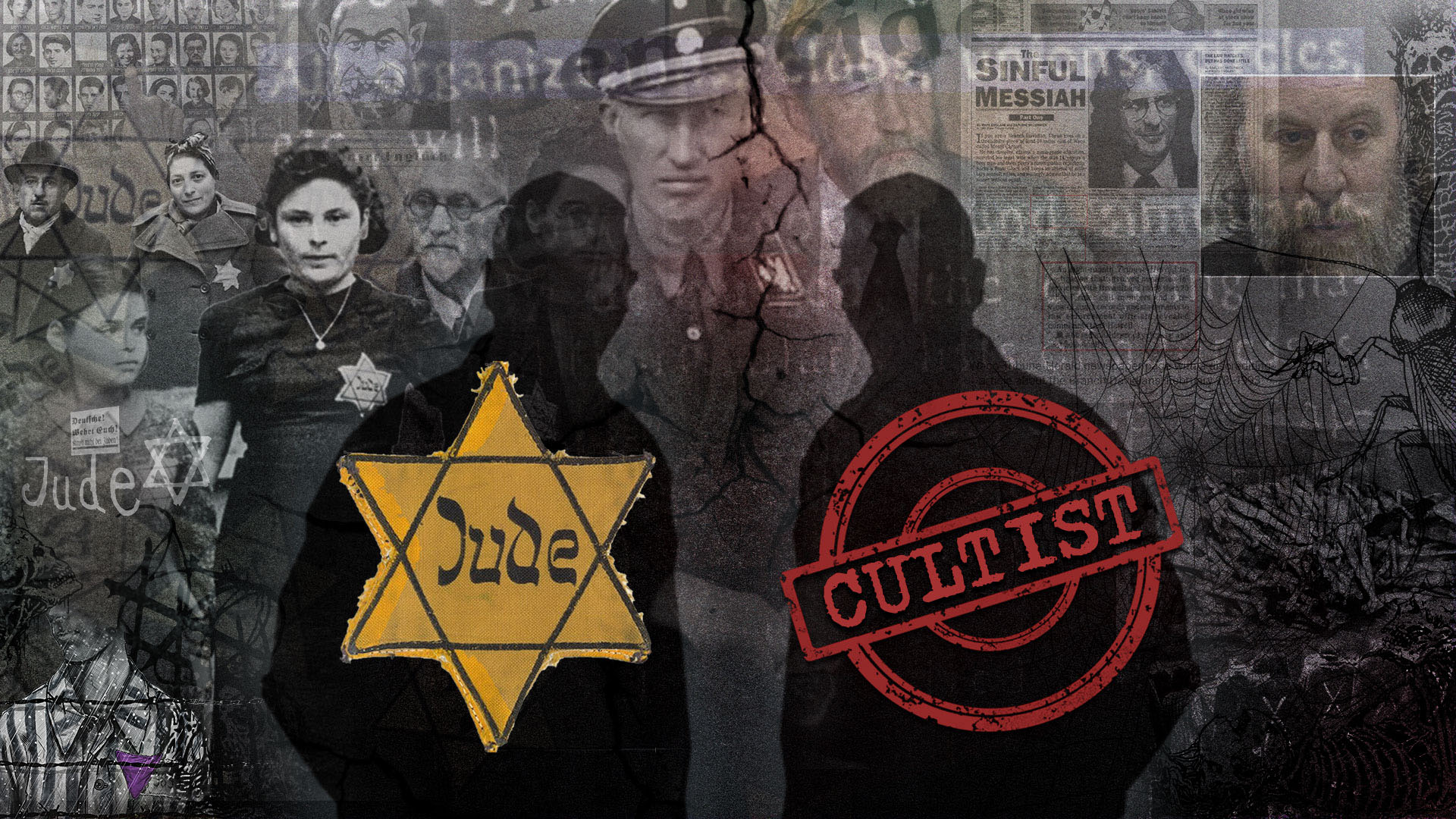
History knows periods when social “immunity” to injustice failed. Nazi Germany, with its anti-Semitic policies, is often cited as an example of what publicists call the “boiling frog syndrome”. The metaphor is apt precisely because it illustrates the mechanism of gradualism: if repressions are introduced not abruptly but in stages, society has time to adapt to them and stops perceiving each new step as a catastrophe. In 1933–1939, the regime passed hundreds of laws systematically excluding Jews from the civil service, the economy, culture, and public space. Taken individually, each decree might have seemed “tolerable” or “necessary”, but collectively they led to complete dehumanization. Historians note that if anti-Jewish policies had begun immediately with mass extermination, it would in all likelihood have caused open shock and resistance even among loyal citizens. Gradual escalation made it possible to bypass the natural moral barriers of society, although it is important to remember: the silence of the Germans was explained not only by habituation, but also by fear of terror, powerful propaganda, and already deeply rooted prejudices.
Therefore, over the course of six years, the Nazi regime, step by step, using the mechanisms of propaganda, dehumanization, and stigmatization, consistently formed the conditions on both legislative and ideological levels that led to the genocide of an entire people. Like a surgeon operating layer by layer, the Nazi propaganda machine gradually dismantled humanistic and moral barriers, preparing society for a tragic and brutal finale.
Let us briefly outline the timeline of events. 2
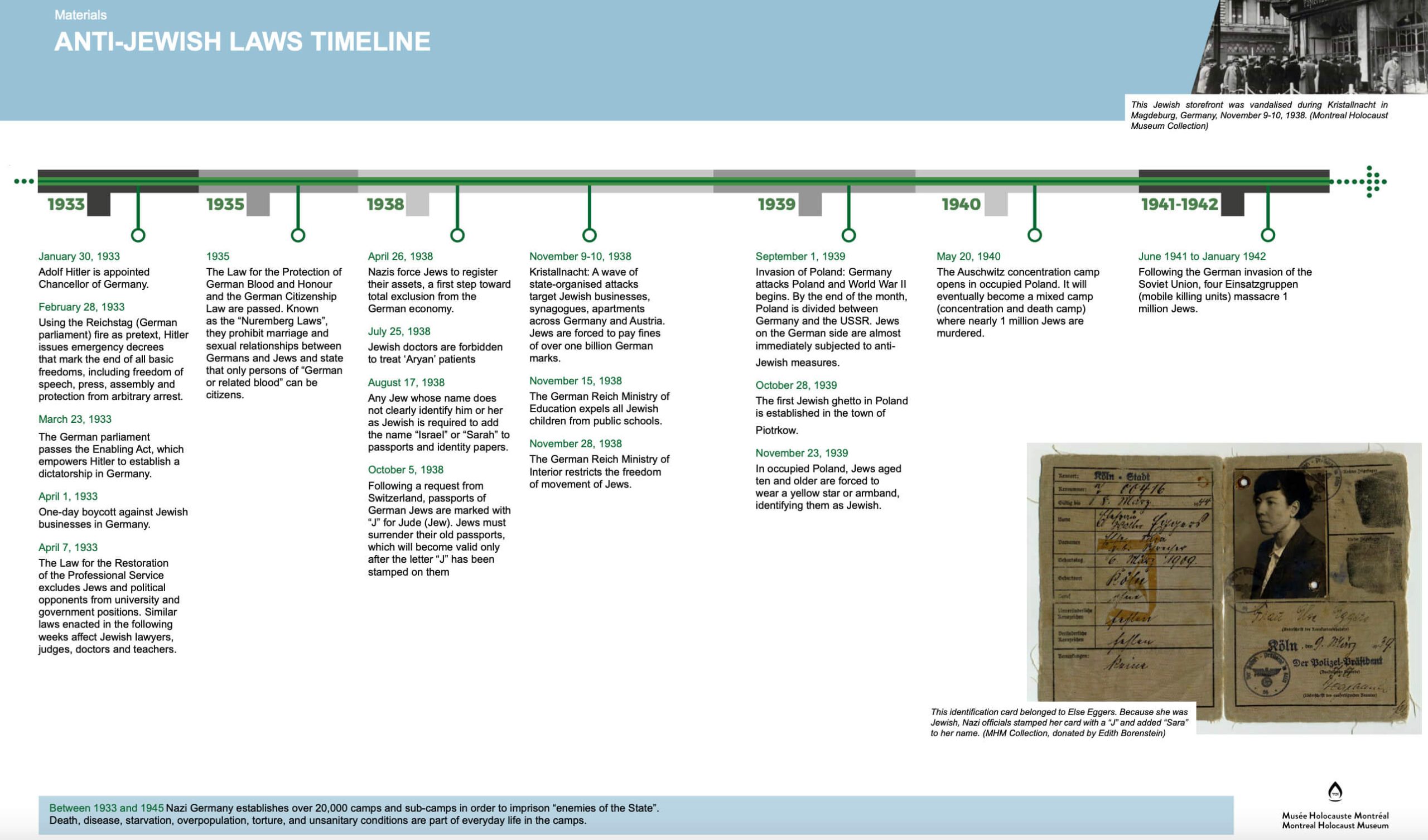
- April 1: A nationwide boycott of Jewish shops and businesses is organized by the SA and SS. The first mass economic blow.
- April 7: Law for the Restoration of the Professional Civil Service — Jews are dismissed from the civil service, universities, and courts. Similar laws in the following weeks affected lawyers, judges, doctors, and teachers.
- April 25: Law Against the Overcrowding of German Schools and Universities — quotas are introduced: no more than 5% of Jewish students in schools and 1.5% in universities.
- July 14: Denaturalization Law — depriving naturalized Jews and “undesirable elements” of citizenship.
- October 4: Editor’s Law — Jews are banned from working in the press and publishing houses.
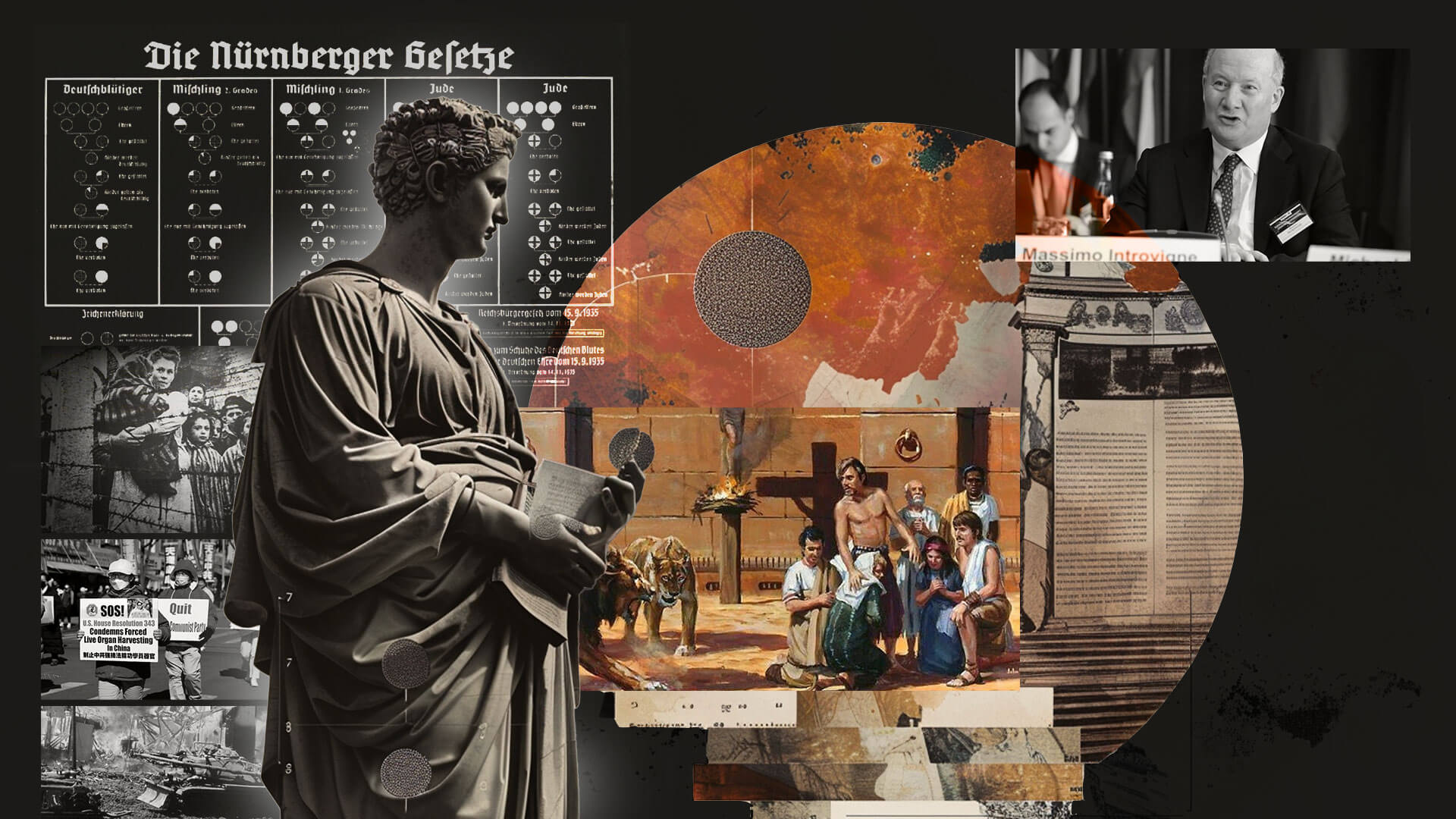
1935: Nuremberg Race Laws — loss of citizenship and racial “purity”
September 15 at the NSDAP rally in Nuremberg:
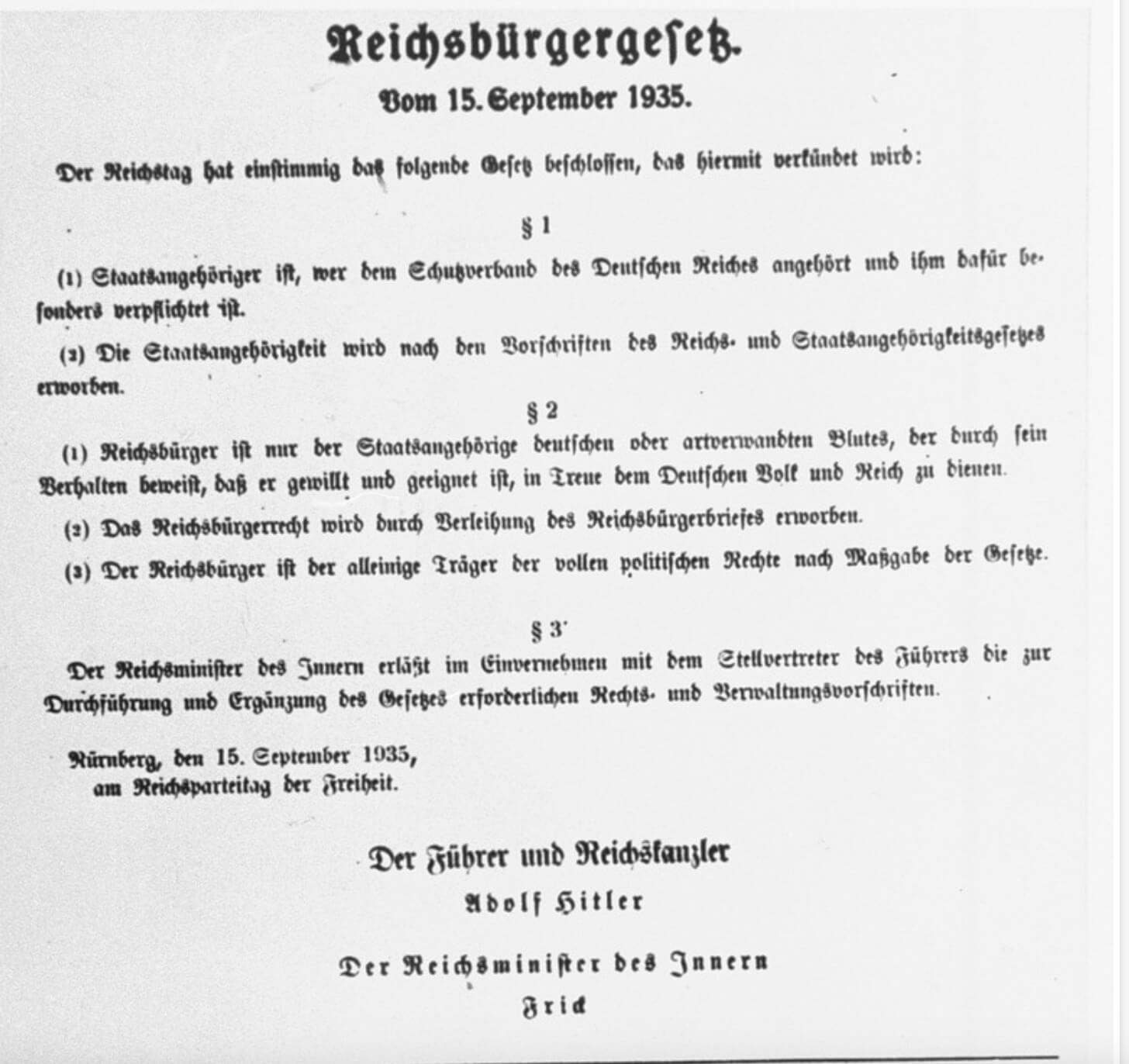
“Reich Citizenship Law of September 15, 1935
(Translated from Reichsgesetzblatt I, 1935, p. 1146.)
The Reichstag has unanimously enacted the following law, which is promulgated herewith:
Article 1
- A subject of the state is a person who enjoys the protection of the German Reich and who in consequence has specific obligations toward it.
- The status of subject of the state is acquired in accordance with the provisions of the Reich and the Reich Citizenship Law.
Article 2
- A Reich citizen is a subject of the state who is of German or related blood, and proves by his conduct that he is willing and fit to faithfully serve the German people and Reich.
- Reich citizenship is acquired through the granting of a Reich citizenship certificate.
- The Reich citizen is the sole bearer of full political rights in accordance with the law.
Article 3
The Reich Minister of the Interior, in coordination with the Deputy of the Führer, will issue the legal and administrative orders required to implement and complete this law.
Nuremberg, September 15, 1935
At the Reich Party Congress of Freedom
The Führer and Reich Chancellor
[signed] Adolf Hitler
The Reich Minister of the Interior
[signed] Frick”
“Law for the Protection of German Blood and German Honor of September 15, 1935
(Translated from Reichsgesetzblatt I, 1935, pp. 1146-7.)
Moved by the understanding that purity of German blood is the essential condition for the continued existence of the German people, and inspired by the inflexible determination to ensure the existence of the German nation for all time, the Reichstag has unanimously adopted the following law, which is promulgated herewith:
Article 1
- Marriages between Jews and citizens of German or related blood are forbidden. Marriages nevertheless concluded are invalid, even if concluded abroad to circumvent this law.
- Annulment proceedings can be initiated only by the state prosecutor.
Article 2
Extramarital relations between Jews and citizens of German or related blood are forbidden.
Article 3
Jews may not employ in their households female subjects of the state of Germany or related blood who are under 45 years old.
Article 4
- Jews are forbidden to fly the Reich or national flag or display Reich colors.
- They are, on the other hand, permitted to display the Jewish colors. The exercise of this right is protected by the state.
Article 5
- Any person who violates the prohibition under Article 1 will be punished with a prison sentence with hard labor.
- A male who violates the prohibition under Article 2 will be punished with a jail term or a prison sentence with hard labor.
- Any person violating the provisions under Articles 3 or 4 will be punished with a jail term of up to one year and a fine, or with one or the other of these penalties.
Article 6
The Reich Minister of the Interior, in coordination with the Deputy of the Führer and the Reich Minister of Justice, will issue the legal and administrative regulations required to implement and complete this law.
Article 7
The law takes effect on the day following promulgation, except for Article 3, which goes into force on January 1, 1936.
Nuremberg, September 15, 1935
At the Reich Party Congress of Freedom
The Führer and Reich Chancellor
[signed] Adolf Hitler
The Reich Minister of the Interior
[signed] Frick
The Reich Minister of Justice
[signed] Dr. Gürtner
The Deputy of the Führer
[signed] R. Hess”
1936–1937: Further exclusion from professions
- Bans on working as a veterinarian, tax consultant, and public school teacher.
1938: Economic destruction, marking, and Kristallnacht
- April 26: Mandatory registration of all Jewish property — the first step towards “Aryanization” (the forced transfer of businesses to “Aryans”).
- August 17: Jews with “non-Jewish” names are required to add “Israel” (men) or “Sara” (women) to their documents.
- October 5: Jewish passports are invalidated; new ones are issued only with a red letter “J” (Jude).
- November 9–10: Kristallnacht — pogroms against Jewish shops, businesses, and synagogues.
- November 12: Decree on the Exclusion of Jews from German Economic Life — closure of all Jewish businesses and shops. A fine of 1 billion Reichsmarks is imposed on the Jewish community “for the pogrom” (destruction).
- November 15: All Jewish children are expelled from public schools.
- November 28: Restriction on the freedom of movement for Jews. Leaving one’s place of residence without permission is prohibited. 2
1939–1941: Complete Isolation and Marking
- February 1939: Jews are required to surrender gold, silver, and jewelry to the state without compensation.
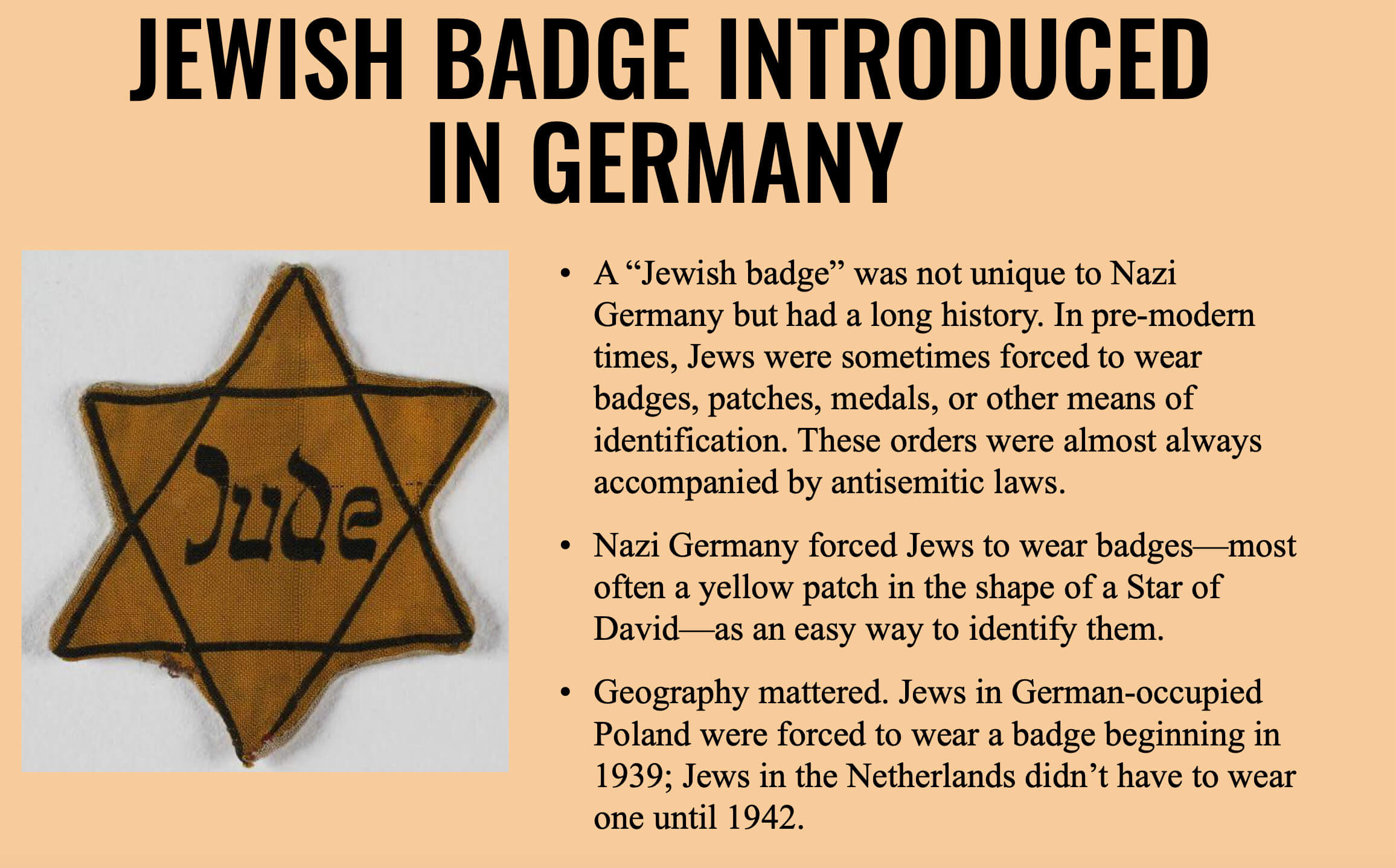
- September 1, 1941, throughout Germany: Mandatory wearing of the yellow Star of David with the inscription “Jude” on clothing. This made Jews visible to everyone and facilitated further repression.
- Additional regulations: curfews, bans on purchasing groceries during certain hours, bans on using radios, telephones, and public transport, as well as forced labor. 4
1942–1945: Transition to the final phase of resolving the Jewish question. Genocide — physical extermination
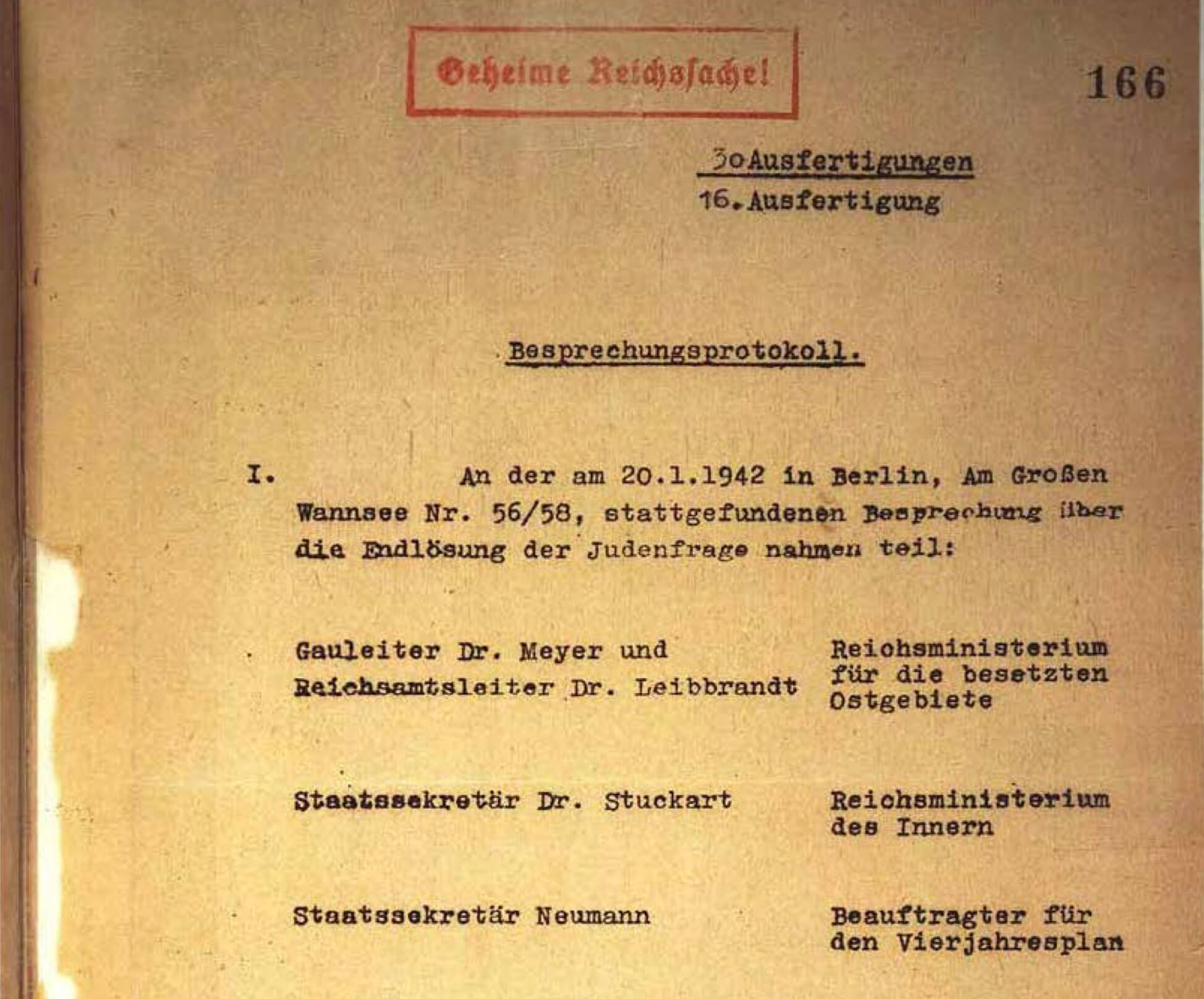
- From 1941–1942: mass deportations to ghettos and death camps. The Wannsee Conference of 1942 formalized the genocide. 5
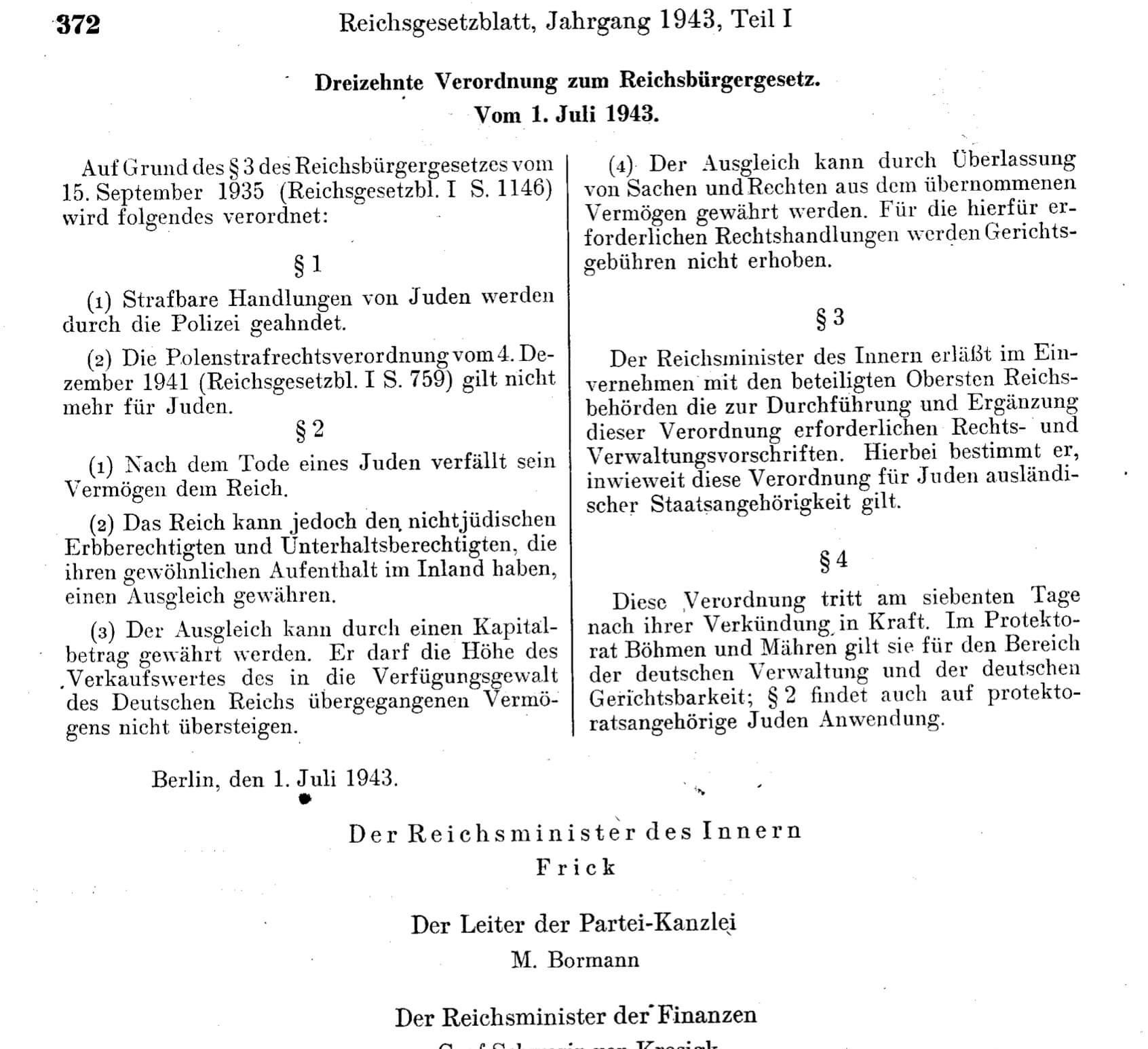
- July 1943: Ordinance completely removing Jews from the protection of German law. 7
Every new law was built upon the previous ones, making the lives of the Jewish population increasingly unbearable and preparing society for the next stage. This became one of the most illustrative examples of how a genocide can be orchestrated in stages — through the gradual deprivation of rights under the guise of “legality,” “public safety,” and “protecting the interests of the people.” Such a transformation was made possible through the combination of two key tools: state propaganda and institutionalized power.
The Reich’s totalitarian machine devoured human lives with an insatiable appetite. And this was all done by the hands of ardent followers of the Führer’s antisemitic policies. History remembers political figures such as Wilhelm Frick — who served as the Reich Minister of the Interior, — and fervent propagandists like Julius Streicher — the editor of the newspaper “Der Stürmer.” Both were found guilty and sentenced to death at the Nuremberg Trials. It is this link between propaganda and politics that leads to the legalization of violence at the state level.
And just like that, the past fades from memory and remains in the dusty archives of museums and libraries. This is especially true since people want to forget the Nazi era and the horrors of Hitler’s regime like a terrible nightmare. But just imagine: what if, in our eagerness to forget a terrible past, humanity overlooks the same horror of the past emerging right now in the present? The kind that will burst into our days from a quiet echo of bygone times with a loud cry of lawlessness.
Today, the facts indicate that Russia is marching in lockstep with the Nazi past, repeating Hitler’s scenario step by step.
So what could Nazi Germany and modern Russia possibly have in common? At what point did the historical parallels of totalitarianism manage to intersect?
To answer this question, we must turn to the legislative framework of the Russian Federation. It is often within legal mechanisms that the legitimization of modern repressive practices against citizens occurs. History shows that authoritarian and totalitarian regimes seek to adapt legislation to their own political goals, because in such cases, repressions are no longer perceived as arbitrary rule or terror, but as formally legal actions carried out under the pretext of protecting the state and public safety.
Freedom of conscience and religion is one of the fundamental pillars of a democratic system. Democracy is not only the principle of the political majority, but also a system of inalienable rights and freedoms that cannot be arbitrarily restricted, even in the presence of a social or state consensus. Such basic rights include freedom of conscience, encompassing a person’s right to independently determine their religious beliefs and worldview.
If the state gains the power to dictate to a citizen what to believe, it signifies a transition to an authoritarian model of governance. In such a system, the sovereignty of the individual is significantly restricted, and the citizen effectively loses autonomy in the realm of beliefs, which is one of the key foundations of a rule-of-law state and a democratic system.
“Without freedom of belief, there is no true freedom at all” — John Locke.
In order to ensure and largely regulate the basic right to freedom of conscience in Russia, Law No. 125-FZ “On Freedom of Conscience and Religious Associations” was adopted on September 26, 1997. Formally, this law, with hundreds of amendments introduced up until 2025, guaranteed freedom of conscience, the equality of religions, and the separation of church and state. In practice, however, it and subsequent amendments created a system of state control that severely restricted actual freedom of religion for non-traditional groups, while simultaneously strengthening the positions of “traditional” denominations.
Much like in Nazi Germany, step by step, Russian legislation gradually restricted the basic rights of citizens and firmly imposed state policy regarding freedom of conscience and religion.
Below, we will examine the key changes in Russian legislation that resulted not only in restrictions, but also in a huge number of fines, arrests, torture, and the deaths of civilians.
The final nail in the coffin of freedom of conscience in Russia, and a resounding chord in the victorious march of totalitarianism, was the so-called Yarovaya Package (Law No. 374-FZ of 2016), with Articles 24.1–24.2 regulating missionary activity and stipulating administrative liability in the form of fines of up to 1 million rubles.
Below is the original text of Article 24.1, Content of missionary activity, Part 3:
“3. The implementation of missionary activity in residential premises is not permitted, except for the cases provided for by paragraph 2 of Article 16 of this Federal Law.” 9
“Article 24.2. Procedure for conducting missionary activity.
Violations of these articles entail administrative liability under Part 4 of Article 5.26 of the Code of Administrative Offences of the Russian Federation.
Article 5.26. Violation of legislation on freedom of conscience, freedom of religion, and religious associations.
4.Conducting missionary activity in violation of the requirements of the legislation on freedom of conscience, freedom of religion, and religious associations entails the imposition of an administrative fine on citizens in the amount of five thousand to fifty thousand rubles; on legal entities, from one hundred thousand to one million rubles.”10
Now imagine that members of a certain religious group have gathered at someone’s home and decided to discuss issues of certain sacred texts together, or perform a prayer or namaz, or perhaps meditate, depending on what cultural or religious traditions the group follows. And it so happens that they do not have written permission with them, or there is no official representative of their organization among them, and then, according to Articles 24.1 and 24.2 of the Russian Constitution, their activity violates the law.
From a common-sense perspective, this sounds absurd, but the law is the law, and the authorities demand that citizens comply with it. One might think there is nothing terrible about this — they met, talked, prayed, and went their separate ways. But from the perspective of legislation that has already been manipulated by destructive forces, if such violations are repeated, this is already considered a systematic violation and subversive activity against the state.
That is, the amendments adopted in 2016 to Law No. 125-FZ “On Freedom of Conscience and Religious Associations” begin to interact closely with Federal Law No. 114 “On Counteracting Extremist Activity.” And in particular, with Article 9 of Federal Law No. 114.
“Article 9. Liability for carrying out extremist activity
(as amended by Federal Law No. 215-FZ of July 23, 2025)
In the Russian Federation, the creation and activity of public and religious associations, and other organizations whose goals or actions are aimed at carrying out extremist activity, are prohibited.
In the case provided for by Part 4 of Article 7 of this Federal Law, or in the case of extremist activity being carried out by a public or religious association, or other organization, or their regional or other structural subdivision, which entails a violation of the rights and freedoms of man and citizen, causing harm to the individual, public health, the environment, public order, public safety, property, the legitimate economic interests of physical and (or) legal entities, society, and the state, or creating a real threat of causing such harm, the corresponding public or religious association or other organization may be liquidated, and the activity of the corresponding public or religious association that is not a legal entity may be prohibited by a court decision based on a statement from the Prosecutor General of the Russian Federation or a relevant subordinate prosecutor.”
In this context, it can be concluded that any “missionary” or educational activity can be classified as extremist if “experts” — often loyal to the harsh legislation, from the Expert Council for Conducting State Religious Studies Expert Evaluation under the Ministry of Justice of the Russian Federation — find “signs of supremacy” or “incitement of hatred” in it. The example of the Jehovah’s Witnesses religious organization demonstrates how this mechanism is applied in practice.
After the Yarovaya amendments came into force, the police began to massively record violations of Articles 24.1 and 24.2 — violations of the norms of missionary activity under Part 4 of Article 5.26 of the Code of Administrative Offences of the Russian Federation. The systematic nature of the recorded violations, among other things, played a key role when cases were referred to court. After all, it was in court that cases of violating missionary activity were considered under Article 9 of Federal Law No. 114.
Based on an analysis of the facts, the Yarovaya amendments adopted in 2016 can be considered the starting point for mass repressions. After all, they became the stairway that sent “non-traditional religions” or “unregistered associations” to the scaffold of extremism.
On April 20, 2017, the Supreme Court of the Russian Federation recognized all 396 local religious organizations of Jehovah’s Witnesses as extremist and banned their activities.
The consequences: searches, confiscation of property, prohibition of assemblies, and criminal cases even for reading the Bible and praying within the family circle.
These articles provide a more detailed look at the case of Jehovah’s Witnesses in Russia.
- https://actfiles.org/following-in-the-footsteps-of-nazism-the-history-of-persecution-of-jehovahs-witnesses-in-russia-causes-and-perpetrators/
- https://actfiles.org/prisoners-of-conscience-jehovahs-witnesses-who-are-they/
- https://actfiles.org/the-beastly-face-of-anticultism/
These articles not only detail the mechanism for destroying democratic foundations and human rights but also the stories of cruel treatment towards followers of this organization. These materials clearly confirm the similarities between the political course of modern Russia and Nazi Germany.
The growing statistics of administrative violations demonstrate the dynamics of repressions against citizens’ free will. While some semblance of religious pluralism still existed in Russia before 2016, following the Yarovaya amendments, the totalitarian machine only began to gain momentum, mercilessly grinding down not only rights but also citizens’ destinies.
The SOVA Center records a steady increase in administrative and criminal cases against religious minorities. 11 Presumably, this data is not entirely accurate, as it can be obtained from open sources in Russia, which may not be accessible in America and European states, and there is a possibility that the numbers are understated. However, for the specific purposes of our investigation, the dynamics of change are what matter.
According to the Judicial Department of the Supreme Court of the Russian Federation for 2025: 2,241 extremist-related crimes (+30.4% compared to 2024). 12
According to the Ministry of Internal Affairs and OVD-Info: dozens of new cases based specifically on religious grounds.
Over 3,000 individuals and 80 organizations have been added to the list of extremists/terrorists; hundreds of millions of rubles in assets have been frozen.
The SOVA Center records a steady increase in administrative and criminal cases against religious minorities. 11
While in 2016 the courts heard between 150–200 cases involving violations of missionary activity, in 2017 this figure rose to 300–350. And in the first half of 2025 alone, courts reviewed 297 cases of illegal missionary activity. Fines remain the primary penalty. However, there are also cases of imprisonment ranging from 4 to 15 years.
On March 15, 2022, Russia officially notified the Secretary General of the Council of Europe of its intention to withdraw from the organization and denounce the European Convention on Human Rights.
On March 16, 2022, Russia was expelled from the Council of Europe. 13 This means that the European Court of Human Rights can no longer help people living in the Russian Federation defend their rights. In other words, all the horror and lawlessness occurring today in Russia and in the occupied territories can in no way be stopped by higher judicial instances.
Human rights in Russia have been crushed by the jackboot of the repressive machine. Having chosen the course of totalitarian subjugation of human will, Russia has systematically strangled democratic foundations over the course of 30 years, and most importantly, the fundamental human right to choose what to believe in. Totalitarianism demands unquestioning obedience. It does not tolerate freedom of will, thought, or speech. A dictatorship needs submissive slaves, not free citizens. Just as Nazi Germany deprived some of the right to life and others of the right to vote, observing what is happening today leads to the conclusion that Russia has uprooted and destroyed the foundation of democracy and the personal freedom of its citizens.
So who exactly has become the new Streichers, Fricks, and similar ideologists and executioners of the repressive regime in Russia today? Whose actions can clearly exhibit the traces of a bloody, anti-human past? Who carried out all these manipulations with Russian legislation? A comparative analysis of the facts points to publicly represented figures through whom this was successfully pushed at the state level — these are Senators Elena Mizulina and Irina Yarovaya. Their role was tied to the political and legislative arena, much like Frick’s in Nazi Germany.
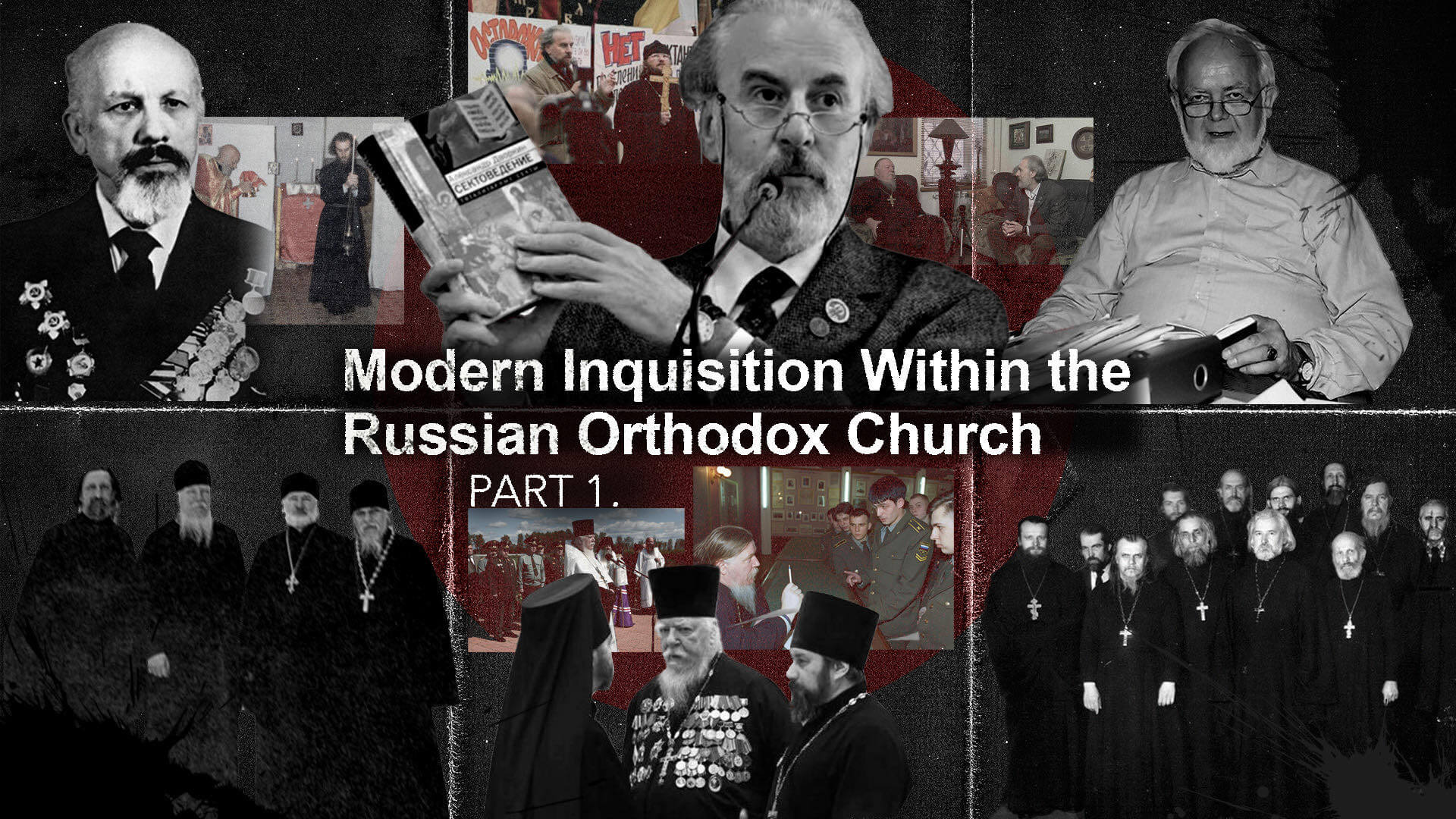
However, changing the law requires grounds to equate missionary activity with extremism. This required expert evaluations and reports. This is exactly what was done by the representatives of anticultism in Russia, colleagues within RACIRS: Alexander Dvorkin, who according to numerous sources is the main ideologist of the anticult network, and Alexander Novopashin.
For a deeper understanding of Alexander Dvorkin’s psychological profile, we recommend reading the series of articles “Sectology Professor Or Serial Killer?” And what such “expert reports” have led to can be learned from separate articles on our portal.
Alexander Dvorkin was part of a working group under Senator Elena Mizulina to develop anti-sectarian legislation. Furthermore, since 2009, he has headed the Expert Council for Conducting State Religious Studies Expert Evaluation under the Ministry of Justice of the Russian Federation. In this regard, critics note that the formation of the regulatory framework in this sphere turned out to be closely tied to the anticult paradigm.
Proponents of this position argue that as a result of such influence, law enforcement practices can take on an overly broad interpretation, affecting, among other things, citizens’ right to freedom of religion. Within the framework of this critical assessment, it is argued that regulatory mechanisms in the religious sphere require additional guarantees against potential ideologization and the unjustified expansion of repressive practices.
Any court case requires an expert evaluation. But if this evaluation is compiled by deliberately biased individuals who, according to some sources, hold openly Nazi, anti-humane, and radical views, then what are the chances of a fair trial in a state with legislation manipulated by anticult ideologists?
Russia’s new repressive machine has been in the making for 30 years, starting from the inception of the anticult vector headed by Alexander Dvorkin. Today, these are expert sectologists, police and prosecution officers, judges, deputies, officials, senators, and priests who support the agenda of the anticult network: all of them, one way or another, can be said to serve the new Nazi regime. For them, the law has turned into an instrument of power and suppression.
Within this logic, the anticult rhetoric and ideological mindsets of certain expert groups are capable of exerting a substantial influence on the application of legal norms, which, according to opponents, increases the risk of an arbitrary and overly broad interpretation of the law. As a result, this can lead to situations where it becomes possible and normalized to convict an elderly man for praying at home, separate children from their parents, or torture someone to death in a prison cell while beating out yet another confession or testimony advantageous to the repressive machine.
If the law truly worked in this country as it does in any other democratic nation, then every representative of the anticult movement would have answered for their crimes and faced punishment. In that case, there would be no arrests of innocent citizens, no deaths, no fear, and no dictatorship.
Just look at Article 3, Part 6 of that very same Law No. 125-FZ “On Freedom of Conscience and Religious Associations.” 14
“6. Obstructing the exercise of the right to freedom of conscience and freedom of religion, including when accompanied by violence against a person, the intentional insult of citizens’ feelings in connection with their attitude toward religion, the propaganda of religious supremacy, the destruction or damage of property, or the threat to commit such actions, is prohibited and prosecuted in accordance with federal law. Holding public events, or displaying texts and images that insult the religious feelings of citizens near objects of religious veneration, is prohibited.”
So where was this very federal law looking when Russian Streichers like Dvorkin and Novopashin were traveling around the country and spreading an anticult ideology so destructive to society?
The law, by all appearances, was directed toward the future — a future that even today already reeks of the ghosts of a totalitarian past. As the author of this article, allow me to ask a question: do the main ideologue of the anticult network and its representatives remember what such historical scenarios lead to, and how the activities of figures like Frick and Streicher ultimately ended in their time?
Sources:
1. https://museeholocauste.ca/app/uploads/2019/03/anti_jewish_laws_timeline.pdf
2. https://encyclopedia.ushmm.org/content/en/article/antisemitic-legislation-1933-1939
3. https://encyclopedia.ushmm.org/content/en/article/nuremberg-laws
4. https://www.ushmm.org/m/pdfs/USHMM-Timeline-Activity-Laws-Decrees.pdf
5. https://www.yadvashem.org/docs/wannsee-conference-protocol.html
6. https://www.ghwk.de/fileadmin/Redaktion/PDF/Konferenz/protokoll-januar1942_barrierefrei.pdf
7. https://avalon.law.yale.edu/imt/1422-ps.asp
8. https://www.servat.unibe.ch/dns/RGBl_1943_I_372_VO_ReichbuergerG.pdf
9. https://www.consultant.ru/document/cons_doc_LAW_16218/04154b11ab7aacf1f7a3b270b5d034e15009ce83/
10. https://www.consultant.ru/document/cons_doc_LAW_16218/8c786bbd612ebce7f0579b6034d926be67b91c60/
11. https://www.sova-center.ru/religion/news/harassment/intervention/
12. https://cdep.ru/?id=79
13. https://rm.coe.int/0900001680a5da51
14. https://www.consultant.ru/document/cons_doc_LAW_16218/2fb31209f29e0fee531bafad8af983b99b030921/