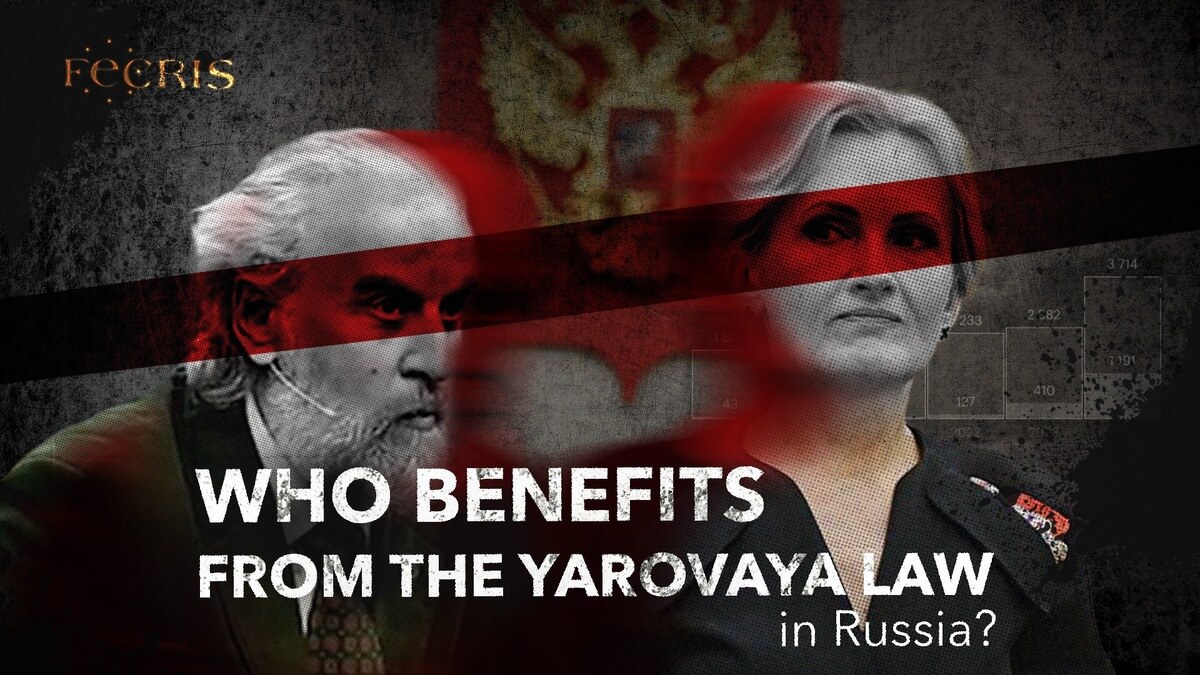
Over the past decades, many laws have emerged in Russia that were presented to the public as security measures. The fight against extremism, countering terrorism, protecting citizens — these are formulas familiar to everyone. Yet, quite often, these formulations conceal mechanisms that effectively restrict freedom of belief and persecute people for their worldviews. One of the most telling examples is the so-called Yarovaya Anti-Terrorism Package, or the Yarovaya Law.
When this package of bills was adopted in 2016, it was presented as an urgent and necessary response to the threat of international terrorism. However, even during discussion of the documents, many specialists drew attention to their controversial provisions. Telecommunications industry experts, IT company representatives, lawyers, and economists pointed out the technical difficulties of implementation, the high cost of deployment, and the dubious practical effectiveness of several proposed measures.
Today, years later, it is becoming increasingly obvious that this package has become one of the key tools for exerting pressure on independent spiritual movements and civil initiatives. But the main question remains open: who was actually behind the formation of this legislative framework?
In previous investigations, we repeatedly showed the degree of influence exerted by Alexander Dvorkin and his affiliated anticult entities on various branches of power in the Russian Federation. In our materials, we examined how the system of expert councils was formed, how the infrastructure of pseudo-expert assessments was created and subsequently used in courts, and how anticult rhetoric infiltrated operations of law enforcement agencies. We also analyzed in detail how representatives of this network gained the ability to influence legislative initiatives and shape government policy regarding freedom of conscience.
To understand the real scale of this influence, we propose to examine a specific example — to trace how Dvorkin’s anticult organization, through its supporters, managed to influence the legislative process in Russia, how the ideas they promoted ultimately found reflection in the adoption of specific legislative norms, and why it is exactly his ideology that can be seen in the framework of Russia’s modern government system.
In this article, we will examine the so-called Yarovaya Anti-Terrorism Package, a set of laws named after the State Duma member Irina Yarovaya.
Adopted in 2016, the Yarovaya Package, or the Yarovaya Law, included a whole range of norms. Its most famous and widely debated provisions have been measures affecting both the security field and daily communications of citizens. Among them were the introduction of criminal liability for “failure to report terrorism-related crimes,” the establishment of a mandatory data retention system for users’ phone conversations and Internet correspondence, as well as the requirement for Internet service providers to provide state authorities with technical means to decrypt messages.
During the drafting stage of the law, several other initiatives were also discussed. In particular, proposals were considered to strip individuals convicted of terrorist crimes of citizenship and to lower the age of criminal liability for certain terrorism-related offenses to age 14. Some of these norms were later softened or excluded from the final version of the law during parliamentary discussions, but the process itself was accompanied by widespread debate over the scale and severity of the proposed measures.
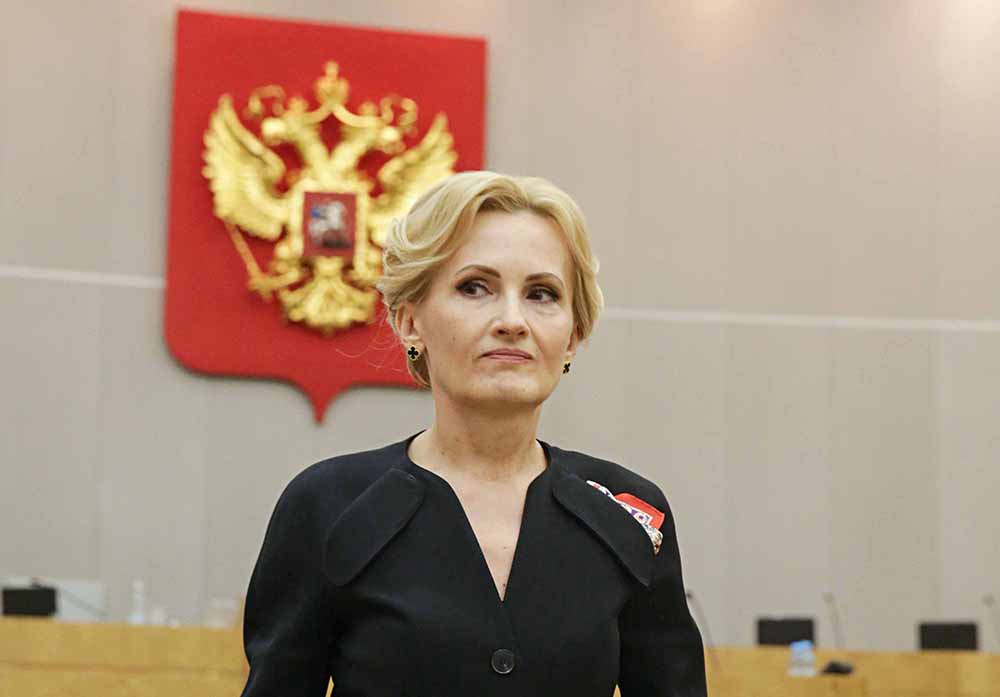
The main question of this investigation is simple: was the Yarovaya Anti-Terrorism Package truly a tool for combating terrorism, or did it serve as a key legal formalization of the final stage of Alexander Dvorkin’s agenda aimed at significantly tightening control over society and restricting civil liberties in Russia under the pretext of ensuring security?
Was There a Need to Toughen the Legislation?
By the time the anti-terrorism package was adopted in 2016, the level of terrorist activity in Russia had already been showing a steady decline for several years. According to the Global Terrorism Database (GTD) 1, one of the largest international databases of terrorist attacks, the number of such incidents in Russia had significantly decreased compared to the beginning of the decade. The database includes over 200,000 recorded terrorist events worldwide since 1970 and is used by researchers and international organizations to analyze the dynamics of terrorism.
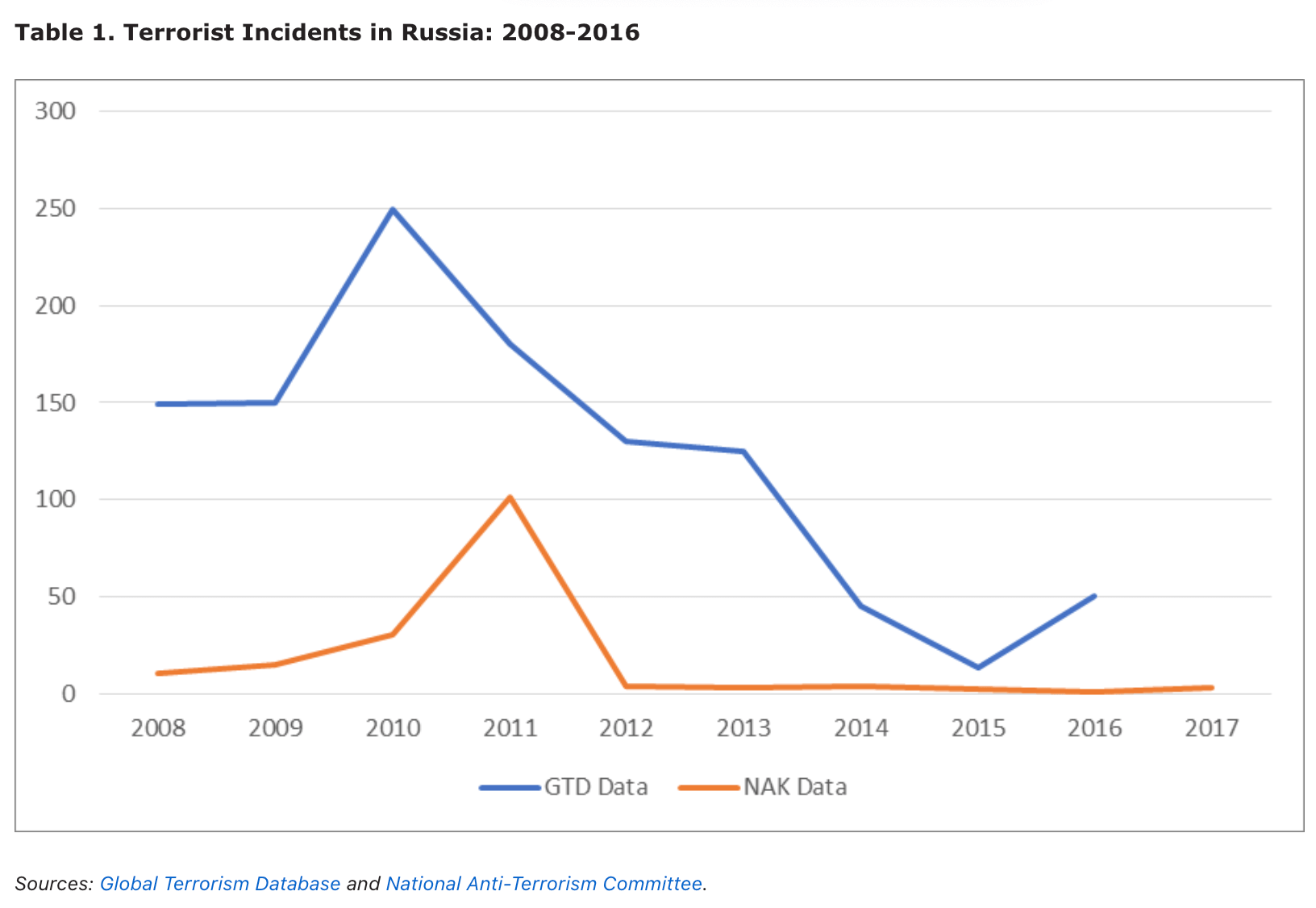
Analysis of data from this database shows that after a peak of terrorist activity in the early 2010s, the number of attacks in Russia began to consistently decline. By the middle of the decade, their number had dropped severalfold compared to the figures at the decade beginning.
Researchers attribute this primarily to the gradual weakening of armed insurgency in the North Caucasus and the systemic work of Russian intelligence and law enforcement agencies. During the first half of the 2010s, a significant portion of organized insurgent entities was eliminated or seriously weakened.
By 2015, a year before the adoption of the so-called anti-terrorism package drafted by deputy Irina Yarovaya, the number of terrorist attacks was at one of its lowest levels in previous years. This very trend can be seen in the graphs below, which are based on international research databases and open statistical data.
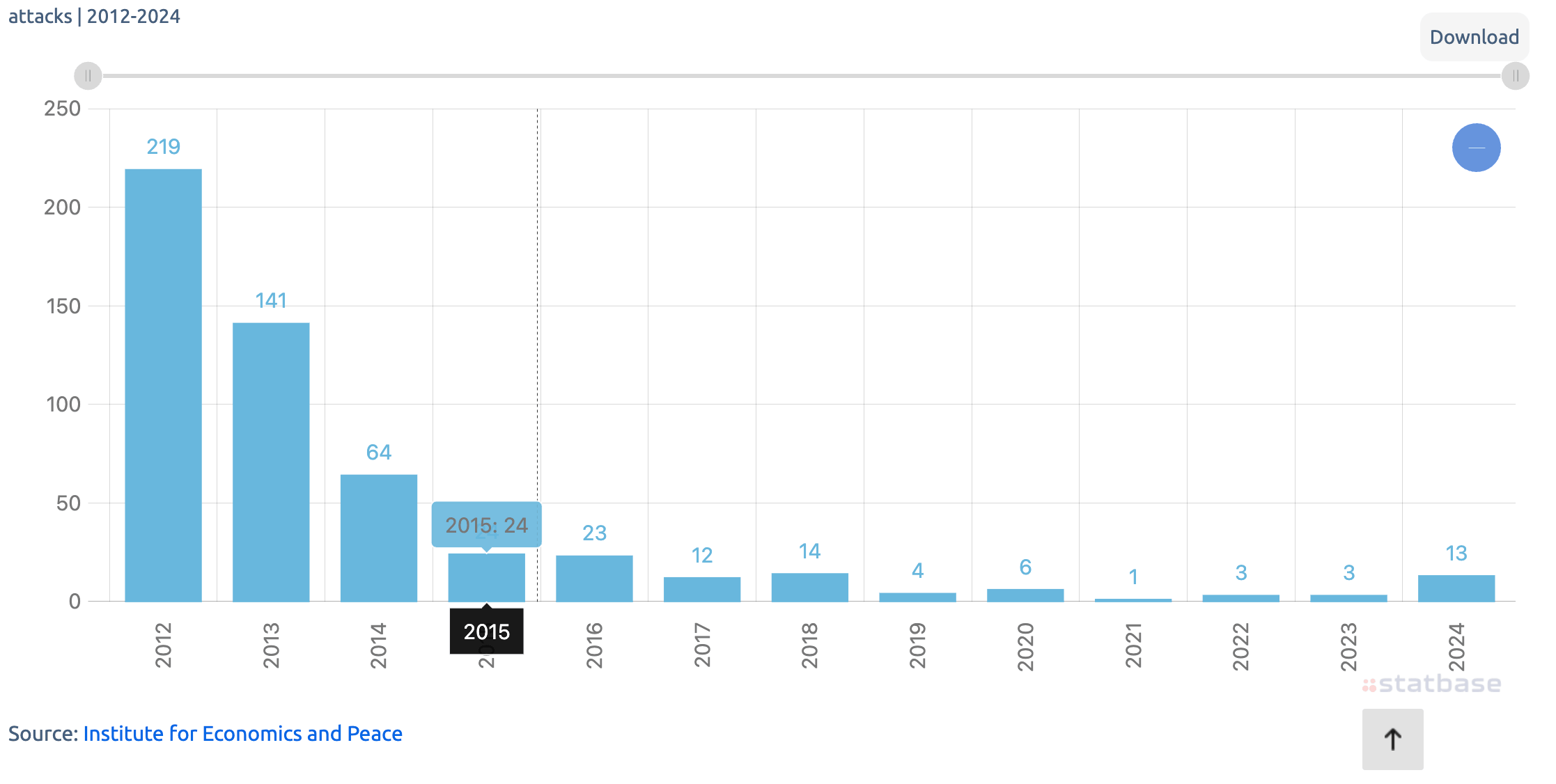
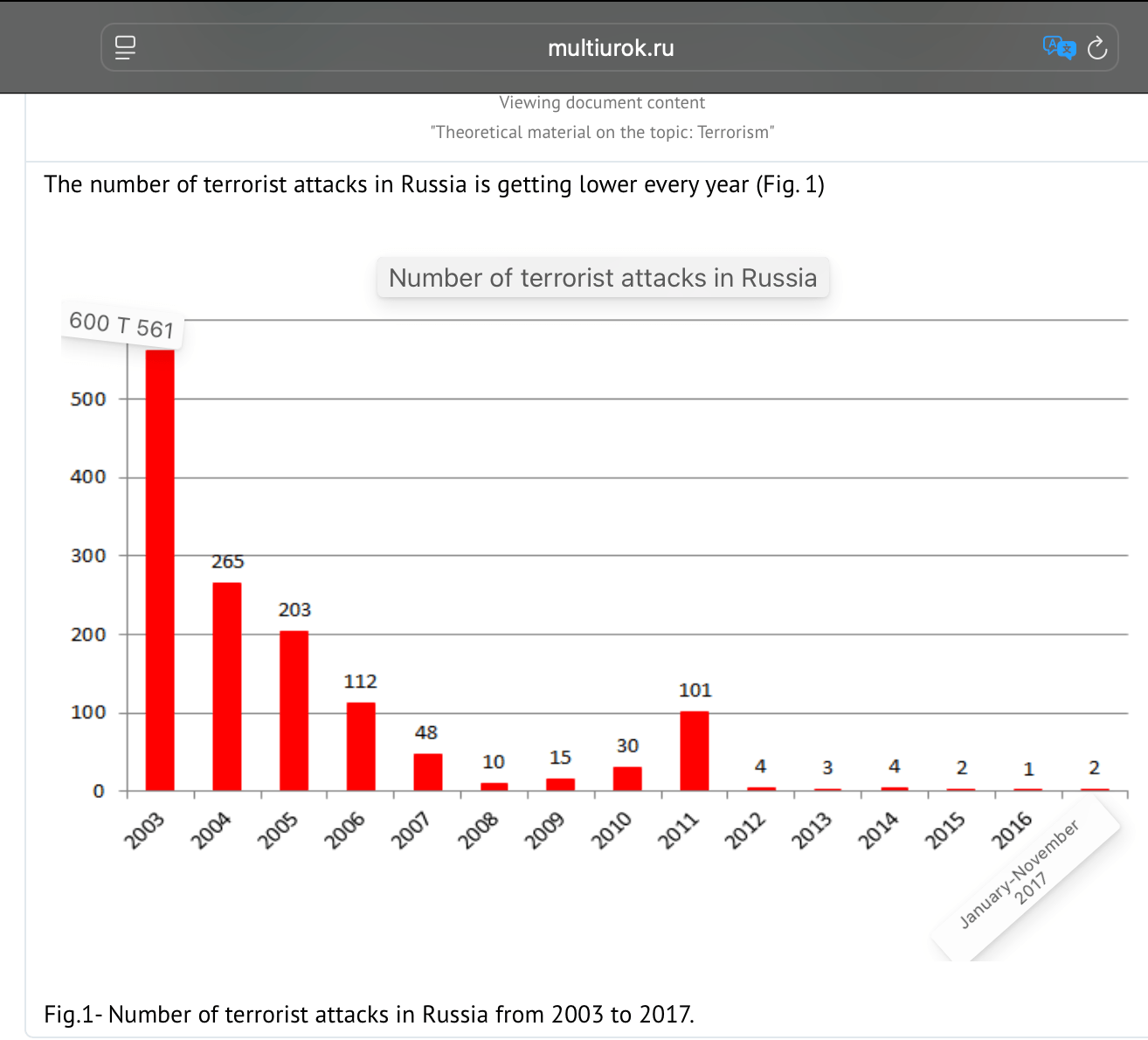
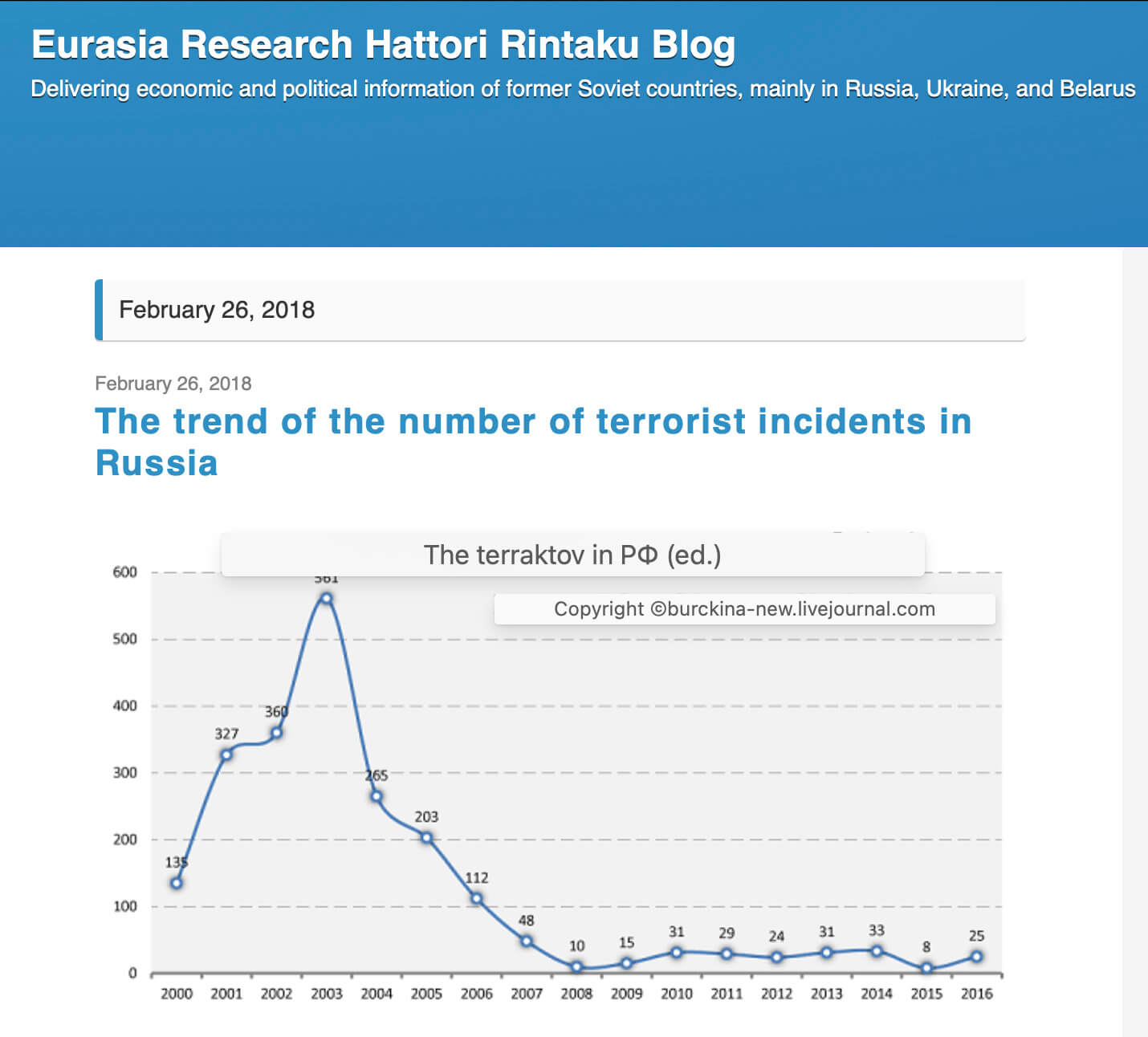
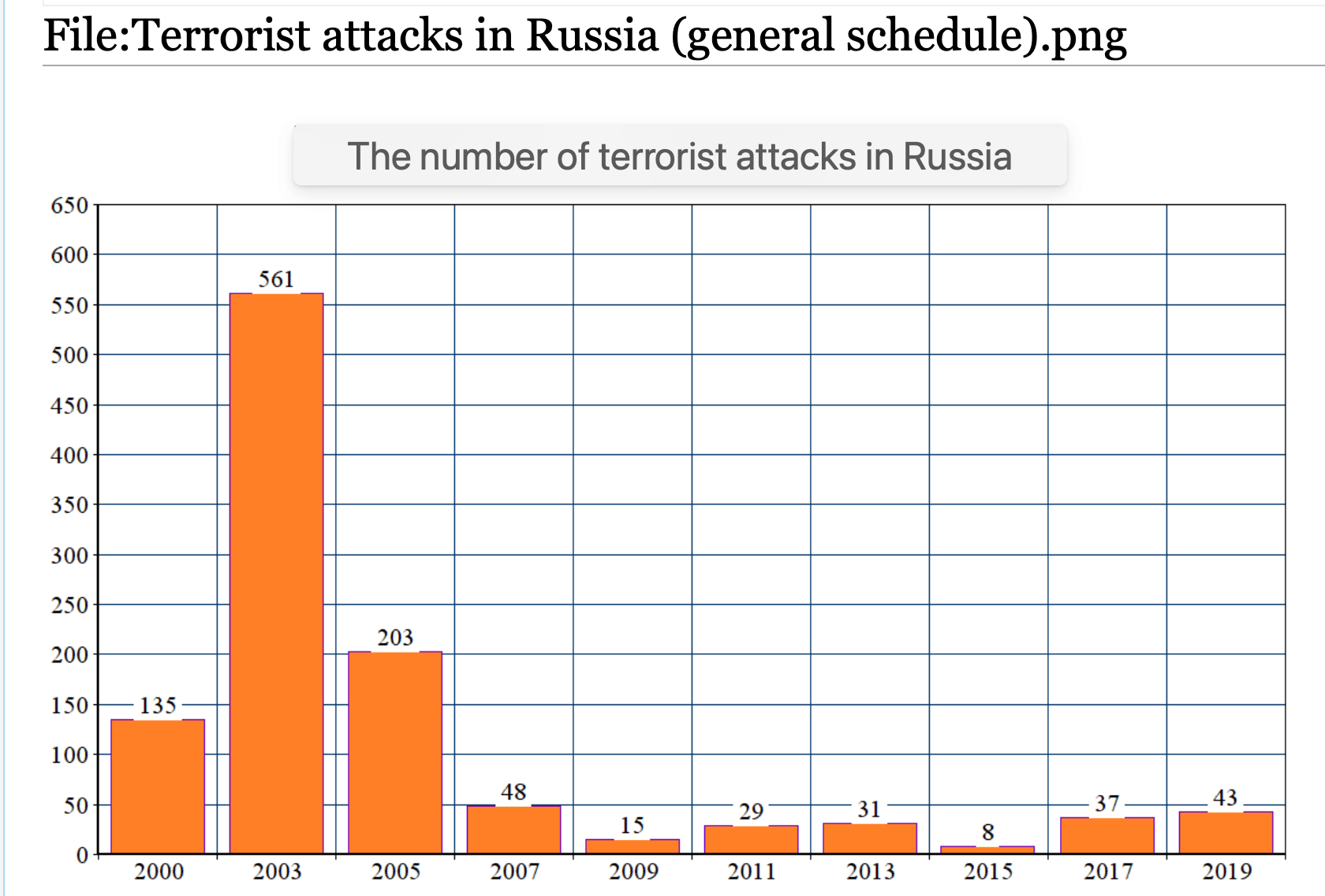
This raises a logical question. If the dynamics of terrorist activities was showing a steady decline and, judging by statistics, law enforcement agencies were successfully coping with their assigned tasks, then what caused such an urgent need to adopt a massive package of anti-terrorism amendments in 2016? Why was there a need for one of the harshest sets of anti-terrorism laws in modern Russian history precisely when the number of terrorist attacks had reached its lowest values in many years?
This is only the first of the contradictions discovered upon careful analysis of the circumstances surrounding the emergence of these laws, the urgency of their adoption, and the arguments used to justify them.
The dynamics of statistics on terrorism-related crimes recorded in official law enforcement reports deserves special attention. Starting in 2013, changes were made to the criminal legislation of the Russian Federation, expanding the list of acts classified as terrorist crimes. In particular, it included offenses such as public calls to carry out terrorist activities, public justification of terrorism, and undergoing training for the purpose of carrying out terrorist activities.
The expansion of the list of corresponding articles led to an increase in the total number of registered terrorism-related crimes, which is clearly visible in the statistical graphs after 2013 (see Figure 6). However, this growth primarily reflects changes in accounting principles and the composition of crimes rather than an increase in the number of actual terrorist attacks.
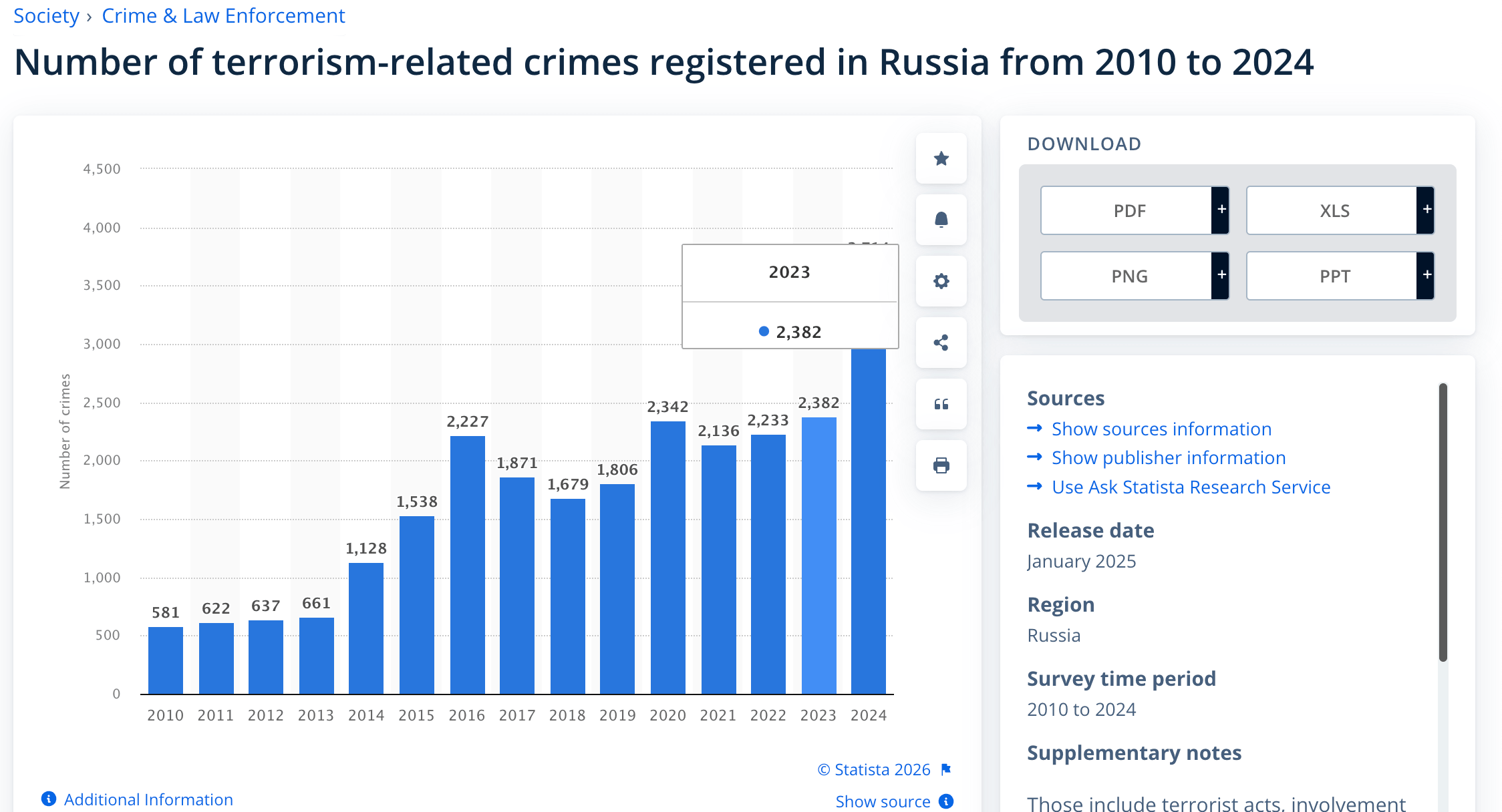
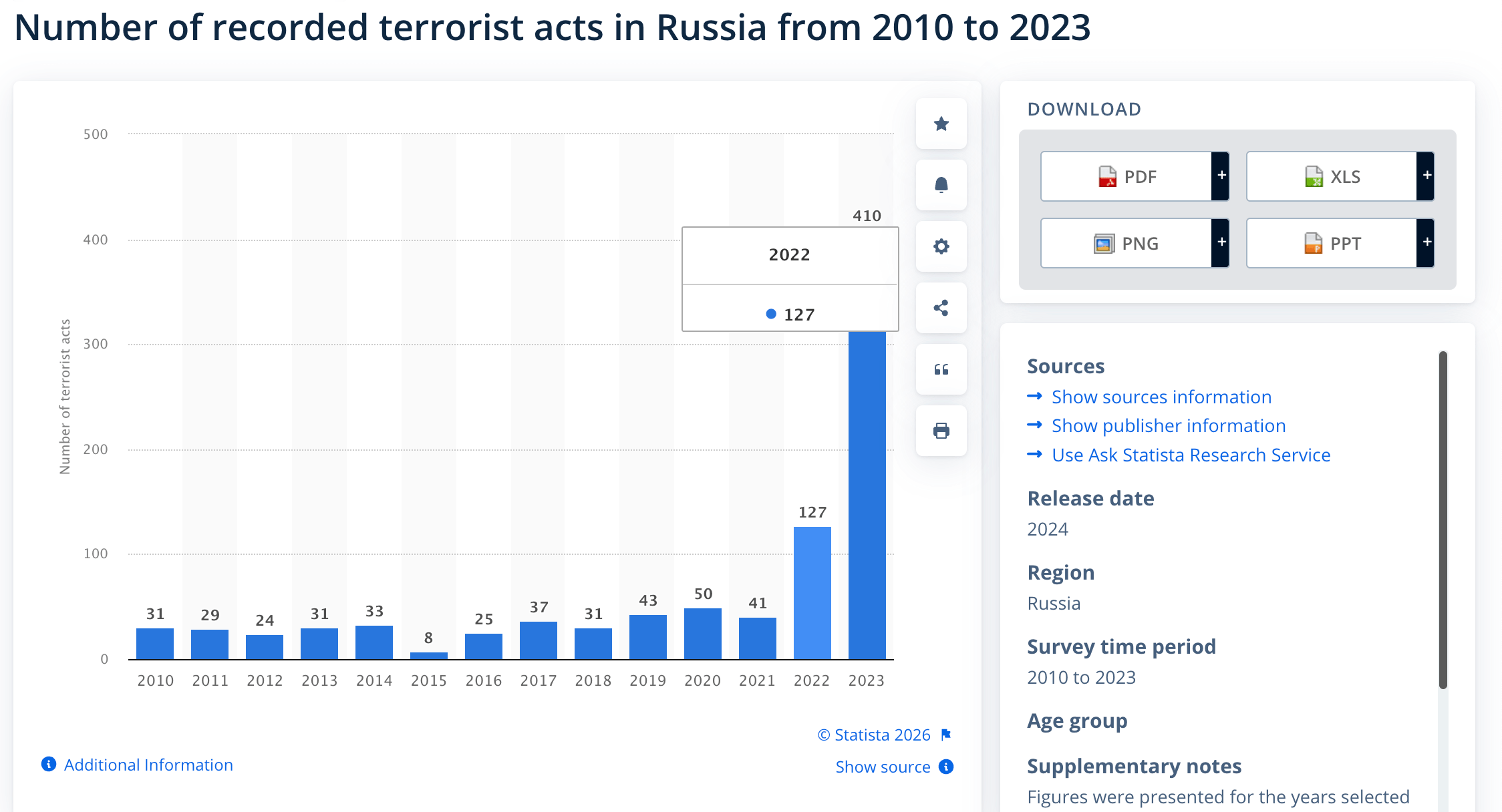
Thus, even with the expansion of the list of terrorist crimes and an increase in their registration, the Russian law enforcement and special agencies generally coped effectively with the tasks of countering terrorism and ensured a consistent decline in the number of real terrorist attacks.
Technical Feasibility of the Yarovaya Package and Effectiveness of the Proposed Measures
The next group of questions relates to practical feasibility of the key technical requirements of the anti-terrorism package. This primarily concerns the provisions obliging telecom operators and Internet companies to store massive volumes of user traffic and ensure it can be provided to law enforcement, as well as the requirements regarding access to encrypted communications.
Even during the discussion of the bill, representatives of the telecommunications industry and specialized experts pointed out that complying with these requirements at the time the law was adopted was technically impossible. According to telecom operators’ estimates, the volume of data that was supposed to be stored under the new provisions required a creation of a storage infrastructure that didn’t exist at the time neither in Russia nor in most countries of the world. In addition, this involved multi-billion-dollar costs for purchasing equipment and building data centers.
In July 2016, at a meeting with the President of Russia, the Minister of Communications and Mass Communications, Nikolai Nikiforov, reported on the state of the industry:
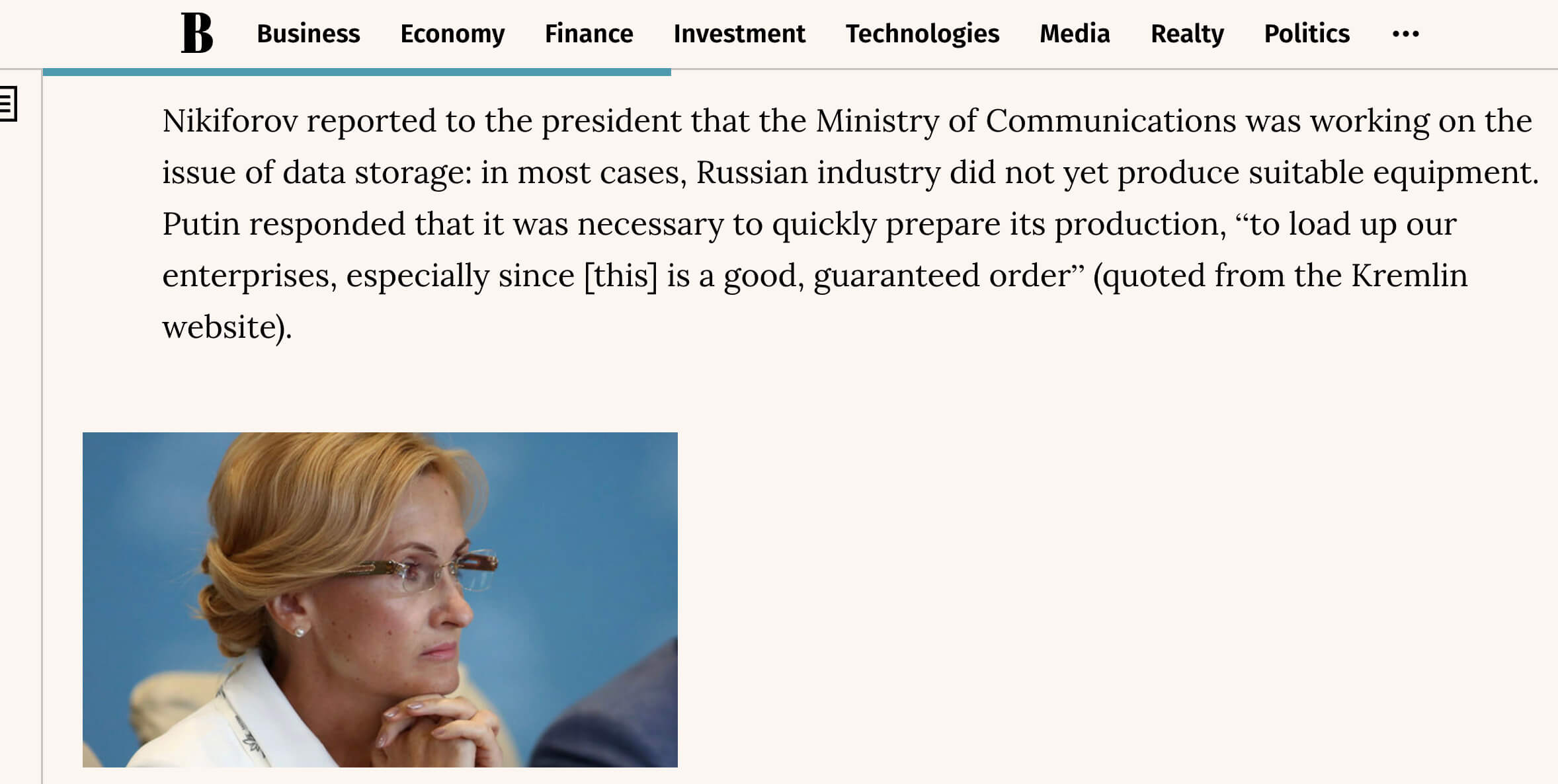
“Nikiforov reported to the President that the Ministry of Communications was working on the issue of data storage: in most cases, Russian industry does not yet produce suitable equipment. Putin responded that it was necessary to promptly prepare its production, ‘to load up our enterprises, especially since [this] is a good, guaranteed order’ (quotes from the transcript on the Kremlin website).” 8
Shortly thereafter, the Ministry of Communications, together with telecom operators, started collecting technical parameters for the equipment needed to implement the law requirements:
“Official representatives of MTS, Dmitry Solodovnikov, and VimpelCom, Anna Aibasheva, also confirmed that the entire range of equipment needed to implement the law requirements isn’t produced in Russia.
‘Moreover, certain types of hardware and software systems, e.g., for intercepting, cataloging, and storing massive amounts of information, are not mass-produced not only in Russia, but anywhere in the world,’ Solodovnikov noted.
Andrei Kolesnikov, an expert at the Russian Institute for Public Networks (RIPN), explained that we have a large number of companies that produce niche but not mass-market equipment for telecommunications, but it is based on foreign components.
‘To set up production of the necessary equipment in Russia, it will take about 20 years, since the establishment of an electronic component base must be started from scratch,’ Kolesnikov said. ‘The component base we currently have does not meet the operators’ requirements. If we use ready-made components and modules produced abroad, production can be launched in two or three years’.” 9
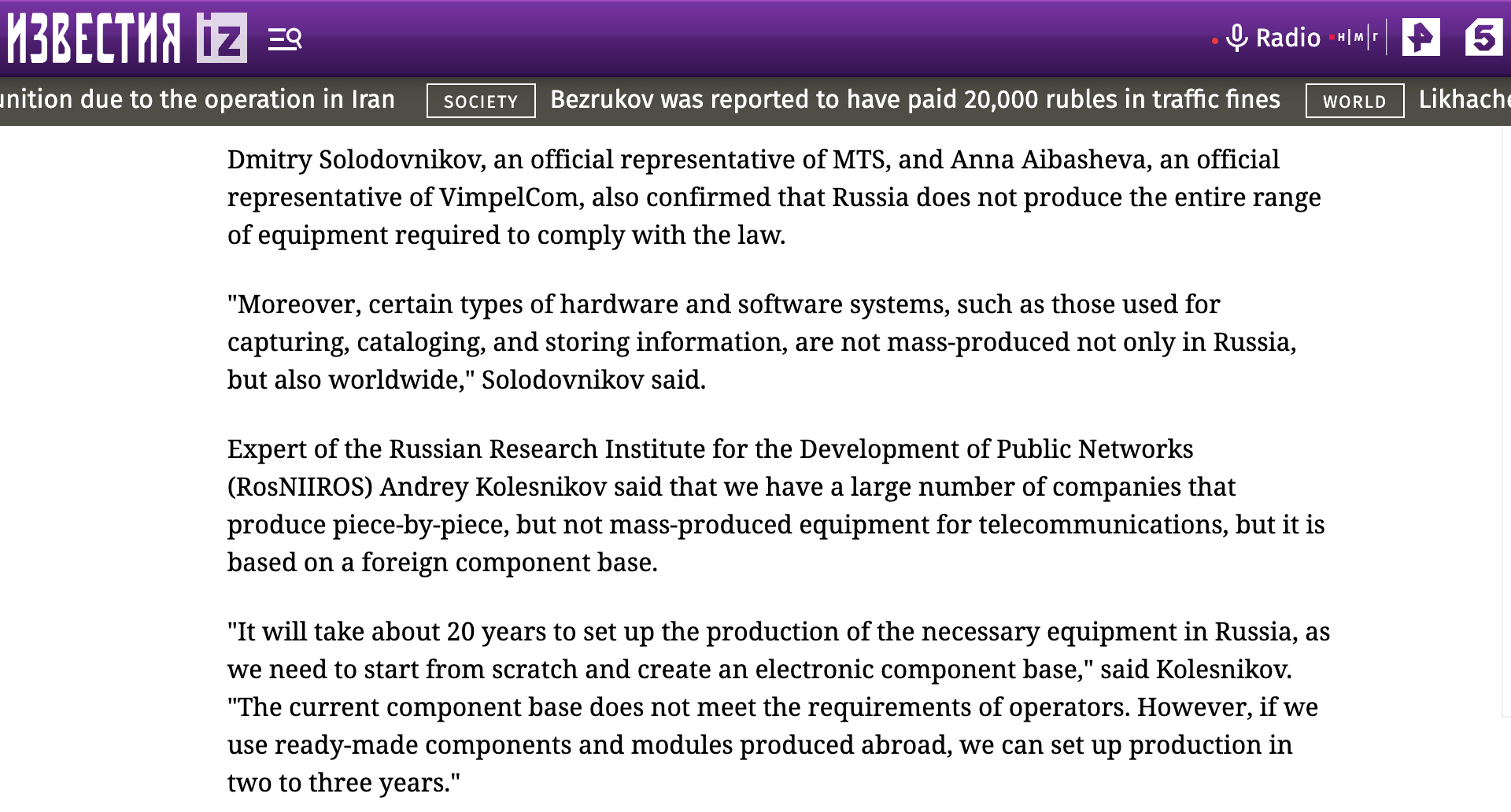
Thus, as early as in 2016, industry representatives and telecommunications experts explicitly pointed to the lack of both domestic equipment and the technological base for its mass production. This wasn’t merely about upgrading the existing infrastructure, but practically about the need to create a new industrial chain — from basic components to complete data storage systems.
The law provided for a two-year grace period before the key provisions came into force: they took effect in July 2018. However, a year after that, the situation in the industry remained virtually unchanged: as experts had predicted, technical implementation of the law continued to face serious hurdles. A characteristic description of the state of affairs is provided by Telesputnik, an authoritative Russian media and communications platform covering development of the telecommunications industry, digital technologies, and the media market. In its article titled ‘A year into application, the Yarovaya Law has hit a stalemate,” dated July 18, 2019, the editorial board notes:
“The lack of certified equipment helps operators delay the process. Certification is not a fast process. It requires development of the equipment itself and creation of testing methodologies, followed by actual testing and doing a massive amount of paperwork. Formation of the methodology is inevitably hindered by competition between manufacturers, each of whom is interested in adapting it to specific features of their own equipment. Testing, in turn, requires renting a data center to host the systems and concluding agreements with operators to provide their networks for field tests. According to Dmitry Galushko’s estimates, the paperwork alone should also take about 3 months. As a result, he predicts that certified equipment will only appear in the mid-2020.” 10
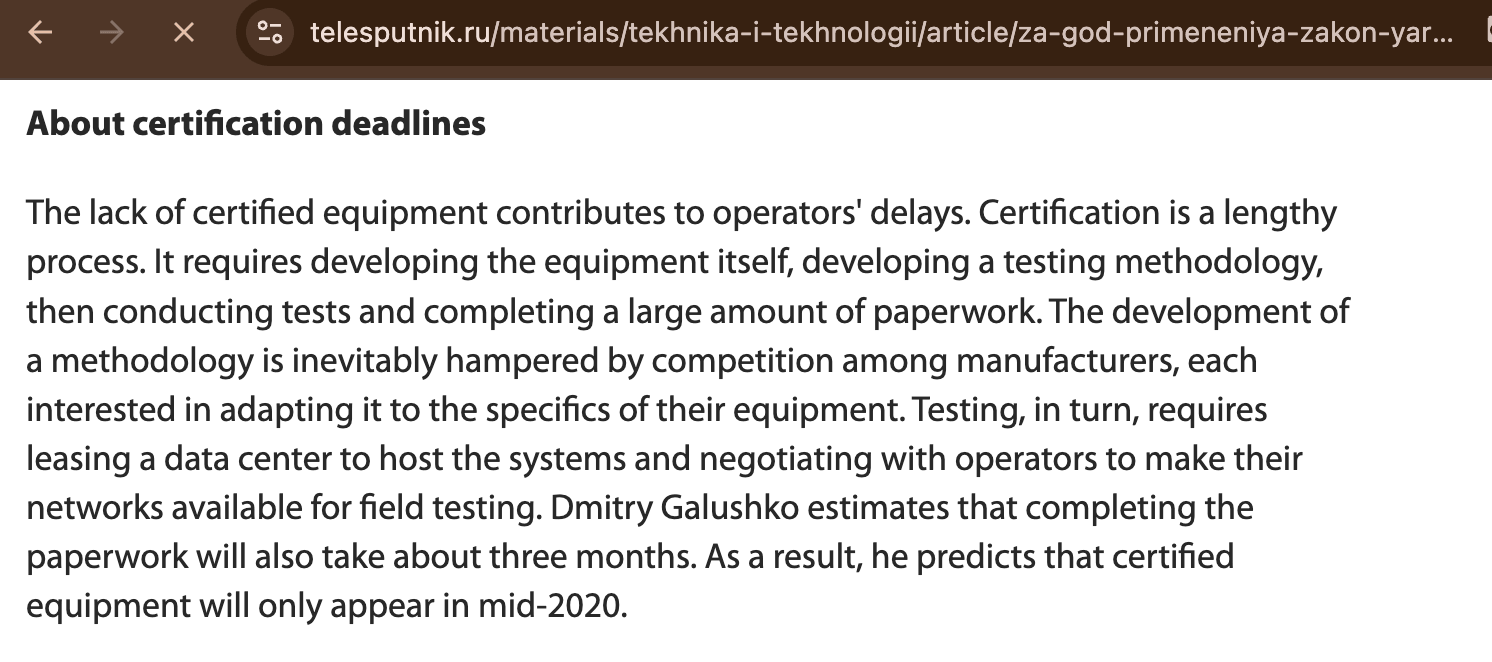
The practical feasibility of storing Internet traffic in the context of modern encryption technologies also raised serious doubts:
“Many object to the pointlessness of storing Internet data, the majority of which is transmitted in an encrypted format. It’s impossible to decrypt such data retroactively, as one-time keys generated solely for duration of the data exchange are used for encrypting and decrypting Internet traffic.
“Today, over 90 % of Internet traffic is encrypted, and its share is steadily growing. Of course, one can store the remaining percentage, but the likelihood that there will be anything there that would contribute to the success of OIA (operative-investigative activities) is extremely small.” 11
Incidentally, a federal-level expert working group headed by the Minister for Open Government Affairs, Mikhail Abyzov, warned about this two years ago when drafting their assessment on the Yarovaya Law. The authors highlighted a rapid growth in the share of encrypted Internet traffic. According to their calculations, at the time the study was prepared in 2016, the share of encrypted traffic on operators’ networks was about 49 %. At the same time, experts predicted that this figure could rise to 90 % within the next three years. The main problem pointed out by specialists is the lack of technologies capable of decrypting such traffic. In this case, a significant portion of the information transmitted over telecom operators’ networks effectively becomes unusable for analysis and practical application by government authorities. 12
Furthermore, even before the anti-terrorism package came into force, Vladimir Gabrielyan, Vice President and Technical Director of Mail.Ru Group (one of the largest Russian IT companies), highlighted its potential uselessness in terms of combating terrorism. In his publication 13 dated June 22, 2016, he pointed to fundamental technical constraints associated with the proliferation of cryptographic protection for Internet traffic.

According to him, a significant portion of online communications was already being transmitted in an encrypted format at that time, making its storage virtually pointless for subsequent analysis. Gabrielyan noted that:
“Currently, 40 % of Internet traffic is encrypted. Storing this 40 % of traffic is useless because it cannot be decrypted.”
He also emphasized that even if requirements to hand over encryption keys were introduced, this wouldn’t solve the problem because many services simply do not possess such keys. Moreover, users can employ additional encryption systems distributed by various software products where only a holder of the key has access to data.
Thus, according to the assessment by the Technical Director of Mail.Ru Group, the proposed traffic storage mechanism not only creates a severe financial burden, but is also unable to significantly increase the effectiveness of combating terrorism.
Returning to the same article on Telesputnik platform from July 2019, industry representatives believed that practical application of the law would reveal the effectiveness or ineffectiveness of such an approach:
“According to expectations of Alexander Vasilyev, CEO of the Lanta network, it is future criminal cases that will demonstrate the uselessness of storing traffic and, along with it, of the Yarovaya Law itself.”
However, a year after the law took effect, the situation remained virtually unchanged.
“Over the year since the Yarovaya Law came into force, there has been no serious movement either toward its enforcement or toward its repeal. A bill to postpone the implementation deadlines of the Yarovaya Package has been lying dormant in the State Duma for three years, and a few attempts to prove the legal insolvency or practical uselessness of the package have also been unsuccessful so far.” 14
Representatives of the legislative branch also stated the dubious effectiveness of the anti-terrorism package’s technical provisions. For instance, the State Duma member Oleg Shein, who co-authored the bill to postpone the effective date of the Yarovaya Package by five years, pointed out the redundancy of a number of its provisions and questioned the practical expediency of the proposed measures. According to him,
“Our main issues with this law are that it is redundant. It contains many provisions that are simply unnecessary. As is well known, special agencies are engaged in combating terrorism. Thus, if they’re going to study all the correspondence and calls of millions of people, they simply won’t have time left to perform their direct duties. I don’t even mention how much the law implementation will cost society. Those billions could be spent much more efficiently, including on fighting terrorism.” 15

Concluding the analysis of technical feasibility and practical effectiveness of the anti-terrorism package, it should be noted that critical assessments were voiced not only by telecommunications industry representatives and Russian experts. Doubts about the expediency and effectiveness of the proposed measures were also expressed by international-level specialists well-versed in the practices of intelligence and analytical systems.
For example, former CIA and US National Security Agency employee Edward Snowden, who was granted asylum in Russia, harshly criticized the adoption of the anti-terrorism legislative package. Commenting on signing of the law, Snowden stated:
“Dark day for Russia.”16
Furthermore, he called the signed Yarovaya Package of anti-terrorism laws “a repressive new law that violates not only human rights but common sense.” 17
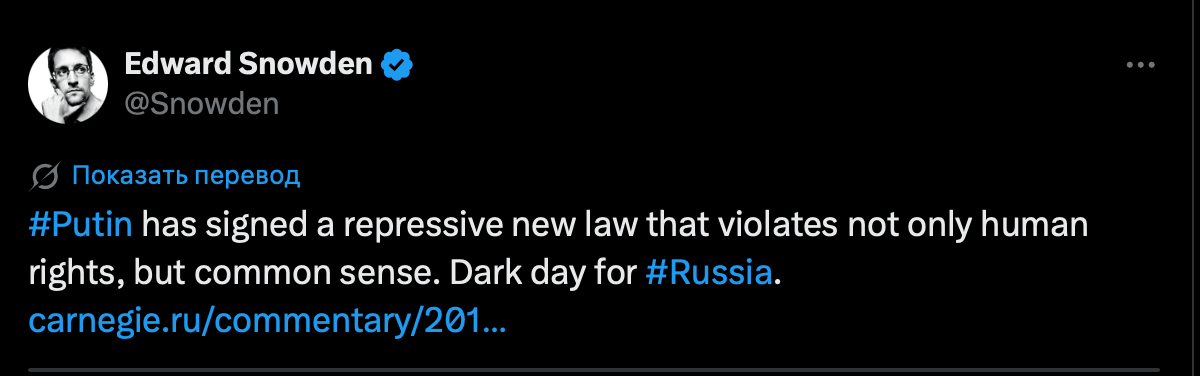
Such an assessment by a specialist who worked in organizations engaged in analyzing massive datasets and national security issues effectively pointed not only to the risks for civil rights, but also to doubts regarding the rationality of the law’s very concept. In the context of the aforementioned assessments by telecommunications industry experts and information security specialists, this criticism gains additional significance as it points to a possible discrepancy between the stated goals of the law and its actual technical capabilities and effectiveness.
As a final touch to analysis of the technical feasibility and effectiveness of the anti-terrorism package, another circumstance draws attention. As noted above, even several years after the law adoption, its practical implementation faced serious technical difficulties: necessary equipment was lacking, certification deadlines were pushed back, and a significant portion of Internet traffic remained encrypted and practically useless for analysis. Nevertheless, alongside that, officials continued to report a substantial decrease in terrorist activity in the country.
For instance, speaking at a conference on countering international terrorism in St. Petersburg, the Chairwoman of the Federation Council, Valentina Matviyenko, noted:
“The number of terrorism-related crimes in Russia has decreased nearly 100-fold over the past 10 years.” 18
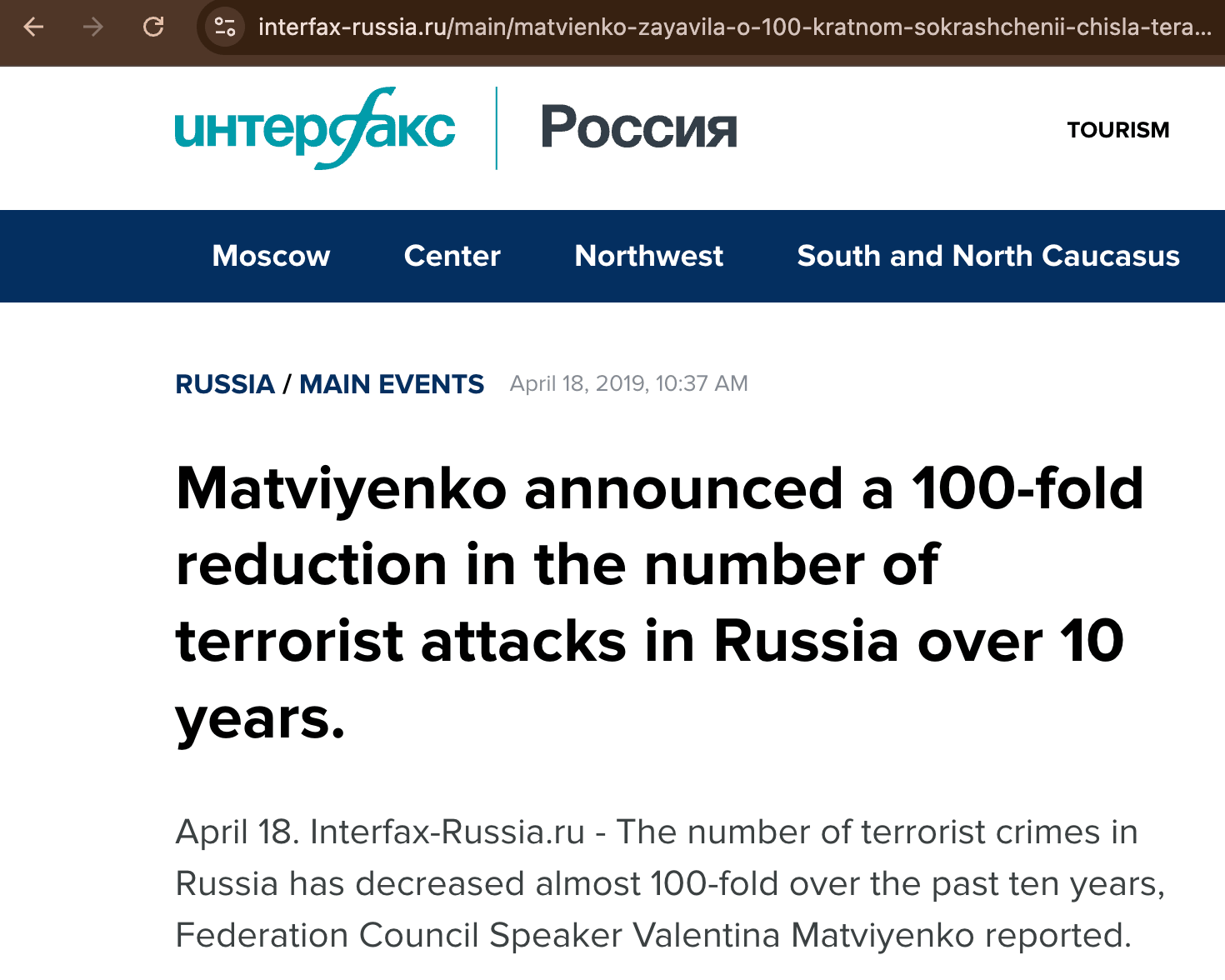
A similar assessment was previously provided by Russian President Vladimir Putin at an FSB board meeting in early March 2019:
“The number of terrorist crimes in Russia over the decade has decreased manifold — from 997 to 9. At the same time, the number of prevented terrorist attacks remains high — about 20 per year.” 19
The same trend was confirmed later as well. For example, in 2021, the Russian FSB Director, Alexander Bortnikov, reported that over the previous ten years, security agencies had prevented about 200 terrorist acts, while the number of committed terrorism-related crimes had decreased even more significantly:
“In Russia, about 200 terrorist attacks have been prevented over the past 10 years, and the number of committed terrorism-related crimes has decreased by a factor of 260.” 20
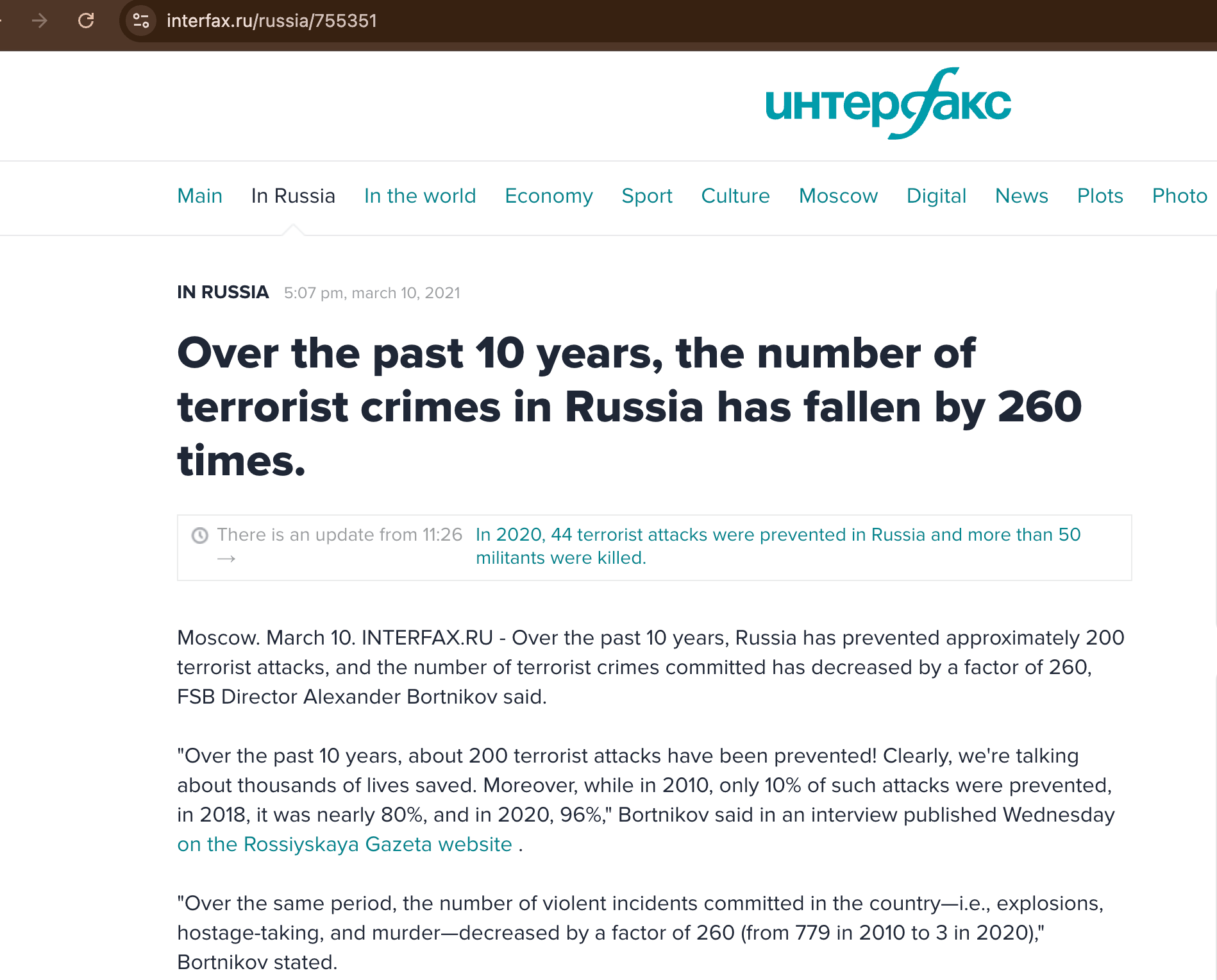
Thus, official data from Russian authorities point to a steady downward trend in terrorist activities in the country over many years. Notably, this decrease was recorded regardless of the actual implementation of the Yarovaya Package technical provisions which, as industry expert assessments and specialized publications indicate, remained unresolved for a long time after the law adoption.
It is also worth noting the timeline for actual appearance of the equipment needed to comply with the law requirements. As reported by mass media, it was only towards the end of 2019 that Russian telecom operators started purchasing specialized data storage systems to implement the provisions of the Yarovaya Package. For instance, according to the Vedomosti newspaper, Russian telecom operators purchased approximately 10 billion rubles worth of equipment from the state corporation Rostec. This was stated by Sergei Sakhnenko, the industrial director of the state corporation’s radioelectronic cluster, at the “Electronics in Russia: The Future of the Industry” conference organized by the media outlet. 21
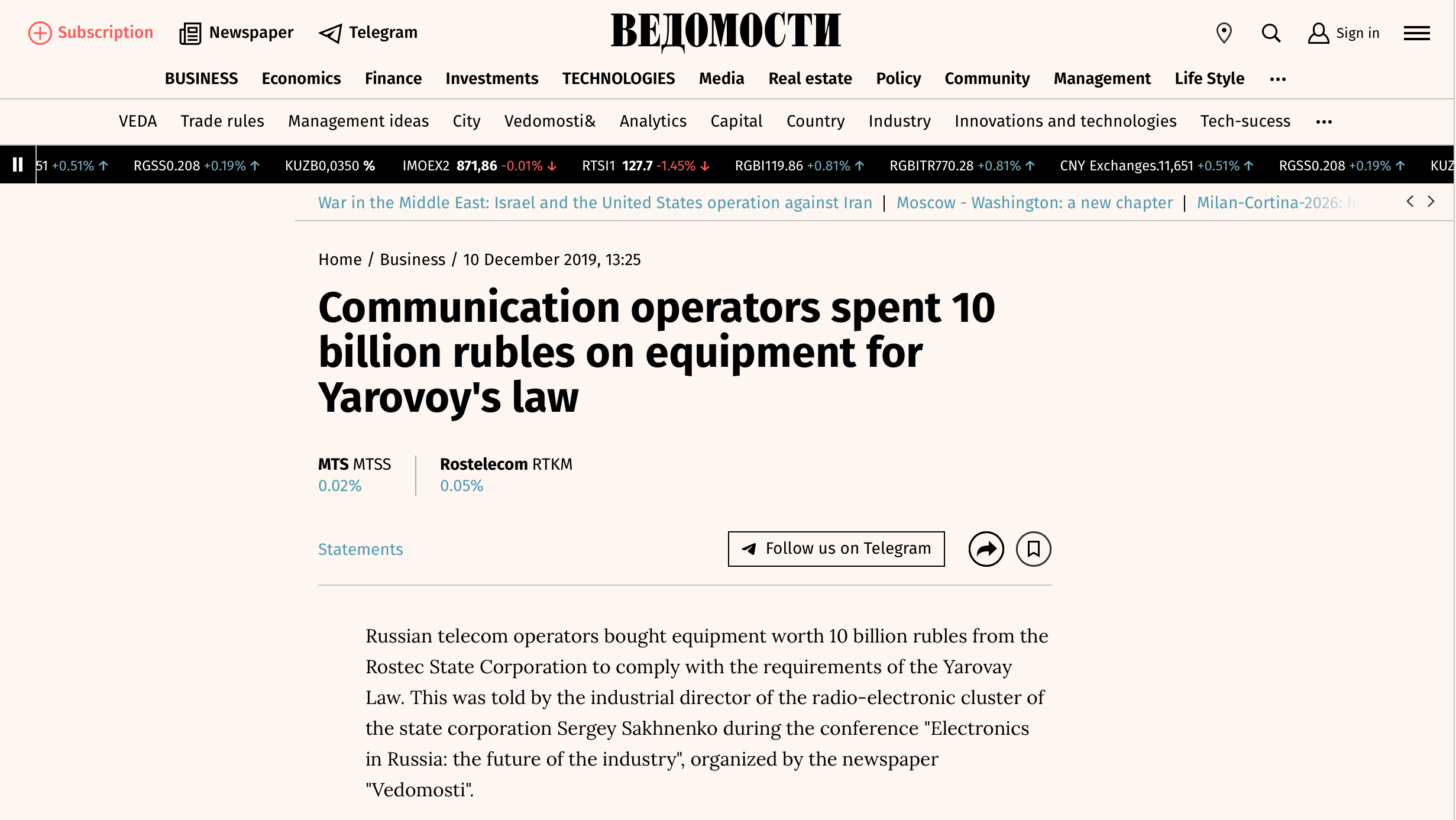
Thus, even the first major purchases of the necessary equipment occurred only about three and a half years after the law was adopted in 2016. Furthermore, it is obvious that the very purchase of data storage systems did not mean their immediate commissioning. Deployment of such complexes requires time for integration into telecom operators’ infrastructure, configuration, testing, and certification.
Taking these technological procedures into account, it may be assumed that full-fledged operation of respective systems could have begun only a few years after the purchases — roughly in 2021–2022. Participants in the bill discussion indirectly indicated the duration of such a process. In particular, one of its critics, the aforementioned State Duma member Oleg Shein, proposed postponing the effective date of the law by five years, pointing out, among other things, the technical complexity of its implementation.
These circumstances demonstrate once again just how lengthy and complicated the process of practically implementing the law requirements turned out to be. In one of subsequent parts of our investigation, we will return to this issue as well as to what impact such technical measures had on the actual dynamics of terrorist activities.
Criticism of Legal Grounds of the Law
Serious questions regarding the legal logic of the anti-terrorism package arose as early as the drafting stage. Moreover, criticism came not only from NGOs, but also from professional legal bodies including parliamentary lawyers and the Presidential Council for Civil Society and Human Rights.
One of the harshest documents was a conclusion by the Legal Directorate of the State Duma, which, according to media reports, spanned about five pages and contained a detailed analysis of the bill’s internal contradictions. Lawyers drew attention to the bizarre structure of criminal sanctions. For instance, a new article of the Criminal Code, “Act of International Terrorism,” provided for 15 to 20 years of imprisonment for committing a terrorist attack outside Russia, while similar actions on Russian territory were punished with a prison term of 8 to 15 years. The conclusion emphasized that “the place where a terrorist act is committed cannot be a ground for establishing such significantly different terms of criminal liability.”
Furthermore, lawyers pointed out another contradiction: in several cases, the punishment for aiding and abetting terrorism turned out to be stricter than for the crime itself. While a terrorist without aggravating circumstances could face 10 to 15 years in prison, their accomplice would face 15 to 20 years. According to lawyers, such a structure of criminal liability appeared legally illogical. 22
Criticism was also voiced by the Presidential Council for Civil Society and Human Rights that prepared an expert opinion on the anti-terrorism package. The document noted that the regulation introduced by the Yarovaya Package “entails a restriction of citizens’ constitutional rights and is disproportionate to its effectiveness in countering terrorism.”
Human rights advocates also pointed out the problem of mass storage of user data. The requirement for telecom operators and Internet service providers to store massive volumes of information regarding citizens’ correspondence and conversations was described as an “unprecedented encroachment on citizens’ privacy.” At the same time, HRC experts considered a number of new offenses in the Criminal Code to be unjustified and devoid of clear legal logic. 23
Certain provisions of the law also raised alarms among experts who monitor enforcement in the field of extremism. Human Rights Council member Alexander Verkhovsky who heads the SOVA Center for Information and Analysis drew attention to the risks of provocation that the new article on ‘facilitating extremist activities” could create. According to him, “One could first incite some young man and then inform the authorities in time. An ideal scheme for provocations.” 24
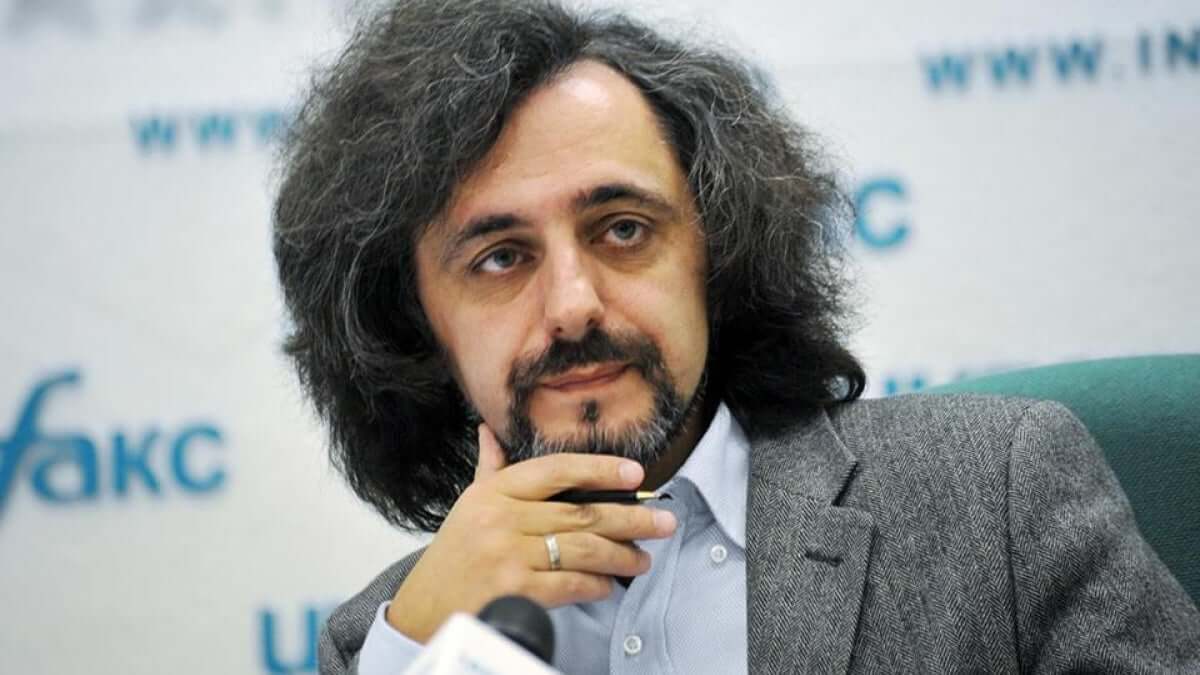
The expert indicated that such a legal structure potentially creates opportunities for abuse and manipulation.
A separate debate was triggered by the introduction of a new criminal article on the failure to report terrorism-related crimes (Article 205.6 of the Criminal Code of the Russian Federation). Formally, it was aimed at preventing terrorism, but lawyers pointed out the resulting legal collision. On the one hand, a citizen could face criminal liability for failing to report a suspected crime. On the other hand, existing legislation provides for liability for a deliberately false report. As a result, a person could find themselves in a contradictory situation: if they didn’t report a suspicion, it could be interpreted as a crime, whereas if they reported information that later turned out to be unreliable, there was a risk of being prosecuted for a false report.
Additional questions were raised by the wording of the law itself — the obligation to report a crime that has become “reliably known” to a citizen. Lawyers noted that in practice, determining the degree of such “reliability” is extremely difficult, which opens up space for arbitrary interpretations.
Critics of the law also pointed to potential abuses. Lawyer Dmitry Dinze noted that the new article is “very convenient for operatives and investigators to recruit people who will work for the investigation.” While previously a person could refuse to be a prosecution witness, now they might agree to cooperate under the threat of criminal prosecution for failing to report a crime. 25
At the same time, lawmakers were forced to include a special exception in the article: criminal liability for failure to report does not apply to spouses and close relatives of an alleged criminal. This caveat was introduced to avoid a conflict with Article 51 of the Constitution of the Russian Federation, which enshrines the right not to testify against oneself and one’s relatives.
Some experts also drew attention to the historical context: essentially, introduction of this norm brought back into the criminal law the practice of liability for failure to report, which existed during the Soviet era.
Taken together, these observations showed that even at the stage of discussing the bill, professional lawyers and human rights organizations pointed out serious problems with its legal architecture: internal contradictions of criminal norms, disproportionate punishments, and potential risks to the constitutional rights of citizens.
After analyzing the legal contradictions, economic consequences, and technical problems of the anti-terrorism package, a natural question arises, known since the times of Roman law: Cui bono? Who benefits?
It is precisely from this perspective that the adoption of the Yarovaya Law should be considered. Who turns out to be the main beneficiary of these changes?
We aren’t the only ones asking this question. At the time, business journalists also tried to figure it out by analyzing who could benefit from such an unexpectedly emerged legislative initiative. For instance, experts from the Vedomosti newspaper, in the article “Who can make money on the Yarovaya Law,” drew attention to the unusual nature of the bill’s emergence. According to the newspaper’s sources, the discussed package of amendments came as a surprise not only to participants in the telecommunications market, but also to the officials who later had to ensure its implementation.
“The Yarovaya Package hit like a ton of bricks for both officials and participants in the telecommunications market,” noted a source of Vedomosti. “This suggests that the law was initiated by two or three very influential individuals for whom business interests are not paramount.” 26
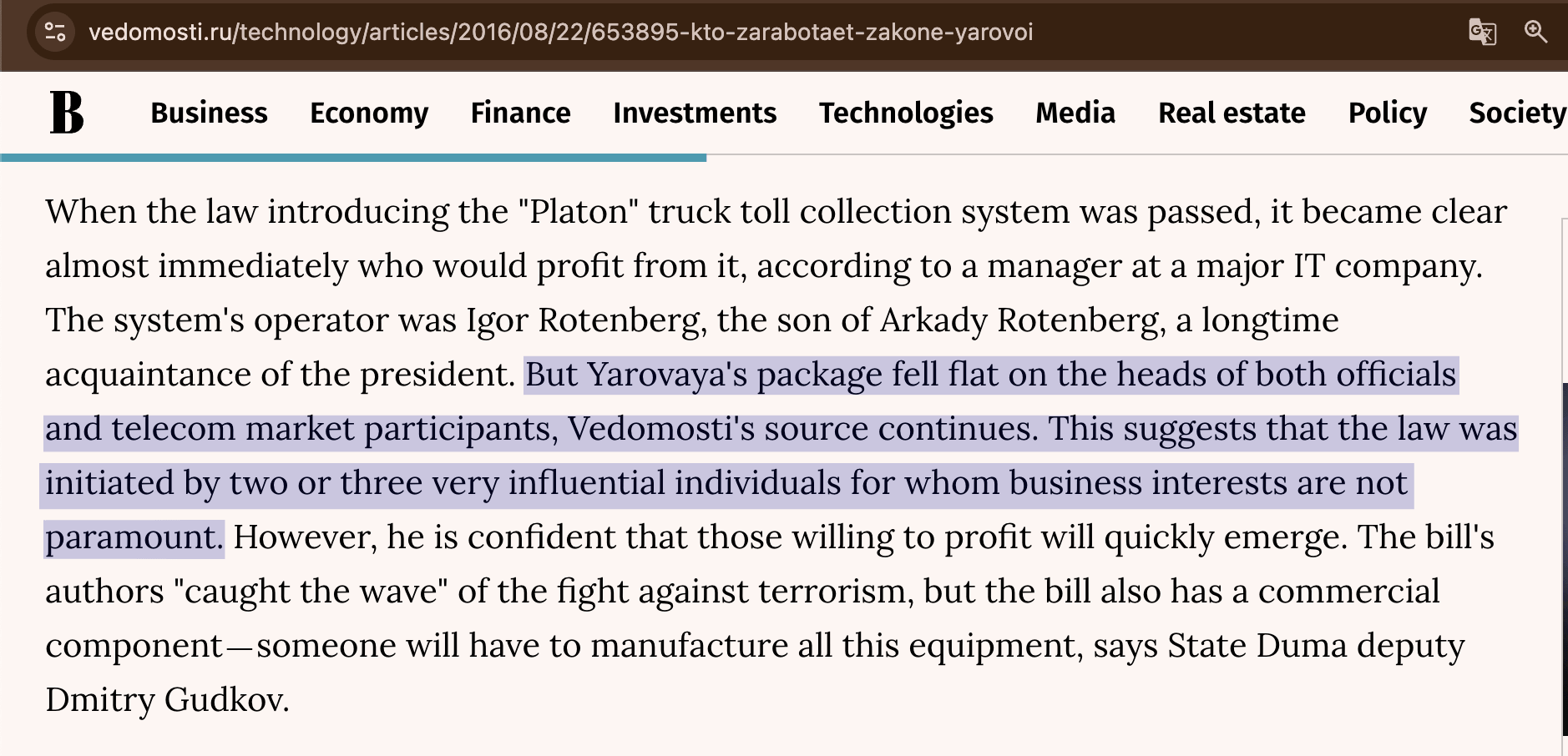
Subsequent publications in the business press only reinforced this impression. As Vedomosti sources noted, even agencies and officials who should have logically participated in drafting such a massive bill actually distanced themselves from its preparation.
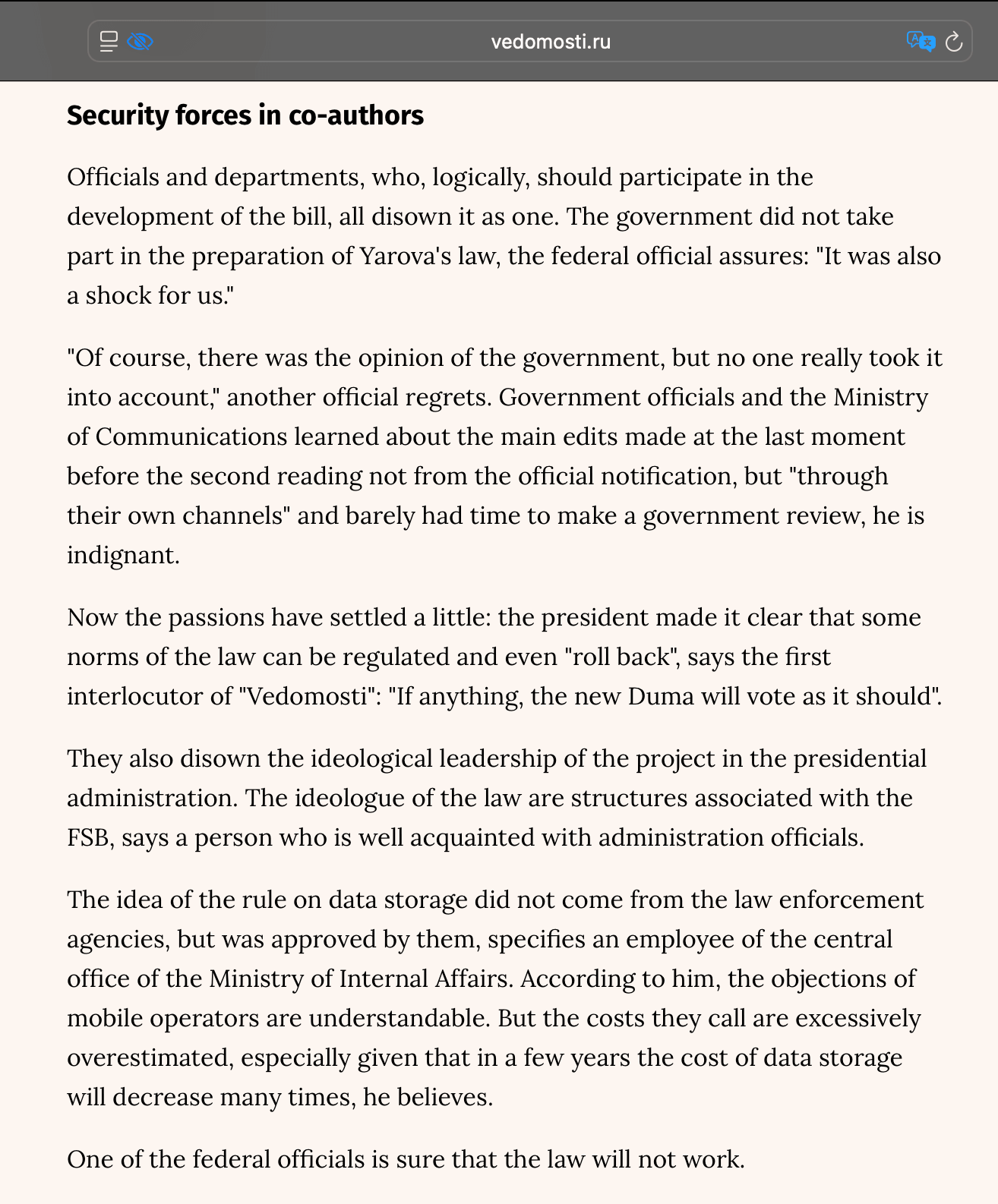
Officials and agencies who, logically, should participate in the development of the bill, all disown it as one. The government did not take part in preparing the Yarovaya Law, a federal official assures: “It was a shock to us, too.”
“Of course, there was the opinion of the government, but no one really took it into account,” another official regrets. Government officials and the Ministry of Communications learned about the main edits made at the last moment before the second reading not from an official notification, but “through their own channels” and barely had time to make a government review, as he indignantly said.
The Presidential Administration also disavows ideological leadership of the project. “The ideologists of the law are entities affiliated with the FSB,” says a person well-acquainted with administration officials.
“The idea of the rule on data storage did not come from the law enforcement, but was approved by them,” specifies an employee of the central office of the Ministry of Internal Affairs. According to him, objections of mobile operators are understandable, but the costs they call are excessively overestimated, especially given that in a few years the cost of data storage will decrease many times, as he believes. 27
One federal official is confident that the law will not work.”
This conclusion is particularly telling. When trying to understand who benefited from such a rapidly adopted law, experts were unable to find any large corporations or industry players gaining an obvious commercial advantage. On the contrary, many provisions of the package imposed huge financial obligations on telecom operators, requiring an establishment of expensive data storage infrastructure.
Therefore, the conclusion that the law could have been initiated by “two or three very influential individuals” for whom business interests were not the main motive takes on special significance. If neither economic interests nor practical expediency or expected effectiveness in fighting terrorism can be seen behind the initiative, a natural question arises: what real goals stood behind the adoption of this law, and who was it really meant to serve?
It is all the more telling that even among officials familiar with the bill preparation, there were opinions that the law would not work. Therefore, to answer the question about potential beneficiaries, it’s enough to look at those who actively supported the adoption of this law in the public space and demanded further expansion of control.
For example, on June 20, 2016, senator Elena Mizulina, who for many years has been publicly interacting with representatives of the anticult movement and is considered a longtime ally of RACIRS’ head Alexander Dvorkin, proposed considering a possibility of pre-filtering messages in closed groups on social networks and messengers.
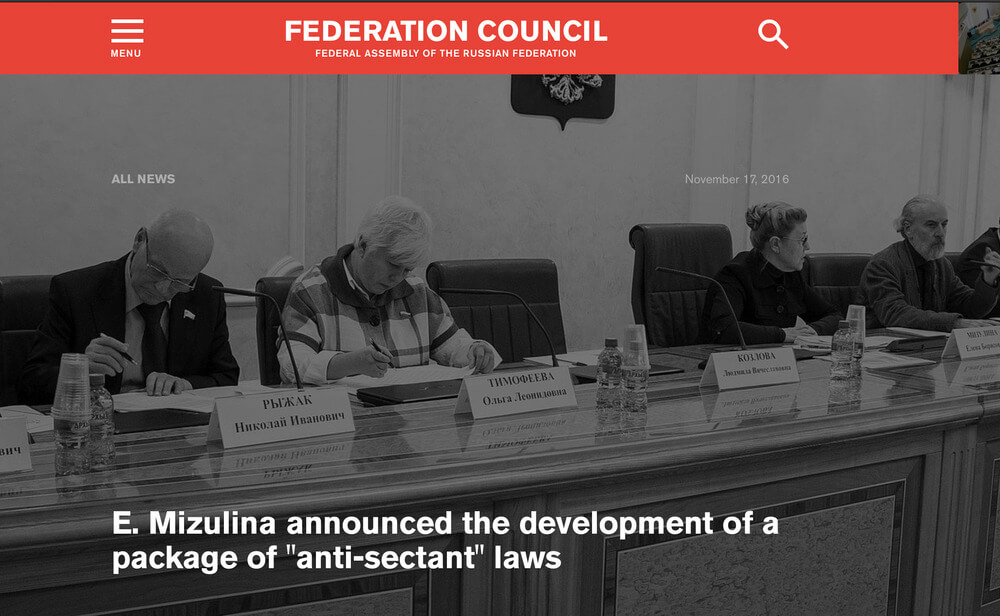
She explained her initiative, citing data from the Safe Internet League organization which, according to her, had allegedly identified “a whole range of closed groups where teenagers are being brainwashed to murder police officers.”
“Perhaps, we should return to the idea of pre-filtering messages. We cannot silently watch this,” Mizulina stated. 28
At the same time, no public evidence of the existence of such networks or the scale of the described threat was presented. The statements remained at the level of assertions, which, however, is quite typical for the rhetoric of anticult activists who regularly appeal to certain “hidden threats” that cannot be independently verified.
That’s exactly why it is highly indicative that, against the backdrop of widespread criticism of the law from lawyers, industry experts, and human rights organizations, support for initiatives to further tighten control was expressed primarily by allies of the anticult movement in the political field.
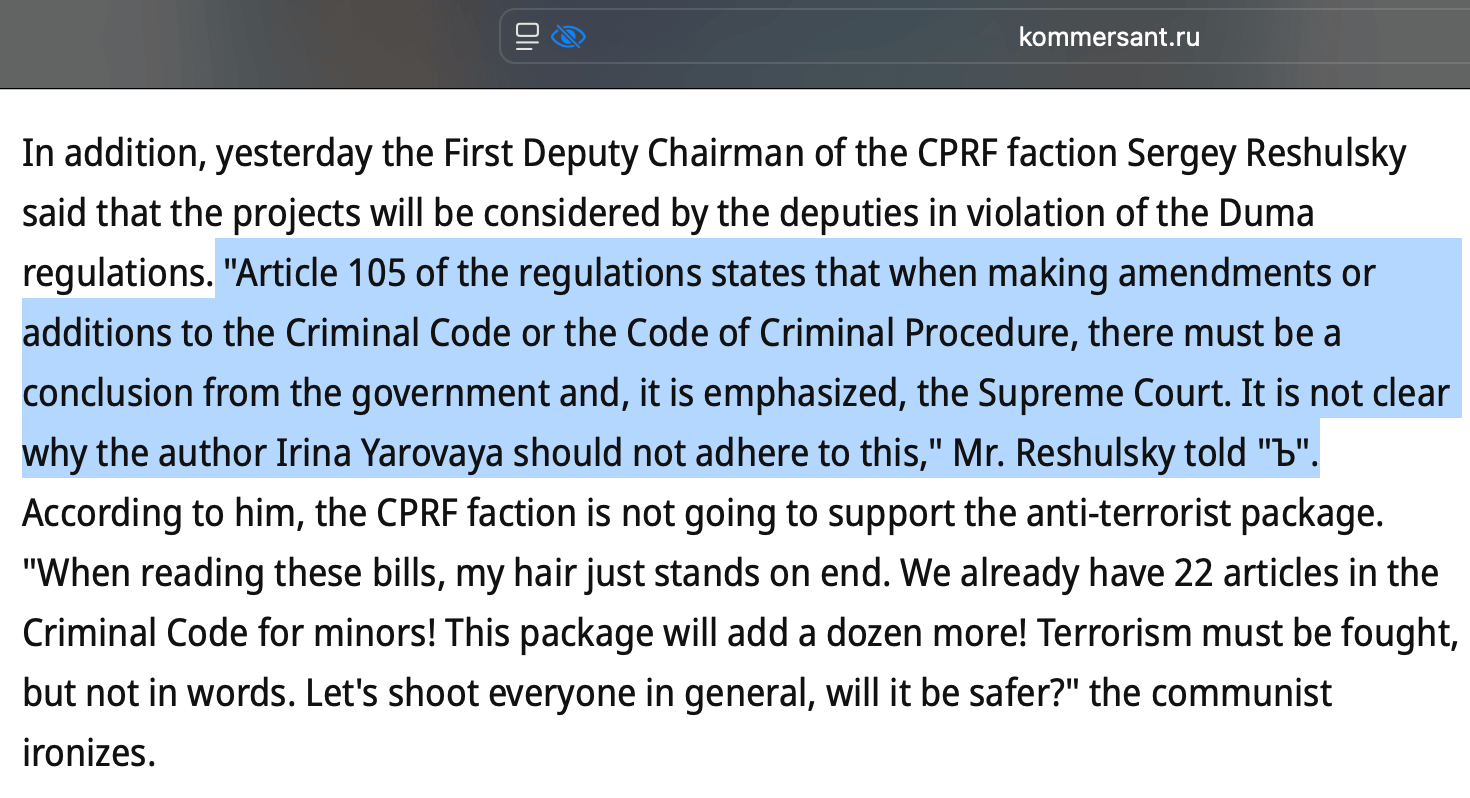
The very procedure for passing the law — the haste and the changes made literally at the last minute, already at the stage of the second and third readings — also helps understand the real goals of the law. Although questions regarding compliance with parliamentary procedure arose at an even earlier stage, before the first reading of the bill. Sergei Reshulsky, First Deputy Head of the CPRF faction, drew attention to a violation of the Duma regulations. He recalled that, when making amendments to criminal legislation, mandatory evaluations from the government and the Supreme Court are required.
“Article 105 of the regulations states that when making amendments or additions to the Criminal Code or the Code of Criminal Procedure, there must be an evaluation from the government and, it is specifically emphasized, the Supreme Court. It is not clear why the author Irina Yarovaya should not adhere to this,” the deputy stated. 29
Nevertheless, the bill continued its progression. It was at the final stage of considering the bill that the most unexpected changes occurred, and it is those, in our opinion, that allow us to see who was actually behind its emergence.
Initially, these changes were presented as technical revisions for the second reading. However, the procedure for preparing them looked extremely unusual:
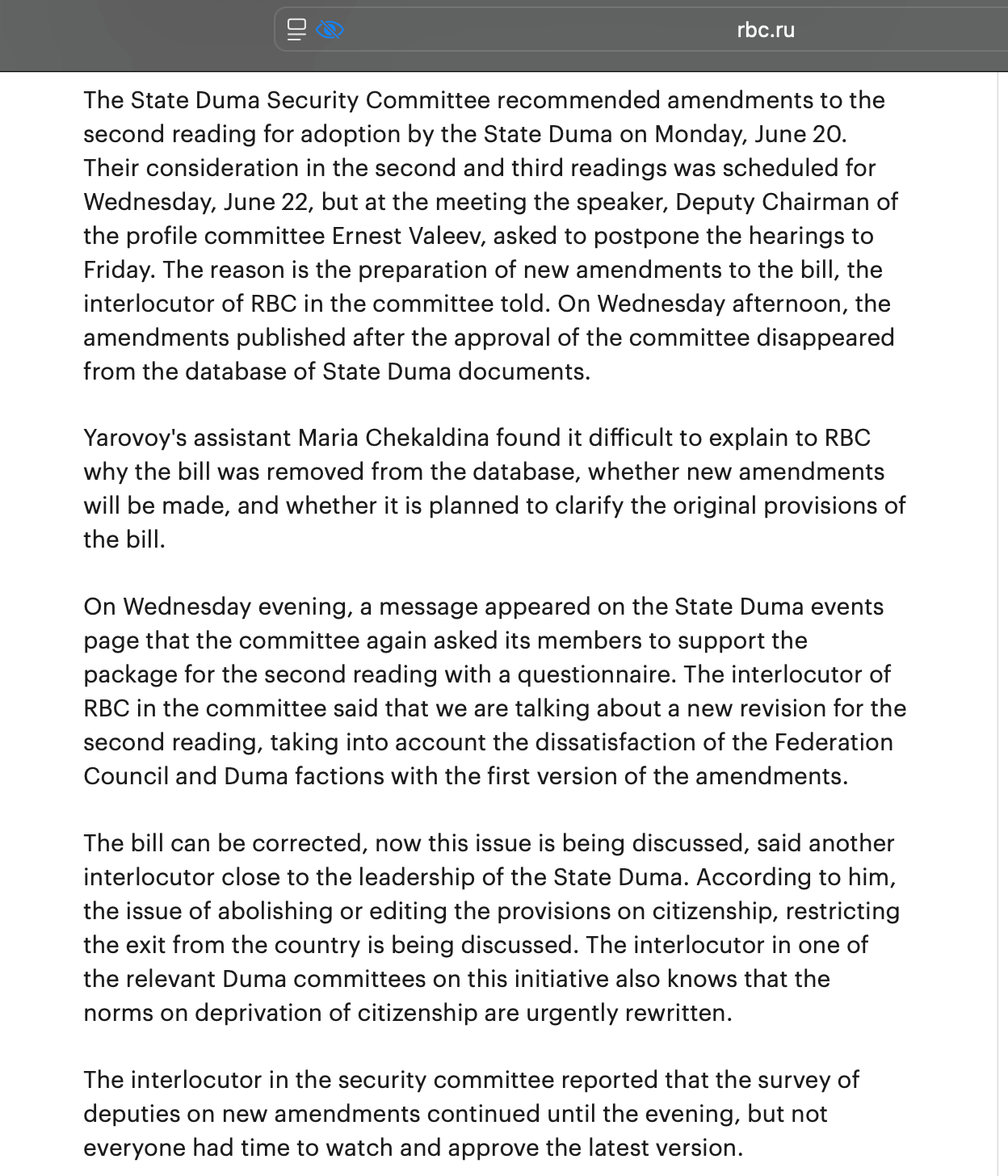
“The State Duma Security Committee recommended the amendments for the second reading to be adopted by the State Duma on Monday, June 20. Their consideration in the second and third readings was scheduled for Wednesday, June 22, but at the meeting the speaker, Deputy Chairman of the profile committee Ernest Valeev, asked to postpone the hearings to Friday. The reason was the preparation of new amendments to the bill, an RBC source in the committee said. On Wednesday afternoon, the amendments published after the approval of the committee disappeared from the database of State Duma documents.
Yarovaya’s assistant Maria Chekaldina found it difficult to explain to RBC why the bill was removed from the database, whether new amendments would be introduced, and whether clarifications to the initial provisions of the bill were planned.
On Wednesday evening, a message appeared on the State Duma’s events page stating that the committee had once again asked its members via a survey sheet to support the package for the second reading. An RBC source in the committee reported that this was a new revision for the second reading, taking into account the dissatisfaction of the Federation Council and Duma factions with the first version of the amendments.
The bill could be amended, this issue is currently being discussed, another source close to the State Duma leadership said. According to him, the issue of canceling or editing the points on citizenship and restrictions on leaving the country is being discussed. A source in one of the relevant Duma committees for this initiative also knows that the norms on deprivation of citizenship are being urgently rewritten.
A source in the Security Committee reported that the polling of deputies on the new amendments continued until the evening, but not everyone had time to review and approve the latest version.” 30
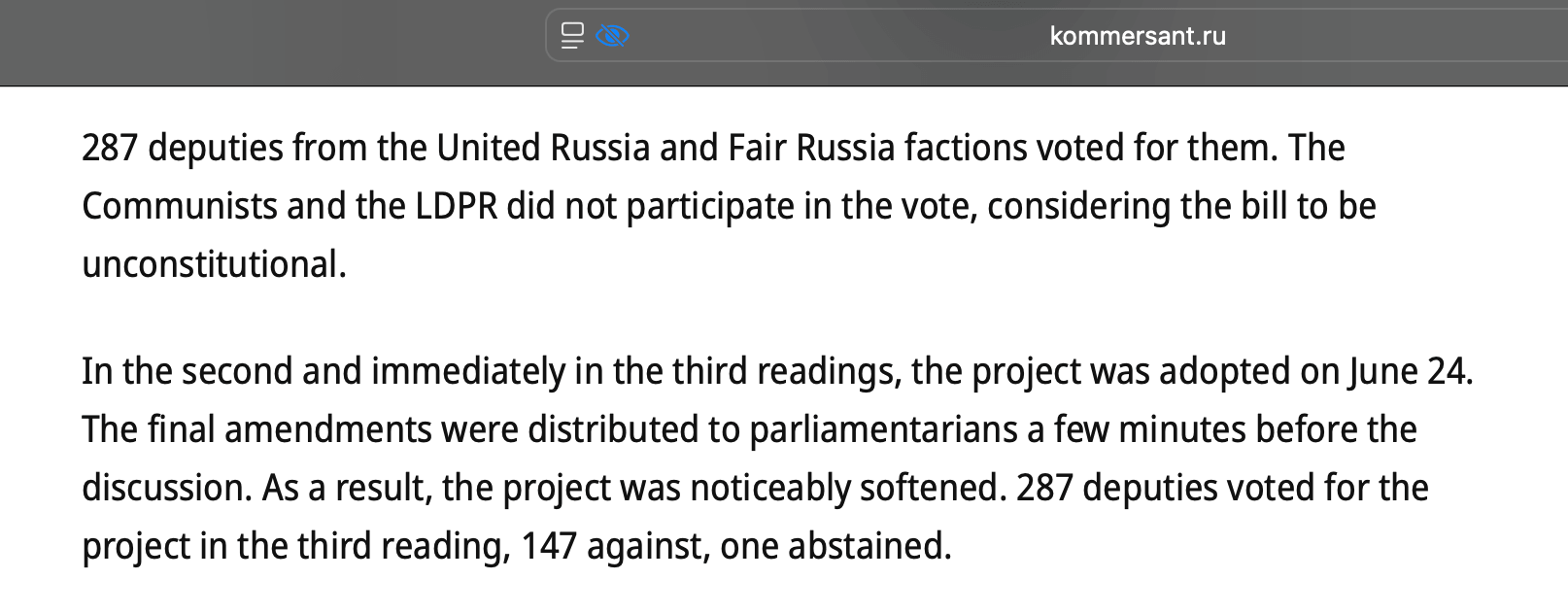
The Kommersant newspaper also wrote about how hastily the bill was being finalized. According to its data, work on the amendments continued even on the morning of the voting day, which effectively meant that deputies were making a decision on a document whose text continued to change up until the very last minutes. 31
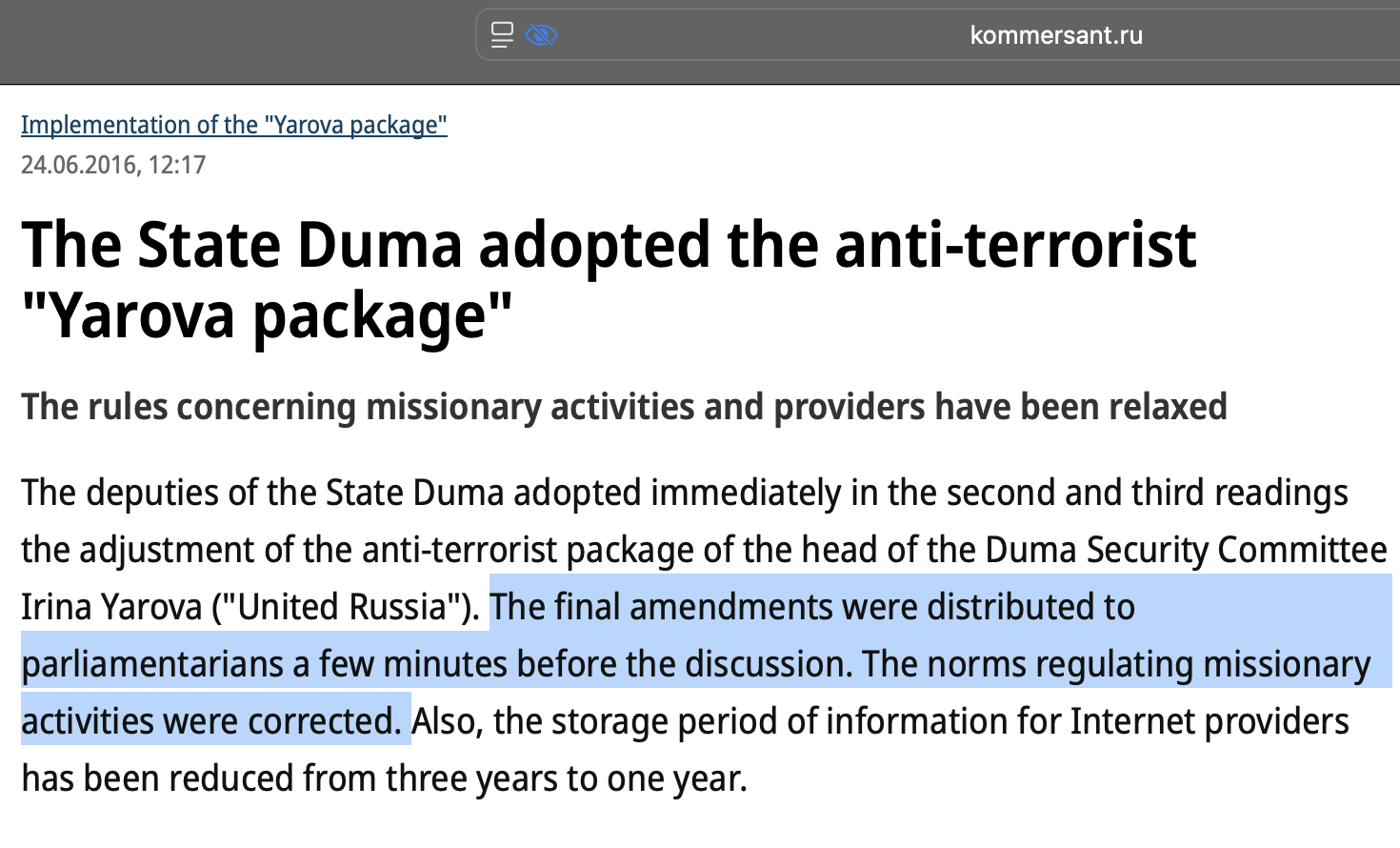
Ultimately, the bill was adopted in both the second and third readings at once. 287 deputies voted for it, 147 against, and one abstained. At the same time, the CPRF and LDPR factions opposed the initiative, while the necessary majority of votes was provided by deputies from the United Russia and “A Just Russia.” 32
At this point, questions inevitably arise.
What kind of full-fledged parliamentary procedure and objective discussion can we talk about if deputies vote for a document whose text is changing literally up to the last minute, and which many of them haven’t even had time to review?
Moreover, who has such political influence that a bill of this scale is passed with virtually no discussion — essentially on command?
Especially if we recall the conclusion reached by the Vedomosti newspaper experts: the initiators behind the key norms could have been “two or three very influential individuals” for whom the economic logic of the law was not the primary motive, just as, apparently, were the stated goals of combating terrorism and ensuring the safety of citizens.
All of this forces a question: what real tasks was this law meant to solve? The answer began to emerge almost immediately after the new norms took effect.
But first, what were the amendments that the deputies hurried so much to pass? What changes appeared in the bill literally in the final days before the vote?
It was at this moment that provisions completely unrelated to combating terrorism unexpectedly appeared in the bill, which was presented to the public as a package of urgent anti-terrorism measures. In our opinion, it is those provisions that allow us to understand who was the real initiator of these changes. Thpse were the so-called “missionary” clauses introduced into the Federal Law “On Freedom of Conscience and Religious Associations.”
These amendments significantly tightened the rules for religious activity. In particular, they introduced restrictions on missionary activity outside specifically designated places, prohibited the spread of religious beliefs in residential premises and public spaces without the official status of a religious organization, and also established administrative liability for conducting missionary activity without the appropriate permit or outside legally established forms.
The appearance of such norms within the anti-terrorism package looked particularly unexpected given that the bill itself was initially presented as an urgent anti-terrorism measure. That is exactly why they provoked a severe reaction among representatives of various religious denominations and human rights defenders, many of whom asked the obvious question: what does restricting missionary activity have to do with anti-terrorism legislation?
However, the very manner in which these norms appeared within the anti-terrorism package is telling. By placing the regulation of religious activity in the same legislative context as terrorism and extremism, the authors of the amendments essentially created a stable semantic link between the activities of religious associations and security threats.
Such a mechanism is well-known as a classic manipulative tactic — guilt by association, where different phenomena are artificially placed in the same semantic field, forming a false causal link between them in the public mind. This is precisely the tactic that representatives of the anticult movement have been actively using for years, consistently linking the activities of new religious movements with extremism, security threats, and so-called “destructive cults.” We have already outlined the mechanisms of such information manipulation in detail in our article “Lies and Propaganda: Foundation of AntiCultism.”
Taken together, the facts presented above point to a very specific sponsor. Based on the analysis, that individual is Alexander Dvorkin, the ideologue of the international anticult movement. With the help of his representatives in the highest echelons of Russian power, he has for many years consistently pushed for the introduction into Russian legislation of tools to exert pressure and purge the religious field of competitors to the Russian Orthodox Church.
The nature of how these amendments were passed only confirms that it was a pre-planned operation. Public attention was focused on the discussion of the “anti-terrorism package,” and it was exactly under the cover of this topic that provisions completely unrelated to fighting terrorism were included in the law. They appeared in the bill in the final days before the vote, were rushed through parliament, and effectively underwent no full-fledged professional discussion.
All of the above points to the existence — even then, 10 years ago — of an influential lobby capable of pushing through the legislative norms Dvorkin needed and securing the support of law enforcement agencies.
The actual application of these norms only confirmed our earlier conclusions and once again points to Alexander Dvorkin as the main beneficiary of the emergence of such norms in Russian legislation. The primary targets of these legal cases were representatives of new religious movements and religious minorities. This indicates that the real objectives of the adopted legislation lay in this area from the outset. It is quite possible that the introduction of these mechanisms became one of the key stages in preparation for subsequent decisions to ban religious organizations undesirable to Dvorkin and his anticult network, primarily Jehovah’s Witnesses.
The very issue of the enforcement of the Yarovaya Package was raised at a meeting of the Council for Civil Society and Human Rights on December 11, 2018. At that time, lawyer and Council member Vladimir Ryakhovsky directly raised the question about the real results of the law’s application:
“In July 2016, a Federal Law titled ‘On Amendments to the Federal Law On Countering Terrorism’ was passed, commonly known as the Yarovaya Law.
This law also introduced amendments to the law on freedom of conscience. A new chapter on missionary activity was added, defining what constitutes missionary activity and establishing the procedure for conducting it. It went so far as to require that, in order for a person to speak about their beliefs, they must be officially authorized by a religious organization and carry a standardized document confirming that authorization.
Article 5.26 was added to the Code of Administrative Offenses to establish liability. A year and a half has already passed, and I would very much like to ask the initiators of this law: has it achieved the goals set by the authors? Has at least one extremist been brought to justice under this law?
Nevertheless, law enforcement agencies have initiated and brought to court over 600 administrative cases against representatives of various religious denominations, with the exception of perhaps only one — the largest one. These cases are as unbelievable as one’s imagination can probably allow.
Here’s just one vivid example: Nizhny Novgorod, a student, a citizen of an African country, a sixth-year medical university student, with a little over a month away from her final state exams. She gives an interview to an Internet channel, talks about herself, her family, her childhood, about being a believer since childhood, a Christian, and that in Russia she also goes to church, and all this helps her in her studies.
Two administrative cases are initiated against her. The first was for violating the rules of missionary activity, resulting in a fine. The second was for violating the purpose of her stay in the Russian Federation. She arrived on a missionary visa, and here she is saying something about her beliefs. As a result, she is penalized with a fine in the second case and deportation from the Russian Federation. Fortunately, the appellate court showed some common sense: they did not overturn these rulings, but they postponed her deportation until she received her diploma, literally a few months later.
What is particularly striking is that these cases were based on an assessment by experts who discerned in this video hidden appeals and hidden missionary activity.
Do you understand the issue? Hidden. There are no explicit signs of missionary activity. And why aren’t there any? Because it is hidden, and because of this she was brought to justice.
I could cite many such cases, since this falls within the scope of my professional interests. The Constitution contains an established concept: when freedom of conscience is defined, it speaks of the right to disseminate one’s beliefs. This legal measure, this norm of the law, to put it mildly, appears clearly overtly excessive. It does not contribute to the harmonization of interfaith relations; on the contrary, it leads to an imbalance and the violation of the constitutional rights of citizens…” 33
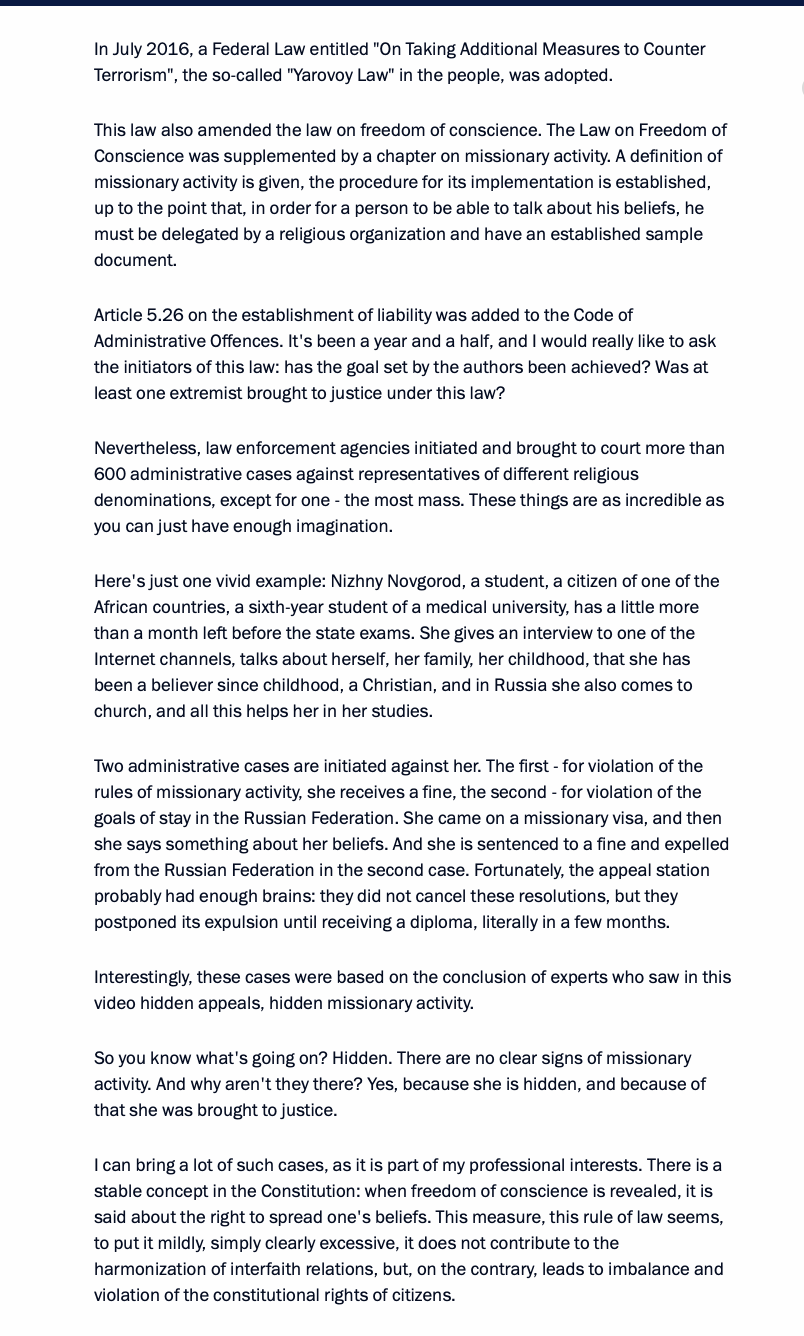
This assessment, voiced at the meeting of the presidential advisory body, effectively captured the main point: norms that were presented to society as a tool to fight terrorism began to be applied primarily against religious communities.
Revealing, too, was the reaction of Vladimir Putin, who during the same meeting acknowledged the absurdity of the situation. Commenting on the persecution of believers, he stated:
“Jehovah’s Witnesses are also Christians, why they are being persecuted, I also do not quite understand…” 34
And he added: “This is complete nonsense, we need to carefully look into this”. 35
These words were widely quoted in the media.
At the same time, an important detail draws attention: in the official transcript of the meeting published later on the Presidential Council for Civil Society and Human Rights website, the wording appears more softened, 36 whereas journalistic publications preserved the President’s original direct remarks, which explicitly mention Jehovah’s Witnesses and the absurdity of their persecution.
At this point, it is worth pausing and citing once again the verbatim phrase spoken by the Russian President at the meeting of the Council for Civil Society and Human Rights, which directly relates to the situation surrounding Jehovah’s Witnesses.
“Jehovah’s Witnesses are also Christians, why they are being persecuted, I also do not quite understand. Therefore, we just need to analyze it, this must be done. I will speak with Vyacheslav Mikhailovich (Vyacheslav Lebedev, Chairman of the Supreme Court — author’s note), and we will try to do this.” 37
Let’s recall that earlier, in April 2017, the Supreme Court of the Russian Federation recognized the Jehovah’s Witnesses religious organization as extremist, and in July of the same year, it upheld this ban. In August 2017, the Ministry of Justice of the Russian Federation included the organization in the list of organizations liquidated for extremism.
Religious scholar Roman Lunkin drew attention to the unusual reaction of the head of state. According to him, what was unexpected was not only that the president expressed an intention to look into the situation despite a court decision having already been made, but also the very emphasis that religious minorities should not automatically be considered destructive or almost terrorist organizations. 38
At the same time, Alexander Dvorkin, President of the Russian Association of Centers for the Study of Religions and Sects, expressed his position on the issue. He reminded of the existence of the court decision and stated:
“If there was a court decision, it cannot be overturned by a presidential decree. I don’t understand how one can look into this, other than in further judicial instances. And those options have largely been exhausted.” 39
However, despite the president’s public promise to appeal to the Chairman of the Supreme Court and analyze the situation, law enforcement practice remained practically unchanged: criminal cases against followers of Jehovah’s Witnesses continued to be initiated, and believers themselves continued to receive actual prison sentences.
Through this revealing example, you can independently evaluate who actually shapes and determines the direction of state policy in this field: the “almighty dictator” Putin or the “modest sectology professor” Dvorkin. It is exactly here that it becomes obvious who turns out to be the real beneficiary of these changes. The long-standing activity of the head of the Russian Association of Centers for the Study of Religions and Sects — Alexander Dvorkin — was aimed precisely at achieving such legislative restrictions. His speeches, publications, and participation in expertise-related organizations consistently promoted the idea of tightening control over “nontraditional” religious movements and restricting their missionary activity.
The practice of enforcing the Yarovaya Package has shown that this exact line was implemented in practice. Moreover, what is particularly important, is that subsequent years demonstrate an increase in the number of terrorist acts, making the contradiction between the stated goals of the law and its real results especially stark.
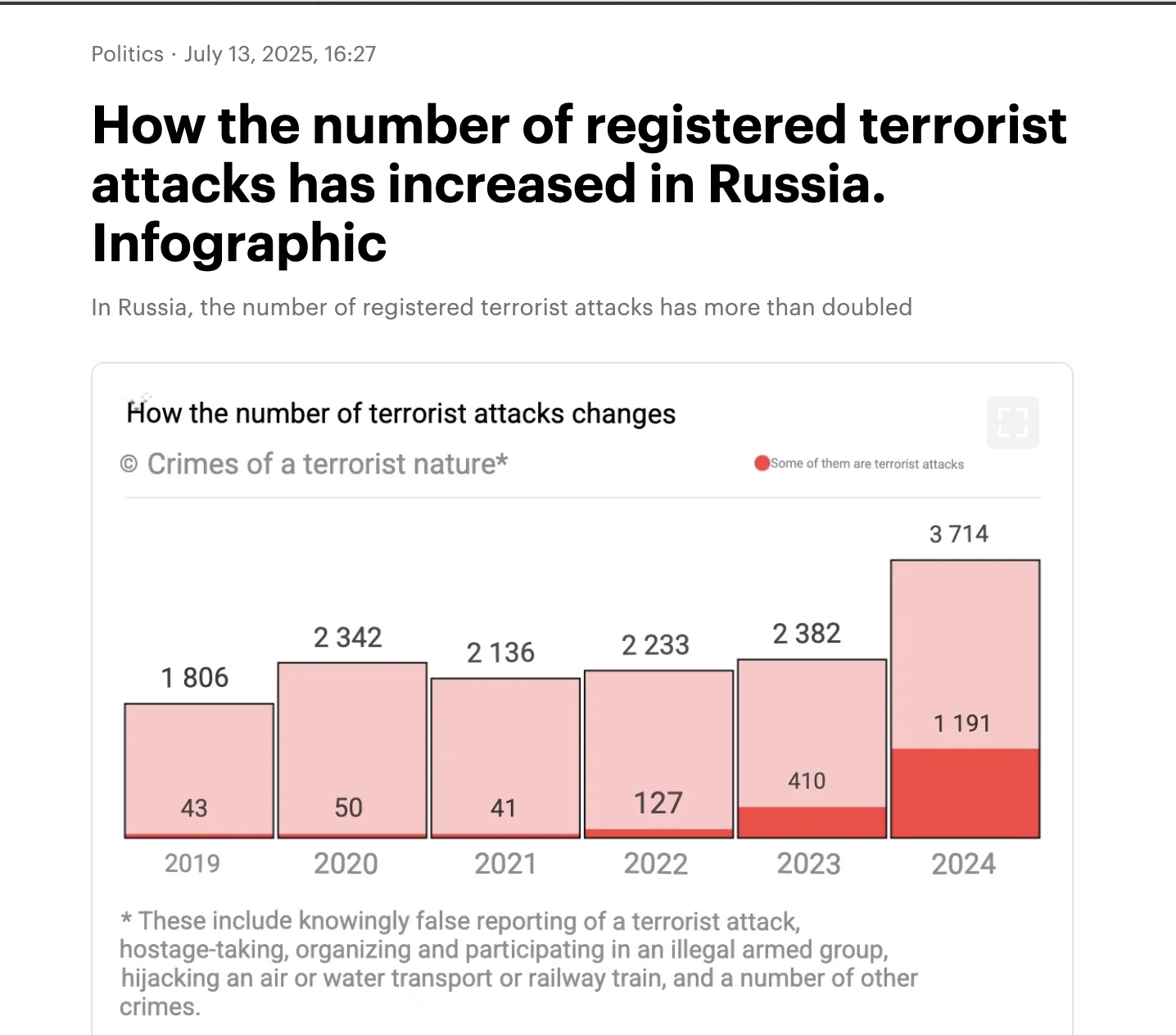
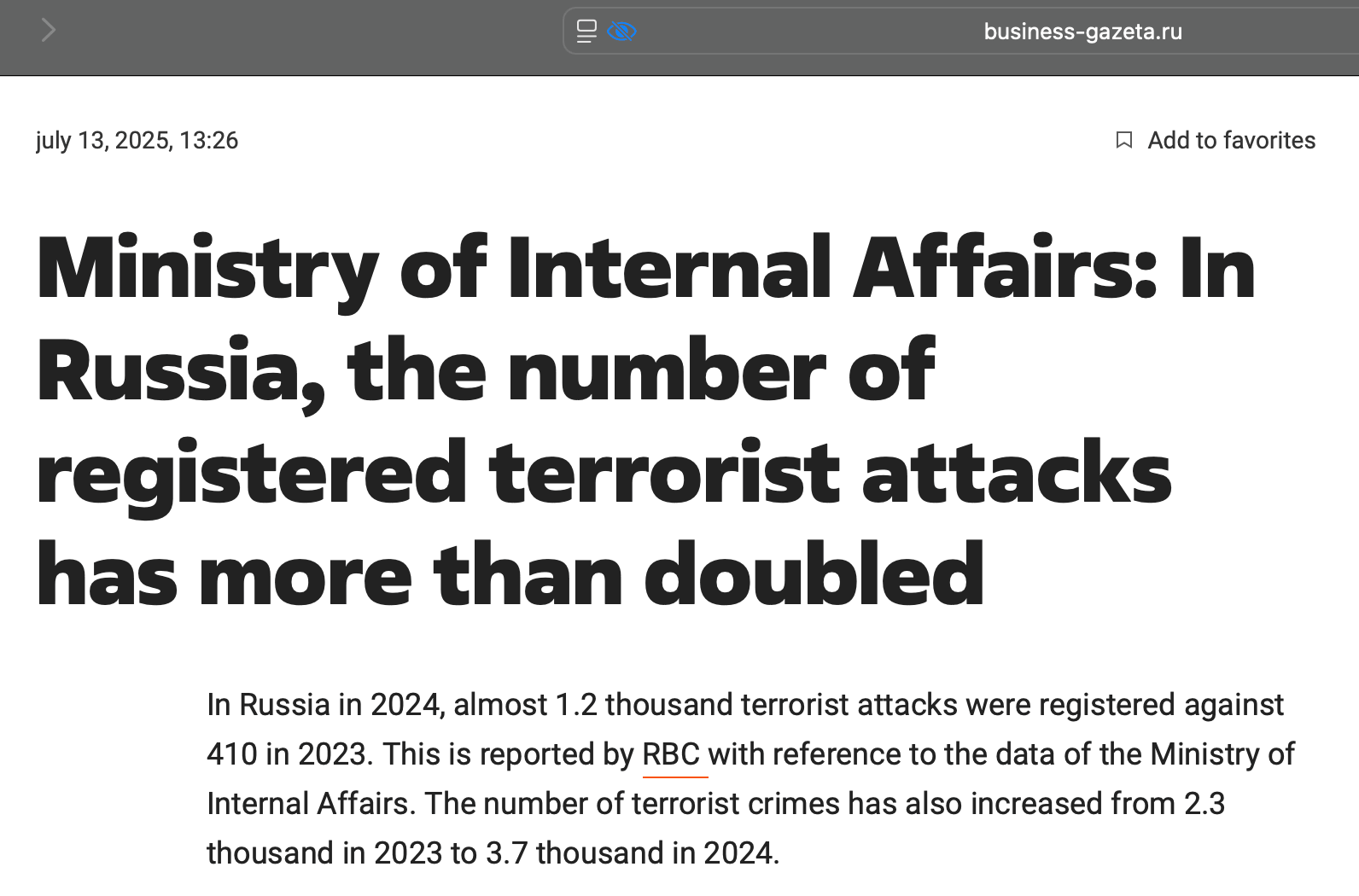
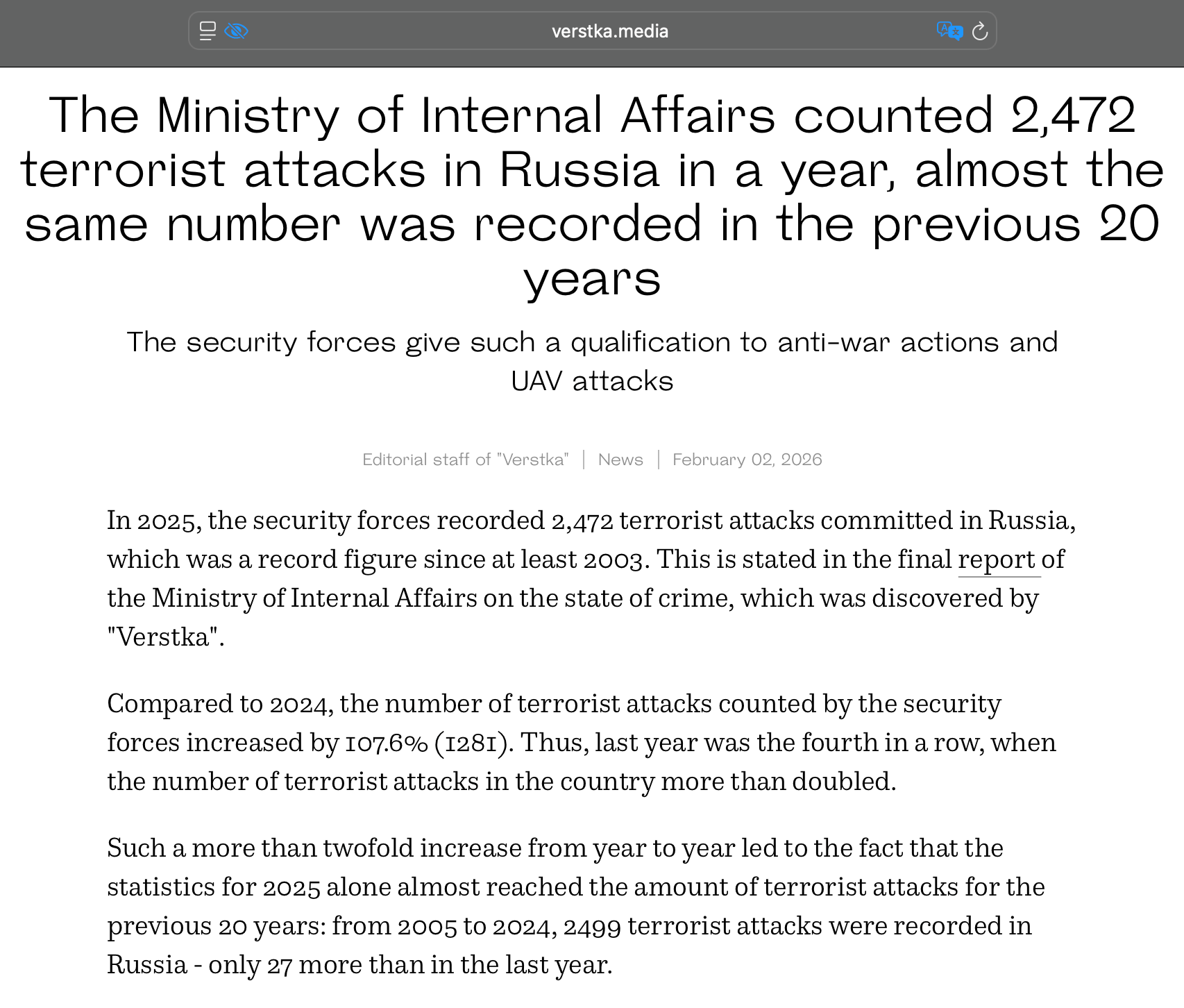
At the beginning of our investigation, we already showed that before the adoption of the so-called anti-terrorism package, law enforcement demonstrated a rather high efficiency. Against this backdrop, it is particularly noticeable how the situation changed after the Yarovaya Package implementation. A significant portion of the personnel and operational resources of the law enforcement system was diverted from directly combating the terrorist threat and directed toward the persecution of religious organizations and the suppression of dissent. As a result, the burden fell on the same staff of operatives and investigators, which inevitably reduced the overall efficiency of the system for countering real threats.
Thus, resources that previously ensured a real reduction in terrorist threats were partially redirected to tasks that had no direct relation to combating terrorism — primarily to fighting competitors of the ROC, controlling the entire religious sphere, persecuting religious minorities, and fighting so-called “sects’ and “cults.” This is the very agenda that representatives of the anticult movement, primarily Alexander Dvorkin, had been promoting for decades, gradually introducing it into the practices of state and law enforcement agencies.
Such a redistribution of priorities inevitably impacts the overall effectiveness of the security system. As official statistics and reports from the law enforcement agencies themselves show (which is clearly reflected in the provided graphs and screenshots), the level of the terrorist threat and the number of terrorist attacks notably increased in the subsequent years. As a result, the public’s sense of insecurity intensifies, and distrust in the state’s ability to effectively counter the terrorist danger grows.
As is also stated in the “The Impact” documentary, anticult activities are primarily directed against the state and government, as they undermine citizens’ trust in its institutions and the authorities’ ability to ensure public security.
The entirety of the presented facts shows that this is not about accidental excesses in law enforcement, nor isolated decisions by individual officials. This is about the systemic work of the anticult network, the ideological center of which for many years has been Alexander Dvorkin and the RACIRS structure he created. It was through this network that an agenda was shaped, which then found support among certain representatives of the legislative branch, law enforcement agencies, and the judicial system.
In our articles, we show in detail how this happened. First, the creation of an “enemy” image in the form of new religious movements. Next, the introduction of the necessary rhetoric into government structures. Following that, the emergence of legal provisions allowing for the use of repressive measures against religious minorities. And finally, law enforcement practices that confirmed the true aims of these initiatives.
In 2016, this looked like point-specific changes in legislation. Ten years later, it becomes clear what this policy has turned into. The expansion of bans, increased censorship, pressure on religious organizations and public associations, restriction of freedom of speech and freedom of conscience — all this creates an atmosphere of fear and distrust in society. It is exactly this result that inevitably arises whenever state institutions begin to operate under the influence of ideological networks seeking to monopolize the worldview.
History has already known such examples. In the last century, Russia paid an enormous price for the victory over Nazism that came from the outside. However, today society faces another question: will the Russian people be able to recognize the ideology of intolerance if it spreads from within — through laws, government agencies, and public consciousness?
Will Russians be able to recognize in the anticult ideology that very seed of Nazism which once already led the world to tragedy? And will they have the courage to admit their own mistakes and stop this dangerous trend before it once again leads the world to a global-scale catastrophe?
We hope that the moment of clarity will come soon, and then the system created by Dvorkin’s adherents will inevitably turn against its architects: the adopted repressive laws and accumulated tools of control will allow for a detailed investigation to be conducted, identifying all those involved and bringing them to justice — within the framework of the very legal mechanisms that they themselves introduced.
Russia’s experience in this sense becomes illustrative. It demonstrates the consequences that can arise when an anticult network gains access to state institutions and begins to shape the legislative and law enforcement agenda.
This looks particularly alarming when taking into account the international connections of such structures. We are referring to the European anticult federation FECRIS, with which Alexander Dvorkin has been closely associated for many years and where he served as vice-president for a long time. This organization has institutional ties with international entities: it holds participatory status with the Council of Europe, consultative status with the UN Economic and Social Council, and is also involved in the Fundamental Rights Platform at the European Union Agency for Fundamental Rights.
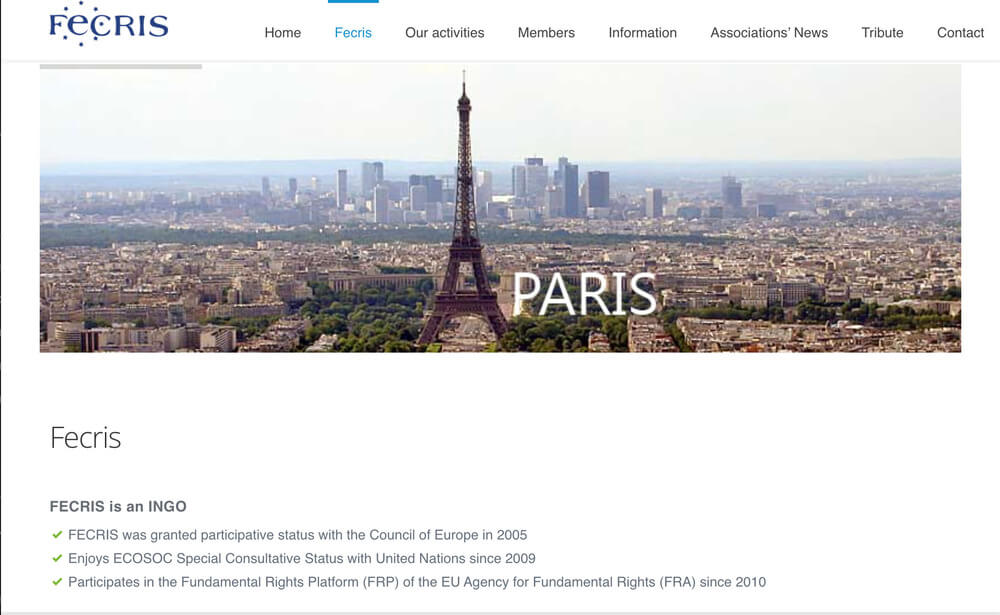
This very circumstance causes particular concern. An entity promoting anticult ideology and linked to Alexander Dvorkin’s activities that are explicitly characterized as religious extremism aimed at spreading intolerance, stigmatizing religious minorities, and introducing repressive mechanisms, gains an opportunity to participate in international discussions on human rights and religious freedom. In the context of the aforementioned facts, this raises a logical question: how were such organizations able to gain access to international institutions, and who facilitated their institutional strengthening at the European level? Obviously, these circumstances require a separate and thorough international investigation.
Sources:
1. https://www.ponarseurasia.org/the-nature-and-sources-of-terrorist-threat-in-russia-an-armed-underground-or-isil/
2. https://statbase.ru/data/rus-number-of-terrorist-incidents/
3 https://multiurok.ru/files/teoreticheskii-material-po-teme-terrorizm.html?utm_medium=organic&utm_
4. https://www.hattorimichitaka.net/archives/2018-02-26.html?utm_medium=organic&utm
5. https://ruxpert.ru/Статистика:Численность_терактов_в_России
6. https://www.statista.com/statistics/1044909/russia-number-of-terrorist-related-crimes/?utm_source=
7. https://www.statista.com/statistics/1033366/russia-number-of-recorded-terrorist-acts/?utm_source=
8. https://www.vedomosti.ru/technology/articles/2016/07/15/649300-vladimir-putin-poruchil-organizovat-proizvodstvo-oborudovaniya-dlya-ispolneniya-zakona-yarovoi
9. https://iz.ru/news/625351
10. https://telesputnik.ru/materials/tekhnika-i-tekhnologii/article/za-god-primeneniya-zakon-yarovoy-ugodil-v-patovuyu-situatsiyu
11. https://telesputnik.ru/materials/tekhnika-i-tekhnologii/article/za-god-primeneniya-zakon-yarovoy-ugodil-v-patovuyu-situatsiyu
12. https://www.rbc.ru/business/17/02/2017/58a6727f9a794740d6b083d8?utm_referrer=https%3A%2F%2Fyandex.ru%2F
13. https://www.rbc.ru/opinions/business/23/06/2016/576be9c99a79470862790d2d?utm_referrer=https%3A%2F%2Fwww.google.com%2F
14. https://telesputnik.ru/materials/tekhnika-i-tekhnologii/article/za-god-primeneniya-zakon-yarovoy-ugodil-v-patovuyu-situatsiyu
15. https://ruskline.ru/news_rl/2017/07/05/yarovoj_hotyat_dat_pyat_let_dopolnitelno/
16. https://www.interfax.ru/world/517397
17. https://www.interfax.ru/world/517397
18. https://www.interfax-russia.ru/main/matvienko-zayavila-o-100-kratnom-sokrashchenii-chisla-teraktov-v-rf-za-10-let
19. https://www.interfax-russia.ru/main/matvienko-zayavila-o-100-kratnom-sokrashchenii-chisla-teraktov-v-rf-za-10-let
20. https://www.interfax.ru/russia/755351
21. https://www.vedomosti.ru/business/news/2019/12/10/818309-operatori-svyazi-kupili-oborudovanie-rosteha
22. https://www.kommersant.ru/doc/2984588
23. https://www.vedomosti.ru/politics/articles/2017/01/25/674856-zakon-yarovoi-religii
24. https://www.kommersant.ru/doc/2961107
25. https://www.mk.ru/politics/2016/07/05/instrukciya-dlya-donoschika-v-pakete-yarovoy-taitsya-eshhe-odna-bomba.html
26. https://www.vedomosti.ru/technology/articles/2016/08/22/653895-kto-zarabotaet-zakone-yarovoi
27. https://www.vedomosti.ru/technology/articles/2016/08/22/653895-kto-zarabotaet-zakone-yarovoi
28. https://www.currenttime.tv/a/27809255.html
29. https://www.kommersant.ru/doc/2984588
30. https://www.rbc.ru/politics/23/06/2016/576aff4a9a7947d32fbae67f?utm_referrer=https%3A%2F%2Fyandex.ru%2F
31. https://www.kommersant.ru/doc/3020489
32. https://www.kommersant.ru/doc/3022832
33. http://kremlin.ru/events/president/news/59374
34. https://vz.ru/news/2018/12/18/955841.html
35. https://vz.ru/news/2018/12/18/955841.html
36. http://kremlin.ru/events/president/news/59374
37. https://vz.ru/news/2018/12/18/955841.html
38. https://vz.ru/news/2018/12/18/955841.html
39. https://vz.ru/news/2018/12/18/955841.html
40. https://www.rbc.ru/politics/13/07/2025/687153669a7947a67e3030a3
41. https://www.business-gazeta.ru/news/677419?fullpage
42. https://verstka.media/mvd-naschitalo-za-2025-god-stolko-zhe-teraktov-skolko-za-predydushhie-20-let