Introductory Remarks
Before we begin, let’s agree on a unit of measurement, just as we did in the first part. There, the unit was a ton, and it was chosen not by us, but by the recipient who weighed the gifted archives and announced the weight publicly: five tons of documents that left Berlin for Minsk in 2010.²⁴ Here, the unit is different, and it is absurdly small. It’s a single line of a bibliographic reference and a dozen characters including spaces and dashes: “S. 980–986.”
Here’s a citation for the article “The Jewish Question,” published in 1937 in the first volume of the Calwer Church Lexicon and signed by Dr. Kurt Hutten.¹⁰ Seven pages of reference text, a routine glossary entry written by a man who turned thirty-six that year. He managed affairs of the Württemberg Church Press Union, held a doctorate in general history of religion from the University of Tübingen, and had an official evaluation in his personnel file describing him as capable, modest, and courteous.¹
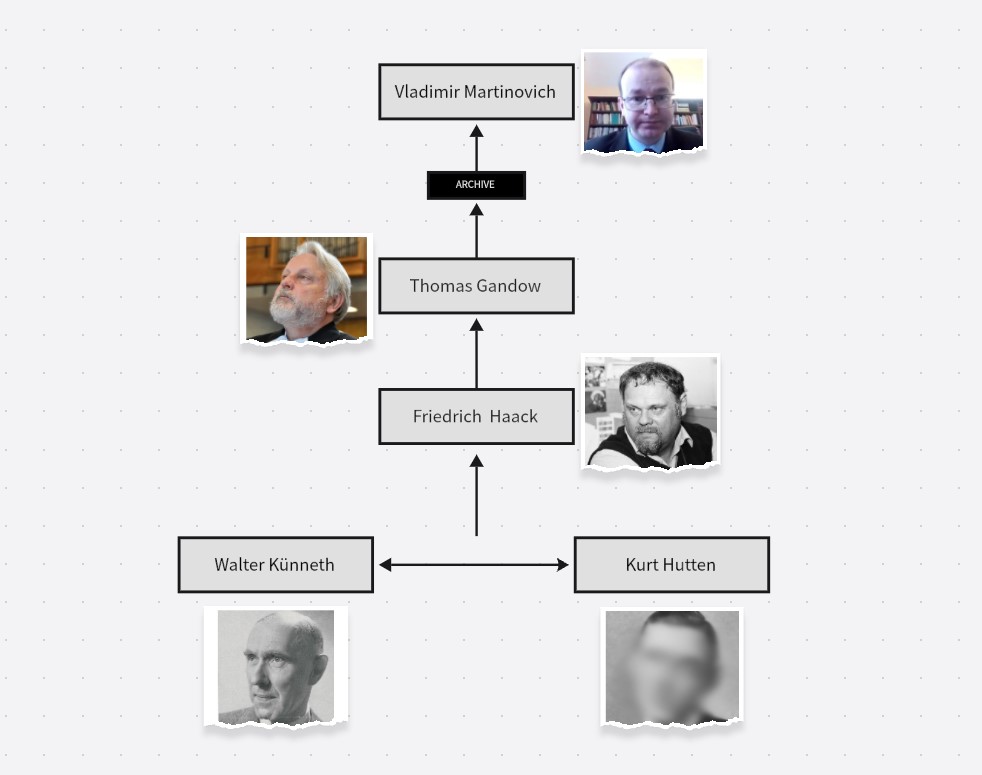
Two decades later, this same man would head West Germany’s primary anticult institution and author a reference book that would go through fifteen editions over half a century. ¹¹ ¹² Ten years later, his position would be assumed in modified form by the Bavarian pastor Friedrich-Wilhelm Haack, and from Haack it would pass to the Berlin pastor Thomas Gandow whose five tons of archival papers now sit in a Minsk storage facility. We constructed this chain in the first part, using dates, names, and staffing decisions, and all that time, something was missing from it: the contents of pages 980 through 986.
In order to read them, one must take the book off the shelf, open it, and read seven pages. Yet, judging by everything that has been published, between October 1946 when the denazification court cleared Hutten after finding nothing anti-Semitic in his record ¹, and 2007 when religious historian Horst Junginger described the article as “marked by hostility toward Judaism so radical that it was unusual even for National Socialist publications,”⁶ no one performed this simple act. Sixty-one years, all passing in a country that worked through its own past more deeply and honestly than any other in Europe. Sixty-one years! Here’s a unit of measurement for this part: not a ton, but seven pages that no one bothered to open.
In the first part, we examined the framework: the card catalog, the reference service attached to it, and the continuity of institutions and personnel from Berlin in 1921 to Minsk in 2010. We promised to return to the “shadow” biography of Walter Künneth and Kurt Hutten, to his doctoral advisor Jakob Wilhelm Hauer, to the spring and summer of 1933 when the director of the Berlin institution and its author found themselves in the same church-political faction, and to the question of what this anticult office actually engaged in between 1933 and 1937.
This part delivers on those promises, and the distinction between the two parts is worth stating clearly so readers understand. The first part dealt with institutions: who succeeded whom, which entity declared itself the successor of another, and what administrative decisions formalized those shifts. The second part deals with texts: what those people wrote, in which publications, using what words, and with what consequences for living human beings.
The difference exists, and it is immense. Institutional continuity can always be explained away by inertia, staffing shortages, postwar devastation, and a hundred other circumstances. None of these force anyone to call things by their true names because an administrative decision may be neutral. A text offers no such loophole: it is either written or not, and if it is written, it bears a name and a date.
The German historian of the Protestant press, Dietrich Hub, after completing his review of Kurt Hutten’s personnel file at the Regional Church Archives in Stuttgart, summarized it as follows:
“The assertion that Hutten approved of Hitler’s measures against the Jews and against Jehovah’s Witnesses cannot be refuted.” ¹
The sentence is constructed according to every rule of academic caution, which is precisely why it carries more weight than a direct accusation. The historian doesn’t write “he approved” — he writes that defense in this case is impossible because there’s simply nothing to defend with. Throughout the years of his postwar life, this file revealed neither retraction nor explanation or a single line where the author looked back upon his former self. ¹
It might seem fair to ask: why would a modern reader care about an article from a 1937 church dictionary? Because the question of the origins of expert evaluations isn’t resolved in the abstract, but in the specifics, through a concrete individual and a concrete page. In the abstract, it sounds as follows: “the German Church collaborated with the Nazi regime.” That’s an indisputable, well-known statement taught in school curricula and, unfortunately, entirely useless. Nothing flows from it: not a single question to our present-day “experts,” not a single objection in a court hearing, and not a single revision to a textbook can be derived from it.
In specific terms, however, the question sounds different, and implications emerge immediately. In 1960, the man who wrote in 1937 that the solution to the Jewish question was conceivable only through “removal of Jews from the host nation altogether” 6 became the head of an institution that decided which religious groups in Germany were to be considered dangerous! 12 Moreover, he authored a reference book that educated the next generation of anticultists.11
Now, let’s talk about the implications. If a person spends thirty years describing religious minorities as a threat to the Nazi state and after 1945 continues describing the same minorities as a threat to democracy, then his method remains unchanged. It is the exact same working tool set against two different political backdrops, and this tool requires separate analysis. Up to now, this hasn’t been done, as the political agenda obscured the technology itself. While debates raged over the changing of eras, the practical mechanism of stigmatizing dissidents remained in the shadows, even though it is precisely what survived intact to this day.
As for the procedure itself, in 1946 the denazification court completely exonerated Hutten without ever opening a single one of his prewar articles. This looks nothing like German meticulousness and nothing like ordinary oversight. Today, it is difficult to say why this happened. Perhaps, bureaucratic logic took over: inspectors looked at the official questionnaire and his clerical title rather than his actual texts. Seventy years later, according to the exact same logic, religious expert evaluations would begin to be rubber-stamped in Russian courts where the authority of an expert’s position and titles carry far more weight than verifiable evidence. Yet, we will return to that later.
Nonetheless, let’s not be naive: it’s quite possible that someone influential intervened to save Kurt Hutten from the tribunal.

Prologue. Explanation From September 5, 1946
The document that we’ll begin with lies in his personal file and takes up just a few lines. Written by Dr. Kurt Hutten, it was attached to his questionnaire for the denazification court:
“In the spring of 1933, I enrolled in NSDAP and the German Christians, believing as a Christian that I bore a relevant responsibility for their internal stance… I was never a party member… As early as 1932, I began my struggle against public religiosity.”
Interestingly enough, he indeed registered with NSDAP in the spring of 1933 and indeed never became a full party member, remaining listed as a candidate. He did in fact write against “public religiosity,” and his books on the subject were published between 1935 and 1938.
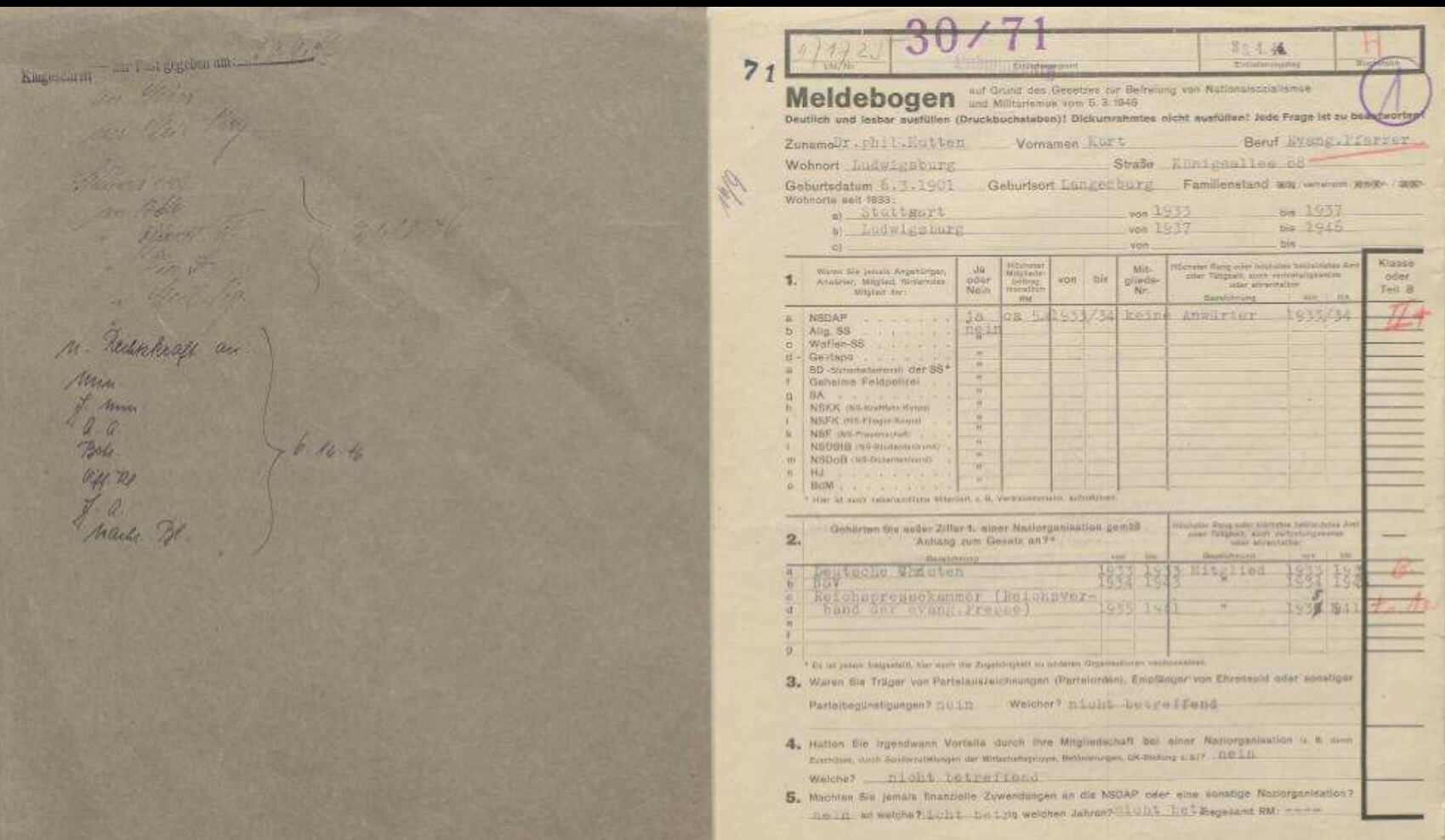
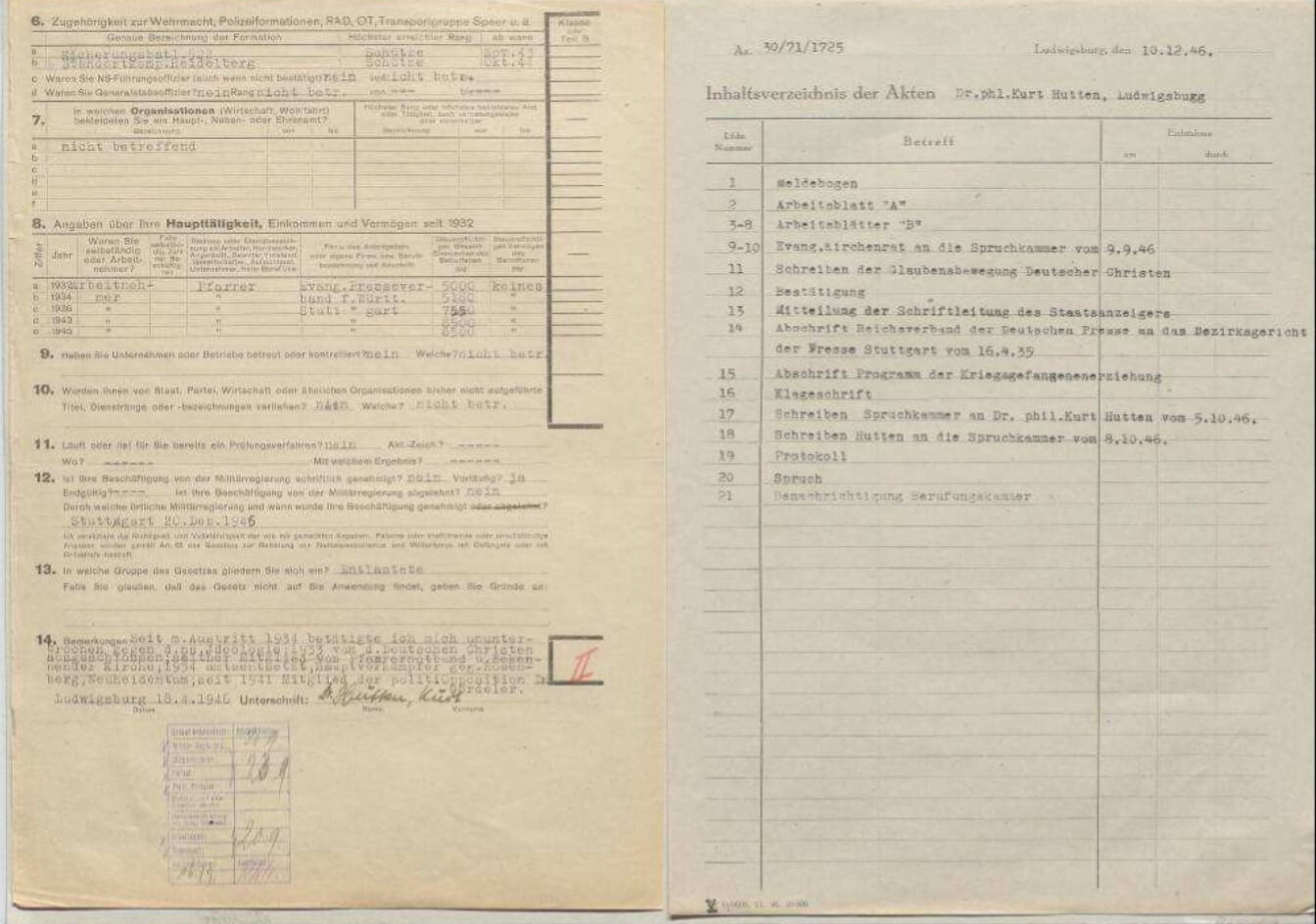
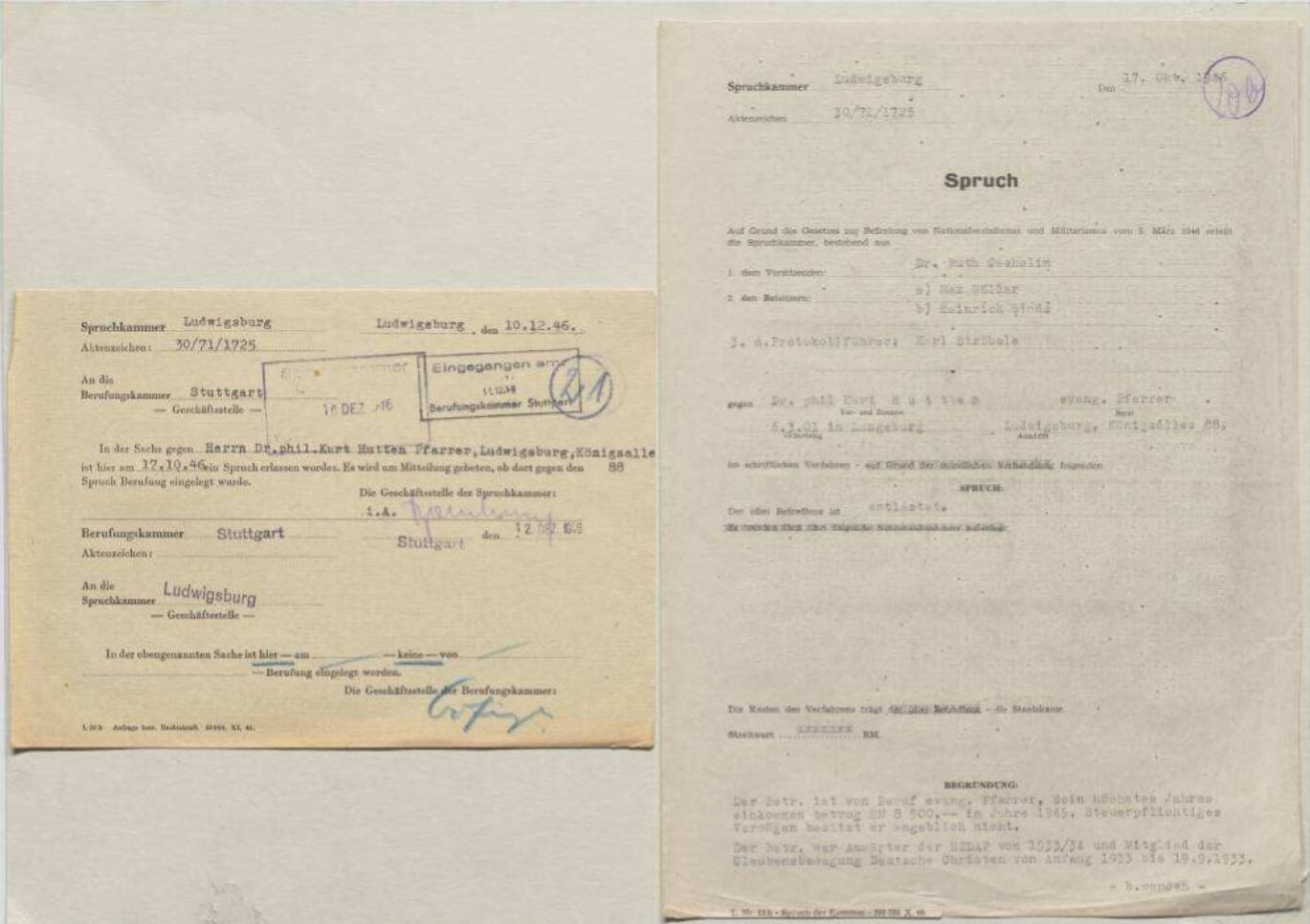
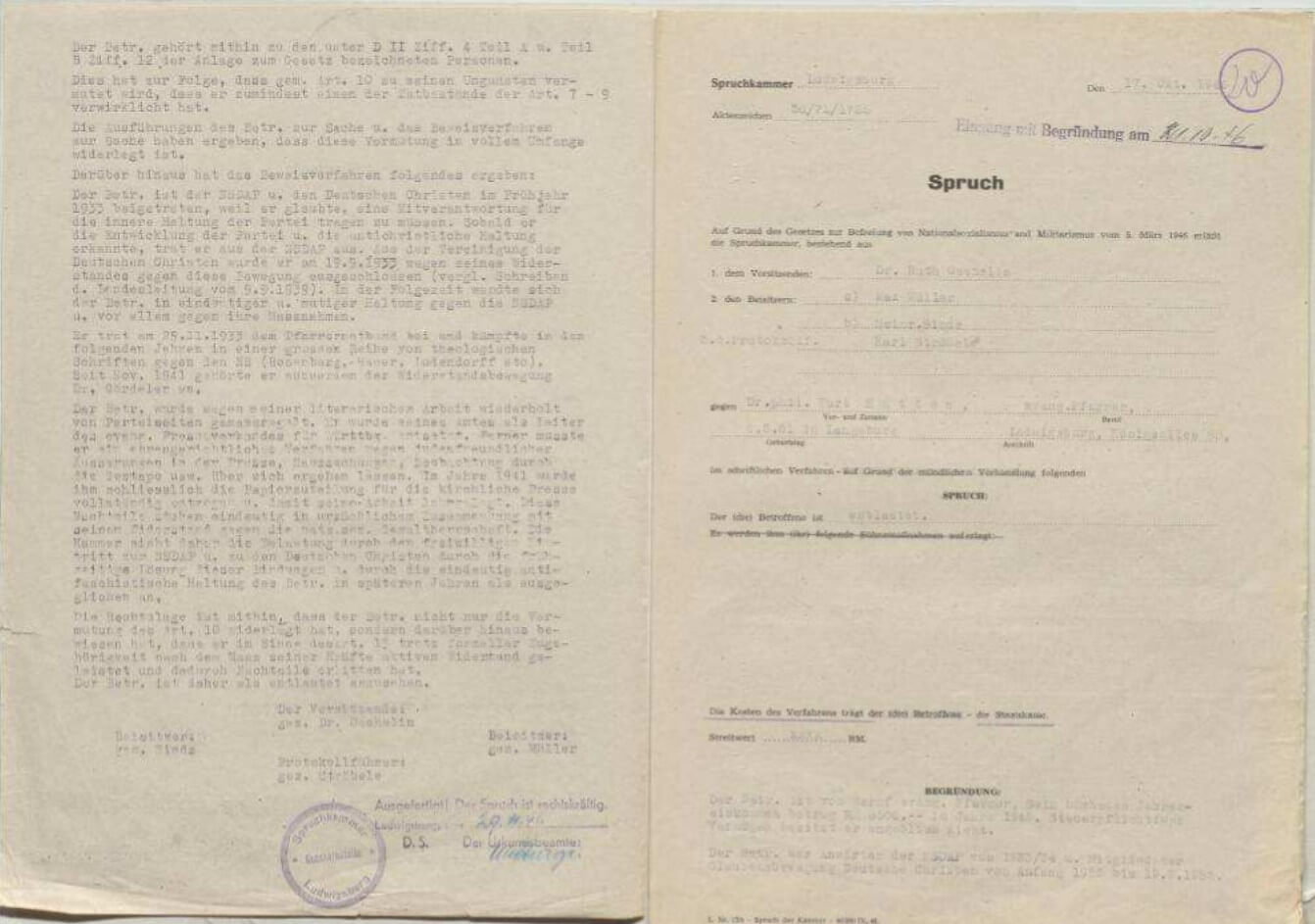
What needs to be verified, therefore, isn’t the statements themselves, but what lies between them. The 1946 explanation contains no direct lies and is built entirely on omissions arranged with the professional precision of a man who, by that time, had worked for fourteen years as an editor, including for the Apologetic Center under the leadership of Walter Künneth.
What it fails to mention is that since 1930 Kurt Hutten had served as managing director of the church’s People’s Union, and that in 1932 he sought to restructure this union according to the führer principle. 2 It fails to mention that in 1935 he declared in print his readiness to “stand with all our might for the great work of renewal [undertaken] by the Führer and NSDAP.” 1 It further fails to mention that in 1937 his seven-page article on the Jewish question was published, 10 and that in 1942 he published an article on National Socialism, stating in black and white that “obedience to the voice of blood is the supreme law.” 6 Finally, it fails to mention the most revealing point of all: that the “struggle against public religiosity” he reported to the court was conducted in publications whose contents he himself aligned with the goals of the Third Reich — a fact Junginger states directly and unambiguously.6
Omission, not falsehood. The difference between them is that a lie is refuted by a document, whereas an omission cannot be refuted by anything short of a counter-question — one that, for some reason, no one was around to ask in 1946.
The second document in this story is already familiar to readers from Part 1: the report by the director of the Apologetic Center, Walter Künneth, to the Reich church government on December 16, 1933 — the very one stating that an “exchange of materials” with the Gestapo had already begun. 5 At the time, this too was somehow overlooked.
This raises a lot of questions. What exactly was written in those texts that the 1946 tribunal never opened, and why were they not opened neither then nor in 1960 when the author assumed a leadership position in the revived anticult organization? Nor in 1979 when obituaries were written for him? How did the exact same line of work, begun in 1930 and continuing uninterrupted until 1968, twice survive a change of political regime without changing its method, its card catalog, or the list of people whose files were maintained in the catalog? And above all, what cannot be brushed aside is this: wasn’t this decades-long silence a fully conscious and planned collusion?
Chapter 1. Tübingen, 1928: Doctoral Thesis
The year of Kurt Hutten’s thesis defense is cited as 1928. The thesis was printed in 1929, and the book edition was released in 1930.⁸ Junginger dates it by the printing, Dietrich Hub by the book, and both are correct, each within his own framework. A review of the book was written by a Leipzig religious scholar Hans Haas and published in Theologische Literaturzeitung 55 (1930), No. 12, columns 265–266.⁸
One detail of this bibliography is worth noting, and it is by no means a mere formality: the book was published as the first volume in the series “Publications of the Oriental Seminar at the University of Tübingen.” In other words, the work of a 29-year-old doctoral candidate in theology from Württemberg marked the beginning of a publication series for the very seminary headed by his academic advisor, Jacob Wilhelm Hauer. This is typically done with a work that the advisor considers successful and wishes to showcase to his colleagues.
Who Kurt Hutten’s Academic Advisor Was
BACKGROUND
- Jakob Wilhelm Hauer (1881–1962),25 Indologist, religious scholar, full professor at the University of Tübingen holding the chair of Indology and general history of religions, and founder of the German Faith Movement (Deutsche Glaubensbewegung) — an attempt to establish a non-Christian “German faith” for the Third Reich. A complete examination of Hauer’s figure, his Tübingen circle, and his ties to the SS and SD leadership forms the content of the next part of this investigation.
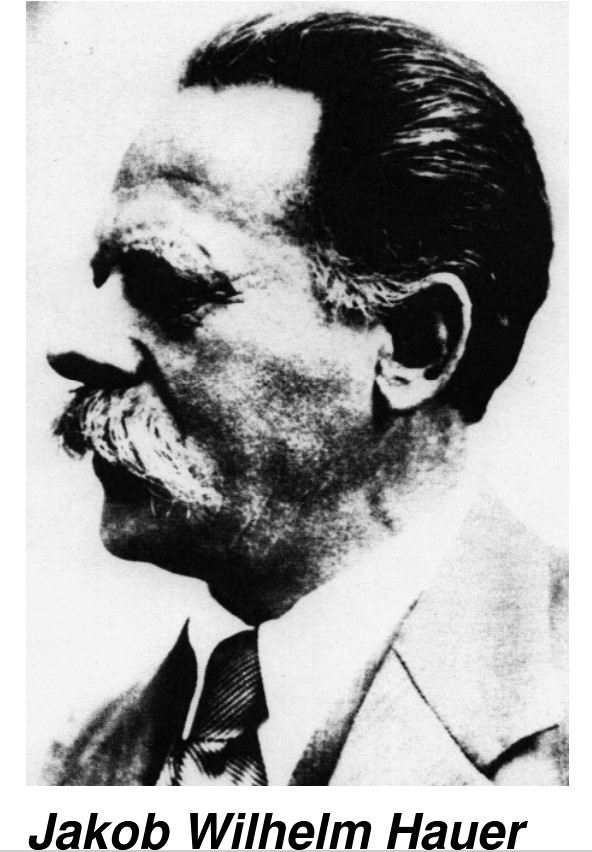
For now, three circumstances are sufficient for us, and all three have been established independently of our premise.
The discipline in which Hutten earned his degree was called “general history of religion,” ⁶ the very science that studies another’s faith without judging it. The man who conferred this degree upon him soon headed a movement aimed at replacing Christianity with a religion of Germanic blood.²⁵ Finally, Hub himself, a scholar of a thoroughly academic mindset, cautiously placed in a footnote a hypothesis that, when considered carefully, contains the underlying premise of our entire investigation:
“Hauer later became one of the ideologues of the ‘German Faith,’ left the church in 1933, and founded the German Faith Movement. It is possible that this personal closeness through his doctoral advisor led Hutten into the sphere of this religiosity.” ¹
What does this mean? As it turns out, a specialist in “public religiosity” who spent his entire postwar life describing it as a danger, arrived at this topic not through fighting it, but through personal closeness with one of its primary ideologues? The hypothesis isn’t ours, yet a reliable source stands behind it.
Yet, there is one more small chronological detail that is usually overlooked. Hauer died in 1962,²⁵ so when his former doctoral student took the helm of West Germany’s primary apologetics institution, the EZW (Protestant Central Agency for Worldview Issues), on April 1, 1960, his doctoral advisor was seventy-nine years old, alive, reading newspapers, and fully capable not only of seeing this appointment, but of influencing it.
What Was in the Doctoral Thesis Itself
The contents of Hutten’s work were most precisely summarized by Junginger, and his summary is worth quoting in full because it contains the core paradox of the entire biography:
“However, he wrote his doctoral thesis, ‘Bhakti Religion in India and Christian Faith in the New Testament,’ under the Tübingen Indologist and religious scholar Jakob Wilhelm Hauer in the discipline of ‘general history of religion.’ Under the influence of his teacher, he quite clearly distanced himself in it from Christian apologetics and missiology in order to instead emphasize the worldview neutrality and objectivity of the ‘general’ history of religion. But with the advent of the Third Reich, both Hauer and Hutten no longer wanted to know anything about their former goals.” ⁶
The question is not whether Hutten was a student of a Nazi, but rather whether there was a personal closeness between them sufficient for the student’s work to open the series of the advisor’s seminar. However, we do not yet know this. Whether Hauer was able to exert influence on the student’s entire subsequent fate also remains questionable. Nevertheless, the main conversation about Hauer is still ahead.
The topic of the thesis is worth naming in full. Bhakti is an Indian tradition of personal loving devotion to a deity. It’s a movement that springs from the depths of religious feeling and requires neither a priest nor a temple, or scholarly knowledge. The young theologian Hutten compares it to New Testament faith, that is, he does precisely what comparative religious studies does: searching for common ground between another’s faith and one’s own, having accepted in advance that the other is worthy of understanding, not judgment.
The work received a good review in the country’s primary theological journal and opened the series of the Tübingen Oriental Seminar,⁸ and had two or three dates in this biography aligned slightly differently, its author might well have remained an Indologist. However, literally a few years later, the same author would write that the solution to the Jewish question was conceivable only through “removal of Jews from the host nation altogether.” ⁶
Chapter 2. 1930–1934: The People’s Union, the Fuhrer Principle, and Eight Months With “German Christians”
One version of this story goes like this: Hutten joined NSDAP and the German Christians. NSDAP is the abbreviation for the National Socialist German Workers’ Party, or simply put, the Nazi Party. The version is exactly half true, and the second half, strangely enough, works against him more strongly than the first.
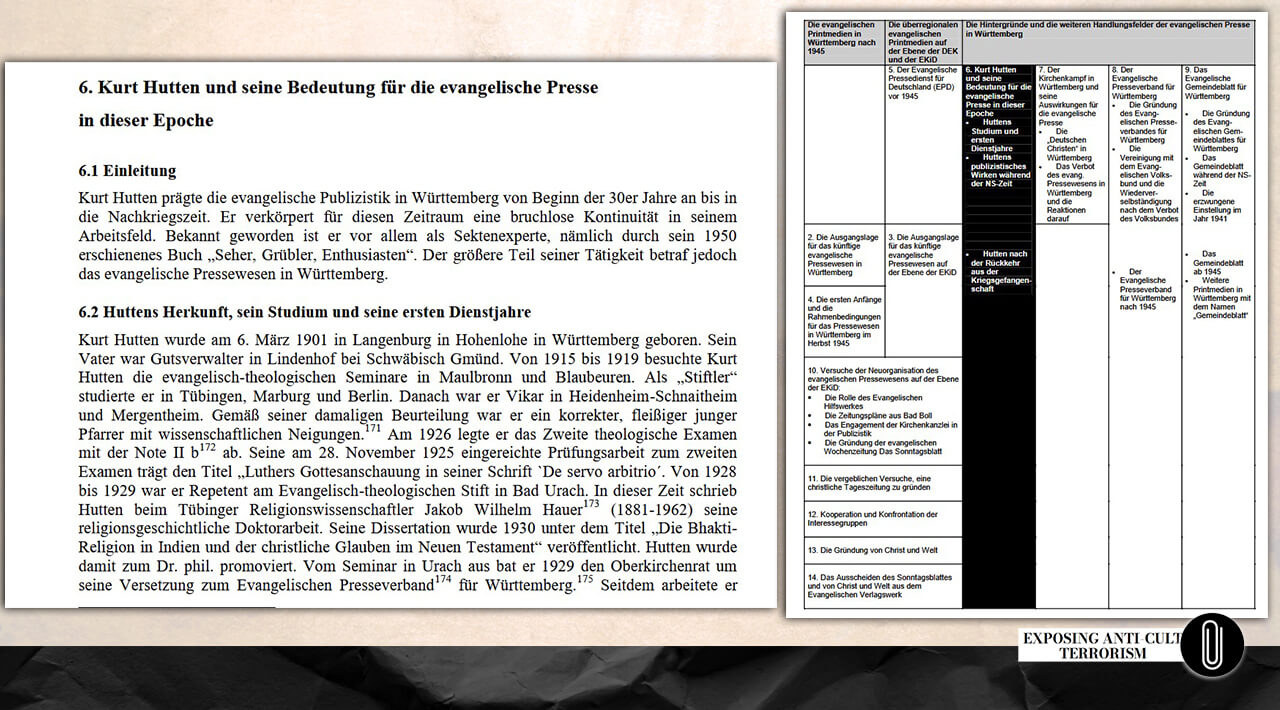
On September 12, 1930, the Supreme Church Council conferred the title of pastor upon Hutten, although after his vicarage he no longer served in a congregation and had no intention to do so, taking up the position that same year as permanent executive director of the Protestant People’s Union of Württemberg, which was then merged with the Württemberg Press Association.¹
A church evaluation from those years has been preserved in his personal file, and it’s a model evaluation of a promising bureaucrat:
“Dr. Kurt Hutten is a young theologian of outstanding qualities, personally amiable, quick-witted, and modest in his interactions, yet he possesses strength of character and candor. […] In his scholarly work, he has demonstrated substantial results.”¹ Quick-witted, modest, with character, with substantial scientific results. A good employee who did what everyone did, doing it better than many others.
Hutten’s first book was published when he turned thirty, and he would carry its words through his entire life, altering only those to whom these words were applied:
“They want to replace traditional culture with a standardized, vulgar, characterless, and faceless cultural mixture […] that has now taken the place of genuine traditional culture and seeks to undermine the spiritual identity of the peoples.” ¹
According to Hutten, cultural Bolshevism waged war against religion, against the family, against the fatherland, and against distinct characteristics of individual peoples, while “heroism” opposed it. The difference between the two was succinctly summarized as follows:
“Cultural Bolshevism desires gratification; the heroic man desires service.” ¹
The book concluded with a finding dated 1931 and therefore particularly intriguing:
“Fortunately, there is once again a movement sweeping through the people today that is reviving and reigniting the spirit of these derided words — ‘fatherland’ and ‘people’” ¹
Incidentally, what other movement was reviving the words “fatherland” and “people” in Germany in 1931? The Nazi movement. There simply was no other, hence the author knew perfectly well of whom he wrote, and the word “fortunately” stands here not for stylistic flourish, but as a matter of substance.
Let us note at once, so as not to return to it later, that the list of enemies from this book, where a “standardized cultural mixture,” destruction of the family, and erosion of national characteristics stand in the same rank, would survive the Third Reich, the Federal Republic, and the Soviet Union, and in the 1990s would surface almost verbatim in Russian texts on “spiritual aggression” and “erosion of national identity,” even though the authors of those texts would have no knowledge of Kurt Hutten’s existence. We will encounter such coincidences more than once, and they are explained not by borrowing, but by peculiarities of the genre under our investigation.
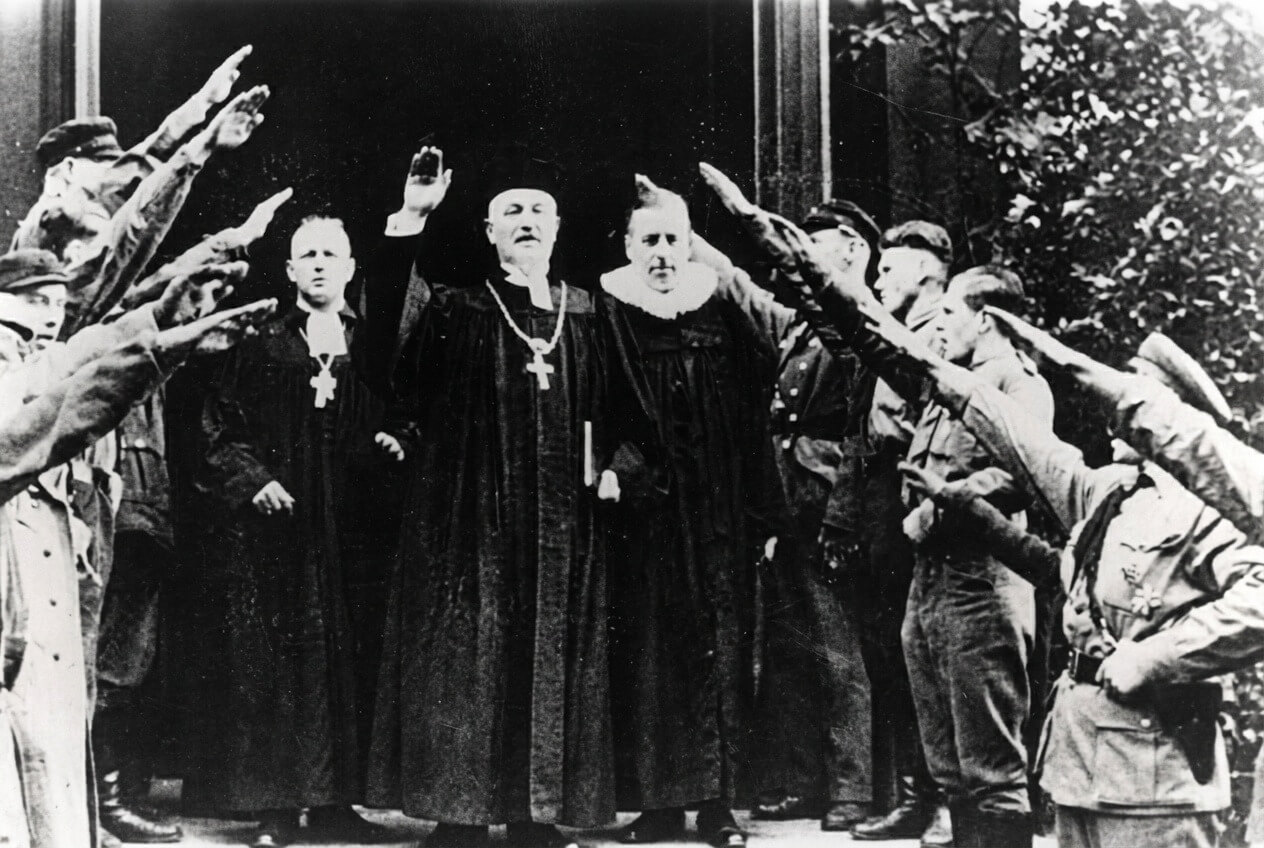
The Führer Principle in Church Organization
In 1932, there was a detail recorded by Rudolf Ladwig that usually falls out of such biographies: Hutten “sought in 1932 to reorganize the Protestant People’s Union, where the Führer principle (Führerprinzip) was to be instituted.” ²
Hold this date before your eyes. The year is 1932! The Nazis are not yet in power, Hitler’s appointment as Reich Chancellor is still several months to a year away, while the executive director of a church public organization is already proposing to restructure it according to the Führer principle, that is, to abolish collegiality and elections in favor of one-man rule that relies not on procedure, but on the leader’s personality.
“National Socialism and Christianity” (1932)
The second book is interesting because the author writes it not under censorship, but by his own lights, attempting to theologicalize a movement that hasn’t yet come to power. He derives the origins of National Socialism from the frontline experience of the First World War:
“Amidst the barrage of the battle of material resources, a new understanding of the fatherland celebrated its resurrection. […] ‘Fatherland’ and ‘people’ became an absolute magnitude which must be affirmed by man as it is his destiny, and which stands above the life of an individual, for it’s not an individual who possesses intrinsic value, but the people.”¹
For him, the idea of the people is an ideal “shrouded in loftily held hopes, imbued with the deepest yearning,” and possessing “a downright eschatological character,”¹ while the book’s conclusion is cautious and thoroughly academic: a Protestant Christian may be a National Socialist, but is by no means obligated to be one.¹
Right here appears Hutten’s first statement on the “Jewish question,” which bears careful reading:
“A part of Jewry — by no means all! — has latched onto our national soul like a demon, like a principle of eradication and corruption. […] Anti-Semitism directed against this spirit is a thoroughly moral movement and must be unconditionally approved by us Christians as well.”¹
Here we have a “moral” anti-Semitism, ostensibly directed not against lineage, but against a “spirit,” and moreover supplied with the caveat “by no means all”… The construct that “it’s not the race that is bad, but the spirit” appears softer than a racial one, and in 1932 it looked that way, but it possesses a property that makes it more dangerous than the original. Racial theory can at least be tested and refuted as a demonstrably false natural-scientific claim, while “spirit” cannot be tested through anything because who precisely belongs to “this portion” and who to the rest is decided by an author, moreover according to criteria that are listed nowhere and presented to no one.
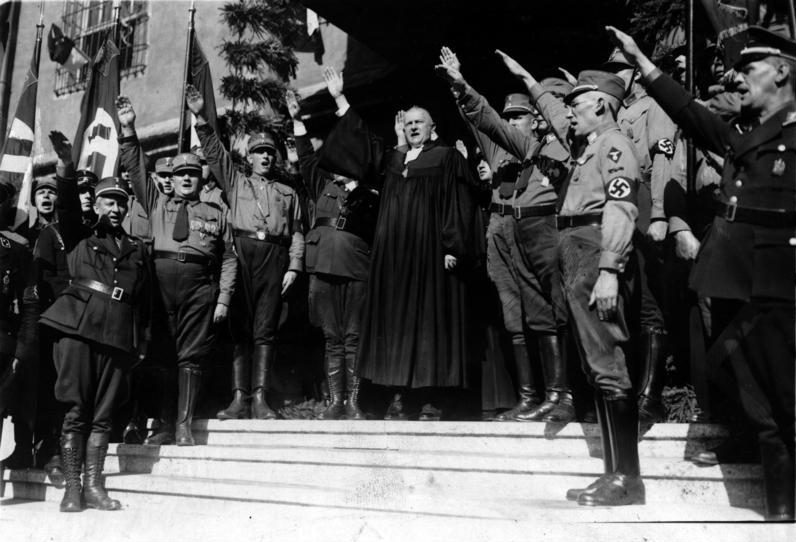
1933: NSDAP Applicant and Member
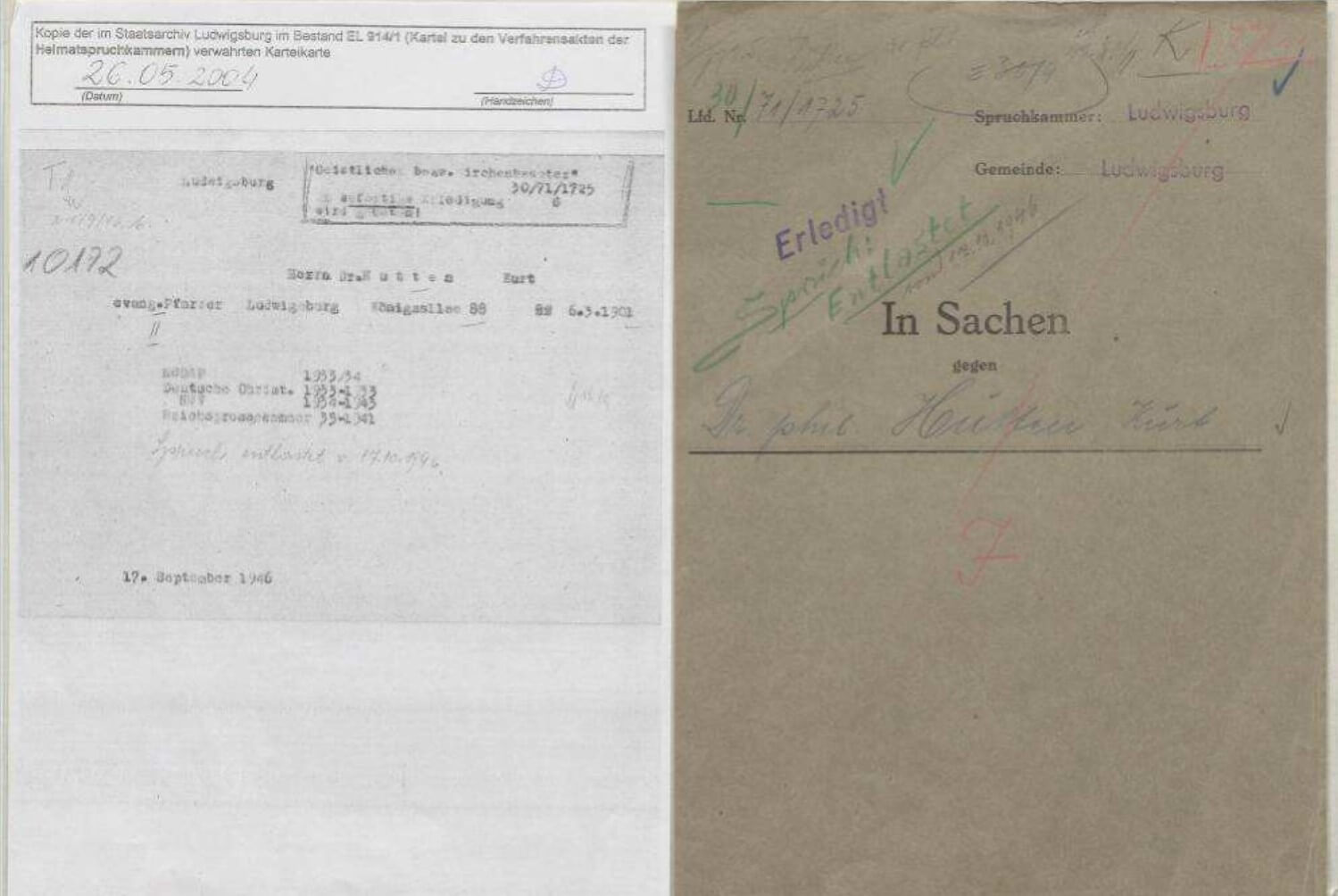
The only fact established by documentary evidence is precisely what’s recorded in the ruling of the denazification court on October 17, 1946, and it’s recorded in the driest possible terms:
“Hutten was an NSDAP applicant (Anwärter) in 1933/34 and a member of the Faith Movement ‘German Christians’ from early 1933 until September 19, 1933.” ¹
Thus, he applied to join the Nazi Party in the spring of 1933 and was registered as an applicant.
The word “Anwärter” is worth examining because it is usually lost in subsequent retellings. This was neither a “sympathizer” nor a “fellow traveler,” but the official status of a person who had submitted an application and was awaiting admission. There were great numbers of such people in the spring of 1933 as on May 1 the party froze the admission of new members, leaving everyone who applied during the spring months suspended in applicant status indefinitely. The mass influx of March and April earned the derisive German moniker Märzgefallene — the “March casualties,” by analogy with those who fell in the revolution of 1848, denoting people who joined the party not due to conviction, but opportunely. Hutten seems to have been one of them, being a man who, in the spring of 1933, deemed it prudent to join the Nazi Party ranks.
Eight Months With “German Christians”
This episode is usually recounted in a single glib line: he joined and was expelled for opposing the Aryan clause.” This paints an inaccurate picture, as if the man simply joined, then protested, and left, so let’s try to untangle the facts.
The “German Christians” were not a party cell, but a party within the church, fighting for power in church governing bodies and demanding that the Protestant Church align itself with the ideology of the new government, including introduction of the Aryan paragraph for the clergy, which meant dismissing pastors of Jewish descent²⁶. Hutten joined at the beginning of 1933, like thousands of other pastors, when membership seemed less a deliberate choice than a token of loyalty. In September, when the movement’s regional leadership demanded the introduction of the Aryan paragraph in the Württemberg church as well, he joined others in backing Bishop Theophil Wurm, publicly criticized the head of the Württemberg “German Christians,” Wilhelm Rehm, and was expelled from the movement for doing so (Hub dates the expulsion to Sept. 18). ¹ In October, an entire group of about 150 pastors left the Württemberg branch, and on Nov. 25, 1933, Hutten joined Martin Niemöller’s Pastors’ Emergency League, which six months later would give rise to the Confessing Church. ¹ ³⁰
That comes to about eight and a half months of membership.
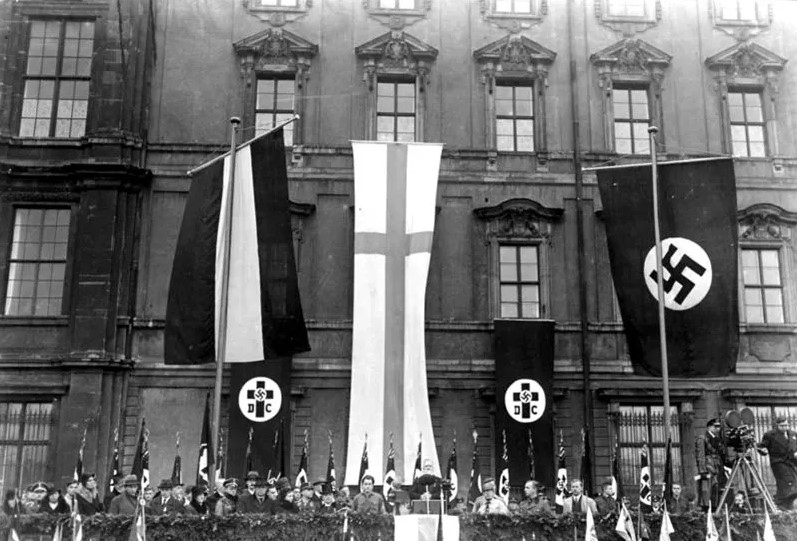
Now, here’s the hidden backstory. As late as the end of October 1933, the defectors themselves explained that they were protesting against the “unacceptable conduct of the regional leadership,” and by no means against the German Christians as a movement¹, taking issue with the people rather than the idea. Nor was the rupture definitive even after the expulsion: on January 16, 1934, the movement’s Württemberg leadership publicly announced via the newspaper NS-Kurier that it had no intention of collaborating with Hutten and his colleague Weber, because they “not fully adhered to the National Socialist worldview.” ¹ Note that in order to withdraw from the collaboration, the issue must be on the table, and it appears that it was still on the table four months after the exclusion. “Not fully”! There is the precise measure of distance, provided not by critics, but by former like-minded associates who had no reason to shield him.
Junginger formulates the same point as a warning to anyone writing about the “moderate” church figures of that era:
“Hauer emerged as the leader of the ‘German Faith Movement,’ while Hutten joined the ‘German Christians,’ belonging to their moderate wing. […] let it be noted that ‘moderate’ should not be confused with anti-Nazi. The group around Hutten likewise demanded of its adherents ‘an unequivocally clear and joyful profession of allegiance to the National Socialist state and the Führer.’” ⁶
Hutten himself left no doubt that same year: “The political struggle is over. The party system is heading toward complete demise. […] From now on, there is only one defining political will.” ¹ And in the same passage: “The new state is emphatically founded on Christian grounds […] The church, therefore, is first and foremost in alliance with the state.” ¹
Hence, the crux of the matter is this: Kurt Hutten withdrew from the Nazi faction inside the church, but he didn’t withdraw his support for the Nazi state outside the church, and in 1933 the two were in no way mutually exclusive. The dispute was over who held mastery in the ecclesiastical household and what rules governed admission there, not over whether the order that had been established outside the fence was a good one.
May 1933: Archival Documents of the Jungreformatorische Bewegung
We mentioned the Jungreformatorische Bewegung (Young Reformation Movement) in Part 1, and we referred to its dual stance: endorsement of the new state alongside the defense of ecclesiastical autonomy. Now let’s present arguments that support this assessment because, without them, it remains nothing more than an opinion.
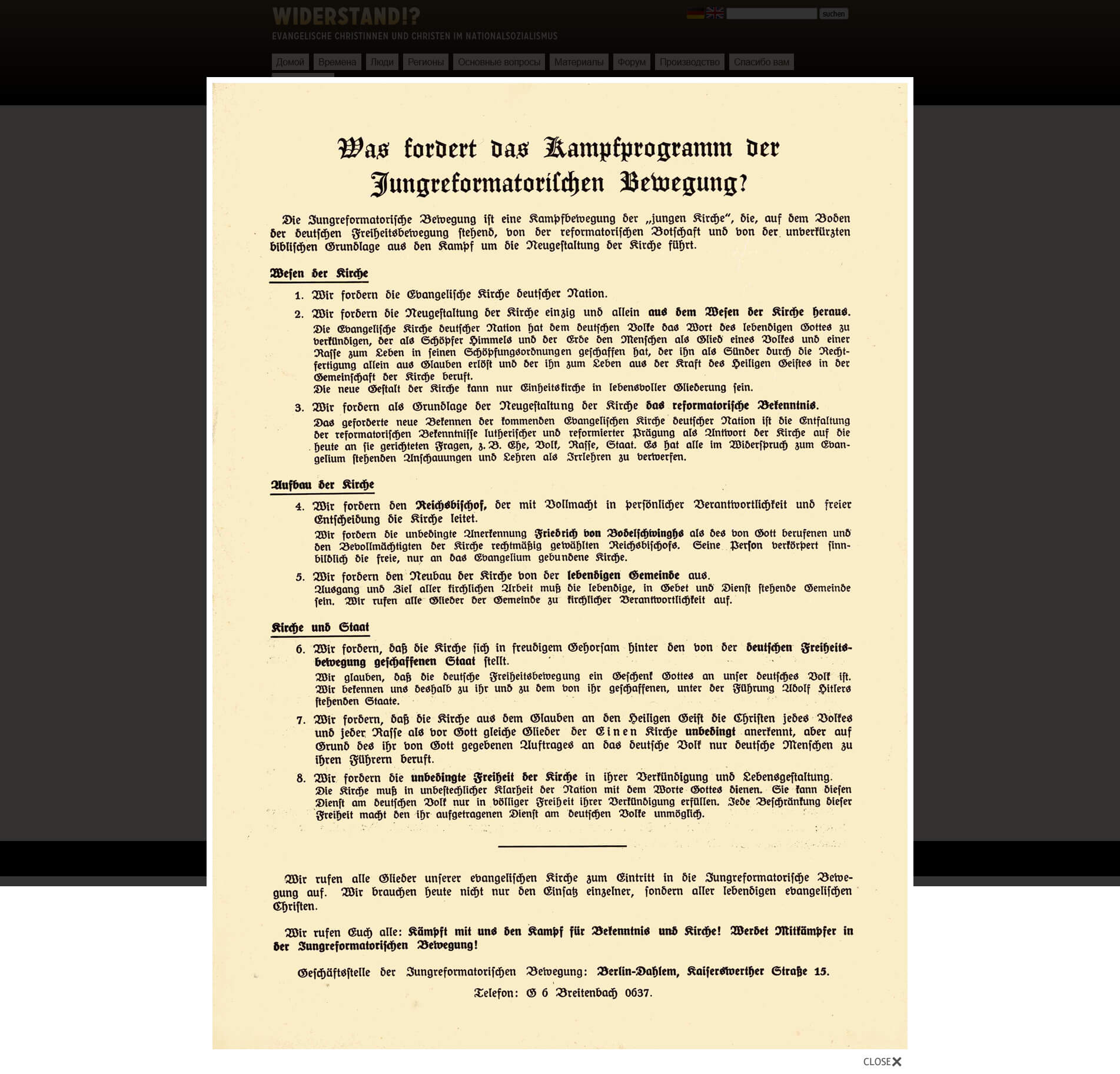 The policy statement dated May 9, 1933, combined two things commonly considered irreconcilable:
“We demand that all future decisions be based solely on the church essence.
We demand that the church fulfills its God-given mission in complete freedom from all political influence. […]
Based on our belief in the Holy Spirit, we fundamentally reject the exclusion of non-Aryans from the church.” ³⁷
Yet, in that same document, as summarized in the same reference literature, the movement “said ‘yes’ to the new German state” and saw the church in “inseparable service to the German people.” ³⁷
The refusal to apply a racial criterion inside the church and endorsement of the government applying that very same criterion outside it appeared in one and the same document. The phrase “the boundary runs along the church fence,” which we deduce from Hutten’s conduct, was thus formulated by the participants themselves in May 1933.
At the time, a sharper phrase was in common use: a “joyful ‘yes’ to the new state,” but we didn’t find it in the text of the appeal.
Archival Papers Bearing Both Names
The document from the Stuttgart Church Land Archive is mentioned in a single line in the first part, and there is one inaccuracy in that line that needs to be corrected.
Its archival signature is D 33, No. 140, the personal papers of Pastor Heinrich Fausel (1900–1967), titled “Jungreformatorische Bewegung: Tätigkeit als Vertrauensmann in Württemberg” (“Young Reformation Movement: Activity as Representative in Württemberg”). The file is dated May to December 1933, measures one and a half centimeters thick, contains 142 digitized folios under a CC0 license, and the entry is accessible via the Archives Portal Germany and the German Digital Library, meaning anyone can verify it. ³⁸
The abstract lists the following contents: collaboration with the movement’s Reich leadership, Fausel’s notes on meetings in Plochingen and Berlin-Dahlem in late May and July 1933, announcements, memoranda, and leaflets, as well as letters whose list of correspondents includes, among others, Kurt Hutten and Walter Künneth, alongside Theodor Dipper, Wilhelm Gohl, Ernst Lachenmann, Wolfgang Metzger, Richbert Rieber, Paul Schempp, Ernst Steinbach, Karl Wöhringer, Heinz-Dietrich Wendland, and Bishop Theophil Wurm.³⁸
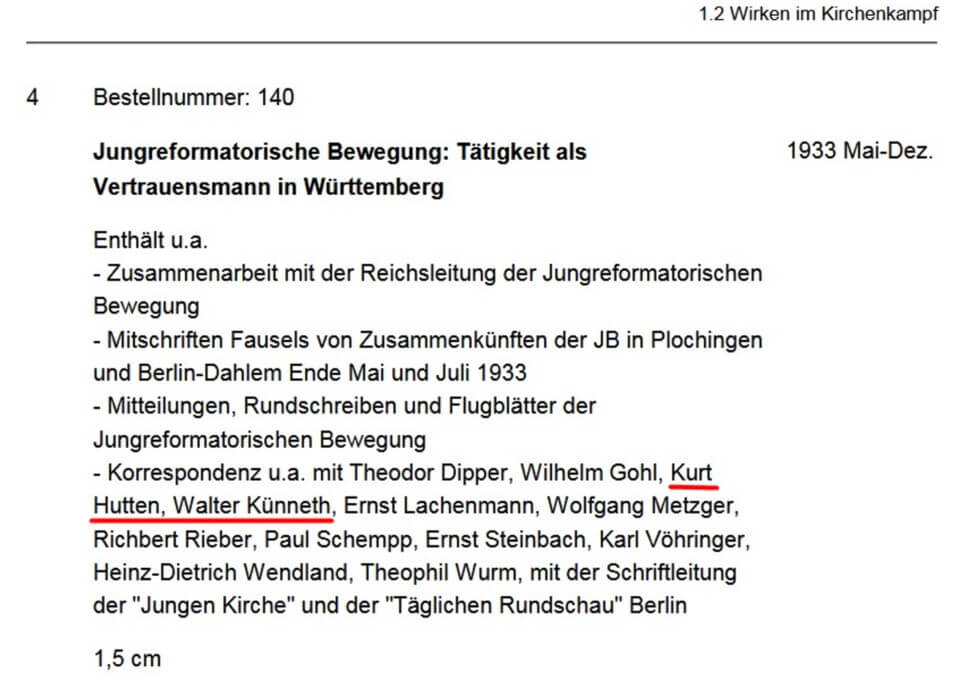
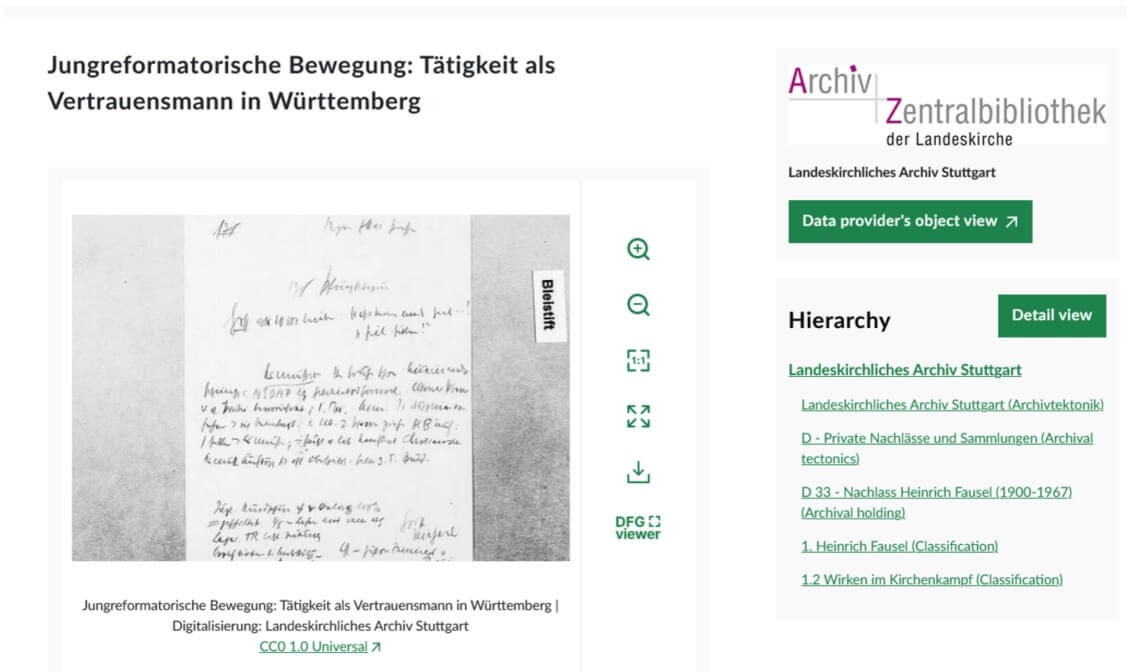
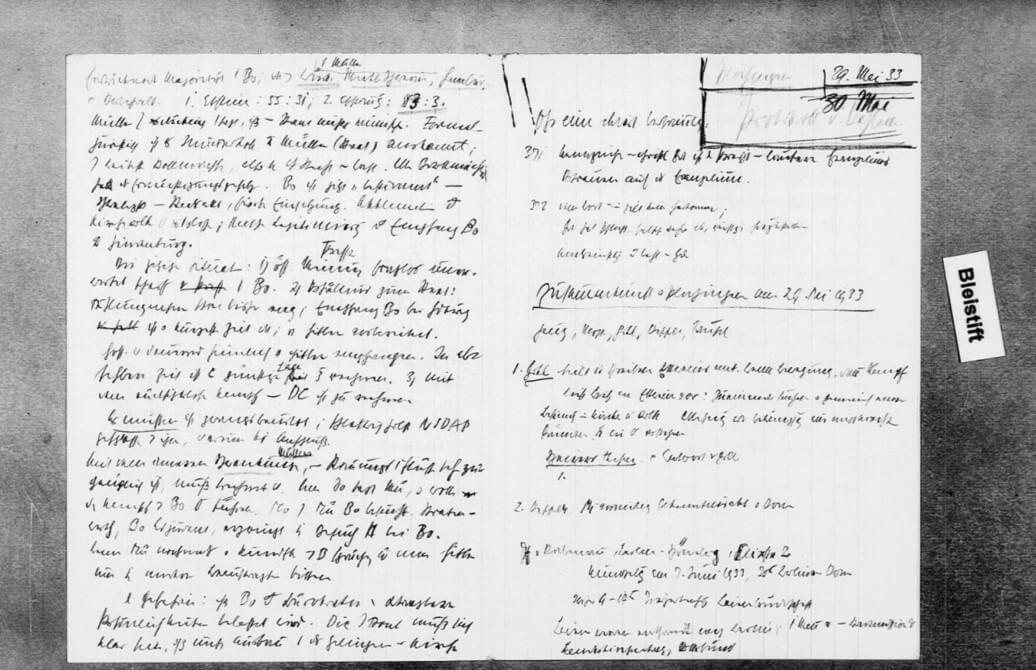
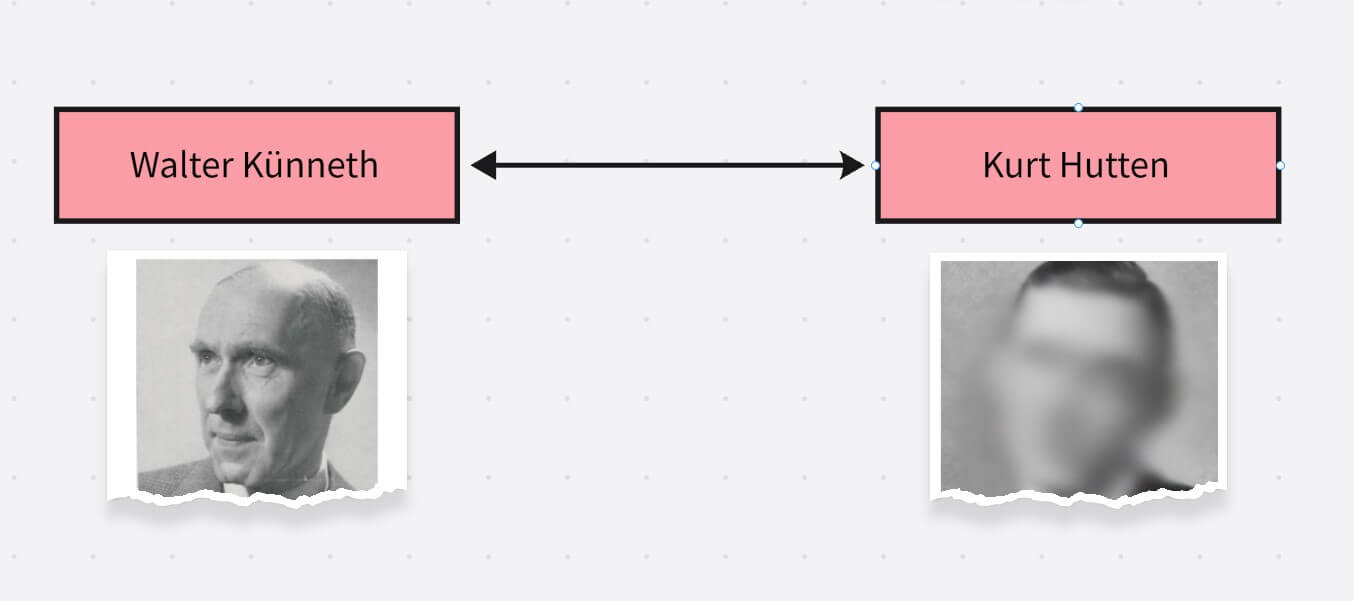
The “representative for Württemberg” was Fausel himself; this is his personal collection. The file establishes the following: the papers preserved from May to December 1933 contain correspondence conducted within a single movement. This means that the connection between Künneth and Hutten has gained a second anchor: a shared church-political structure in the spring and summer of 1933, documented by the regional church archives.
We haven’t read the 142 digitized pages of this file. Direct correspondence between Hutten and Künneth may well be discovered among them, a task that Part 2 leaves open.
Chapter 3. Walter Künneth and the “Jewish Problem”
It’s important to remember that in 1937 Kurt Hutten was merely a staff writer and lecturer for the Apologetic Center, while Walter Künneth remained the real boss. The chief had formulated his position on the “Jewish problem” as early as 1933 in far greater detail, with a more programmatic scope, and carrying a far higher degree of responsibility. After all, Künneth spoke not as a private columnist, but on behalf of the entire Apologetic Center.
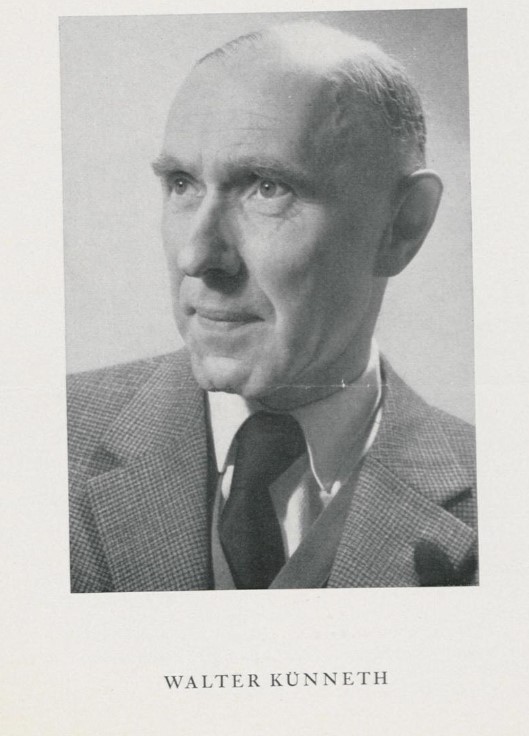
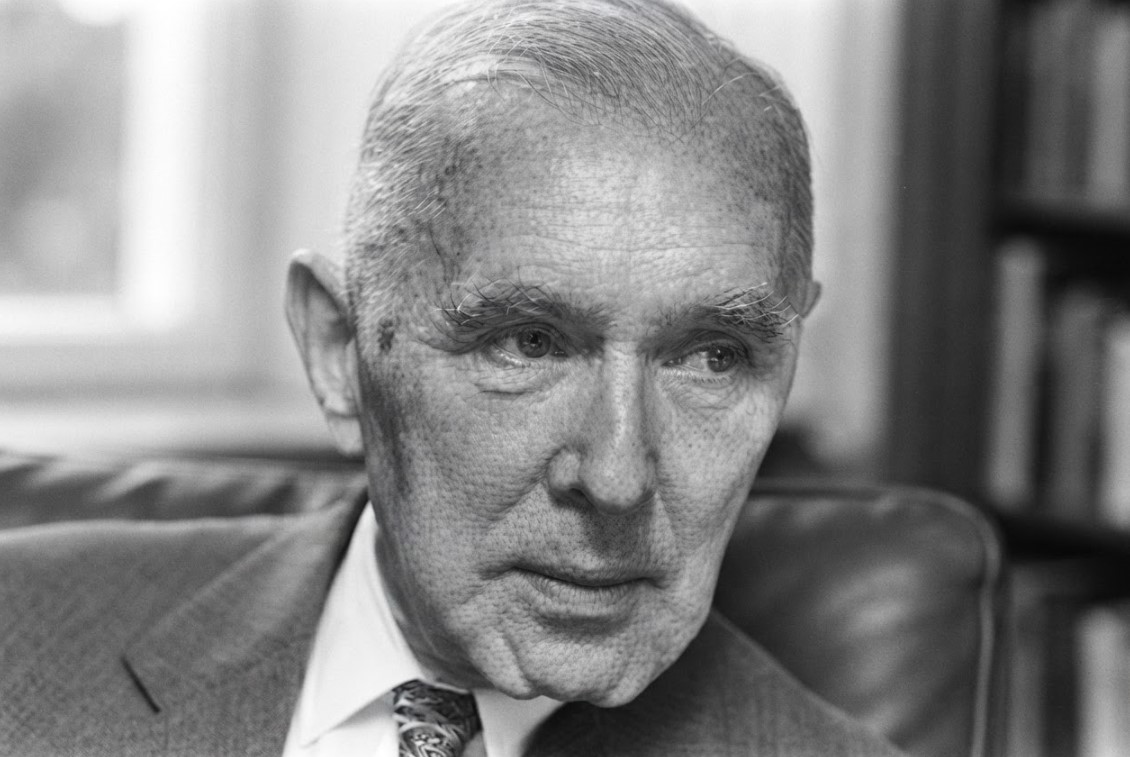
As noted earlier, Künneth was Hutten’s contemporary; both were born in 1901 just two months apart, yet one lived 78 years while the other lived 96, meaning the latter had nearly 20 more years to explain what he had written. Neither of them used that time.
The difference in their status is crucial for everything that follows, and it is worth visualizing clearly. In the 1930s, Hutten was a managing director, an editor, a contributing writer, and a figure known within his own region, but virtually unknown beyond it. Künneth, meanwhile, was the director of the Berlin institution, editor of its book series, co-editor of its programmatic anthology, and one of three spokesmen for a nationwide church movement. The statements of the former were merely the opinion of an employee, whereas the statements of the latter represented the position of the organization. The difference is roughly the same as that between an ordinary doctor’s personal letter and a hospital order.
April 1931: Where, From the Standpoint of the Gospel, One Can Say “Yes” to National Socialism
Two years before the Nazis came to power, Walter Künneth delivered a lecture evaluating National Socialism. A facsimile is preserved in the archives of the Evangelische Arbeitsgemeinschaft für Kirchliche Zeitgeschichte (Evangelical Working Group for Contemporary Church History) in Munich under call number KK 13.7420 and has been digitized, accessible to anyone.⁴¹
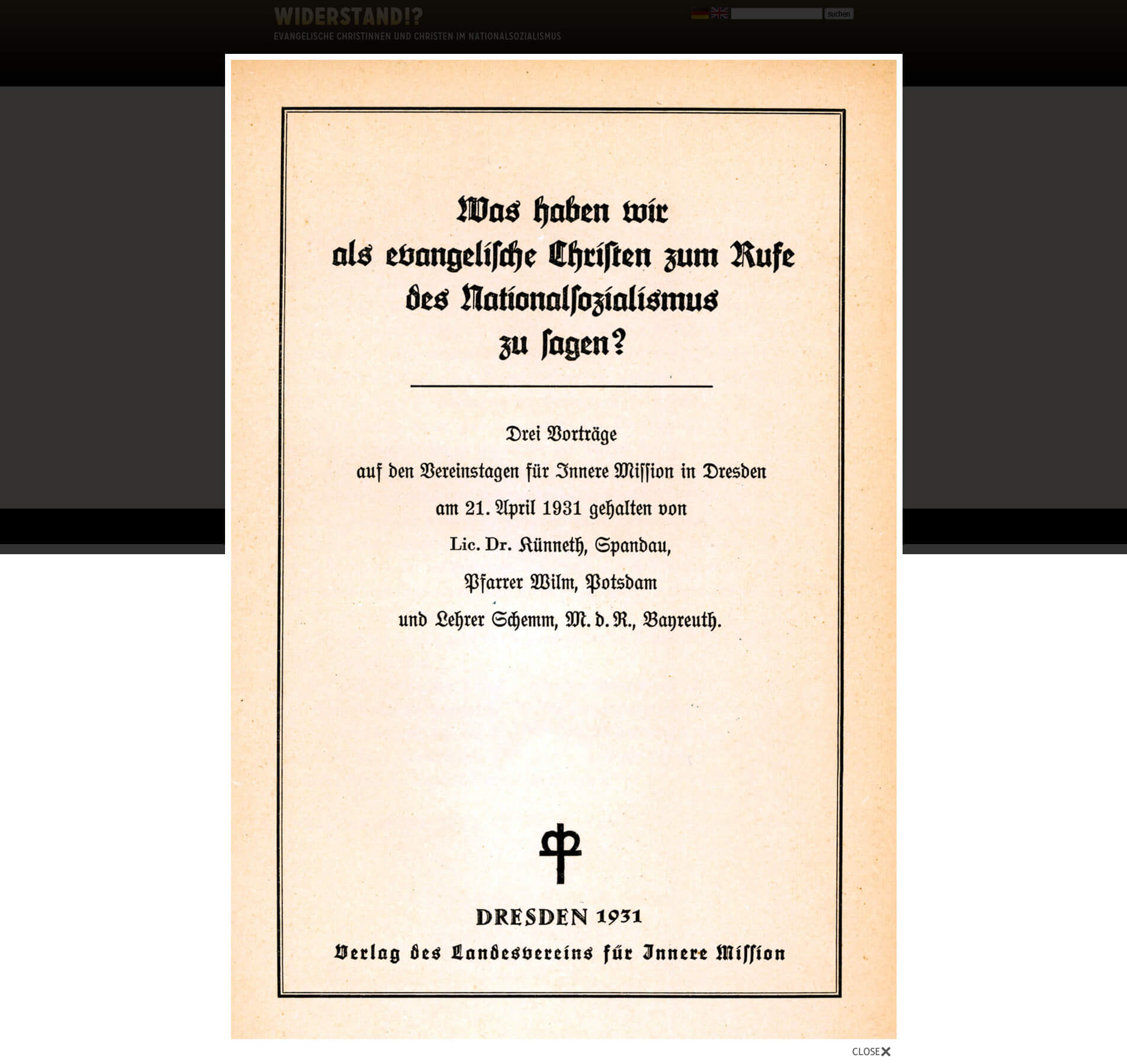
The report’s arguments proceed point by point, like an inventory of property. The movement’s nationalism, its social goals, and its “claims to have Christian roots” are deemed acceptable, while “biological racism” (biologistischer Rassismus) and the political practices of the Nazi movement are rejected.
We are essentially looking at an inventory audit. Please note that exactly one point, albeit the most essential one, is rejected from the movement’s ideological core, moreover, the young theologian in 1931 rejected it outright and without reservation. However, two years later, this very point would reappear in his own text, albeit transformed: he names “race” and “ethnicity” as “orders of creation,” that is, things to which the church says “yes” on theological grounds.
1933: The Dual Principle
The article “The Jewish Problem and the Church” was published in the anthology “Die Nation vor Gott” (“The Nation Before God”), which Künneth edited alongside Helmuth Schreiner in 1933. It spans pages 90–105 in the first edition and pages 115–137 in the third edition of 1934.⁴⁸

The article opens with a premise that sets the tone for everything that follows:
“Our research must be guided by a dual principle: On the one hand, it involves forming theological judgments based on biblical revelation. We must ask what practical conclusions can be drawn from the Gospel itself regarding the resolution of the Jewish question in Germany. On the other hand, however, the church itself must develop an understanding of practical necessities of national policy.” ³⁹
Two guiding principles are placed side by side here as equals: biblical revelation and, nothing less than, “necessities of national policy.” Theology here does not judge politics, nor does it even separate itself from it; it simply occupies one of two pans of the scale, while the other pan is labeled national necessity.
In that same sentence sits a phrase destined eight years later to become an administrative term: Lösung der Judenfrage, the “Solution to the Jewish Question”. In 1933, it did not yet mean what it would come to mean later, and we will not attribute prescience to the author, but another point must be made: the very framing of the issue as something subject to a “solution” arrived in a church text not from theology, but from outside, along with the political vocabulary of the era.
The Verb “to Welcome”
The article then proceeds to what turns it from detached observation into active participation:
“From this position, we are just as safeguarded against a humanitarian sentimentality that is entirely incapable of taking the Jewish question seriously as a problem, as we are distant from a superficial anti-Semitic radicalism.”³⁹
The sentence is constructed as a golden mean, except that the extremes of this mean are rather strange. On one side stands compassion, dismissed as “humanitarian sentimentality.” On the other stands anti-Semitism, rejected not in substance, but for its poor execution, being, you see, “superficial.” Neither revulsion nor rejection — merely a demand for depth.
“In principle, the nation-state should not merely be granted the right to make the Jewish question a matter of political reorganization; rather, this reflection on the distinct identity of the German people should be welcomed by the church, in accordance with its affirmation of God’s order, as race and ethnicity must be understood.” ³⁹
“Through statutory protective measures, the German people are to be shielded from ‘alien infiltration.’” ³⁹
Let’s pause on the verb “zu begrüßen” — “to welcome.” One welcomes what one is glad to see, and a welcome is a gesture of friendly acceptance. Anticultism essentially does not step aside or keep silent; on the contrary, it endorses, and does so with theological justification, since race and ethnicity are declared here to be orders of creation, that is, something instituted by God.
In other words, the very “biologistic racism” (biologistischer Rassismus), which had been rejected in a report two years earlier, returned here in the guise of the doctrine of creation, and what is more, with full legitimacy. By 1935, when the Nuremberg Laws were issued and these “legislative protective measures” against “foreign infiltration” became a reality, Künneth’s written endorsement had preceded the actual laws by two full years. ²⁸ ³⁹
“Office of the Sword”
The passage, which we’ve only seen in part until now, can be read in its entirety as follows:
“…the Jewish influence has been so rampant for decades that the danger of it overgrowning German intellectual life and alienating the German public could no longer be denied […] The church knows that the state must exercise the office of the sword. This office entails harshness and severity. The church cannot and will not stand in the way of the state as it exercises this office. From this perspective, the new state legislation regarding Jews, Jewish Christians, and Jewish ‘mixed-bloods’ living in Germany must also fundamentally be evaluated.” ⁴⁰ ³⁶
It turns out that the theological doctrine of the two kingdoms rests here not on theology at all, but on a premise borrowed straight from anti-Semitic polemics: Jewish influence has “become rampant,” German intellectual life is being “overgrown.” The verbs here, notice, are horticultural and biological (überwuchern means “to become overgrown with weeds, choking the cultivated plant”), and these propositions have nothing to do with Scripture.
The second half is constructed in such a way that it’s almost impossible to fault as theology: the sword has been entrusted to the state, the word to the church, and the church does not encroach upon the realm of the sword. It is a classical framework tracing back to Luther, taught in any seminary.
However, applied in 1933 to a specific subject, it means exactly one thing: the government started purging people based on their ancestry, while the church, through its anticult organization, declared in advance — even before it all began — that it would not intervene, and would not intervene even on behalf of the baptized, the “Jewish Christians,” that is, its own parishioners, who in those very months were losing their jobs, positions, and parishes. ²⁶ Theology functions here much like an alibi, and it works perfectly, because the alibi was presented in advance, not after the fact.
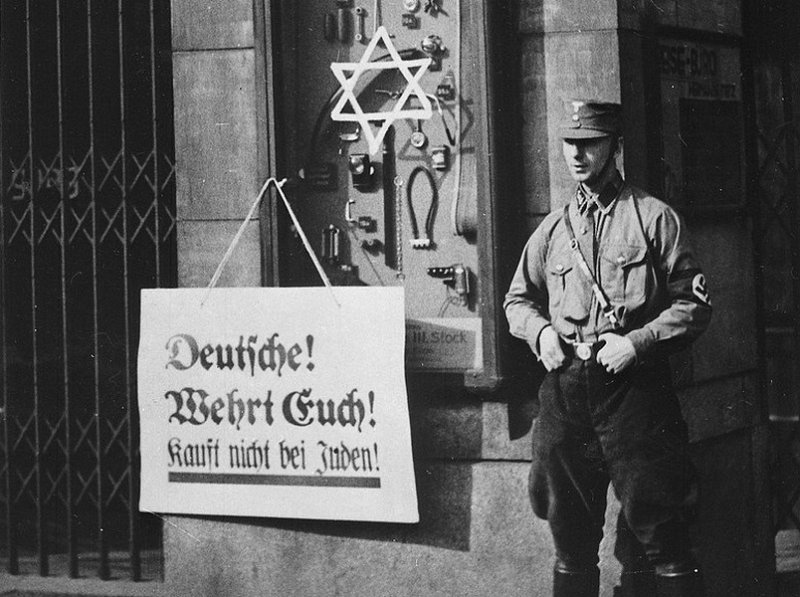
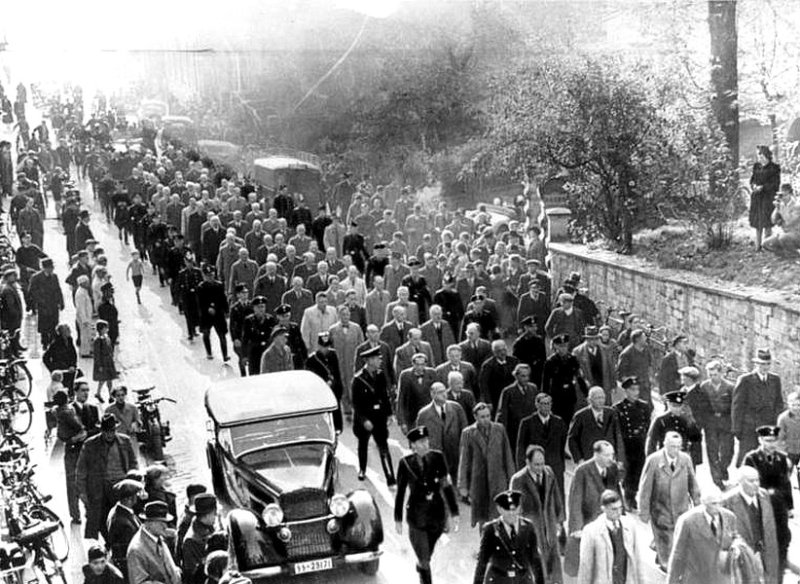
The third term in the list deserves separate mention. “Jewish mixed-bloods” (jüdische Mischlinge) is neither a theological nor an ecclesiastical category, but a classification unit of racial law, which two years later would be codified in the implementing decrees of the Nuremberg Laws. ²⁸ Again, in 1933 it already appeared in an anticult text, moreover, as something self-evident, as though referring to a routine line on an administrative form.
“Shutdown” and the Reich Chancellor’s Will
What, then, remains for the church to do in such a case if it welcomes the measure itself and has no intention of intervening? The article provides the answer:
“The church must therefore, with all its authority and for the sake of the internal and external dignity of the nation, see to it that the shutdown of Jewish influence in national life takes place in a manner that does not contradict the Christian ethos to which the state has repeatedly said a joyful ‘yes.’ In this conviction, it knows itself to be at one with the will of the Reich Chancellor who made it clearly understood that a proud victor is free from feelings of hatred and instincts of vengeance.” ³⁹
Notice that the concern of this anticult “theologian” is not living human beings at all, but merely the technical method of elimination. Künneth accepts the “shutdown of Jewish influence” itself as an unquestioned fact. All that is left to discuss is the manner of execution, while the primary criterion is not saving fellow citizens, but the “internal and external dignity of the nation,” which is to say, the Nazi regime’s image abroad.
The German term Ausschaltung means “shutdown,” “disconnection,” or “elimination.” Typically, one “shuts down” an electric current, a machine, or a radio device. The word carries no connotation of vulgarity or rage; it is distinctly technical in nature. And therein lies its main manipulative power: repression is presented as a purely routine technical operation, where there are neither human victims nor executioners, but only a planned outcome. Four years later, Huttner would introduce the next step on the same terminological ladder: Entfernung — “removal.” ⁶
Yet, what is most striking is the final chord. The church institution’s policy document cites Adolf Hitler’s will as the highest moral standard and declares itself united with the Führer. Hitler is portrayed not merely as a politician, but as the supreme guardian of Christian morality.
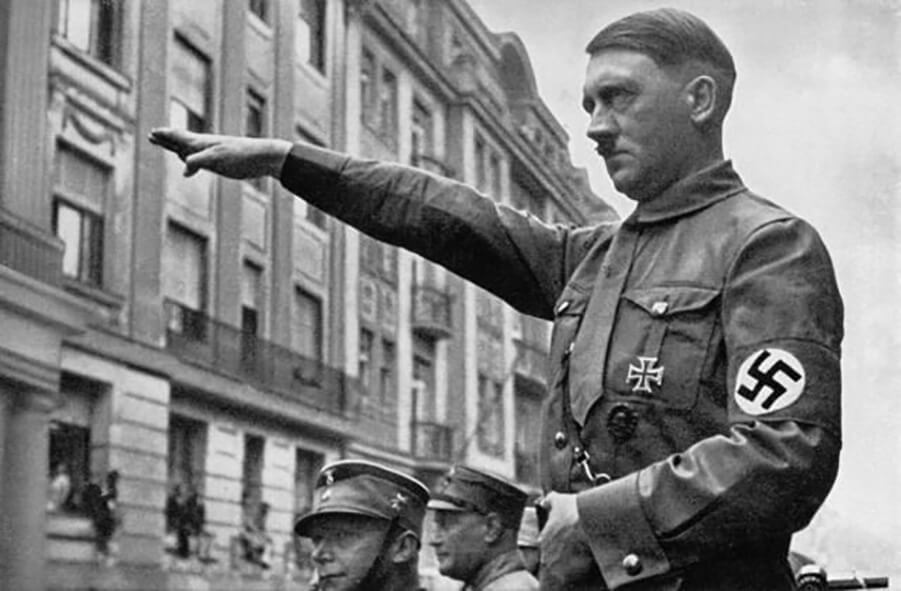
An independent source confirms that the “shutdown” wasn’t merely a matter on paper. Rudolf Ladwig, who wrote the history of the organization for the International Union of Non-Denominationalists and Atheists, reports:
“Immediately following Hitler’s seizure of power, the staff of the Apologetic Center readily provided the Reich Ministry of the Interior, the Ministry of Propaganda, and the Secret State Police with materials regarding the political stance of various religious communities.” ²
Caveat Regarding the Baptized, Framed in Racial Terms
“The standard of race… simply cannot be decisive for ecclesial communion…”; “It would be a sign of a superficial view of history… to fundamentally deny the missionary… effectiveness of racially alien servants of the church.”” ⁴⁰ ³⁹
In May 1933, this quotation was incorporated into the appeal of the Jungreformatorische Bewegung (Young Reformation Movement) where Künneth was one of three spokesmen.³⁷ Baptized clergy were labeled “racially alien servants of the church,” meaning that racial criteria were not disputed, only their application within the confines of the church walls.
Therein lies the crux of the entire ecclesiastical stance of 1933. The dispute wasn’t directed against Nazi racism as such, but merely concerned the limits of its application. Outside the churchyard fence, the Nazi racial criterion was unconditionally acknowledged, welcomed, and even granted theological justification.
1934: “A Foreign Body”
A year later, the same phrasing returned in a church theological opinion, the original of which is preserved in the Regional Church Archives in Stuttgart, Old Registry, 116a IV, and published by Röhm and Thierfelder in the first volume of “Juden, Christen, Deutsche” (“Jews, Christians, Germans”), pages 369–371 ⁴²:
“The church must see to it that the shutdown of the Jews as a foreign body in national life does not take place in a manner that contradicts the Christian ethos.” ⁴²
Compared to 1933, the change is minor and for that very reason especially telling: back then, what was to be shut down was “Jewish influence,” whereas now it was “the Jews as a foreign body.” Fremdkörper is a medical term designating an object that has entered the organism from the outside and must be extracted, preferably as quickly and completely as possible.
1935: Anti-Rosenberg Book With an Anti-Semitic Wording
In 1935, Künneth published the book “Antwort auf den Mythus” (“Response to the Myth”), ostensibly a rebuttal to Alfred Rosenberg, the Nazi Party’s chief ideologue and author of “The Myth of the Twentieth Century.” The book sold 36,000 copies in three months,⁴⁰ and it forms the primary basis of Künneth’s reputation as a church opponent of the regime.
Incidentally, on page 67 of this book, one finds phrases such as: “rootless asphalt Jewry of the present day”“decadent world Jewry,” while Jewry itself is characterized as “minderwertig” (inferior) and “zersetzend” (corrosive).⁴³ Furthermore, according to a documentary compendium on Protestant resistance, in Künneth’s view, Rosenberg made entirely accurate observations regarding the “durchaus richtige Feststellungen” (corrosive influence of decadent world Jewry).⁴⁴
The polemic against the ideologue of racial doctrine was thus conducted from within his own framework: it disputed the religious aspect of the teaching, not its anti-Semitic premise, and on one key point the author explicitly agreed with his opponent. Crucially, this was noted by contemporaries, not just by later generations. On July 28, 1935, Elisabeth Schmitz, author of the famous memorandum on the situation of the Jews, wrote a letter to Walter Künneth quoting his own book back to him:
“You speak of our contemporary German Jewry in no other terms than today’s popular slogans of ‘decadent world Jewry’ and ‘asphalt Jewry’ and the like, and you actually manage to assert that post-Christian Jewry ultimately seeks only itself, exploits the nations, and becomes the ‘germ carrier poisoning the nations’…” ⁴⁴
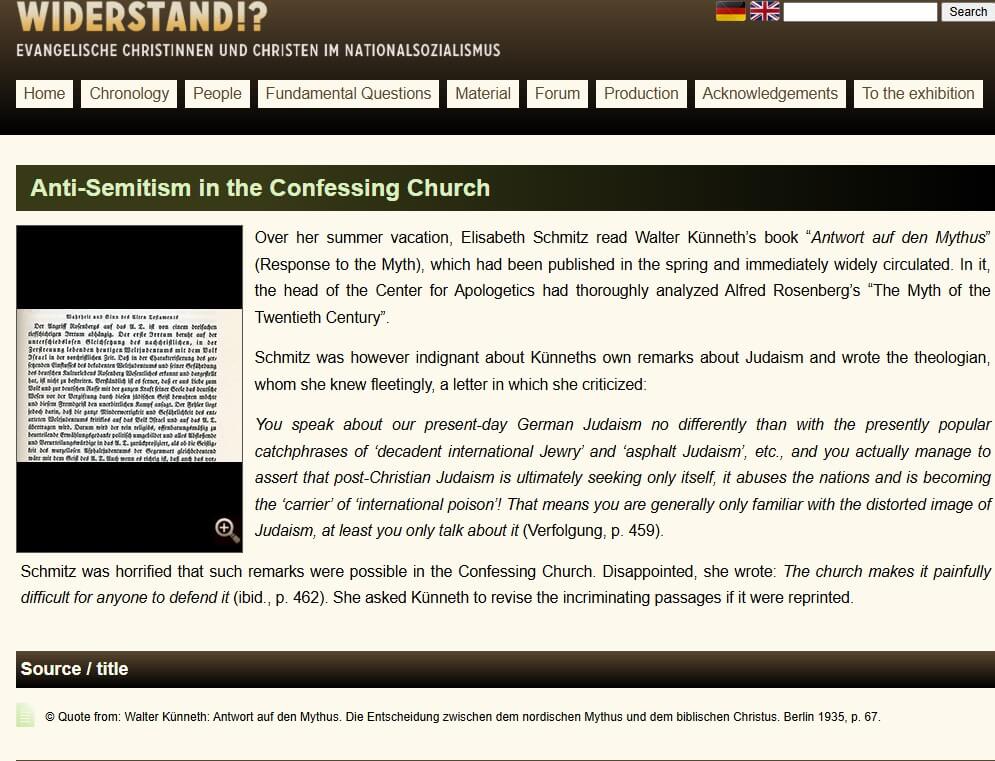
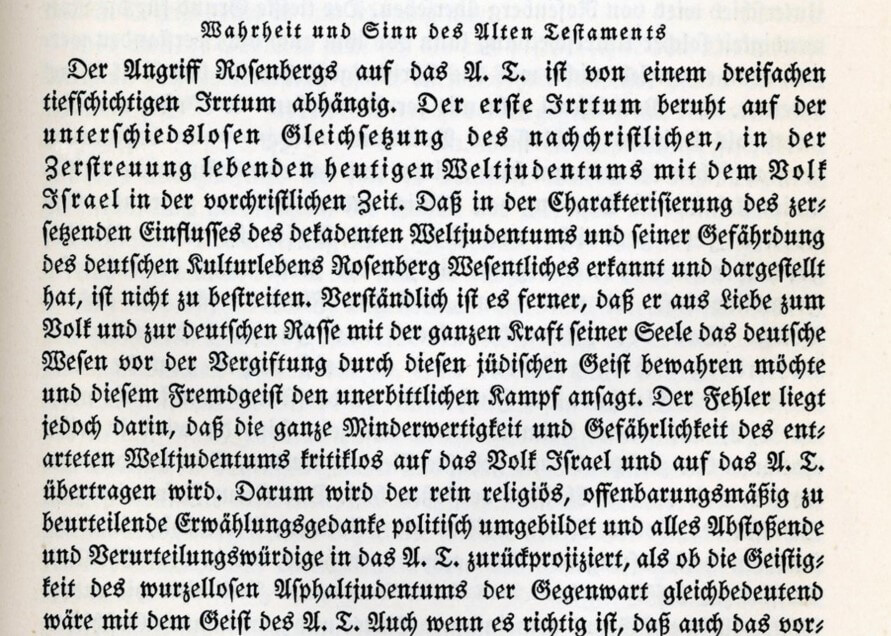
The letter draft is preserved in the personal papers of Elisabeth Schmitz and has been published, meaning this testimony is substantiated by two independent sources.⁴⁴
It is more valuable than any later analysis because it was contemporaneous with the event and written in 1935, rather than in the 1990s when hindsight makes judgment easy. It came from a person whose moral standing is beyond question: Schmitz was one of the few who attempted to compel the church to speak out publicly on the fate of Jews. Moreover, it was addressed directly to Künneth, delivered into his hands, and quoting his own book.
English-language scholarship documents the same stigmatizing concepts; as Matthew Hockenos recounts, citing the work of Ruth Zerner, Künneth described the Jews as a “cursed people” and “carriers of disease,” and endorsed the “shutdown of Jewish influence.”⁴⁵
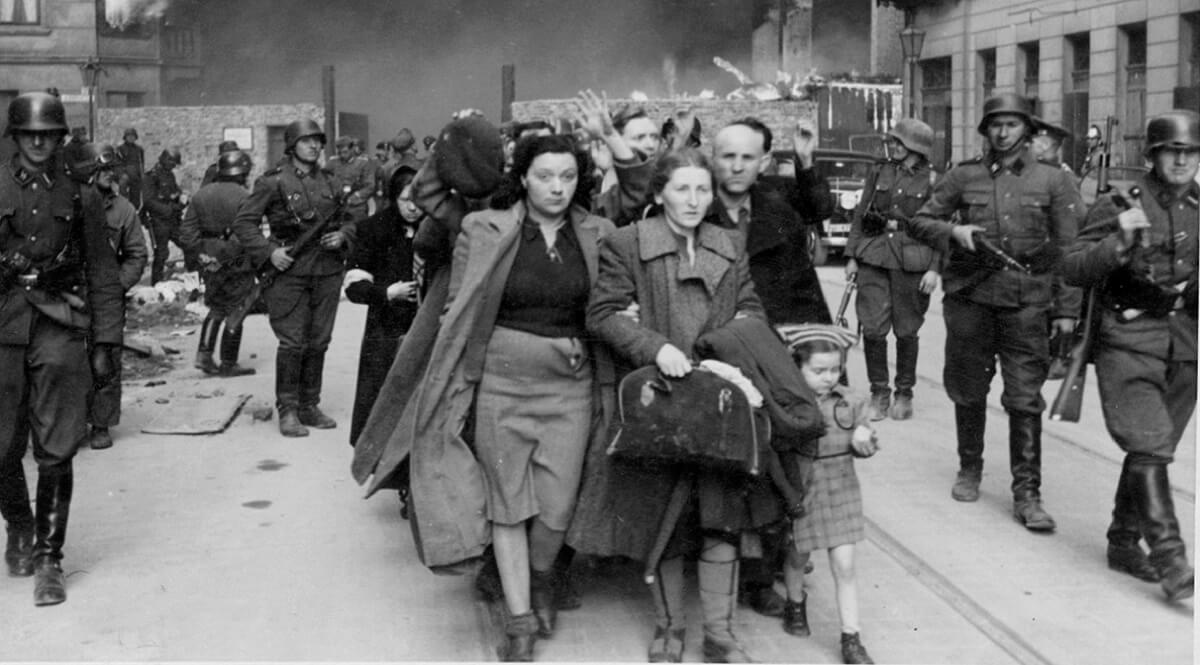
1946: Rosenberg
There is another dark chapter in the history of Walter Künneth, an exhaustive explanation for which we will, in all likelihood, never find. Lutheran church historian Jochen Eber, in his article “WALTER KÜNNETH AT 90: A TRIBUTE,” cited the following lines:
“At the Nuremberg war crimes trial in 1946, Rosenberg called Künneth as a witness for the defense, since he would not have called for the death penalty. Künneth, however, did not appear as a witness, since he would have had to incriminate him.” 64
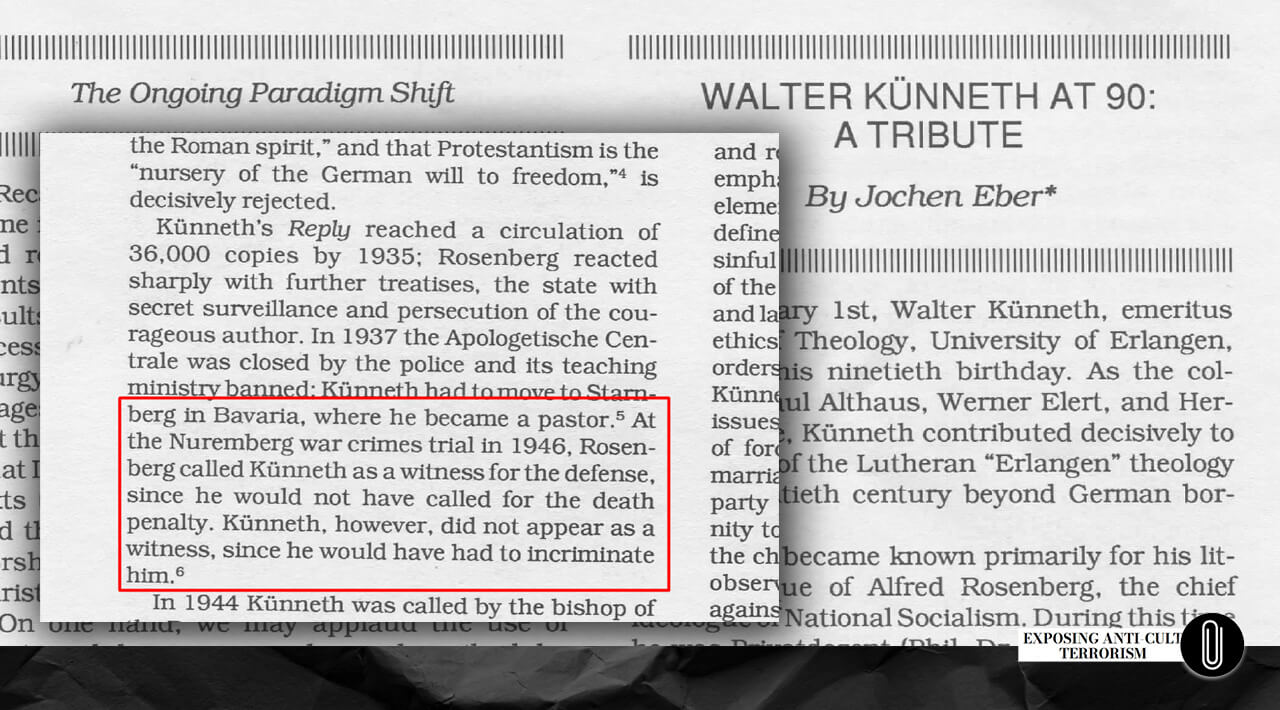
Eber’s conclusions and interpretation certainly remain merely his own subjective view, yet the question is left hanging in the air: Why did Alfred Rosenberg — the Nazi ideologue, head of the NSDAP Office of Foreign Affairs and one of the principal architects of racial theory — when seated in the dock before the International Military Tribunal and staring into the face of an inevitable noose (he was subsequently sentenced to death by hanging), think specifically of Walter Künneth and attempt to rely on him as a witness for his defense?
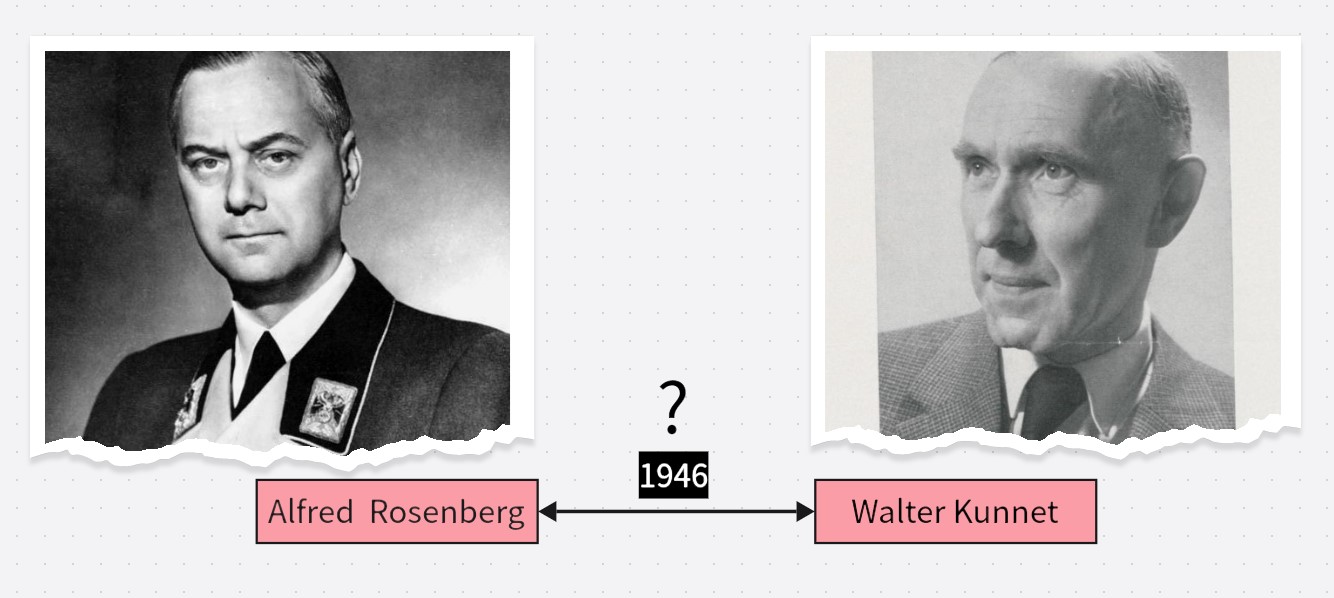
How This Is Assessed by Descendants
The successor anticult organization, the Evangelische Zentralstelle für Weltanschauungsfragen (EZW; Protestant Central Agency for Worldview Issues), addresses this period cautiously, yet unequivocally. Matthias Pöhlmann described the “exchange of materials” with the Gestapo as belonging “to the darkest chapters of Protestant apologetics,” while the EZW’s official jubilee history refers to the Künneth era as a “dark spot” in the institution’s past.⁴⁷
Horst Junginger calls Künneth’s statements “decidedly anti-Semitic” and cites his classification of Jewry, liberalism, and Bolshevism as the “three great demonries of the time.” ⁶ The phrasing “three demonries,” to be precise, comes from Junginger’s account citing Wolfgang Maser.
The primary body of analysis remains Maser’s monograph “Theologische Ethik und politische Identität: Das Beispiel des Theologen Walter Künneth” (“Theological Ethics and Political Identity: The Case of the Theologian Walter Künneth”), Bochum, 1990, where pages 173–201 are devoted to Künneth’s anti-Semitism. ³⁴
The anti-Semitic phrases of “Antwort auf den Mythus” is independently documented by Ernst Klee in the book “Persilscheine und falsche Pässe” (“Denazification Certificates and False Passports”),⁴³ while the 1935 contemporary record belongs, as we have seen, to Elisabeth Schmitz. ⁴⁴
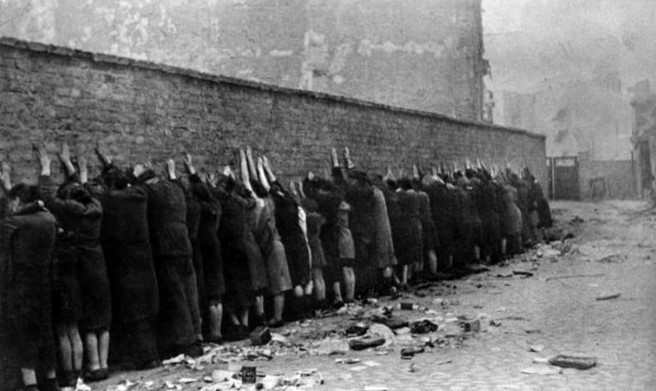
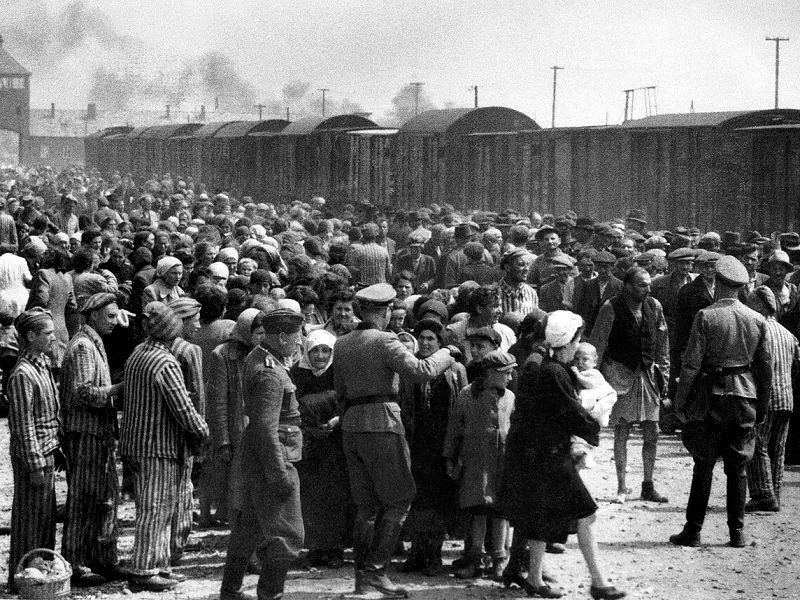
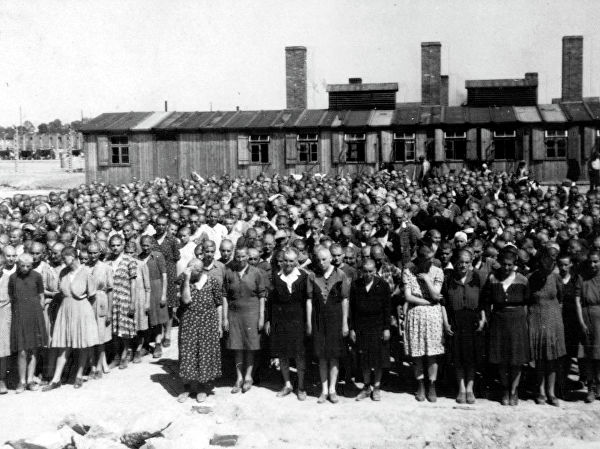
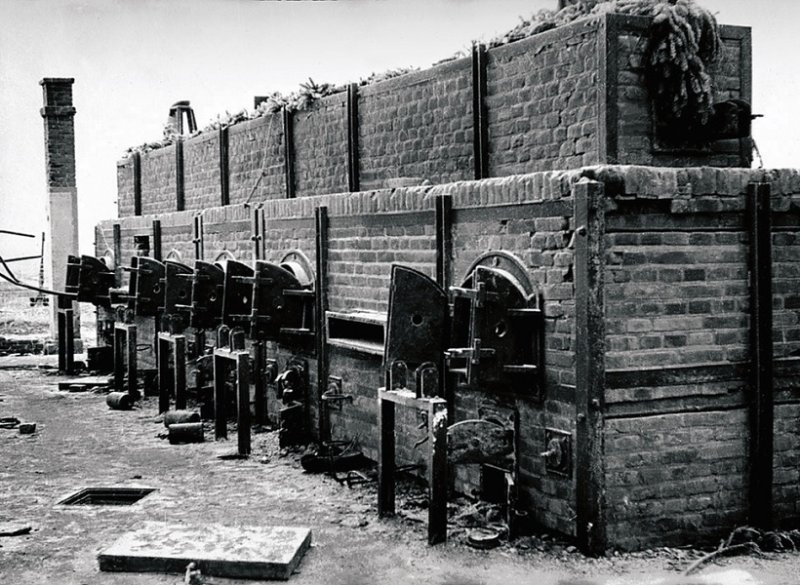
What these statements ultimately meant for the Jewish nation, the world remembers all too well.
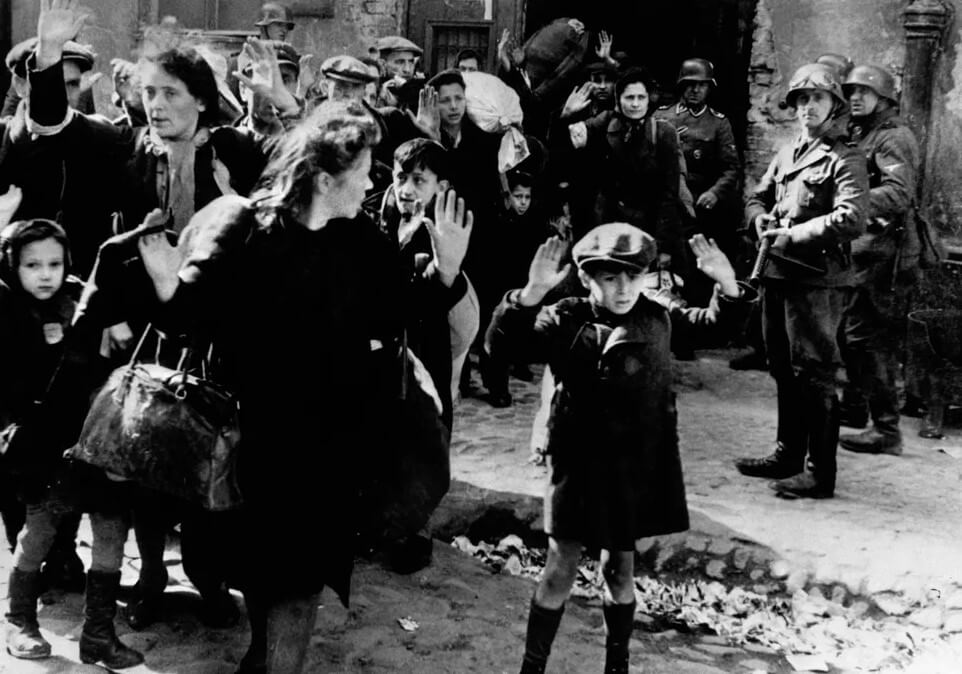
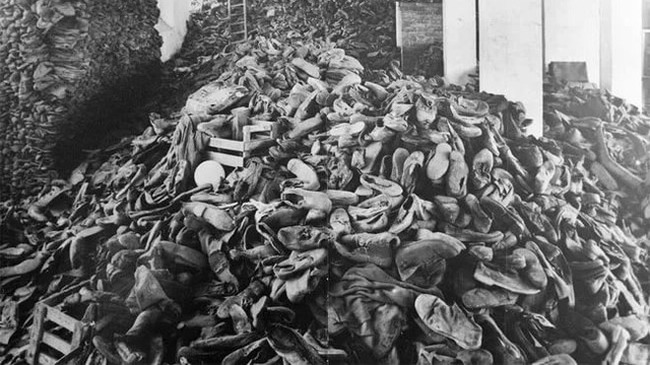
Chapter 4. Jesus Christ or German Faith?
Let’s return to Kurt Hutten and examine his publications from those years.
“Christus oder Deutschglaube?” (“Christ or German Faith?”), 1935. Formally, this was a polemic against the “German Faith” movements, that is, the very circle to which the author’s doctoral advisor belonged. In reality, the book made concessions that did not exist in 1932: Hutten now included ethnicity (volkstum) among God-given orders, described racial intermixing as a disregard for creation, and wrote that “only the Nordic race created great works of culture.”¹ He drew the line only where the racial worldview laid claim to serving as a “religious source of meaning,” that is, he challenged not racial theory itself, but its ambition to become a religion.
In that same book appears a sentence that can hardly be read as anything other than a declaration of loyalty:
“From this fundamental stance, we are obliged and gladly prepared to stand with all our might for the great work of renewal [undertaken] by the Führer and NSDAP.” ¹
“Ein neues Evangelium?” (“A New Gospel?”), 1936. A “racial-spiritual” interpretation of the Bible is rejected as destructive to its essence, yet political aspirations of the national movement are fully endorsed, all under the formula: “The church should not get involved in politics.” Note that this rule works exclusively one way: it prohibits the church from criticizing the government, but does not in any way prevent it from praising the latter. A convenient arrangement, to say the least.
“National Religion und biblische Wahrheit” (“National Religion and Biblical Truth”), 1937, and “Brauchen wir Christus noch?” (“Do We Still Need Christ?”), 1938. That’s where the tone changes: the “German Faith” is no longer termed mere paganism, but anti-Christianity; positive evaluations of current policy disappear; and Hub candidly leaves open the question of whether this was an inner evolution or simply a reaction to tightened censorship. ¹
The answer to that question is provided by a document published squarely between these two books.
The Jewish Question (1937)
We have already cited its bibliographic address: Kurt Hutten, “Die Judenfrage,” in “Calwer Kirchenlexikon”, Vol. 1, 1937, pp. 980–986. ¹⁰
Junginger provides its academic assessment, which we quote verbatim:
“The article on the ‘Jewish question’ published by Hutten in 1937 in the ‘Calwer Kirchenlexikon’ was marked by hostility toward Judaism so radical that it was unusual even for National Socialist publications.” ⁶
Here’s the article itself:
“The solution to the Jewish question is conceivable only in such a way that the appropriate conclusions are drawn from these racial realities: the revocation of political equality, the severance of Jews from the national community of blood and culture, their placement under alien law, and, if possible, the removal of the Jews from the host nation altogether. […] With swift work, the National Socialist revolution enacted several fundamental laws to solve the Jewish question.” ⁶ ¹
Let’s examine this transformation.
The caveat vanished. In 1932, he had written “A part of Jewry — by no means all!”¹; in 1937, there were no longer any parts, only “Jews” as an undifferentiated whole, and to this whole were prescribed removal and excision.
A racial argument appeared that had previously been rejected. Junginger points this out explicitly: “It is also striking that Hutten now resorted to an emphatically racist line of argument that he had previously rejected: Jews, he asserted, are members of an alien race and therefore ‘separated by barriers of natural law from the Aryan host nations.’” ⁶
Historical legitimation through the church appeared. “Beginning with the Council of Nicaea in the fourth century, Hutten depicted the church’s anti-Jewish measures as a unique success story in Christianity’s struggle against Judaism. To this, he specifically added Luther’s demand to burn down synagogues and Jewish schools and confiscate Jewish prayer books.”⁶ In other words, a 16-century-long chain of events has been constructed, and the current measures turned out to be just another link in that chain.
A theological justification for finality appeared. Hutten declared that the chosenness of the Jewish people had inverted from positive to negative: because of their refusal to acknowledge the Messiah, Jewry had “fallen out of God’s order of creation,”⁶ and from the order of creation, as one can easily deduce, there is no way back.
Analysis of the expression “Wirtsvolk” (“Host Nation”). In the German language, the word Wirt has two specific meanings: in everyday life, it means a host, landlord, or innkeeper; in biology, it denotes a host organism upon whose body an alien species parasitizes. Substitute either meaning, and the conclusion regarding the minority’s status is equally unequivocal. In this schema, Germans are declared the hosts, while Jews are either lodgers granted temporary shelter or parasites feeding at another’s expense. In both instances, the outcome is predetermined: a guest can always be shown the door, and a parasite is eradicated without sentimentality.
Which meaning the author intended becomes clear from the context. In Junginger’s quotation, Jews are separated from Germans by naturgesetzliche Schranken (“barriers of natural law”)⁶. A guest is separated from a host by culture or custom, whereas “laws of nature” divide only biological species. The sentence is crowned by the medical term Entfernung (“removal”) which surgeons apply to bodily tissues.
There is no theology in this text; what we have before us is the unadulterated vocabulary of a school textbook on zoology and parasitology, and it is signed by a doctor of theology in an academic church reference work. The primary danger of such language is that an outright demand to “expel the Jews” is a crude political opinion that can be debated. Meanwhile, the “removal of an alien element from the host organism” masquerades as an objective scientific fact, as a medical diagnosis. After all, a surgeon feels no personal hatred toward a cancerous tumor; he simply excises it for medical reasons. In Hutten’s article, there is not a single profanity or slur, and that is precisely why it is truly chilling.
Such biological metaphors have outlived their creators. Masquerading as “objective expert evaluation,” they survive to this day, voiced out loud in Russia by Alexander Dvorkin and his associates. Later in our investigation, we will encounter the very same verbal machinery in Russian source material, in terms such as “parasites,” “cancerous tumor,” “infiltration,” “cult penetration,” “sect-infected regions,” and “prevention of destructiveness.”
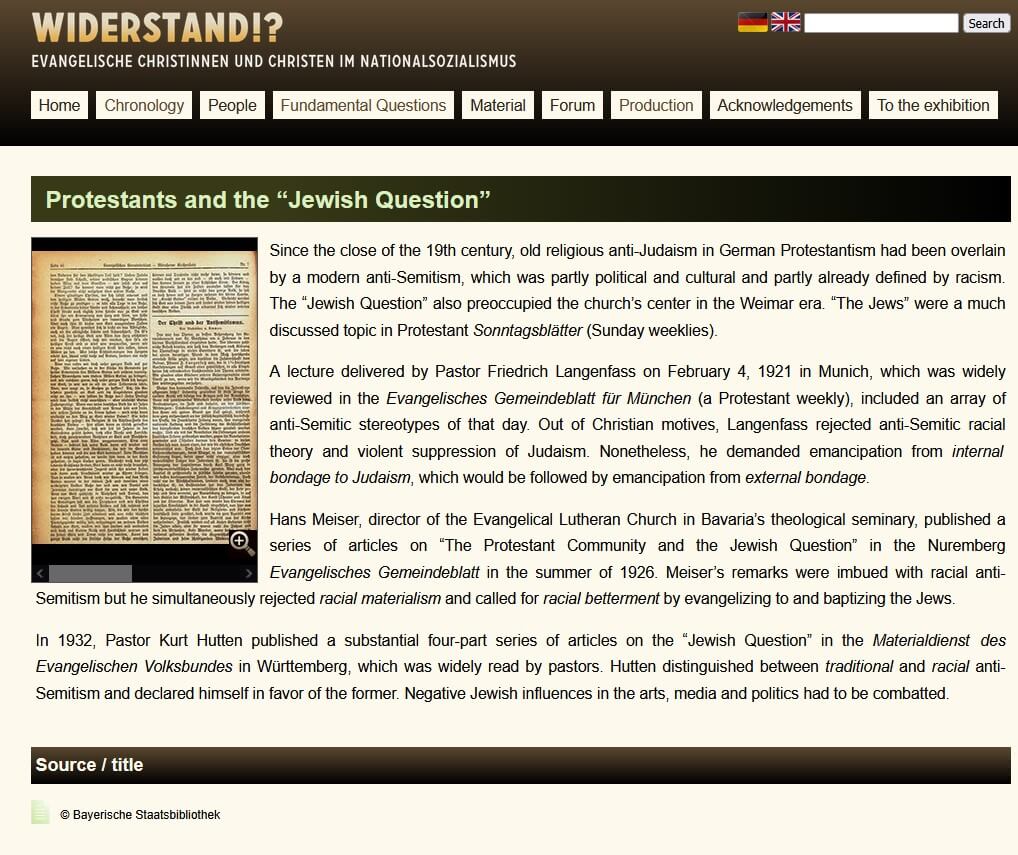
“Obedience to the Voice of Blood” Named the Supreme Law
Kurt Hutten’s anti-Semitic article was hardly an accidental slip of the pen. Historian Horst Junginger states bluntly:
“Most of the other 15 articles written by Hutten for the ‘Calwer Kirchenlexikon’ are blatantly pro-Nazi and in places riddled with distinctly anti-Semitic phrases.” ⁶
Fifteen publications cannot be written off as a one-time assignment. Moreover, he was writing not for a polemical newspaper, but for an academic two-volume reference lexicon. People consult such works looking for an authoritative point of view, as a lexicon codifies standards. Three of his articles must be highlighted; they utterly demolish the convenient legend that Hutten quietly reconsidered his views after 1937.
“Racial Doctrine, Racial Worldview, Race” (Calwer Kirchenlexikon, Vol. 2, pp. 652–655) / “Rassenlehre, rassische Weltanschauung, Rasse” (Vol. 2, pp. 652–655, citation p. 653; Junginger, note 21)
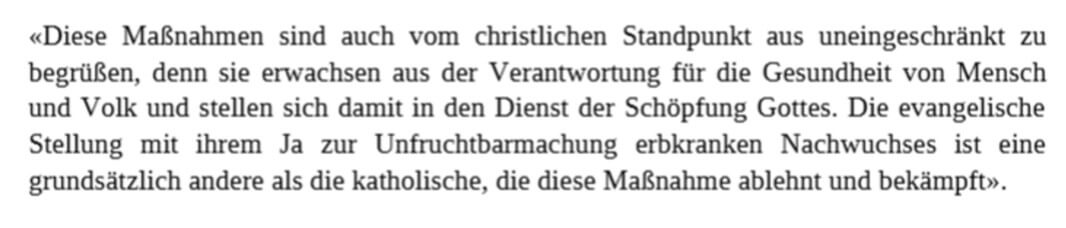
“These measures are to be unconditionally welcomed from a Christian standpoint as well, for they arise from responsibility for the health of the individual and the nation, and thereby place themselves at the service of God’s creation. The Protestant position, with its ‘yes’ to the sterilization of hereditarily diseased offspring, is fundamentally different from the Catholic position, which rejects this measure and opposes it.” ⁶
This referred to the Law for the Prevention of Hereditarily Diseased Offspring, which took effect on Jan. 1, 1934, providing for compulsory sterilization by decision of specialized “hereditary health courts.”²⁷ Historians estimate that approximately 400,000 people were subjected to this procedure. “To unconditionally welcome” appeared in a church publication and was framed, notably, as an interconfessional competition: the Protestant “yes” was contrasted with the Catholic “no” as a badge of superior virtue for one’s own denomination.
“Love of the Fatherland” (Vol. 2, p. 1242) / “Vaterlandsliebe” (Vol. 2, p. 1242; note 22)

“Free-floating cosmopolitanism, Marxist internationalism, the un-German ideologies of pacifism and global-mercantile capitalism are manifestations of degeneracy that a people must eradicate if it wishes to remain healthy.”⁶
The list here is precisely the same as in Künneth’s 1933 letter which listed freethinking, Marxism, and Bolshevism,⁵ only expanded to include pacifism and capitalism. The verb itself is notably intensified: not “overcome” or “reject,” but “eradicate” (ausmerzen), a term drawn from agriculture and animal breeding, where it denotes culling.
“National Socialism” (Calwer Kirchenlexikon, Vol. 2, Stuttgart 1942, pp. 317–321) / “Nationalsozialismus” (Vol. 2, Stuttgart 1942, pp. 317–321, quotation pp. 319f.; note 20)
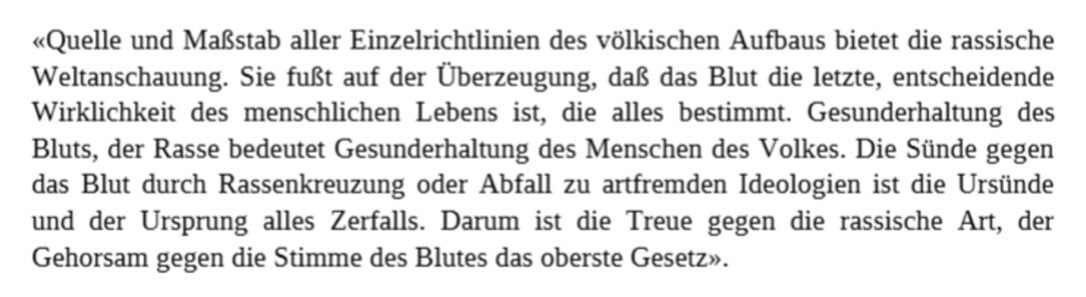
“The source and measure of all individual guiding principles of national reconstruction are provided by the racial worldview. It rests on the conviction that blood is the ultimate, decisive reality of human life, determining everything. […] A sin against the blood through racial mixing or defection to alien ideologies is the original sin and the source of all decay. Therefore, loyalty to racial lineage and obedience to the voice of blood is the supreme law.”⁶
From that same article, page 319, comes a second quotation in which both strands of this part converge:

“Strengthening of the national community through elimination of all class-struggle, party-political, and confessional sources of unrest; eradication of all Jewish, Bolshevik, Masonic, and Ultramontane influences.”
The exact same roster of enemies as in the article “Love of the Fatherland,” and the same verb ausrotten, only now Jewish, Bolshevik, Masonic, and Ultramontane influences are placed on the exact same footing. This list was drawn up according to one specific rule: anyone who is not “one of us” is targeted.
Now look at the date of this volume: not 1933, when, according to popular belief, “everyone made mistakes,” and not 1935, but 1942 (nineteen forty-two!). The very year when, on January 20, a conference was held at Wannsee to coordinate the technical implementation of the “Final Solution to the Jewish Question.”³¹

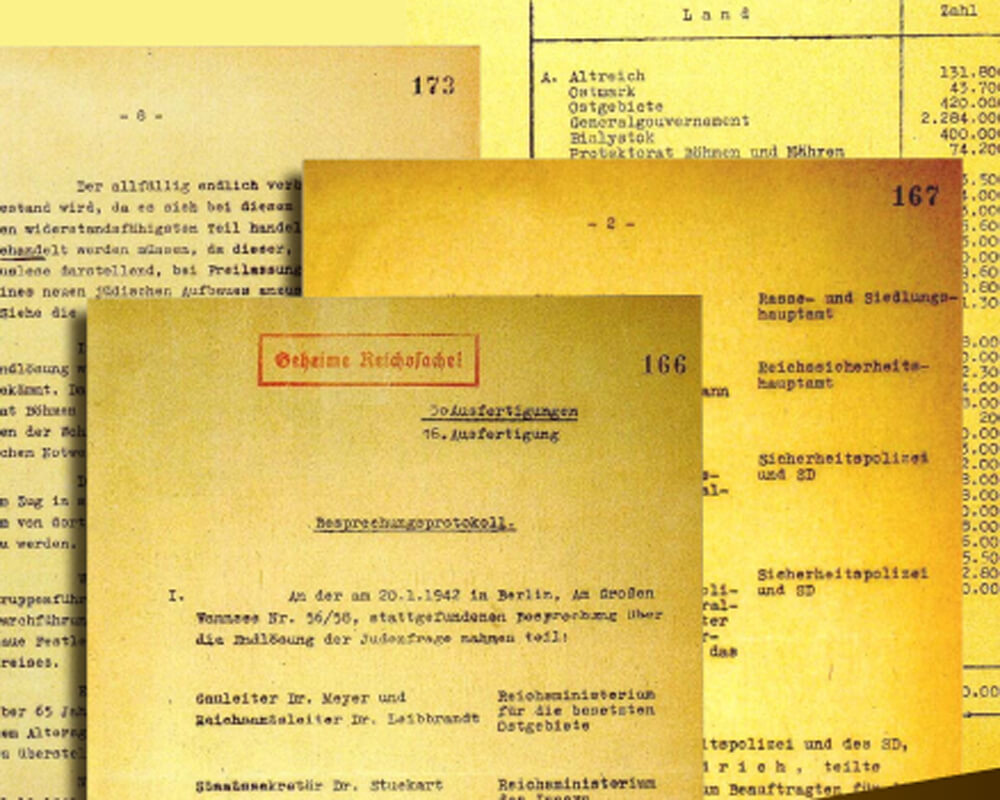
We do not claim that Hutten knew of the top-secret Wannsee Conference on the “Final Solution.” The minutes of that meeting didn’t come to light until 1947.
The issue is a different, far more obvious fact: by 1942, trainloads of deported Jews were departing German cities in broad daylight. Neighbors witnessed neighborhoods being cleared, church congregations whispered about the arrests, and a courageous few among the pastors openly spoke of this tragedy from the pulpit.
At that very moment, in 1942, an academic reference work published an article under Hutten’s name declaring “obedience to the voice of blood” to be the supreme law.
A single text from 1937 might still be excused as opportunism or an editorial assignment. But how does one explain 15 articles published over the course of five years, the last of which appeared in 1942?
The Talmud and Der Stürmer, September 1939
There is yet another document, this time editorial rather than authorial. An issue of “Materialdienst,” the bulletin of the Protestant Press Union of Württemberg, devoted to the Talmud, appeared in September or October 1939 and opened with a selection of quotations from “Der Stürmer,” Julius Streicher’s anti-Semitic tabloid, which even in Nazi Germany was considered the most extreme manifestation of the genre. The issue’s opening sentence read:
“First, a series of quotations from the Talmud must be presented, as they appear again and again in ‘Der Stürmer’.” ⁶
Bibliographic reference: Materialdienst, No. 17/18, September–October 1939, cols. 129–144, quotation in col. 129.⁶
Here too, the date is telling: September 1939 was the first month of the world war. A church bulletin edited by a doctor of philosophy opened its issue by citing Streicher’s tabloid, and did so nonchalantly, in the matter-of-fact tone of a news dispatch: “as they appear again and again.”
Director and Author: Two Ways of Saying the Same Things
Now let’s compare statements made by the director of the Apologetic Center, Walter Künneth, in 1933, and by a staff member of the center, Kurt Hutten, in 1937. Let us place one text by each side by side, as they are best understood together.
Künneth, 1933. The article “The Jewish Problem and the Church” in the volume “Die Nation vor Gott,” which he co-edited with Helmuth Schreiner. Three key phrases:
- “The church cannot and will not stand in the way of the state as it exercises this office”;
- “The shutdown of Jewish influence in national life” takes place “in a manner that does not contradict the Christian ethos”;
- “The political reorganization of the nation-state should be ‘welcomed’ by the church.” ³⁹ ⁴⁰
Hutten, 1937. Article “The Jewish Question” in the first volume of “Calwer Kirchenlexikon.” A single phrase:
- “The revocation of political equality, the severance of Jews from the national community of blood and culture, their placement under alien law, and, if possible, the removal of Jews from the host nation altogether.” ¹ ⁶
Walter Künneth cedes public space to the government, providing a theological justification for why the church must not interfere with the persecution of people outside the parish. Kurt Hutten, on the contrary, actively wades into this arena himself, articulating specific directives on exactly how the authorities and society ought to treat “aliens.”
Both texts are genuine historical records. Both were penned by key figures of the Apologetic Center — its director and its principal author. Yet, neither of these documents was ever openly acknowledged or examined within the church institution that declared itself their direct postwar successor. On April 1, 1960, this successor organization, the Protestant Central Agency for Worldview Issues (EZW), came to be headed by none other than Kurt Hutten himself. ¹²
Chapter 5. Denunciation From April 16, 1937
In the previous chapter, we examined Hutten’s views. Here, we will focus on his specific actions. It’s one thing to discuss racial theory in the pages of an academic dictionary, and it is quite another to publish in an official bulletin a consolidated list of religious communities marked with the triumphant notation “successfully eliminated” and attach to it dossiers on those whom the police have not yet gotten their hands on.
On April 16, 1937, “Materialdienst,” the bulletin of the Protestant Press Union of Württemberg, published a detailed article on “sectarianism,” listing religious communities “that had been successfully dissolved since the beginning of the Third Reich.”⁶ Junginger attributes this article to the editor himself, that is Hutten, though with a caveat: “in all probability written by the editor himself.”
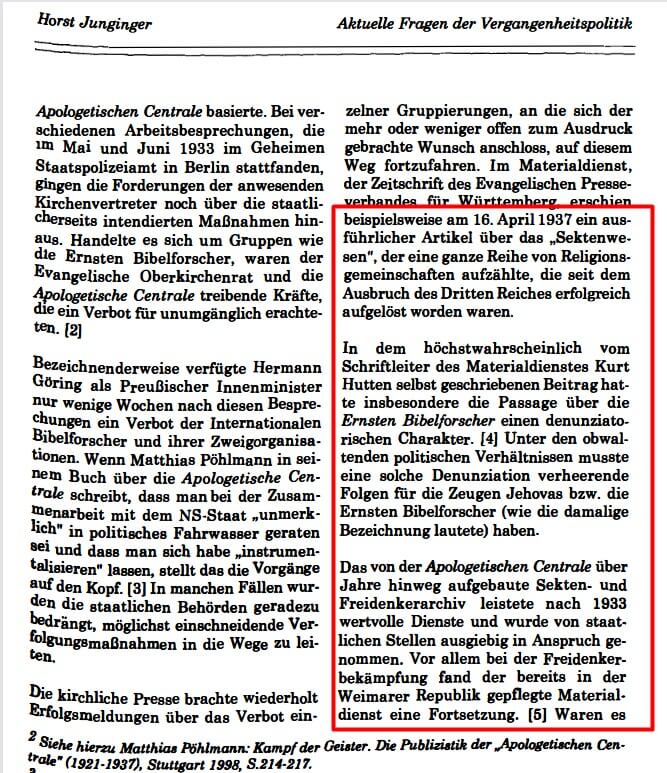
The historian assesses the passage concerning the Ernste Bibelforscher (“Earnest Bible Students”), that is Jehovah’s Witnesses, in clear terms:
“Under prevailing political conditions, such a denunciation could not fail to have catastrophic consequences for Jehovah’s Witnesses.” ⁶
Here’s the sentence itself, which he characterizes as a denunciation:
“The program of the ‘Earnest Bible Students’ is the destruction of governments in all countries and the establishment of an Israelite world state” (Materialdienst, No. 8, April 16, 1937, cols. 57–64, citation in col. 62). ⁶
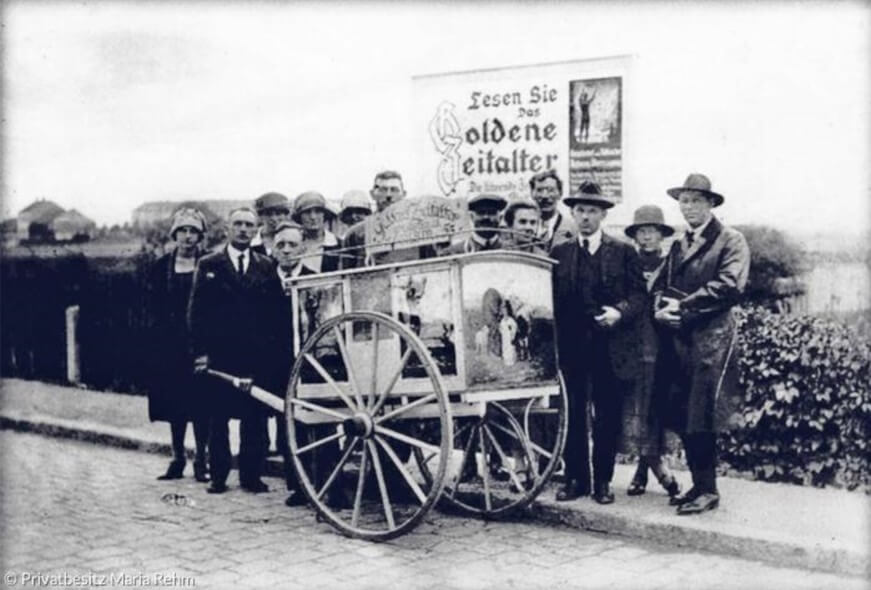
What did this mean in April 1937? Let’s consider the implications. “The destruction of governments in all countries” was, in the legal terminology of 1937, high treason and plotting a violent overthrow of the government. “The establishment of an Israelite world state” was an explicit invocation of the paramount conspiracy myth of the era (The Protocols of the Elders of Zion), of a global Jewish conspiracy, placed here right alongside the political threat. Both components were conjoined in a single sentence and pinned onto a religious community whose doctrine did indeed anticipate the Kingdom of God and the abolition of earthly governments, only in an eschatological sense, not a political one.
The main trick of the anticult craft is simple: take a person’s religious beliefs and translate them into the language of the penal code. Such a mechanism requires neither Nazis nor Communists, or atheists. Only two components are needed:
- An “expert” reference guide where suspicions are presented as “proven facts”;
- An investigator or bureaucrat who is obligated to act upon this paperwork and open a case.
We will return to this technique in subsequent parts.
Chapter 6. 1941: A “White Lie,” or How the Ban Myth Was Constructed
The postwar version of this story, by contrast, sounded remarkably neat: Kurt Hutten’s bulletin “Materialdienst” was shut down by the Nazis in 1941, while the Protestant Press Service (Evangelischer Pressedienst, or EPD) was banned in 1937, with both actions represented as political measures — retaliation for resisting the regime. The entire postwar rehabilitation of Protestant journalism was based on this version because the press which the Nazis had allegedly silenced should not be subject to accusations. Yet, both halves of that narrative proved false.
Statement of May 12, 1941
Let’s begin with the bulletin, as a verbatim document is available. Hutten appended a statement to the final issue, the text of which is cited by Junginger. As we read, publication ceased “in order to release personnel and material for other war-essential purposes.”⁶ There was, consequently, no ban at all; it was a routine mobilization measure announced by the editor himself in his own publication. Junginger comments:
“There was not the slightest cause for such a measure. Hutten, as editor-in-chief and lead author, personally saw to it that the material appearing in ‘Materialdienst’ aligned with the objectives of the Third Reich.” ⁶
The bulletin ceased publication not because it was an obstacle, but because the war was underway and paper was better needed elsewhere.
What Is EPD?
The Protestant Press Service (Evangelischer Pressedienst, EPD) was established in 1910 in Wittenberg out of the Protestant Press Union for Germany, beginning publication under its own name and logo in 1919. ⁵⁰ It’s a news agency of the Protestant Church and an organization providing news not directly to readers, but to editorial desks: newspapers, radio stations, and parish bulletins. Today, it is published by the Community of Protestant Journalism (Gemeinschaftswerk der Evangelischen Publizistik) founded in 1973 in Frankfurt am Main. It employs about 80 permanent staff members, maintains correspondent bureaus in Berlin, Brussels, and Geneva, and operates editorial offices in more than 30 locations across Germany. ⁵⁰ According to Wikipedia, Kurt Hutten served as an editor with the agency beginning in 1935. ⁹
The agency’s position within the system explains why its track record is so important. As long as we’re talking about an individual author, the debate centers on the reputation of a single person; but when it comes to an agency that supplied news to the country’s entire church press, the debate shifts to the basis on which that press existed after 1945 and how it proved its own innocence.
Legend of the EPD Ban
The second half of the story is more complex and, admittedly, more instructive.
“The legend of political suppression fabricated by former EPD editor-in-chief Focko Lüpsen recently turned out to be a wretched falsification of history, indeed an intentional forgery designed to re-establish the Protestant Press Service after the war. Research initiated by EPD itself revealed that EPD not only adapted very quickly to the Hitler regime, but even became part of the National Socialist propaganda machine. With regard to its own ‘coming to terms with the past,’ people now speak quite openly of historical falsification and a ‘white lie’.” ⁶
The source of this exposure is precisely documented: first, Volker Lilienthal’s article “Ende einer Zwecklüge: das angebliche Verbot des epd 1937” (“End of an Expedient Lie: The Purported Ban of the epd in 1937”) in the journal “epd medien,” No. 48, June 24, 2002; followed by his scholarly paper “‘In die Illegalität gedrängt’? Herkunft, Tradierung, Funktion und Korrektur der Legende vom epd-Verbot 1937” (“‘Forced Underground?’ Origins, Transmission, Function, and Correction of the Legend of the 1937 epd Ban”) in Publizistik, Vol. 48 (2003), No. 2, pp. 156–175; and finally, the comprehensive history of the press service written by Hans Hafenbrack and published in 2004. ³³ ⁴⁹
As Lilienthal summarizes it, the legend asserted that the agency had supposedly been banned by Nazi censorship in 1937 and “driven underground.” In reality, it operated until May 1941 and ceased publication not for political reasons, but due to wartime paper shortages, as did numerous other outlets. Throughout this time, its editorial content did not differ in any substantial way from National Socialist propaganda. ⁴⁹
Focko Lüpsen served as editor-in-chief of the press service from 1933 to 1966, heading it for more than 30 consecutive years under both the Nazis and the Federal Republic.⁵⁰ In 1946, he told the British licensing authorities that National Socialists had banned the agency in 1937, while a license was urgently needed, so the story of the ban served effectively as a letter of recommendation.⁴⁹ ⁵⁰ He repeated the same tale in print in 1950.
Junginger takes particular note of Hutten’s own role in this affair:
“As Hans Hafenbrack writes in his history of the Protestant Press Service, another leading representative of Protestant journalism, Kurt Hutten, also participated in constructing the legend of the EPD ban.” ⁶
Zwecklüge
The German word Zwecklüge literally translates as an “expedient lie” or “purpose-driven lie” — a falsehood told for a specific objective rather than for personal gain, whereas the nearest equivalent (“white lie” or “pious lie”) adds a nuance of mercy that the German word lacks. It is worth pausing on this concept since the entire postwar history of the sector rests upon it.
An ordinary lie is self-serving and therefore fragile: the liar has an identifiable interest, that interest can be uncovered, and the lie collapses under its own weight. As for Zwecklüge (“purpose-driven lie”), it operates differently because the liar gains no personal advantage; it serves a cause deemed noble. In our case, that objective was “to re-establish the Protestant press after the war.” ⁶
A falsehood of this type encounters almost no internal resistance as the liar doesn’t feel like a liar: he feels like a builder and restorer. That’s why it persists for decades and is usually exposed only by chance and from within, when someone from a subsequent generation, free from institutional obligations or personal stakes, sits down in the archives.
Now, notice who ultimately dismantled the legend: the EPD itself, by commissioning a rigorous study of its own past. ³³ This is a rare instance of an institution auditing itself, and in our narrative, unfortunately, it remains the only one.
Chapter 7. 1946: Denazification
Hutten’s return was swift: by late 1945, he was already working to revive the Press Union, and starting February 1946, he was back to publishing press dispatches.¹ All that remained was to undergo denazification.
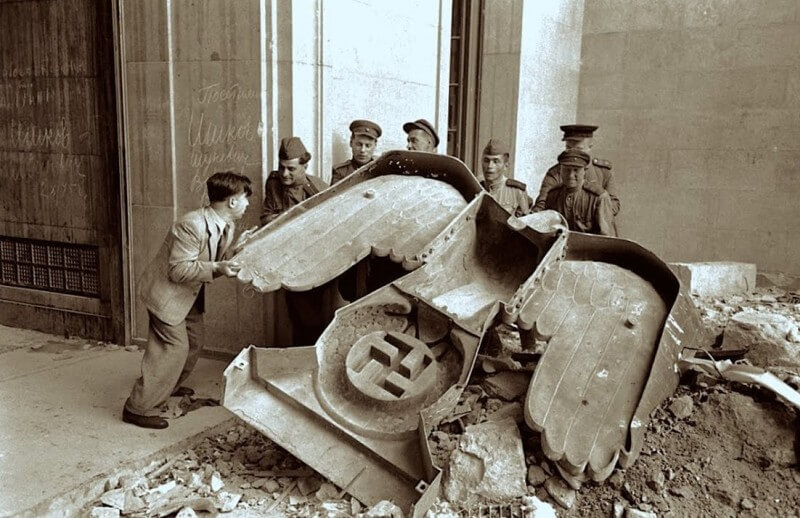
A few words should be said about the process itself. Denazification in the American occupation zone, which included Württemberg-Baden, was governed by the law of March 5, 1946. The statute handed cases over to German civilian tribunals (Spruchkammern) and established five categories: major offenders, offenders, lesser offenders, fellow travelers, and exonerated persons. ²⁹ Proceedings were initiated based on a questionnaire accompanied by personal statements and third-party references. Those very references became the primary currency of the whole process.
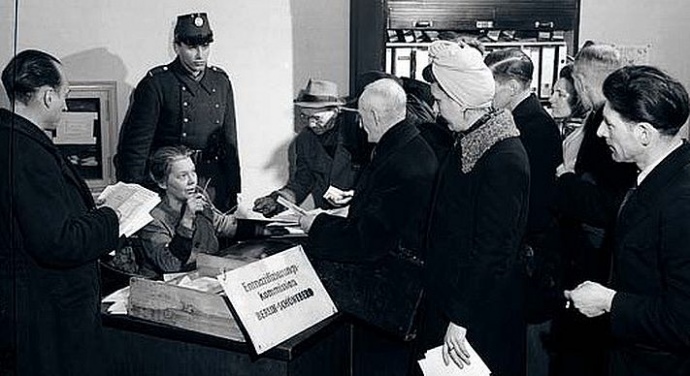
The German language even coined a specific term for them: Persilschein, or “Persil certificate,” named after the popular laundry detergent. This was the nickname for the clean-bill-of-health certificates that former coworkers, neighbors, and colleagues readily wrote for one another. There were no formal obstacles to that, and tribunals, buried under millions of files were physically incapable of vetting their contents. The outcome is well known: the overwhelming majority of cases concluded with the subject classified either as a “fellow traveler” or as “exonerated.”
Preparing for his hearing, Hutten turned to church lawyer Rudolf Weeber for assistance, stating his motive plainly: he needed to avoid the professional ban imposed on “former publishers.” Hub’s assessment here is bone-dry: “Nowhere in Hutten’s record is there any evidence of a self-critical look back at the past.” ¹
The linchpin of the defense was a letter dated December 13, 1945, from Pastor Hermann Maas, ¹ and crucially, the author’s moral authority was beyond reproach. Hermann Maas, a pastor from Baden, had saved Jews during the Nazi era. After the war, he became the first German officially invited to visit the State of Israel, and a tree was planted in his honor on Yad Vashem’s Avenue of the Righteous.³² In his letter, he described Kurt Hutten as “one of the most active and courageous champions of the Confessing Church and the most effective fighter against National Socialist ideology.” ¹
Contrast this glowing endorsement with what actually appeared in print under Hutten’s name between 1935 and 1942:
- “stand with all our might for the great work of renewal [undertaken] by the Führer and NSDAP,” ¹
- “removal from the host nation altogether,” ⁶
- “unconditionally welcome” sterilization, ⁶
- “obedience to the voice of blood is the supreme law.” ⁶
There is just one way to explain this discrepancy, and it by no means implies bad faith on Maas’s part. Maas knew Hutten through the church struggle, specifically along one narrow front where Hutten had opposed the Aryan Paragraph within the church and belonged to the Pastors’ Emergency League. By all indications, Maas had not read Hutten’s articles or, if he even had, certainly not in the exhaustive volume that Junginger would assemble sixty years later. Doing so would require digging through both volumes of the church lexicon and a full archive of industry trade bulletins, while a pastor who deals with saving human lives typically has other concerns.
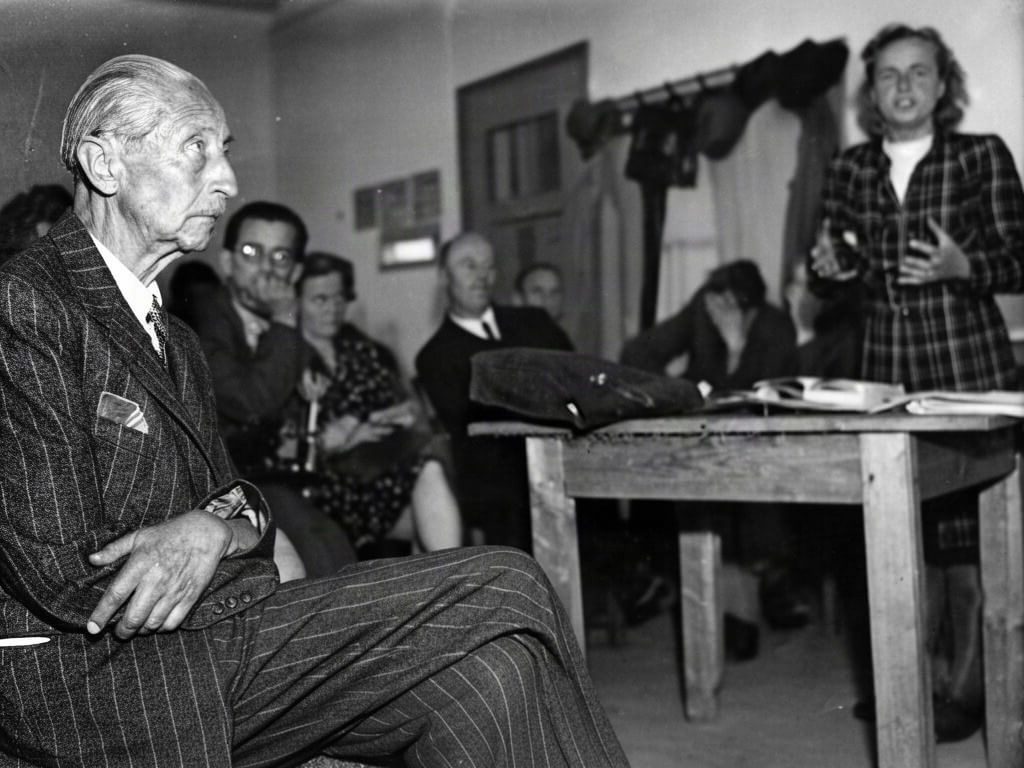
Generally speaking, that’s how any character reference works: it attests not to a whole individual, but only to the particular facet visible to the person who writes it.
On October 17, 1946, the tribunal delivered its verdict: exonerated. The ruling stated:
“The Chamber therefore considers the aggravating circumstance of voluntary entry into NSDAP and the ‘German Christians’ to be offset by the early severance of these ties and the subject’s unequivocally anti-fascist stance in subsequent years.” ¹
The tribunal credited the withdrawal of his NSDAP application, his expulsion from the German Christians, his enrollment in the Pastors’ Emergency League on November 25, 1933, and his affiliation with the Goerdeler resistance movement starting in November 1941.
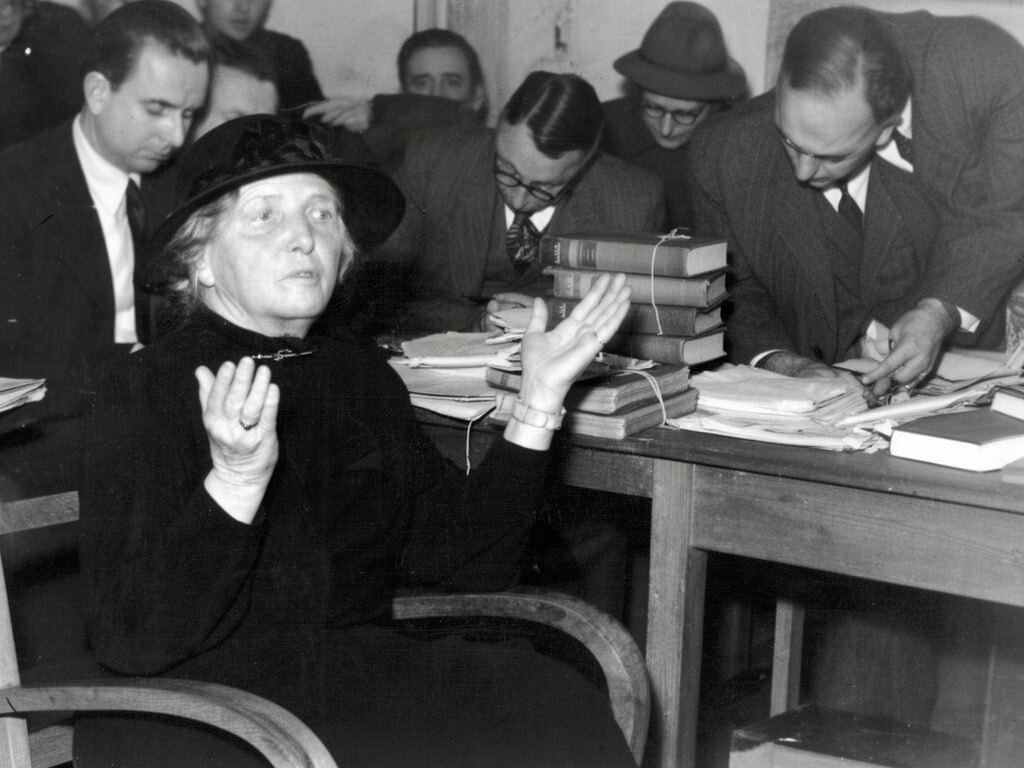
Ausgeglichen (Balanced Out)
The German word “ausgeglichen,” meaning “balanced” or “offset,” is borrowed straight from bookkeeping. After all, an account is balanced when debits and credits reconcile. The logic underlying the denazification verdict was indeed akin to a ledger: aggravating factors (voluntary NSDAP membership) were entered in one column, while mitigating factors (early departure, the Pastors’ League, and the Resistance) went into the other. The final verdict was calculated by subtraction. This model wasn’t an invention of the Württemberg tribunal: it was baked into the law itself where categories differed by degree rather than essence. ²⁹
Yet, accounting has one fundamental flaw: it works only with entries that are actually recorded. Whatever is left off the ledger simply ceases to exist, and no balance sheet will reveal it. Thus, in Kurt Hutten’s case, not a single one of his anti-Semitic writings published between 1935 and 1942 was entered into the debit column.
Here lies Dietrich Hub’s primary finding that brings the whole picture into sharp relief. In an annotation to the verdict, he observes that the tribunal failed to specify where exactly Hutten’s supposed “pro-Jewish statements” had appeared in print. Hub himself, having combed through both the personal file and the published work, could find no such statements anywhere.¹ It wasn’t as if anyone was hiding them: the church lexicons sat on library shelves, bound volumes of the newsletters remained in editorial offices, and his books from 1931–1938 had been legally published and sold in bookstores. All anyone had to do was open them.
On April 1, 1947, Kurt Hutten was officially appointed press pastor for the Evangelical-Lutheran Church in Württemberg, ¹ meaning less than six months elapsed between the tribunal verdict and his appointment.
The concluding assessment belongs to the researcher who examined Hutten’s personal file:
“No decisive departure from practices of the Nazi state is observed in Kurt Hutten right up until the end of the war. As with many of his contemporaries, anti-Semitic statements were acceptable to him before 1945, but no longer acceptable afterwards; he never offered any justification for this shift. […] The assertion that Hutten endorsed Hitler’s measures against Jews and Jehovah’s Witnesses cannot be refuted.” ¹
Chapter 8. The Nation’s Postwar Moral Teachers
Now, let’s look at the mechanism of this transition, which is what the preceding chapters have been leading up to. This mechanism has been described twice in the literature, and both formulations are worth placing side by side as they complement each other.
Iber’s view is mild and purely factual:
“In no postwar account of the AC (Apologetic Center) is there a single word about this connection to National Socialist state agencies.” ⁵
Junginger’s assessment is harsh and explanatory:
“From a purely formal or realpolitik standpoint, the history of the Protestant Church’s ideological journalism after 1945 could be described as a successful model of forward-looking ‘mastering of the past’ [Vergangenheitsbewältigung]. This success was made possible in large part by the fully conscious suppression of its own history. The handling of its past often took the form of historical falsification, bordering at times on a deliberate system of ‘noble lies.’ Only this way did the continued existence of Protestant apologetics seem feasible under democratic conditions.” ⁶
The same source makes the following observation about Hutten:
“After 1945, Hutten also had no trouble addressing either the German public or the occupation authorities with ostentatious self-assurance. […] By contrast, he passed over his earlier work in silence, especially his anti-Semitic incitements. Not even the slightest hint of an attempt to confront his own past can be found.” ⁶
Now, one more quote from Junginger. In our view, this passage represents the most crucial insight of the entire second part. It answers the question of what exactly was carried over from the past into the future:
“Confrontation with ideological opponents was now waged with the intent of presenting the Protestant Church as the form of religion best suited to parliamentary democracy. This agenda was advanced not least by attributing anti-democratic behavior to other religious and ideological communities. It is striking to see the sheer shamelessness with which they acted, passing off their own feat of accommodation as normative behavior. In some cases, these were the very same organizations that had been banned at the beginning of the Third Reich with the support of the Apologetic Center, and which were now maligned as incompatible with democracy.” ⁶
Let’s break down this passage piece by piece, as it captures the entire mechanism with precision. The targeted groups remained identical. First, between 1933 and 1937, they were branded enemies of the German people and the Nazi state, their bans orchestrated with the active participation of anticult experts. After the war, following 1950, the exact same groups were suddenly deemed “incompatible with democracy” — a conclusion drawn by the very same people. The charges were repackaged for a new political regime, but the list of the accused remained completely unchanged.
This is what recoding is. We can identify three key features of this manipulative mechanism, each of which will remain visible throughout the rest of our study:
Feature one: The manipulator does not need to lie. The claim that “this community is undemocratic” might, in certain cases, actually be true, and no one is obliged to prove otherwise. The sleight of hand lies in evaluating the internal religious structure of a community against the criteria of civil governance.
Feature two: The database, the filing system, remains intact. The dossiers compiled back in the 1920s and 1930s continue to be used. Facts about leaders, history, and dogma are neutral in themselves. Yet, simply changing the label on a folder to fit the new political reality can make the same material useful once again.
Feature three (the most important one): The scheme conceals its own past. A reader who picked up a reference handbook in 1953 and read that a group “threatens democracy” would never suspect that twenty years earlier, in 1933, the very same expert had written the exact same thing about that group, only framing it as a “threat to the Aryan people” and sending it to the Gestapo. An old denunciation had been merely translated into a new language and passed off as fresh scholarly analysis.
Junginger adds an observation that deserves special emphasis: they “passed off their own feat of accommodation as normative behavior.” ⁶ The mainstream church had adapted to the Nazi regime faster and far more thoroughly than many religious minorities had; those who refused to adapt, as we know, were sent to concentration camps. However, the ultimate paradox is that, after 1945, this very same church held up its own past adaptability as the benchmark of civic loyalty, while framing the minorities’ non-conformity as a sign of danger.
Situation by 1960
The personnel side of this transition was established in Part I. It is no secret that on April 1, 1960, Kurt Hutten took the helm of the EZW anticult center (Protestant Central Agency for Worldview Issues) in Stuttgart, while both former directors of the Apologetic Center joined its board of trustees. ¹², ⁷, ²
Now, let’s connect the facts. The anticult organization EZW was a direct successor to the Apologetic Center — the very agency that had shared materials with the Gestapo. Sitting on its board of trustees were its former leaders: Carl Gunther Schweitzer and Walter Künneth (the author of the 1933 treatise on the “Jewish Problem” and the 1934 expert opinion). ³⁹ ⁴² Serving as executive director was Kurt Hutten, author of the 1937 entry on the “Jewish Question” and fifteen other articles in the Calwer Church Lexicon. ⁶ Meanwhile, the foundational textbook for the organization was a reissue of the director’s own reference book, “Seher, Grübler, Enthusiasten: Das Buch der traditionellen Sekten und religiösen Sonderbewegungen” (“Visionaries, Brooders, Enthusiasts: The Book of Traditional Sects and Special Religious Movements”). 11

Hutten headed the EZW until 1968. According to official institutional history, his successors were Helmut Aichelin (1968–1979), Reinhart Hummel (1981–1995), and Michael Nüchtern (1996–1998), with Hans-Dieter Reimer serving as research fellow (wissenschaftlicher Referent) from 1971 to 1991.⁴
In 1970, the Evangelical Church in Germany appointed Hutten as its Commissioner for Religious Minorities (Beauftragter für religiöse Minderheiten).⁹ It sounded almost like a human rights post, since a “commissioner for minorities” evokes an office created to defend them. In reality, its function remained unchanged: an expert authority determining how the church (and, by extension, affiliated state agencies) ought to treat minority religious groups.
It was the exact same enterprise: “sectarianism” in 1937, “worldview issues” in 1960, and “religious minorities” in 1970. With every iteration, the title sounded more respectable than the previous. Incidentally, a fourth rebranding would emerge in Russia in the 1990s under the title of “sectology.”
Finally, one last quote from Junginger:
“After the war, writers like Hutten and Künneth cast themselves in the role of moral teachers to the nation, explaining National Socialism as the people’s ‘apostasy from God.’ While in the 1930s Künneth had numbered Judaism, liberalism, and Bolshevism among the ‘three great demonic forces of the era,’ after 1945 he declared Nazism itself to be an anti-Christian force. The scale to which the past was suppressed was so vast that scholar Wolfgang Maaser described it as an attempt to excise entire dimensions of one’s own identity from one’s biography.
Hutten projected public self-assurance before both German society and the Allied occupation authorities. Positing the Protestant Church as the moral compass of the Federal Republic, he continued to stigmatize non-Christian groups while maintaining absolute silence about his own anti-Semitic agitations during the Nazi era. Functionally, this strategy can be termed a model of wildly successful ‘mastering of the past,’ built on the conscious suppression of personal culpability and the manufacture of sanitized myths.
Appealing to an ahistorical religious absolute allowed Protestant theologians to shed the weight of historical responsibility. The hubris with which church publicists still occasionally treat their opponents today stems from this very belief in their own belonging to a ‘higher order’.” ⁶
Chapter 9. What Friedrich-Wilhelm Haack Inherited
The next generation arrived in the anticult sector at the turn of the 1960s and 1970s. Background on Friedrich-Wilhelm Haack (1935–1991), his 1969 staff appointment, his 40 books with a total circulation of 700,000 copies, and his definition of a “sect” was presented in the first part, and we will not repeat it here. ¹⁴ ¹⁹ We require here one additional circumstance not previously mentioned. In 1965, four years before his ecclesiastical appointment, Haack founded his own organization in Munich, the Arbeitsgemeinschaft für Religions- und Weltanschauungsfragen (ARW; Working Group for Religious and Worldview Issues), and directed it until his death. ¹³

In our previous publications, just like in most historical accounts, the sequence was presented in reverse: first the church instituted the post, and then the anticultist appointed to it launched his activities. An examination of the record shows that in Haack’s case, it was quite the opposite: he founded his own organization in 1965, ¹³ and obtained the church post in 1969. ¹⁴ Let us add one more observation that becomes evident only with the chronological record properly arranged: the position was created not for a generic function, but tailored specifically for the individual who was already performing it. As a rule, what emerges from this is not an institutional office, but a personal monopoly disguised as one. And the entire subsequent history of the field – including its Russian branch – is a history of personal monopolies framed as anticult expert institutions.
Those Who Pray Differently, or “Passing the Baton” From Hutten to Haack
Here is what Bertil Persson writes in his book The Struggle Against Sects: Ideological Foundations and Their Bankruptcy: “In 1970, Detlef Bendrath (sect commissioner from Lübeck), Haack, Hutten, Hans-Dieter Reimer, and other Lutheran anti-sect activists held a meeting of the Working Group on Free Churches and Sects. From that time on, Haack took the baton from Hutten and became the most prominent Lutheran anti-sect campaigner.” ¹⁷
All individuals named are real historical figures. Detlef Bendrath was indeed the church’s sect commissioner in Lübeck, appearing in that capacity in the minutes of the Education Committee of the Landtag of Schleswig-Holstein on Feb. 27, 1997, as well as the compiler of an anthology published in 1985 in Haack’s circle’s Munich series, and in the masthead of the magazine Berliner Dialog in 1997.¹⁸ Hans-Diether Reimer (1926–1993) is likewise a real person, a pastor and research fellow of the center. ³
The generational shift itself is documented independently of Persson: Hutten left the center in 1968 ⁴; Haack obtained the first permanent staff appointment in Germany as sect commissioner in 1969.¹⁴ Kurt Hutten, in turn, transitioned in 1970 to the churchwide post of Commissioner for Religious Minorities. ⁹ The 1968–1970 threshold was indeed a generational watershed in German “sectology,” though this transition took place, in our view, not at a single gathering, but over several years.
The paramount legacy that German anticultism passed down through the decades was its criterion for selecting enemies. In his 1988 book Der Weg des Lebens nun ist dieser: Apologetik an der Schwelle des 3. Jahrtausends (This Now Is the Way of Life: Apologetics on the Threshold of the Third Millennium), Haack defined a “sect” as a group that “teaches contrary to the church’s creeds and claims to possess truth derived from sources outside the Bible.” ¹⁷
At first glance, there is not a word about violence, harm, or lawbreaking — not a single tangible pretext to latch onto. A person is declared dangerous simply for reading the wrong books. A peaceful community abiding by the law and harming no one is branded a sect solely because of an “incorrect” source of revelation.
Does this remind you of anything? Russia in 2012? No, this criterion was devised long before 1988. When the Apologetic Center was established in Berlin in 1921, a library and archive were opened alongside it for “worldview communities deemed hostile.”⁶ In other words, the card index was instituted from the very beginning not for those who committed crimes, but for those who think and pray differently.
Walter Künneth, who took over the leadership of the center in 1932, operated with the exact same mindset. In his report to the Gestapo dated Dec. 16, 1933, the designated enemies were freethought and Marxism ⁵; in encyclopedic entries, pacifism and capitalism⁶; and in the roster of the “demonries of the time,” liberalism and Jewry. ⁶ Not a single entry describes a crime: across the board, what is evaluated is strictly a person’s way of thinking.
Friedrich-Wilhelm Haack, therefore, did not reinvent the wheel. His 1988 interpretation precisely replicates the logic of Walter Künneth’s criteria from the 1930s. Haack simply translated his predecessor’s cumbersome theological polemics into the language of an operational manual, turning Künneth’s essays and scholarly disputes into a handy express test allowing any reference desk clerk to sort out someone else’s faith in literally a minute.
And herein lies the answer to why the anticult apparatus survived 1945 unscathed.
A criterion that categorizes people as “proper” or “dangerous” solely on the basis of their faith was utterly independent of the political system. It functioned with equal efficiency under the Kaiser, in the Weimar Republic, under Hitler, and in postwar West Germany. Denazification could remove odious apparatchiks from their offices, but it could not dismantle the triage assembly line itself. For it was never Nazi in origin; it had been fashioned by church apologetics, and indeed thousands of years earlier… while the totalitarian regime merely appropriated an existing, convenient instrument of surveillance and repression. So it was under Hitler; so it was repeated under Putin.
Here emerges the primary implication for our own era. It was precisely this intra-church concept of a “sect” — and not the law or legal norms — that served as the foundation for European, and later Russian, anticult practice. When parliamentary commissions and forensic experts in the 1990s churned out blacklists, they relied on a concept absent from secular law. They lifted it ready-made from denominational manuals running in a direct line back to the Berlin card catalog of 1921.
Chapter 10. Haack and the ARW Press: The House That Printed Other People’s Secrets
A great deal has been written about the Munich-based Arbeitsgemeinschaft für Religions- und Weltanschauungsfragen (Working Group for Religious and Worldview Issues), but almost all of it focuses on the Bavarian church’s anticult center headed by Friedrich-Wilhelm Haack. None of it discusses the publishing house attached to the center, even though its history is fascinating. Over 35 years, it issued more than 200 titles, and a closer look at its catalog confronts researchers of the anticult movement with a question that no one has yet asked.
BACKGROUND
- The ARW Publishing House. Arbeitsgemeinschaft für Religions- und Weltanschauungsfragen (ARW; Working Group for Religious and Worldview Issues) was founded in Munich in 1965 by Lutheran theologian Friedrich-Wilhelm Haack, who directed it until his death in 1991.¹³ ¹⁴ The publishing house affiliated with the association (commonly abbreviated as ARW) was established during a meeting on Dec. 3, 1975. Its permanent staff consisted of just two people: Inge Haack, the founder’s wife, and writer Manfred Ach. Since January 2000, Ach has run the operation single-handedly.
Thus, Haack’s anticult organization emerged in 1965, but the publishing house arrived a decade later. According to Ach, the permanent roster was “limited to Inge Haack and Manfred Ach, seasonally reinforced by extra hands from the Ach and Haack families.” Inge Haack was a licensed bookseller, though almost no biographical information about her survives. Manfred Ach was a writer and educator. At the meeting on Dec. 3, 1975, Friedrich-Wilhelm Haack, Inge Haack, and Manfred Ach, “acting as the authorized leadership of the association,” formalized their publishing program, outlined book series, and adopted the founding charter.
Haack’s connection with Manfred Ach, however, did not begin with books — a distinction worth highlighting, as their publishing partnership is often assumed to be their only tie. Their initial collaboration took place not in a print shop, but within a parents’ initiative. In 1975, Haack founded the Elterninitiative zur Hilfe gegen seelische Abhängigkeit und religiösen Extremismus e.V. (Parents’ Initiative for Help Against Psychological Dependency and Religious Extremism) in Munich, the first association of its kind in Germany.
BACKGROUND
- Manfred Ach. Born on Nov. 21, 1946, in Grünwald near Munich; resides there and in Vienna. Studied German philology, philosophy, and theology. Worked for 33 years as a schoolteacher. Published his first poetry collection in 1967; by 2019, he had published over 200 of his own books. Co-founder of the ARW press (1976), serving as its sole director since January 2000.
Manfred Ach did not merely join the Parents’ Initiative; he established himself firmly within its governing body, remaining there for 15 years.
According to Ach’s own memoirs, at the association’s 1982 annual general conference in Würzburg, he temporarily assumed the duties of first chairman, filling in for Pastor Friedrich-Wilhelm Haack. As his keynote address, he presented a paper titled Die Reduzierung des Menschen zum Verfügungs- und Funktionsmaterial (“The Reduction of Man to Disposable and Functional Material”). In it, he laid out the thesis of how contemporary non-traditional religious movements allegedly break down human psychology, drawing strict preventive pedagogical conclusions from his findings.
Haack’s first book, Geheimreligion der Wissenden: Neugnostische Bewegungen (Secret Religion of the Initiates: Neo-Gnostic Movements), was published in 1966. By the mid-1970s it had sold out, and according to Ach, the author “placed the copyright at the disposal” of the newly minted publishing house, inaugurating its catalog. By 1999, the book had gone through eight editions.
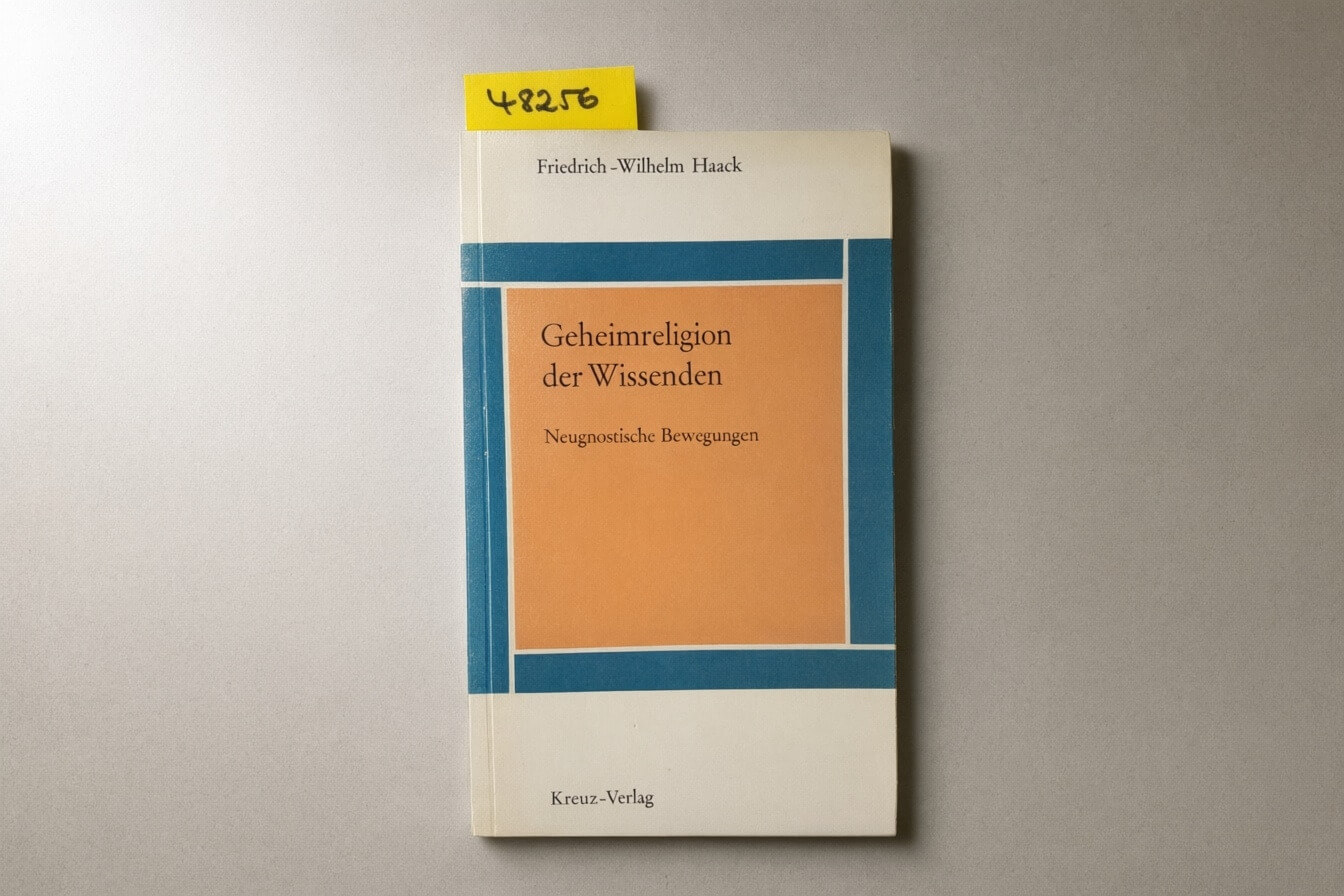
What exactly was “Geheimreligion der Wissenden: Neugnostische Bewegungen”? In Ach’s memoirs (Von Mir Aus 3),⁵² there is an extensive paragraph dedicated to it. It is well worth quoting in full:
“Friedrich-Wilhelm Haack, ‘Secret Religion of the Initiates: Neo-Gnostic Movements’ (Geheimreligion der Wissenden: Neugnostische Bewegungen; Munich, 1976). From the table of contents: Dr. Reuss and the O.T.O. / Lanz von Liebenfels and the ONT / the OMCT temple and its rivals / the magical gnosis of Sir Aleister Crowley / the true Illuminati / the Great Beast No. 666 / Ecclesia Gnostica Catholica / blended gnosis without God / the Gold- und Rosenkreuzer / Rosicrucian genealogical charts / the organization of the true Rosy Cross / Max Heindel and Mount Ecclesia / AMORC, AAORRAC, and other groups / the Universitas Esoterica for Rosicrucian meditation / the myth of the primordial man and Homo Maximus / Adam Kadmon in Lemuria / Anthroposophy and Sufism / the dualism of the light-treasure / esotericism and the New Thought movement / Kabbalah / biblical faith and neo-gnosticism / etc. / bibliography and journal index (neo-gnosticism) // This book inaugurated the ARW venture. The first print run (Kreuz-Verlag, Stuttgart, 1966) had sold out; the author released the copyrights. The cover was redesigned; later editions (totaling eight by 1999) included a supplement to the chapter on the ONT, deemed credible after a visit to the Viennese Neo-Templars (Czepl, Mund, et al.). The ARW bestseller, whose subtitle — ‘Neo-Gnostic Movements’ — became an established term in religious studies literature, also brought the publishing house a bizarre notoriety: ARW was repeatedly suspected of being a front for the Gnostic Church, or at least its accomplice (a suspicion voiced, for instance, in pamphlets from the LaRouche circle and various conspiracy theorists).” ⁵²
The ARW publishing program was organized topically, and the very titles of its series reveal more about their subject matter than any blurb could (VMA3, pp. 69–70; self-description on religio.de/arw ⁵³):
- MATERIAL-EDITION: Varia (Miscellaneous).
- MOONCHILD-EDITION: “Magic and ritualism.” The name references the novel by Aleister Crowley. ⁵⁸
- NADA-EDITION: “Spiritualism, mysticism, poetry, and aphorisms.” ⁵⁹
- IRMIN-EDITION: “Ariosophy and völkisch faith” (“Ariosophie und Völkischer Glaube”). Named after the Germanic sacred pillar Irminsul, an emblem of the völkisch tradition and later incorporated into SS iconography. ⁵⁷
- HIRAM-EDITION: “Orders, lodges, and secret societies.” Hiram is a central figure in Masonic tradition. ⁵⁶
- DOKUMENTATIONS-EDITION: “Documentation, analyses, conference proceedings.”
- EDITION LUDWIG IM TALE: Literary series.
- ARW-ANTIQUARIAT: “Archives, list of subculture and fiction, rarities, facsimiles.”
The contents of the Ariosophy series can be verified through the K10plus union catalog, meaning through official library records rather than hearsay. ¹⁵
The IRMIN-EDITION series included Nazi-occult classics. ARW reprinted:
- Lanz von Liebenfels, “Practical Introduction to Aryan-Christian Mysticism” (reprint)
- Guido von List, “The Armanism of the Ario-Germans” (reprint of the 1922 edition)
- Houston Stewart Chamberlain, “The Aryan Worldview” (reprint of the 1912 edition)
- Sebottendorff, “Bevor Hitler kam” (“Before Hitler Came,” 1933), a title that was banned by the Nazis themselves in 1933. The author was arrested in November of that year, convicted by a Munich special court in February 1934, and expelled from Germany. The only genuinely banned reprint in ARW’s catalog had been banned not by the Federal Republic of Germany, but by the Third Reich: the Nazi Party suppressed the claim that the movement had been created by the Thule Society occultists rather than by the sheer genius of the Führer, Adolf Hitler.
Jörg Lanz von Liebenfels was an Austrian monk, the founder of Ariosophy, and publisher of the magazine Ostara, which preached racial doctrine through a mystical lens. His ideas exerted a profound influence on Adolf Hitler’s early ideological development. Guido von List was a Viennese occultist and founder of Armanism and runic lore, which heavily influenced völkisch symbolism. Houston Stewart Chamberlain was an English-born German publicist, son-in-law of Richard Wagner, and author of “The Foundations of the Nineteenth Century,” one of the core texts of racial doctrine. Rudolf von Sebottendorff was a prominent German occultist, political activist, and founder of the secretive Thule Society. This group played a pivotal role in the genesis of German Nazism, as many key figures of the future Nazi Party emerged from its ranks. The writings of these figures (and others like them) were reprinted by an organization founded and led by Haack, the Bavarian church’s official commissioner for sect affairs.
The MOONCHILD-EDITION series, focusing on historical underground grimoires, began with reprints of the Faustian “Höllenzwänge” (“coercions of hell”), classic black-magic manuals for summoning spirits (reissued in 1976–1978 from Scheible’s 1849 editions). These included:
- “Dreifacher Höllenzwang” (“Triple Coercion of Hell”)
- “Praxis Magica Faustiana” (“Faustian Magical Practice”)
- “Manual-Höllenzwang” (“Manual of Hellish Coercion”)
- Also issued: “Ceremonial-Magie I: 22 Hauptwerke der magischen Literatur” (“Ceremonial Magic I: 22 Major Works of Magical Literature,” 1978) and “Das Buch Jezira” (“The Book of Jezirah,” 1978).
For some researchers, even the mere announcement of an upcoming release evoked a visceral dread of these ancient sorcery texts.
The HIRAM-EDITION series published rare documents from the O.T.O. and Aleister Crowley:
- Early lodge charters, correspondence, and initiation rituals
- One of Aleister Crowley’s most heavily guarded secret texts
- IX° Secrets — confidential instructions for the highest degrees
- The 96th-degree ritual of Theodor Reuss
ARW produced numerous reprints of rare materials that were otherwise inaccessible to researchers. Among them:
“A.A.O.R.R.A.C. Pansophisch-Gnostische Riten III. Opus hermeticum” (“A.A.O.R.R.A.C., Pansophic-Gnostic Rituals of the 3rd Degree”), 1977 reprint, originally published 1956. Contains histories of ancient orders, hierarchical structures, Gnostic prayers, and detailed rubrics for altar rituals.
Moritz Busch “Drusen und Derwische” (“Druses and Dervishes”), 1977 reprint. A historical work on Middle Eastern religious movements, prepared with an introduction by Manfred Ach.
Leopold Engel “Geschichte des Illuminaten-Ordens” (“History of the Illuminati Order”), 1978 reprint, two volumes, featuring a 1978 foreword by F.-W. Haack. An exhaustive study of the Bavarian Order of the Illuminati and its impact on European intellectual history. Engel analyzes the organizational structure, initiation degrees, and circular letters of the order, detailing how the Illuminati infiltrated German Masonic lodges.
Bernhard Beyer “Das Lehrsystem des Ordens der Gold- und Rosenkreuzer” (“The Instructional System of the Order of the Gold and Rosy Cross”), 1978 reprint. It is the first appearance in German-language scholarship, describing the magical degrees, meditative techniques, and internal hierarchy of the Gold- und Rosenkreuzer Order.
Hans Prutz “Geheimlehre und Geheimstatuten des Tempelherren-Ordens” (“Secret Doctrine and Secret Statutes of the Order of the Knights Templar”), 1979 reprint. A critical inquiry into Templar orders and their inner structures. Prutz was a history professor who examined the Knights Templar and their occult traditions.
Lehmberg (HG.)., F. W. “Magische Sonderdrucke und Interna der Fraternitas Saturni” (“Magical Rarities and Internal Documents of the Fraternitas Saturni”), 1980, with an editorial note by Manfred Ach). This marked ARW’s third book on the Fraternitas Saturni. It contains:
- The Rosicrucian rituals Opus I and Opus Magnus
- Degree-level sexual magic (Gradus Pentalphae)
- Rituals of the legendary lodge (FOGC)
- Internal protocols of the fraternity that had never previously been published.
Heinrich Tränker “Die Pansophie Der Hermetischen Bruderschaft Vom Rosenkreuz” (Pansophy of the Rosicrucian Brotherhood), 1981 reprint. Tränker was a prominent teacher in the German Rosicrucian movement. His work details ancient Rosicrucian traditions, their philosophical foundations, and their practical exercises.
Co-founder Manfred Ach described the beginning of their collaboration as follows:
“It was in the mid-1970s that F.-W. Haack and I first tackled this topic as part of our apologetic work: through lectures, articles in trade journals, and book publications. When it became clear that the esoteric scene was growing increasingly fascinated by the occult aspects of Nazism, and that the eco-green subculture was drifting toward the Brownshirts, we at ARW published source materials intended to clarify these connections. With his book ‘Wotans Wiederkehr’ (The Return of Wotan), Haack sought to expose the presence of these activists.” ¹⁶
After the Founder’s Death
Following Haack’s death on March 4, 1991, the publishing house did not close; instead, it pursued the exact same editorial line for another three decades. Ach continued issuing his late partner’s works, including the posthumous collection “Anmerkungen zum Satanismus” (Notes on Satanism). He bought up more than 2,000 remaining copies of Haack’s “The Return of Wotan” and sold them off. Today, the book ranks among those “especially favored by ARW clientele.”
In 1993, 1996, and 1997, Ariosophic volumes by List and Chamberlain appeared. In 2010 and 2016, Ach published his own books on Adolf Hitler. Right up until 2020, anthologies from the anticult network continued to appear under the ARW imprint.
The Author List as an Industry Cross-Section
In Ach’s memoirs, there is a roster of ARW authors that brings together names appearing separately across various chapters of our investigation.
Representing the church were regional bishops Hermann Dietzfelbinger (the very man who created the salaried post for Haack in 1969) and Johannes Hanselmann; sect commissioners Thomas Gandow, Detlef Bendrath, Rüdiger Hauth, and Wolfgang Behnk; and Hansjörg Hemminger and Gottfried Küenzlen, staff members of the Central Office for Worldview Issues (EZW). From the politics came Bavarian minister-president Edmund Stoiber, federal minister Norbert Blüm, and president of the Bavarian Landtag Barbara Stamm. The judiciary was represented by judges Wolf Wimmer and Jürgen Keltsch. From abroad came Danish theologian Johannes Aagaard, co-founder alongside Haack of the international Dialog Center; and, most crucially for our purposes, Minsk-based Vladimir Martinovich, listed as “Vladimir Martinovich Dr. Dr.,” whose article on the Synodal Center for Sectology of the Belarusian Orthodox Church was featured in an ARW anthology in 2020. Let us recall that it was Martinovich himself who received the archive in 2010, the very archive that sparked the idea for this investigation.

Chapter 11. What the ARW Press Sold and Who Was Behind It. The Details
Let us return to the timeline:
- 1965: Friedrich-Wilhelm Haack founds the anticult association. ¹³
- 1966: His first book, “Geheimreligion der Wissenden” (“Secret Religion of the Initiates: Neo-Gnostic Movements”), is published by Kreuz-Verlag in Stuttgart.
- 1969: The Bavarian Church establishes a salaried post for him as commissioner for sect affairs. ¹⁴
- December 3, 1975: At a meeting of the working group, the affiliated publishing house (abbreviated ARW) is officially established.
We have already examined in detail the topics covered in Haack’s first book, “Geheimreligion der Wissenden: Neugnostische Bewegungen” (“Secret Religion of the Initiates: Neo-Gnostic Movements”): Dr. Reuss and the Ordo Templi Orientis; Lanz von Liebenfels and the Order of the New Templars; the magical gnosis of Aleister Crowley; the Illuminati; the “Great Beast No. 666”; various branches of Rosicrucians; Kabbalah; Anthroposophy; and Sufism. It reads like a comprehensive guide to the German-speaking occult underground, compiled by someone with an intimate command of the subject.
And this was only in his second year on the job! This means that by the time the church handed Haack an official mandate to combat sects, he had already spent three years as the author of an authoritative reference guide to secret and occult orders.
To reiterate: in 1976, Haack transferred the rights to this book to his own publishing house, and by 1999 it had gone through eight editions. The unintended consequences were curious: the subtitle “neo-Gnostic movements” established itself in religious studies literature as a standard term, while the ARW group itself, according to Ach, was persistently suspected of being a covert Gnostic church.
In an official statement dated January 25, 1982, the federal executive committee of the European Workers’ Party (Europäische Arbeiter-Partei), the German wing of the LaRouche movement, branded Haack “one of the key figures” behind campaigns against the party, calling him the “notorious” and “self-styled sect expert of the Munich Evangelical Church” who “works for both the right wing… and the left wing.” ⁵⁴ This accusation is worth noting, because a few years later, state police would apply the exact same assessment (almost verbatim) not to Haack, but to his co-publisher, Ach. The LaRouche movement and the state police had independently arrived at the identical conclusion.
A Publishing House Run by an Anticult Center
What did it actually mean to have a “publishing house run by an anticult center”? According to Ach’s memoirs, the group’s catalog operated across four distinct tiers, differentiated not by genre, but by their intended audience.
The first tier was public. This included anticult pamphlets, Haack’s mass-market books distributed through the Protestant Claudius-Verlag with a cumulative run that “soon neared the one-million mark,” and inexpensive reprints, such as the first four volumes of the Faustian series priced at eight marks each. This was standard church education, raising no eyebrows.
The second tier was intentionally restricted. The book “Gottes 5. Kolonne” (“God’s Fifth Column”), about independent (“vagrant”) bishops, was deliberately published in a single print run. Ach describes the outcome without the slightest embarrassment: the book “soon sold out and, given the awareness of its scarcity, fetched exorbitant prices on the scene.” A sequel on the same topic, the 1980 title “Die freibischöflichen Kirchen” (“Independent Episcopal Churches”), was issued in an edition of only four hundred copies, while the 1990 book “Religion und Dekoration” (“Religion and Decoration”) was explicitly labeled: “Not intended for the general public.”
The third tier was for internal official use. The association maintained an archival service that distributed bound collections of photocopied documents. Its circulation list was tiny: materials were sent, in Ach’s words, to “a very limited circle of recipients among sect commissioners.” Three distinct series are documented: twenty-two issues of “Ariosophicon,” ninety-three of “Gnosticale,” and sixteen of “Catholicon.” Ariosophic literature thus circulated strictly within the internal network of German church commissioners as classified trade reading, completely unavailable for commercial purchase.
The fourth tier was strictly confidential. A facsimile collection titled “Argenteum Astrum,” featuring handwritten manuscripts by Aleister Crowley, was published, per its catalog description, “in a strictly limited run exclusively for scholarly research purposes.” The 1994 release “Materialien zum OTO” (“Materials on the O.T.O.”), compiling the order’s “most substantive internal documents,” was issued under the same restrictions.
Thus, an “insider print run” at this publishing house did not simply mean a circle of like-minded enthusiasts; it functioned as a tiered security-clearance system, organized like a classified archive. The general public received basic pamphlets; the scene received overpriced rarities; fellow church commissioners received confidential internal dossiers; and “scholarship” received facsimiles of private esoteric manuscripts.
Other People’s Secrets
What exactly was being sold through this ARW publishing network? Let us break it down by category.
The private secrets of Ariosophy itself. A 1980 reprint of Lanz von Liebenfels, featuring his racial-mystical writings, reproduced texts from the series “Ariomantische Briefe an meine Freunde” (“Ariomantic Letters to My Friends”). As Ach described them, these were texts the author had “circulated as privately typed manuscripts exclusively to personal friends, making them unavailable through the book trade.” In other words, the Munich anticult group took materials that, within Ariosophy itself, held the status of classified circulars for initiates, and made them commercially accessible.
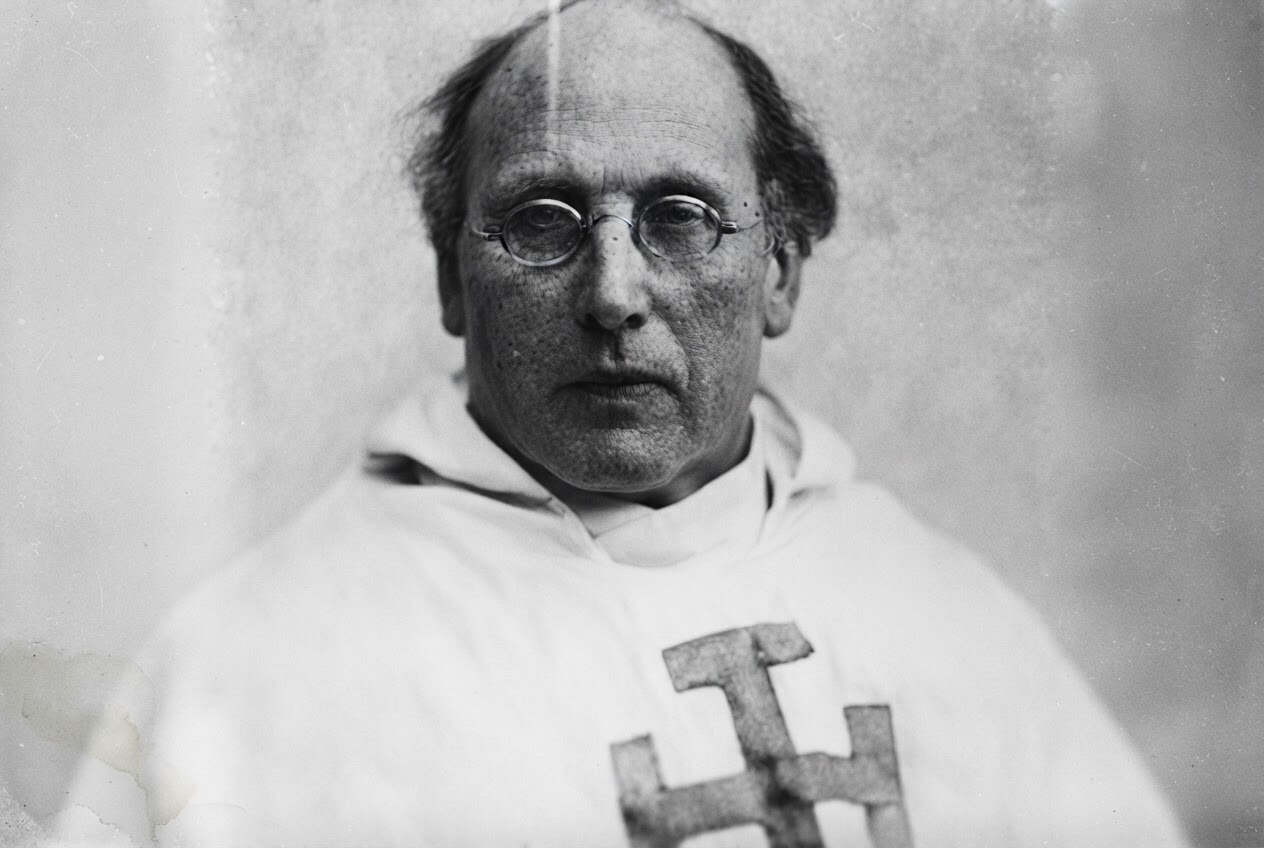
Of the same pedigree was the 1993 reprint of “Mitteilungen der Guido-von-List-Gesellschaft” (Bulletins of the Guido von List Society), whose value Ach states bluntly: it contained “a complete list of members, founders at the inaugural meeting, and the honorary presidium.” A century-old roster of names, precisely the kind of information that never appears in open public circulation.
Second, and this was their core specialty: oath-bound esoteric secrets. The complete corpus of materials of the “Fraternitas Saturni,” a magical lodge founded in 1928, was, according to Ach, “eventually purchased from one of its members.” ⁵² The book by Haack on the order published on the basis of these papers contained, as the blurb stated, “internal documents printed from the originals that had never before been made public”: Grand Master decrees, circular letters to the lodge’s brothers and sisters, rituals, and the sexual-magical texts of the highest degrees. In the same vein were Peter-Robert König’s publications on the Ordo Templi Orientis, which printed “vintage lodge charters, correspondence, and initiation rituals,” “one of Aleister Crowley’s most heavily guarded secret texts,” and confidential ninth-degree instructions.
Third: ancient magical grimoires and textbooks on sorcery. The “Moonchild” series launched in 1976 with reprints of the Faustian “Höllenzwänge,” classic black-magic manuals for spirit conjuration, followed by “Ceremonial-Magie,” a collection of twenty-two major medieval magical works, and “Das Buch Jezira” (“The Book of Formation”). Ach recounts the readers’ reactions with evident relish: the promotional prospectus alone stoked “fundamentalist anxieties about old books of witchcraft among certain interested parties.”⁵²
Fourth: the Nazi-occult classics noted in the previous chapter, ranging from Lanz and List to Chamberlain and Sebottendorff. ¹⁵
Fifth: original intelligence-grade information. “Highly secretive individuals increasingly appeared, some even eager to write books for the working group,” bringing with them “veritable jewels of esoteric lore and extraordinary research,” so that the group’s archive became a “sanctuary for rare manuscripts.” Then comes the sentence that makes this book essential reading: “Our discretion in handling confidential material was valued, and it was never betrayed.” ⁵²
The Only Banned Book
One title from the publishing program deserves special attention. Among the group’s reprints was a 1933 volume “in which the founder of the Thule Society recounts the history of this order.” ⁵² This refers to Rudolf von Sebottendorff’s treatise “Bevor Hitler kam” (“Before Hitler Came”), in which the author, an occultist and founder of Munich’s Thule Society, argued that the National Socialist movement had grown out of his own circle.
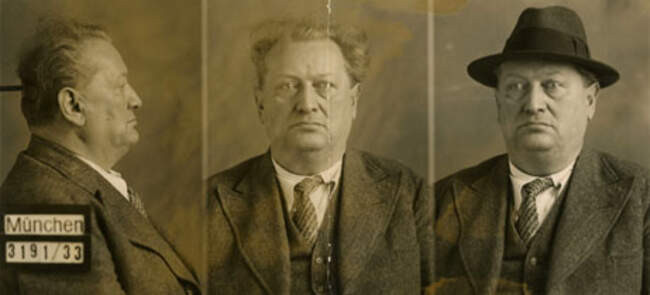
The Munich Documentation Center for the History of National Socialism gave a brief verdict on the fate of this book under the Nazis: “His book ‘Before Hitler Came’ (1933) was temporarily banned.”
Let us pause here. Out of the entire reprint catalog of this Munich anticult press, the only book ever banned by the state had been banned not by the Federal Republic of Germany, but by the Third Reich. And it was banned for a reason worth stating explicitly: the Nazi Party refused to have the movement traced back to an occult coterie rather than to the genius of the Führer. By reissuing it, the Munich group revived the foundational primary source for the entire genre of the “occult roots of Nazism” — the very genre in which Haack himself worked as an author.
A strict distinction must be made here. The anticult group rarely printed state-censored material. Its specialty was not what was banned, but what was restricted: letters for initiates, sworn rituals, secret instructions, internal rosters. Its commodity was someone else’s breached secret.
How It Was Acquired
Material of this nature cannot simply be requisitioned from a library, and the methods used to obtain it varied. One such episode is detailed in Ach’s memoirs; let us quote it.
Securing the rights to Lanz von Liebenfels required personal visits. “This reprint was preceded by several trips to Burg Werfenstein, the order’s castle, to the Viennese leadership of the Order of the New Templars, and to other bastions of historical and active Ariosophy.” ⁵² The word “active” is Ach’s own, and it means precisely what it says: by the 1970s, the order was still very much alive. “We wanted a legally authorized reprint, not a pirated facsimile. So we knocked on the order’s door (Theodor Czepl was still alive then), and discussions, along with extensive correspondence with Rudolf Mund,⁵⁵ finally made the project a reality.” ⁵²
“The Man Who Gave Hitler His Ideas.” The Interrogation Transcript
The details of these negotiations survived in an unexpected place: police interrogation transcripts that Ach, for reasons of his own, chose to publish himself. Thus, the text discussed below comes not from a state archive, but straight from the hands of an interested party. Publishing it was a considerable risk for him; the excerpts cast him in an ambiguous light, and he omits his own answers under interrogation. One must read this material carefully to realize that in Manfred Ach we are looking at far more than an ordinary publisher or a run-of-the-mill anticult activist.
The investigator’s lines are structured as a recital of facts already known to the police.
Excerpt 1:
“Do you claim to be the sole legal copyright holder to ‘Praktische Einführung in die arisch-christliche Mystik’ (‘Practical Introduction to Aryan-Christian Mysticism’) by Lanz von Liebenfels? That you acquired the rights from the so-called Order of the New Templars, represented by Theodor Czepl and Rudolf Mund, on Mollardgasse in Vienna? That you gained the trust of these individuals, who operated with extreme secrecy, through your astonishing knowledge of the occult sciences? That you noted with satisfaction that Mr. Mund, during a subsequent meeting at Café Landtmann, prevented an alleged tourist from photographing the two of you? That you prompted Mr. Mund to write a biography of Lanz and offered to distribute it in Germany? That you personally gathered data on Lanz’s life, visited Heiligenkreuz, and visited Burg Werfenstein, the order’s castle?” ⁵² ⁶⁰
“Der Mann, der Hitler die Ideen gab” (“The Man Who Gave Hitler His Ideas”) is the title of Wilfried Daim’s 1958 book on Lanz von Liebenfels; in other words, the interrogator knew exactly whose reprint the suspect was handling. This was no casual police erudition, but proof of a targeted, well-informed investigation. The phrase “we have classified you until now” points not to a passing suspicion, but to an established institutional file maintained over years.
Notice something else: the investigator does not inquire about the scholarly merit of the reprint or the tenets of Ariosophy; he is interested solely in the mechanics of obtaining the rights and the personal trust of the order’s living practitioners. The authorities viewed Ach not as an academic publishing historical documents, but as someone who had made operational contact with an active esoteric group and secured its blessing.
Excerpt 2:
“May I interpret your silence as consent? Good. You’re nodding. What, exactly, prompted you to take an interest in ‘the man who gave Hitler his ideas’? Until now, we have classified you within the left-wing extremist spectrum — a fact that, one assumes, is obvious to you. Not obvious? Oh, please! But more on that later.
(…)
You were in Vienna when the ‘AAO-Glatze’ emerged.⁶¹ You knew the man in northern Munich and the safe house in Solln where the Black September terrorist group found refuge. You knew the Vampire of the Dachau Moor and his more-than-shady past. You visited the widow of Fritz Schwimbeck on Destouchesstraße, surrounded by symbols of death, as well as the house near the English Garden where séances were held. You are on the LaRouche movement’s hit list. Your name has turned up in the intelligence files of both right-wing and left-wing extremists. You associate with high-degree Freemasons and grandmasters of irregular Masonic sects. You turn up at the annual gathering of the Knights of Malta in Bad Wimpfen. And you have clearance to enter a B’nai B’rith lodge. We can prove contacts with Kurds. You used the writer Schlötelburg, well-known to the municipal criminal courts, for your investigations into the black-magic scene, and he died under bizarre circumstances (at which the scene devilishly scoffs). And the murder of the plastic surgeon Bohnke should also give you pause. After all, it was you who put him on the track that proved to be his undoing.
(…)” ⁵² ⁶⁰
The roster reads less like an indictment and more like a catalog of affiliations, which makes it far more eerie and bewildering than any direct criminal charge. High-degree Masonic lodges, Knights of Malta, a B’nai B’rith lodge, contacts with Kurds, simultaneous entries in the dossiers of right- and left-wing extremists — this looks less like the profile of an outside researcher and more like that of an insider with access to virtually every closed circle in the city and beyond.
Deciphering the political profile of such a figure is nearly impossible. And it was precisely this total illegibility, rather than any specific ideology, that troubled the police most. Gathering useful connections across perilous, occult milieus appears to have been Ach’s standard operating procedure.
Excerpt 3:
“We know that you met repeatedly with Dr. Bohnke, not only at your home but at his, as well as in clandestine meeting places: at the Wörnbrunn forestry lodge, the Grünwald ‘Hütte,’ and the Menterschwaige estate! There were seven meetings in all, one attended by a female artist and a Masonic physician, the very doctor who phoned you with details shortly after Bohnke’s murder! He was attacked in broad daylight in his office by two brutal armed robbers who forced him to open his safe. But he resisted and was shot dead. He confided in you that an attempt had once been made on his life in a Rio nightclub, that he had successfully fought off an assault at his front door, and that with your help he was snooping into political secret societies of every stripe! That the two of you were tailed on your way home after one meeting by ‘Chandalas,’ as Bohnke put it! That at the addresses you recommended, he didn’t enter normally, didn’t knock, but kicked in the doors, as you phrased it. That in South America, he was on the trail of a purebred racial breeding colony, had drafted his own racial-geological map, and had discovered the secret meaning of the Grail in connection with the Pyrenees — an insight that far surpassed all previous esoteric speculation! According to Bohnke, the Pyrenees represent the spinal cord, and the Gobi Desert is the head. Shortly before his death, he let you know that a meeting with you was extremely urgent and that you should not keep him waiting. In the restroom of a beer hall, he verified that you were uncircumcised and not a Mossad agent. He didn’t just collect intelligence on potential global conspiracies; thanks to his wealth, he investigated them in the field. He refused facial surgery to a client seeking to disappear into a new life. From the man’s ‘facies’ [facial features], he recognized him as a high-ranking criminal and said so right to his face, which you considered a fatal mistake. Given Bohnke’s extremely choleric temperament, as you testified, it was entirely predictable that he would react aggressively during a robbery and provoke fatal shots. And that is exactly what happened. But who tipped off the robbers to hit his office in the first place? There was relatively little cash in the safe. Why do it at all, then? Who was behind it? Neither robber ever confessed. Instead, there was a prison escape. What do you have to say to that?” ⁵² ⁶⁰
This incident appears to have been the direct catalyst for the interrogation. Seven face-to-face meetings, three held in outright clandestine safe houses, and the figure of the Masonic physician who telephoned Ach immediately following the slaying: this was a lead investigators were duty-bound to pursue to the end. Stripped of any mysticism, the core documentary fact is stark: the co-founder of the publishing house tied to the country’s primary anticult center sat through a police interrogation in a homicide case.
Here, the boundary between an observer of the occult underground and an active participant in it, a distinction we were bound to examine, evaporates. A man who traveled to meet living Ariosophists, bought lodge secrets from their gatekeepers, and dispatched a writer with a homicide conviction into the black-magic scene was no detached spectator; he was an active player on that stage. It was for this exact reason that the police classified him under their extremism division.
What conclusion can be drawn from the above? Haack and Ach knew the racial-religious tradition not through secondary summaries, but through the primary sources they published themselves. This is precisely why the 1981 book to be discussed next must be read with special scrutiny. Its author commanded the material better than anyone else in Germany at the time. And the question of what he chose to write in it (and what he chose to omit) takes on an entirely different weight.
Chapter 12. Toxic Ideas Migrating Through Time
Friedrich-Wilhelm Haack, “Wotans Wiederkehr: Blut-, Boden- und Rasse-Religion” (“The Return of Wotan: Blood, Soil, and Race Religion”), Claudius-Verlag, Munich, 1981, 255 pages. ²⁰ A review of the scholarship following the publication of Nicholas Goodrick-Clarke’s classic monograph “The Occult Roots of Nazism” (1985), places Haack’s book at the forefront of serious scholarship in the field. Prior to Goodrick-Clarke, only a handful of scholars in the German-speaking world tackled the topic seriously, and Haack preceded that definitive work by four years. ²¹ ³⁵ On page 91, as documented in a reference article on Wilhelm Kusserow, a prominent figure in the Nordic Faith Community (Nordische Glaubensgemeinschaft), Haack analyzes the movement of Jakob Wilhelm Hauer, including the affiliations and defections of individual factions during the 1930s.²³ Unfortunately, we are unable today to read this book in its entirety and evaluate its full contents. We note this merely in brief, as a pointer for future researchers.
The reader has likely already noticed this lineage: Haack was a direct disciple of Kurt Hutten, and Hutten’s doctoral advisor at Tübingen in the late 1920s was none other than the future SS officer Wilhelm Hauer. Here, one could once again trace yet another line of continuity for anticult ideas, or venture hypotheses about the contents of the Minsk archive. As Part 2 draws to a close, we would like to dwell on another point that is, in our view, crucial.
The reissuing of Ariosophy and Nazi-occult classics carries consequences far broader than the fate of a single dormant archive. A print run does not gather dust on a shelf. It circulates, gets read, sparks debate, and is sometimes reproduced anew — in a different country, decades later.
It is worth examining where such publishing activity surrounding Nazi literature flared up like wildfire, and we have found it.
On March 3, 2009, Andrey Vyacheslavovich Vasilchenko, a specialist in German history holding a candidate of historical sciences degree and an alumnus of Yaroslavl State University, was appointed to the Expert Council for State Religious Studies Expertise under the Ministry of Justice of the Russian Federation. ⁶² At the time, the council was headed by Alexander Dvorkin, and as early as April 22 of that year, the public advocacy group Institute of Religion and Law launched an open-ended campaign titled “No to Inquisitors!”, demanding that the Minister of Justice expel Dvorkin along with four other members, including Vasilchenko. ⁴⁶
What is truly significant lies elsewhere. Since the mid-2000s, by his own account, Vasilchenko has “dedicated himself entirely to writing,” focusing on contemporary German history, ⁶² and has since released over three dozen books dealing specifically with the very aspect of history that intersects with this investigation: “The Occult Myth of the Third Reich,” “Secret Societies of the Third Reich,” “SS Mysticism,” “The SS Tibet Expedition,” and others. In total, to reiterate, over 30 titles (!). ²²
Yet another bizarre paradox defying comprehension: a person tasked with assessing and deciding which religious activities may pose a threat to society is simultaneously authoring books introducing the general public to the occult practices and rituals of Nazi orders.
 Something else is just as striking: history seems to repeat itself. Friedrich Haack and Manfred Ach. Anticult figures, a state expert on religious security, and a connoisseur of Nazi occultism once again find themselves in tandem — this time not in Germany, but in Russia: Alexander Dvorkin and Andrey Vasilchenko. Coincidence or not, the division of roles has repeated itself with uncanny precision, far too conspicuous to ignore.
The question worth asking point-blank: why spend nearly twenty years publishing books on a subject whose danger history has already so clearly demonstrated?
Are there truly no other topics?
From this arises a broader question, the very raison that prompted this part of our investigation. The mass dissemination of occult and Nazi literature is never an innocent pastime or a mere archival gesture. Information unleashed upon the public instantly takes on a life of its own, like a virus, regardless of the publisher’s intentions.
How exactly such a toxic idea plays out in a given society is difficult to forecast; it depends heavily on the immunity of the society itself. A direct cause-and-effect relationship between a book’s circulation and the conduct of any given reader is hard to trace. Yet objectively speaking, a connection exists, and it is just as demonstrable as the fact that any information entering human consciousness leaves an imprint: an active or latent program waiting to be executed.
Drawing a connection between the cause — the revival of Ariosophy and Nazi occult concepts — and the effect — what is unfolding in Russia today in light of the above — is not only valid, but necessary. Any clarity gained on this issue has the potential to warn humanity against future catastrophes and upheavals.
What happens to an idea once it is printed, circulated, and takes root in someone’s mind? That question must be posed not only by those who study such toxic ideas professionally. It must be asked by ordinary citizens as well, by people like you and me.
And our investigation poses that question head-on.
Sources
1. Dietrich Hub. “Kurt Hutten und seine Bedeutung für die evangelische Presse” (“Kurt Hutten and His Significance for the Protestant Press”), Chapter 6 of a study on the Protestant press in Württemberg after 1945. PDF: https://dietrich-hub.de/wp-content/uploads/2018/12/Kap-6.pdf. The work draws upon: Landeskirchliches Archiv Stuttgart (LKA Stuttgart), A 227, Kurt Hutten’s personnel file, sections B and G; LKA Stuttgart, Old Registry, Generalia 124 a I (employment contracts of May 21, 1935); EZA Berlin 2/653; Gerhard Schäfer, “Dokumentation zur württembergischen Kirchengeschichte,” Vols. I, II, III, V, VI. Selected original footnotes: No. 173 (Hauer as doctoral advisor), No. 237 (“Die Judenfrage,” “Calwer Kirchenlexikon” 1937, Vol. I, p. 984), No. 241 (Hutten’s statement of Sept. 5, 1946), No. 243 (remark on the absence of “pro-Jewish statements”), No. 244 (ruling of the denazification court of Oct. 17, 1946).
2. Rudolf Ladwig. “Von der ‚Apologetischen Centrale’ zur EZW” (“From the ‘Apologetic Center’ to the EZW”), IBKA-Rundbrief, December 2004: ibka.org/de/artikel/rundbriefe04/apol.html. Verbatim: “Der evangel. Theologe Kurt Hutten (1901-1979), Mitarbeiter des vorerwähnten Preßverbandes und Autor der AC, war gleichfalls Mitglied der GDC”; “Er strebte 1932 die Umbildung des Evang. Volksbundes an, in dem das Führerprinzip zur Geltung kommen sollte”; “entfaltete in Zusammenarbeit mit der AC 1933ff eine rege Vortragstätigkeit”; “Der ehemalige AC-Propagandist, Kurt Hutten, wurde 1960 zum Gründungsleiter der von der EKD neu gegründeten EZW mit Sitz in Stuttgart berufen und blieb dies bis 1968”; “Bereitwillig stellten die Mitarbeiter der Apologetischen Centrale unmittelbar nach der Machtergreifung Hitlers dem Reichsinnen- und Propagandaministerium sowie der Geheimen Staatspolizei Material über die politische Haltung verschiedener religiöser Gemeinschaften zur Verfügung”; “Die früheren AC-Leiter Schweitzer und Künneth wurden in das neue Kuratorium der EZW berufen”.
3. GND 174117035 (lobid-GND): “Reimer, Hans-Diether”, 1926–1993, “Pfarrer”, “Evangelischer Theologe”; biographical note: “Tätig in der Evangelischen Zentralstelle für Weltanschauungen, Stuttgart (1971-1991)”.
4. Reinhard Hempelmann. “Den eigenen Glauben kennen, den fremden Glauben verstehen. 50 Jahre Evangelische Zentralstelle für Weltanschauungsfragen” (“Knowing One’s Own Faith, Understanding the Faith of Others: 50 Years of the Protestant Central Office for Worldview Issues”), in: Materialdienst der EZW 6/2010, p. 205. PDF: https://www.ezw-berlin.de/fileadmin/user_upload/ezw-berlin/publications/downloads/Materialdienst_06_2010.pdf. Verbatim: “Neben den Leitern der EZW Kurt Hutten (1960–1968), Helmut Aichelin (1968–1979), Reinhart Hummel (1981–1995) und Michael Nüchtern (1996–1998) sind die wissenschaftlichen Referentinnen und Referenten bzw. Mitarbeiter zu nennen: […] Hans-Diether Reimer (1971–1991)”.
5. Evangelisches Zentralarchiv Berlin, 1/C3/392: letter from Walter Künneth to the Reich Church Government dated Dec. 16, 1933. Published in: Eberhard Röhm, Jörg Thierfelder (eds.).
6. Horst Junginger. “Aktuelle Fragen der Vergangenheitspolitik. Am Beispiel der apologetischen Publizistik des Protestantismus” (“Current Issues in the Politics of the Past: The Case of Protestant Apologetic Journalism”), in: Humanismus aktuell, No. 20, 2007, pp. 31–42. PDF: https://publikationen.uni-tuebingen.de/xmlui/bitstream/handle/10900/94079/Junginger_026.pdf.
7. Matthias Pöhlmann. “Evangelische Apologetik im Wandel der Zeit” (“Protestant Apologetics Through Changing Times”), in: EZW-Texte, No. 154 (2000), pp. 2–17, here pp. 10–13, 61. PDF: ezw-berlin.de/fileadmin/user_upload/ezw-berlin/PDF/EZW-Texte_PDF_Dateien/EZW-Texte_154.pdf. Verbatim (p. 11): text of the dissolution order for the AC of Dec. 10, 1937; (p. 13): “17.11.1960 eröffnete der 71-jährige Carl Schweitzer in Abwesenheit Künneths, als Abgesandtem der theologischen Fakultäten, die erste Kuratoriumssitzung”.
8. Bibliographic verification of Kurt Hutten’s doctoral dissertation (August 2026): K10plus PPN 1118452445 and PPN 215476069 (“Stuttgart 1929, XVI, 143 S.”, note “Tübingen, Univ., phil. Diss.: 1928”); K10plus PPN 1116889951, PPN 416825362, DNB IDN 580257428 (digitized copy: opendigi.ub.uni-tuebingen.de/opendigi/thlz_055_1930).
9. https://de.wikipedia.org/wiki/Kurt_Hutten “Kurt Hutten”: “* March 6, 1901 in Langenburg; † August 17, 1979 in Ludwigsburg”; “1930 Geschäftsführer beim Evangelischen Volksbund Württemberg”; “1935 Redakteur des Evangelischen Pressedienstes (EPD)”; “1939 Schriftleiter des Evangelischen Gemeindeblatts für Württemberg”; “1941 Vertreter Württembergs beim Rat der Evangelisch-Lutherischen Kirche Deutschlands in Berlin”; 1970 “Beauftragter für religiöse Minderheiten” EKD. Confirmation of dates: Kalliope, GND 1012275396.
10. Kurt Hutten. “Die Judenfrage” (“The Jewish Question”), in: “Calwer Kirchenlexikon,” Vol. 1, 1937, pp. 980–986. No digitized copy exists; cited according to No. 6 and No. 1. https://theologe.de/evangelische-kirche-und-holocaust.htm; https://de.evangelischer-widerstand.de/html/view.php?type=dokument&id=531.
11. Kurt Hutten. “Seher, Grübler, Enthusiasten. Das Buch der traditionellen Sekten und religiösen Sonderbewegungen” (“Seers, Brooders, Enthusiasts: The Book of Traditional Sects and Special Religious Movements”), Quell-Verlag, Stuttgart 1950; 3rd ed. 1953, 10th ed. 1966, 12th ed. 1982 (ISBN 3-7918-2130-X), 15th ed. 1997, reprint 2002. https://www.amazon.de/Seher-Enthusiasten-traditionellen-religi%C3%B6sen-Sonderbewegungen/dp/379182130X.
12. Alexander Benatar. “Lebendige Auseinandersetzung mit den Strömungen der Zeit. Zur Gründungsgeschichte der EZW” (“Vibrant Engagement with the Currents of the Time: On the Founding History of the EZW”), ezw-berlin.de/publikationen/artikel/lebendige-auseinandersetzung-mit-den-stroemungen-der-zeit.
13. “Arbeitsgemeinschaft für Religions- und Weltanschauungsfragen” (“Working Group for Religious and Worldview Issues”). https://de.wikipedia.org/wiki/Arbeitsgemeinschaft_f%C3%BCr_Religions-_und_Weltanschauungsfragen. Verbatim: “die 1965 von Friedrich Wilhelm Haack gegründet und bis zu dessen Tod 1991 von diesem geleitet wurde”; “Dieser 1976 gegründete Verlag war ursprünglich vom ARW getrennt”; “(Material-Edition, Moonchild-Edition, Nada-Edition, Asgard-Edition, Irmin-Edition, Hiram-Edition, Informations-Edition, Dokumentations-Edition)”; “sektenkritische und apologetische Schriften” […] “Reprints älterer, nur schlecht zugänglicher, vorwiegend religionswissenschaftlicher oder volkskundlicher Werke, sowie von Primärliteratur aus den Bereichen Magie, Satanismus, Theosophie und Ariosophie”; “Seit 2000 wird die ARW von Manfred Ach allein betrieben”. See also the self-description: religio.de/arw/wer.html.
14. https://de.wikipedia.org/wiki/Friedrich_Wilhelm_Haack_(Theologe) “Friedrich Wilhelm Haack (Theologe)”: “* August 11, 1935 in Grünberg in Schlesien; † March 4, 1991 in München”; “1969 wurde er vollamtlicher Beauftragter für Sekten- und Weltanschauungsfragen der Evangelisch-Lutherischen Landeskirche in Bayern”.
15. K10plus union catalog (SRU query August 2026; persistent links to records verified in September 2026). Contents of the “Irmin-Edition” series:
● Jörg Lanz von Liebenfels (1874–1954), “Praktische Einführung in die arisch-christliche Mystik” (“Practical Introduction to Aryan-Christian Mysticism”), Munich: Arbeitsgemeinschaft für Religions- und Weltanschauungsfragen, 1980, “Irmin-Edition” series, Vol. 5, approx. 80 folios, ISBN 3-921513-47-2, notes: bibliography, “In Fraktur.” K10plus, PPN 1640684174: opac.k10plus.de/DB=2.1/PPNSET?PPN=1640684174. German National Library, IDN 800882490: d-nb.info/800882490.
● Houston Stewart Chamberlain (1855–1927), “Arische Weltanschauung” (“The Aryan Worldview”), Munich: ARW, 1997, “Irmin-Edition,” Vol. 7, 86 pp., 17 cm, ISBN 3-927890-10-3, reprint of the second Munich edition of 1912. K10plus, PPN 1613403828: opac.k10plus.de/DB=2.1/PPNSET?PPN=1613403828. DNB, IDN 94981556X: d-nb.info/94981556X.
● Guido von List (1848–1919), “Die Armanenschaft der Ario-Germanen” (“The Armanism of the Ario-Germans”), Cologne: Armanen-Verlag, 1993, “Irmin-Edition,” Vol. 6, 96 pp., reprint of the third edition of 1922 with the appendix “Mitteilungen der Guido-von-List-Gesellschaft” (Vienna, 1908). K10plus, PPN 1105070786: opac.k10plus.de/DB=2.1/PPNSET?PPN=1105070786.
● Manfred Ach, Clemens Pentrop, “Hitlers ‚Religion’: pseudoreligiöse Elemente im nationalsozialistischen Sprachgebrauch” (“Hitler’s ‘Religion’: Pseudo-Religious Elements in National Socialist Usage”), “Irmin-Edition,” Vol. 3: first edition 1979 (PPN 021446415), subsequent editions 1982 (PPN 1615077278), 1991 (PPN 185005187), 1996 (PPN 1613726198), 2001 (PPN 1602148724).
16. Manfred Ach. “Ariosophie: Die völkische und rassenreligiöse Szene als Grundlage für die Weltanschauung und die Politreligion des Nationalsozialismus” (“Ariosophy: The Völkisch and Racial-Religious Scene as the Foundation for the Worldview and Political Religion of National Socialism”): account of collaboration with F.-W. Haack at the ARW in the mid-1970s. Biographical details: German Wikipedia, “Manfred Ach (Schriftsteller)”: born Nov. 21, 1946 in Grünwald; “Ach war 1976 Mitbegründer des Verlags der Arbeitsgemeinschaft für Religions- und Weltanschauungsfragen (ARW)”.
17. Bertil Persson. “The Struggle Against Sects: Ideological Foundations and Their Bankruptcy”, Moscow: Drevo Zhizni, 2012 (trans. A. Kurochkina), pp. 51–53; glossary, entries “Hutten, Kurt,” “Haack, Friedrich-Wilhelm,” “Gandow, Thomas.” Also includes the definition of “sect” according to: F. W. Haack, “Der Weg des Lebens nun ist dieser. Apologetik an der Schwelle des 3. Jahrtausends,” Munich 1988.
18. Landtag of Schleswig-Holstein, minutes of the 12th meeting of the Committee on Education of Feb. 27, 1997: “Detlef Bendrath, Sektenbeauftragter der Kirche 14/560”. PDF: landtag.ltsh.de/export/sites/ltsh/infothek/wahl14/aussch/bildung/niederschrift/1997/14-012_02-97.pdf. Also: “Brahma Kumaris, Raja Yoga: Darstellung, Berichte, Dokumente” / Detlef Bendrath (ed.), Munich: Evang. Presseverband für Bayern, 1985, series “Münchener Reihe,” Vol. 23 (K10plus). Impressum of “Berliner Dialog” 3/97: “Pastor Detlef Bendrath, Lübeck”, religio.de/dialog/397/impres397.html.
19. Elisabeth Arweck. “Researching New Religious Movements: Responses and Redefinitions,” Routledge, 2006, Chapter 6 and notes 25–26.
20. Catalog records for “Wotans Wiederkehr”: DNB (SRU, MARC21): “Wotans Wiederkehr: Blut-, Boden- u. Rasse-Religion”, Munich: Claudius-Verlag, 1981, “255 S.”, ISBN 9783532618097 / 3532618095, field 500: “Literaturverz. S. 228–234”; KIT, katalog.bibliothek.kit.edu/bib/41843: “255 S. : Ill. ; 22 cm”, subject headings: Rechtsradikalismus, Neugermanischer Glaube, Rassismus, Neofaschismus; Open Library OL3880143M (Library of Congress record, call number BL863 .H23 1981): “Bibliography: p. 228-234”.
21. Literary magazine Sandammeer, review in connection with Nicholas Goodrick-Clarke, “Die okkulten Wurzeln des Nationalsozialismus”: “Bisher gab es nur wenige Autoren, die sich ernsthaft mit dem okkultistischen Hintergrund des Nationalsozialismus beschäftigt haben. 1981 veröffentlichte Friedrich Wilhelm Haack ‚Wotans Wiederkehr…’”.
22. https://www.labirint.ru/authors/39951/
23. “Wilhelm Kusserow (Lehrer)”: “In der Zeit des Nationalsozialismus schloss sich die Arbeitsgemeinschaft zunächst der Arbeitsgemeinschaft der Deutschen Glaubensbewegung unter Jakob Wilhelm Hauer an”; footnote: “Friedrich-Wilhelm Haack: Wotans Wiederkehr. Blut-, Boden- und Rasse-Religion. Claudius-Verlag, München 1981, S. 91”.
24. St. Joseph of Volotsk Synodal Center for the Study of Sects of the Belarusian Orthodox Church, official website: unrel.org.
25. https://en.wikipedia.org/wiki/Jakob_Wilhelm_Hauer “Jakob Wilhelm Hauer”: 1881–1962, Professor Ordinarius of Indology and the General History of Religions at the University of Tübingen, founder of the “German Faith Movement.” Comprehensive examination of this figure with citations to primary sources in Part 3.
26. Law for the Restoration of the Professional Civil Service of April 7, 1933 (“Gesetz zur Wiederherstellung des Berufsbeamtentums,” RGBl. I, p. 175), § 3: the so-called Aryan paragraph.
27. Law for the Prevention of Hereditarily Diseased Offspring of July 14, 1933 (“Gesetz zur Verhütung erbkranken Nachwuchses,” RGBl. I, p. 529), entered into force Jan. 1, 1934; compulsory sterilization by decree of “hereditary health courts.” Estimates in historiography of the number of individuals subjected to the procedure hover around 400,000.
28. Nuremberg Laws of Sept. 15, 1935 (RGBl. I, p. 1146): “Reichsbürgergesetz” (Reich Citizenship Law) and “Gesetz zum Schutze des deutschen Blutes und der deutschen Ehre” (Law for the Protection of German Blood and German Honor).
29. Law for Liberation from National Socialism and Militarism of March 5, 1946 (“Gesetz zur Befreiung von Nationalsozialismus und Militarismus”): transfer of cases to German denazification tribunals (“Spruchkammern”), five categories (“Hauptschuldige,” “Belastete,” “Minderbelastete,” “Mitläufer,” “Entlastete”).
30. Pastors’ Emergency League (“Pfarrernotbund”), founded Sept. 21, 1933, on the initiative of Martin Niemöller; Barmen Theological Declaration (“Barmer Theologische Erklärung”), adopted at the Synod of Barmen, May 29–31, 1934.
31. Protocol of the Wannsee Conference of Jan. 20, 1942 (“Wannsee-Protokoll”), https://encyclopedia.ushmm.org/content/en/article/wannsee-protocol, discovered in 1947 during preparations for the Nuremberg Trials.
32. “Hermann Maas” (1877–1970) https://en.wikipedia.org/wiki/Hermann_Maas, Baden pastor who rescued Jews, the first German officially invited by the State of Israel; recognized as Righteous Among the Nations.
33. Volker Lilienthal. “Ende einer Zwecklüge: das angebliche Verbot des epd 1937”, in: epd-medien, No. 48, June 24, 2002, pp. 3–24; Hans Hafenbrack. “Geschichte des Evangelischen Pressedienstes”, 2004. Cited according to No. 6. Scholarly version of Lilienthal’s article: No. 49.
34. Wolfgang Maaser. “Theologische Ethik und politische Identität. Das Beispiel des Theologen Walter Künneth”, Bochum 1990, pp. 173–201, 194, 197. Cited according to No. 6.
35. Nicholas Goodrick-Clarke. “The Occult Roots of Nazism”, 1985; German edition: “Die okkulten Wurzeln des Nationalsozialismus.”
36. Walter Künneth. “Das Judenproblem und die Kirche”, in: W. Künneth, H. Schreiner (eds.), “Die Nation vor Gott. Zur Botschaft der Kirche im Dritten Reich,” Berlin 1933. Pagination: pp. 90–105 in the first edition of 1933, pp. 115–137 in the third edition of 1934 (see No. 48). Previously we indicated “p. 193” following Junginger; this does not align with either established pagination, a discrepancy noted in the text that can only be resolved by consulting the original. Cited according to No. 39, No. 40, No. 6, and No. 34. Independent characterization of the book as an expression of “hatred toward Jews”: No. 17.
37. Young Reform Movement (“Jungreformatorische Bewegung”), founded May 9, 1933. https://de.wikipedia.org/wiki/Jungreformatorische_Bewegung, “Jungreformatorische Bewegung”: initiators Otto Riethmüller, Walter Künneth (“Leiter der Apologetischen Zentrale in Spandau”), Hanns Lilje; Martin Niemöller joined several days later; programmatic demands, including “Wir lehnen im Glauben an den Heiligen Geist grundsätzlich die Ausschließung von Nichtariern aus der Kirche ab” and “Wir fordern, dass die Kirche den ihr von Gott gegebenen Auftrag in voller Freiheit von aller politischen Beeinflussung erfüllt”; “Zwar bejahten auch sie den neuen deutschen Staat”; nomination of Friedrich von Bodelschwingh against Ludwig Müller; emergence of the Pastors’ Emergency League following Müller’s election. Second source: Evangelische Arbeitsgemeinschaft für Kirchliche Zeitgeschichte, document A 1.4, de.evangelischer-widerstand.de: the movement “lehnte die Übernahme des ‚Arierparagraphen’ auf kirchliche Institutionen ab” while simultaneously affirming “Bejahung des ‚neuen deutschen Staats’”; signatories of the founding appeal include Hanns Lilje, Walter Künneth, Friedrich Gogarten.
38. Landeskirchliches Archiv Stuttgart, D 33 (Nachlass Heinrich Fausel, 1900–1967), No. 140: “Jungreformatorische Bewegung: Tätigkeit als Vertrauensmann in Württemberg,” May 1933, December 1933; 1.5 cm, 142 digitized folios, document type: Sachakte, license: CC0 1.0 Universal. Catalog record: Archives Portal Germany (Archivportal-D) and German Digital Library, object M36VPX6NZPOAUIYMTN6R76PUWGGFYOPN, context “D 33 Heinrich Fausel >> 1. Heinrich Fausel >> 1.2 Wirken im Kirchenkampf”. From the finding aid summary: “Zusammenarbeit mit der Reichsleitung der Jungreformatorischen Bewegung; Mitschriften Fausels von Zusammenkünften der JB in Plochingen und Berlin-Dahlem Ende Mai und Juli 1933; Mitteilungen, Rundschreiben und Flugblätter der Jungreformatorischen Bewegung; Korrespondenz u. a. mit Theodor Dipper, Wilhelm Gohl, Kurt Hutten, Walter Künneth, Ernst Lachenmann, Wolfgang Metzger, Richbert Rieber, Paul Schempp, Ernst Steinbach, Karl Vöhringer, Heinz-Dietrich Wendland, Theophil Wurm”. The digitized file has not been examined by us.
39. Günter Brakelmann. “Kirche und staatliche Judenpolitik 1933” (“The Church and State Jewish Policy in 1933”), paper presented at a symposium of the Protestant Church of Essen, 2002, PDF pp. 17–18 (kirche-essen.de). Secondary source through which verbatim passages of Künneth’s 1933 article are cited: “doppelter Grundsatz” and “Lösung der Judenfrage in Deutschland”; “humanitäre Sentimentalität” and “oberflächlicher antisemitischer Radikalismus”; “zu begrüßen” and “Ordnungen Gottes, als die Rasse und Volkstum begriffen werden müssen”; “Überfremdung”; “Ausschaltung des jüdischen Einflusses im Volksleben” and “mit dem Willen des Reichskanzlers einig”. https://www.geschichte-bk-sh.de/index.php?id=365&type=1.
40. https://de.wikipedia.org/wiki/Walter_K%C3%BCnneth “Walter Künneth”: extended passage on the “office of the sword” including the first half (“der jüdische Einfluss schon seit Jahrzehnten derartig überhand genommen hat…”) and the list “Juden, Judenchristen und jüdischen Mischlingen,” following the 1934 edition of “Die Nation vor Gott,” https://openlibrary.org/books/OL52961680M/Die_Nation_vor_Gott, pp. 119–135; caveats in favor of the baptized (“Die Norm der Rasse… kann schlechterdings für die kirchliche Gemeinschaft… nicht maßgebend sein”; “fremdrassige Diener der Kirche”), ibid., pp. 124–126; print run of “Antwort auf den Mythus” (36,000 copies in three months); confiscation of the print run of “Evangelische Wahrheit!” in 1937, publication and speaking ban (“Schreib- und Redeverbot”), revocation of venia legendi; parish in Starnberg arranged by Bishop Hans Meiser; substantively, the “office of the sword” matches Junginger’s account (No. 6), representing two independent secondary sources.
41. Ev. Arbeitsgemeinschaft für Kirchliche Zeitgeschichte, München, KK 13.7420: Walter Künneth’s lecture assessing National Socialism, April 1931. Facsimile: https://de.evangelischer-widerstand.de/html/view.php?type=dokument&id=514, document 514.
42. Church Theological Opinion of 1934: Landeskirchliches Archiv Stuttgart, 116a IV, Altregistratur; published in: Eberhard Röhm, Jörg Thierfelder, “Juden, Christen, Deutsche,” Vol. 1, Stuttgart 1990, pp. 369–371. Verbatim: “Die Kirche hat sich dafür einzusetzen, dass die Ausschaltung der Juden als Fremdkörper im Volksleben sich nicht in einer dem christlichen Ethos widersprechenden Weise vollzieht”. Cited via secondary source (https://theologe.de/evangelischer-landesbischof-meiser-ein-antisemit.htm).
43. Ernst Klee. “Persilscheine und falsche Pässe. Wie die Kirchen den Nazis halfen” (“Denazification Certificates and False Passports: How the Churches Helped the Nazis”), Frankfurt am Main 1991, pp. 133, 181: documenting the anti-Semitic vocabulary of “Antwort auf den Mythus” (Berlin: Wichern, 1935), p. 67: “wurzelloses Asphaltjudentum der Gegenwart”, “dekadentes Weltjudentum”, “minderwertig”, “zersetzend”.
44. Elisabeth Schmitz, draft letter to Walter Künneth dated July 28, 1935. Nachlass Elisabeth Schmitz (Hanau); text and facsimile: de.evangelischer-widerstand.de, document 382 (https://de.evangelischer-widerstand.de/html/view.php?type=dokument&id=382); also: Manfred Gailus, in: theologie.geschichte, Beiheft 8/2013. Verbatim: “Sie reden über unser heutiges deutsches Judentum nicht anders als mit den heute beliebten Schlagworten von ‚dekadentem Weltjudentum’ und ‚Asphaltjudentum’ usw., und Sie bringen es wirklich fertig zu behaupten, das nachchristliche Judentum suche letztlich nur sich selbst, es missbrauche die Völker und werde zum ‚Keimträger der Völkervergiftung’…”.
45. Matthew D. Hockenos, in: Studies in Christian-Jewish Relations 2/1 (2007), citing: Ruth Zerner (1983), pp. 62–63: Künneth referred to Jews as “the people of the curse” and “germ carriers” and supported “the elimination of Jewish influence”.
47. Matthias Pöhlmann, in: zeitzeichen, 2016, and diakonie.de materials: “Materialaustausch” with the Gestapo belongs “zu den dunkelsten Kapiteln evangelischer Apologetik”. EZW (Fritz 2021) refers to the Künneth era as “der dunkle Punkt” in the history of the Apologetic Center.
48. Primary sources on archive.org (lending library, free account required): “Die Nation vor Gott” (1933), https://archive.org/details/dienationvorgott0000knne; “Antwort auf den Mythus” (1935), archive.org/details/antwortaufdenmyt0000knne. The article’s pagination was established from these copies (pp. 90–105 in the 1933 edition, pp. 115–137 in the 1934 edition). Borrowing and page-by-page verification have been added to the register of open tasks.
49. Volker Lilienthal. “„In die Illegalität gedrängt”? Herkunft, Tradierung, Funktion und Korrektur der Legende vom epd-Verbot 1937” (“‘Driven Underground’? Origins, Transmission, Function, and Correction of the Legend of the 1937 epd Ban”), in: Publizistik, Vol. 48 (2003), No. 2, pp. 156–175. DOI: 10.1007/s11616-003-0040-6, link.springer.com/article/10.1007/s11616-003-0040-6. From the author’s abstract: the legend of the 1937 ban and being “driven underground” was put forward by editor in chief Focko Lüpsen; in reality, the service operated until May 1941 and ceased due to wartime paper shortages, while its content did not diverge substantially from National Socialist propaganda; the ban narrative served as a “noble lie” before the British licensing authorities.
50. “Evangelischer Pressedienst”, and official website https://www.epd.de/: originated in 1910 in Wittenberg out of the Protestant Press Union for Germany, operating under its own name and logo since 1919; takeover of the Press Union by stormtroopers (SA) in June 1933; special directive of June 1937; final issue in May 1941; Focko Lüpsen as editor in chief from 1933 to 1966 and his statement to British licensing authorities in 1946; current publisher, the Community of Protestant Journalism (“Gemeinschaftswerk der Evangelischen Publizistik,” Frankfurt am Main), founded in 1973, with approximately 80 permanent staff members and bureaus in Berlin, Brussels, and Geneva.
51. https://en.wikipedia.org/wiki/Nazi_Party
52. https://ru.scribd.com/document/671510944/Von-mir-aus-3 “Von Mir Aus 3.” Memoirs of Manfred Ach.
53. https://religio.de/arw/ver.html
54. https://www.agpf.de/larouche.html
55. Rudolf J. Mund (1920–1985) https://en.wikipedia.org/wiki/Landig_Group: Austrian occultist, former Waffen-SS officer, and successor to Theodor Czepl as head of the Order of the New Templars (ONT). He became a pivotal figure linking prewar Ariosophy with postwar esoteric neo-Nazism.
56. https://religio.de/arw/hiram/hir.html
57. https://religio.de/arw/irmin/irm.html
58. https://religio.de/arw/moon/moon.html
59. https://religio.de/arw/nada/nada.html
60. Manfred Ach, “WerkStattBericht,” Augsburg 1998.
61. AAO — Aktionsanalytische Organisation, the Vienna commune of Actionist Otto Muehl (c. 1970), whose members were recognized by their closely cropped / shaved heads. Glatze means “bald head, shaved head.” Thus “AAO-Glatze” literally means the “shaved head [of an AAO member]” as a hallmark badge of the movement.
62. https://cyclowiki.org/wiki/%D0%90%D0%BD%D0%B4%D1%80%D0%B5%D0%B9_%D0%92%D1%8F%D1%87%D0%B5%D1%81%D0%BB%D0%B0%D0%B2%D0%BE%D0%B2%D0%B8%D1%87_%D0%92%D0%B0%D1%81%D0%B8%D0%BB%D1%8C%D1%87%D0%B5%D0%BD%D0%BA%D0%BE
63. https://en.evangelischer-widerstand.de/html/view.php?type=dokument&id=531&l=en
64. https://www.academia.edu/34514771/Jochen_Eber_Walter_K%C3%BCnneth_at_90_A_tribute_Dialog_vol_30_1991_p_299_301