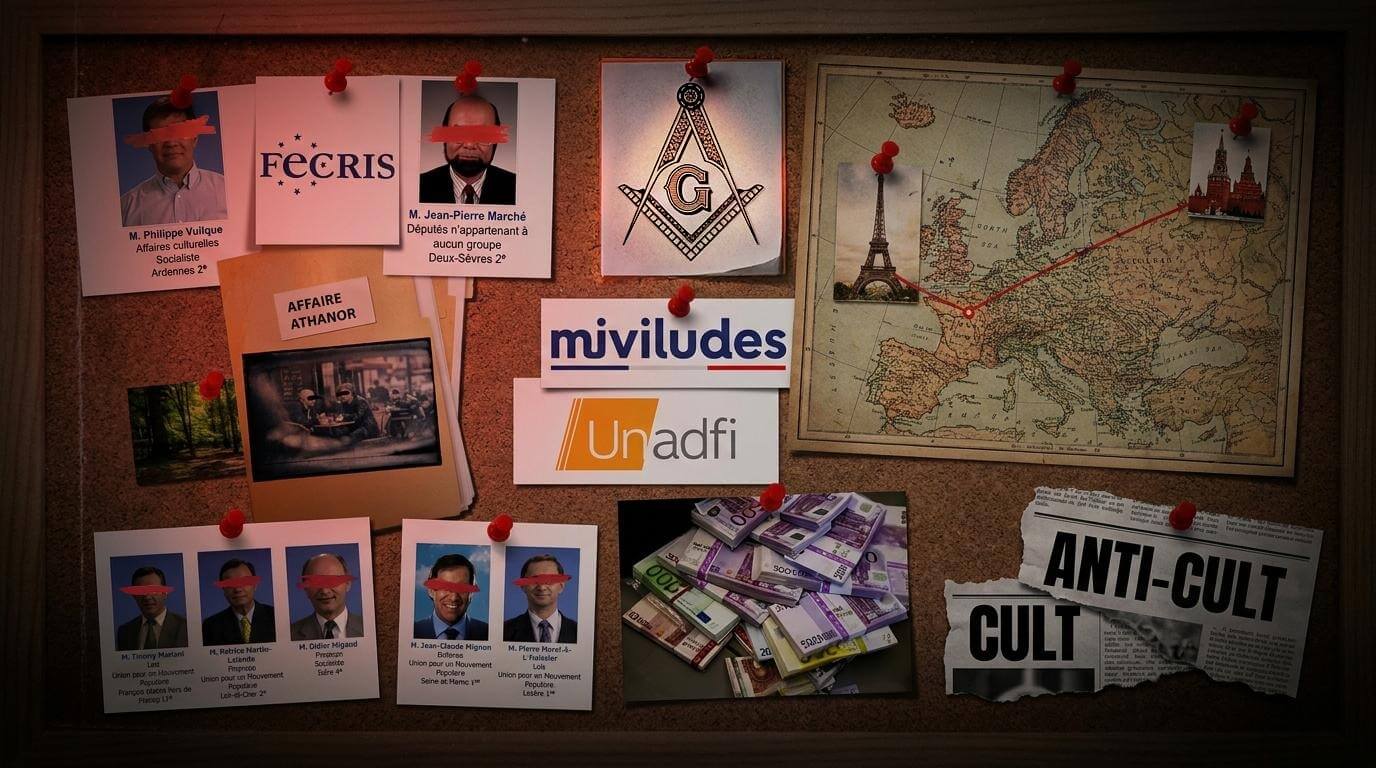
Today, France is witnessing a high-profile trial of 22 defendants in Paris. It has already been called an unprecedented case likened to a spy movie plot. We are talking about a case still little known outside of France, which investigators have dubbed the “Athanor case,” named after the Masonic lodge at the center of the investigation.
The investigation revealed an extensive network of agents suspected of organizing or facilitating targeted violence, planning attacks, contract killings, and various “dirty operations.” A total of 112 crimes have already been identified in this case, including 26 felonies. As of today, the trial is ongoing and is scheduled to run until July 17. At least 13 defendants face life imprisonment.
However, it is important to note that this high-profile case, conducted within the borders of a single country — France — actually unfolds on a completely different scale, transcending both the official investigation and national borders. A direct link has been uncovered between the key figures of this criminal network — the actual organizers of numerous crimes, including murders — and an international anticult network whose ideological center is currently located in Russia.
Precedent: a failed assassination attempt that exposed an underground network
During the investigation, an underground group was uncovered, which included former police officers, intelligence agents, and business analysts. Their violence “contracts” were diverse, ranging from intimidation to murder. Among other things, they are accused of murdering a racing driver and attempting to assassinate professional business coach Mme Marie-Hélène Dini. 1, 2
This long and complex investigation began precisely with the failed attempt on Dini’s life on July 24, 2020. Two suspects arrested near her home claimed they had been misled. According to them, they believed they were going to eliminate a foreign Mossad agent in the person of Dini, and that this mission had been assigned to them by the French state.
Marie-Hélène Dini, who survived a physical assault and later a failed assassination attempt, spoke about the consequences:
“Post-traumatic stress disorder, which I haven’t been able to shake off for six years. It returns periodically. Cancer, and then also being “persona non grata” in my profession. It is very hard to deal with.”
Speaking to the French newspaper Le Monde, Dini said: “I felt as if I were in Russia. As if, without realizing it, I had become embroiled in some sort of mafia-like affair.” 3
The men arrested near the victim’s home claimed to be employees of the French foreign intelligence service with the code names “Dagomar” and “Adélard,” carrying out a mission in France’s interests. 4 The General Directorate for External Security (DGSE, French foreign intelligence) confirmed that the arrested 28-year-old Pierre Bourdin (code-named “Dagomar”) and his accomplice, 25-year-old Carl Esnault (code-named “Adelard”), had indeed served there. However, they were merely security guards at the military base in the commune of Cercottes, where secret agents are trained, and had never been assigned any secret missions themselves.
How, then, did these two former military base guards become involved in this affair? In 2018, Pierre Bourdin met Yannick Pham, a DGSE reservist (French foreign intelligence) and agent of the DGSI* (French domestic intelligence).
* DGSI (Direction générale de la Sécurité intérieure) is the General Directorate for Internal Security, charged with counter-espionage, counter-terrorism, countering cybercrime and surveillance of potentially threatening groups, organisations and social phenomena. 5
Prior to 2014, this agency was known as the DCRI (Direction centrale du renseignement intérieur), which was formed in 2008 through the merger of the DST and the DCRG. 6 It is the DCRG — as a predecessor to the current DGSI that influenced its activities in the context of general intelligence, political, and social monitoring — that will be the focus of this article. Some time later, Bourdin’s new acquaintance, Yannick Pham, offered him secret missions supposedly related to the work of a secret DGSE unit and introduced him to Sébastien Leroy. Sébastien Leroy, in turn, worked for 72-year-old Daniel Beaulieu, a former DGSE agent and former DCRG employee — now the key organizer of the failed assassination attempt on Dini and, more broadly, the mastermind behind this underground network for carrying out “dirty jobs.”
Daniel Beaulieu — former high-ranking officer of the central directorate of general intelligence (DCRG), responsible for the fight against “cults”
As it turned out, Daniel Beaulieu’s career history is far broader than just this underground activity of building a network of contract killers. Its roots go back to the 1990s and 2000s, when he worked for the DCRG (Direction centrale des Renseignements généraux — Central Directorate of General Intelligence, also known as RG — Renseignements généraux — General Intelligence), where he was a divisional inspector heading the unit tasked with monitoring “sects” and “cults.”
Daniel Beaulieu first approached Sébastien Leroy with a request to “beat up” a local councillor from Val-de-Marne right in his own garden. As described in Frédéric Ploquin’s book Les réseaux secrets de la police [Secret Police Networks]: “it could range from a wheelchair to a coffin; the final outcome was left to Beaulieu’s discretion.”
Later, Daniel Beaulieu admitted that he made up the story about the “Mossad agent” to “motivate Leroy and make him think that [the murder of Mme Dini] was a state order.” Does this mean that to provoke someone to murder an innocent person, manipulators like Beaulieu only need to label the target as an agent of a foreign intelligence service? It is remarkable that the activities in which Beaulieu was directly engaged while working at the DCRG — namely, the fight against so-called “sects” and “cults” — involve the use of such methods in the arsenal of those combating “sects.”
Particularly revealing are Beaulieu’s statements during a court hearing in April 2026, which were detailed by journalist Steve Eisenberg in an article titled “Assassinats commandités, francs-maçons, réseaux antisectes et services de renseignement” (Contract Killings, Freemasons, anticult Networks, and Intelligence Services), published on May 14, 2026. 2 Let us quote an excerpt from this article:
“During the hearing on April 8, 2026, before the Paris Court, Daniel Beaulieu was questioned in detail about his personality. The presiding judge of the court noted that he seemed to show multiple faces and asked how she could trust him. Beaulieu’s response was striking: ‘I think this attitude comes from my profession, in which we often operate under a disguise. We lie, we manipulate.’ And this man had been tasked with reporting on religious minorities in the country to the French government.”
“On May 11, the former spy spoke again. Accused of manipulating the operatives of the Athanor agency, he replied: ‘Yes, because manipulation is a form of consent. It’s not me saying this, it’s the researchers: it’s freely chosen submission, comfortable servitude.’”
During a search of his home, police discovered a large collection of books dedicated to manipulation, the art of lying, and psychological influence techniques. Beaulieu clearly stood out as a specialist in these matters.
Observing the obvious correlation between Beaulieu’s methods and his past work, a question arises: did the organizer of this underground criminal network truly leave the DCRG’s unit for “sects and cults,” or was it only a formal departure?
It is also worth noting that many anticult players have no need to be officially listed on the payroll of intelligence agencies in order to combat unwanted organizations and individuals, deploy manipulation and stigmatization techniques, and belong to an international network of self-proclaimed “cult experts.”
Officially, Daniel Beaulieu left the DCRG (RG) in 2009, one year after its merger with the DST and its reorganization into a new agency called the DCRI (Direction centrale du renseignement intérieur — Central Directorate of Internal Security). Beaulieu’s next employer was French foreign intelligence, as noted by journalist Frédéric Ploquin in his book “Les réseaux secrets de la police [Secret Police Networks].”
Here is an excerpt from Frédéric Ploquin’s book “Les réseaux secrets de la police [Secret Police Networks]”:
“One year after the merger of the RG with the DST, he [Daniel Beaulieu] had left the administration, at the end of 2009. His first assignment as a private contractor was in Africa, specifically Cameroon, where he carried out small missions for the DGSE.”
The sequence is remarkable: first, years of fighting “sects,” and shortly thereafter, trips to Africa — a pattern also observed in the activities of other anticultists in different countries.
At the same time, as the investigation and some of Beaulieu’s own statements quoted in Frédéric Ploquin’s book Les réseaux secrets de la police [Secret Police Networks] revealed, Beaulieu continued to maintain contact with individuals from his former workplace in the “sects and cults” unit of the DCRG, and later the DCRI.
An excerpt from Frédéric Ploquin’s book “Les réseaux secrets de la police [Secret Police Networks]”: “Daniel Beaulieu admits to having handled about ten cases for this “Brother,” leading him to believe that he was still active in the intelligence services. He also spoke on the phone at least once a month with Max T., a former chief of staff at the DCRI, whom he had met when he was a probationary police commissioner at the Paris Police Prefecture. He also had a contact at the DGSE, to whom he sometimes passed on information, such as reports coming from the Congo, where one of his former associates, nicknamed Alpha, works. He also had a connection with a divisional commissioner stationed at Interpol through whom he could purchase diplomatic passports.”
But let us return to the story of the failed assassination attempt. Frédéric Vaglio — a 53-year-old entrepreneur, former journalist, and member of the Athanor lodge (which included other accomplices to these crimes, including Daniel Beaulieu himself) — acted as the intermediary between the organizer, Daniel Beaulieu, and the client who ordered the hit on Dini.
The client who ordered to murder Dini was her business coaching rival and the “venerable master” of the same Athanor Masonic lodge in Puteaux: Jean-Luc Avella Bagur (also known as Jean-Luc Bagur or Jean-Louis Bagur). Jean-Luc Avella Bagur owned a competing coaching school, Linkup Coaching, and collected weapons. At some point, he approached his lodge “brother” Frédéric Vaglio with a question of life and death — though not his own. According to investigators, the sum promised for eliminating Dini was “70,000 euros excluding tax” (approximately $80,650).
It all began in 2019, when Dini decided to certify the coaching profession, establish a single, high standard of quality for coaching schools, and eliminate the possibility for self-proclaimed coaching “experts” to conduct training over the phone and issue certificates of questionable quality. This did not please her rival.
The first attack on Dini took place in October 2019, when she was beaten and her laptop was stolen. As it later turned out, this was carried out by Beaulieu’s men. Then, on July 24, 2020, came the failed assassination attempt, which triggered the high-profile ‘Athanor’ case, currently under trial. The attempt on Dini’s life was the catalyst for the investigation, but it was far from the only crime in a chain of offenses carried out over many years by this underground criminal network.
Some journalists note that the verdict in the ‘Athanor case’ should demonstrate “how deeply such networks may have penetrated closed French institutions.” This is an important observation, considering that the list of individuals linked to this underground network of contract killers identified to date remains incomplete.
In this light, one cannot rule out the fact that its key organizer was involved in anticult activities for many years, overseeing this area within the General Intelligence (RG) service. Even after his formal departure, he maintained contact with former colleagues in this structure, which is directly connected to a network of anticult actors operating not only in France but also internationally, and currently coordinated from Russia. More details on the connections of the DCRG with French anticult organizations such as the CCMM, UNADFI, and MIVILUDES will follow.
To quote another passage from Frédéric Ploquin’s book” “He [Daniel Beaulieu] began his career as an inspector with the General Intelligence Service (RG — Renseignements généraux) in 1976, tasked with infiltrating far-right and far-left extremist groups, before joining the Political Unit and eventually taking on the task of monitoring sects. He passed the competitive exams and rose through the ranks to become a division chief and then an operational commander.”
Based on this example and others mentioned below, a question arises: Is fighting “sects” and “cults” actually a stepping stone on the career ladder toward becoming a spy or an intelligence agent? And whose spies are these anti-sect crusaders today?
Another question that arises when studying the anticult movement is why so many opponents of “sects” and “cults” share a common denominator: not only a history of manipulation and a propensity for physical, sexual or psychological abuse, but also traumatic childhood circumstances. For instance, the details of Daniel Beaulieu’s childhood described by Frédéric Ploquin recall the story of Alexander Dvorkin, analyzed in the ActFiles series of articles Sectology Professor Or Serial Killer? and Sectology Professor Or Serial Killer? Part 2. Genesis Of The Motive.
From Frédéric Ploquin’s book “Les réseaux secrets de la police [Secret Police Networks]”:
“Daniel Beaulieu, by the way, was an illegitimate son raised by an alcoholic and violent stepfather.”
“They eliminated the competition — literally — after discovering that it was fairly easy, and inexpensive, to have people killed. Like serial killers, they developed a taste for it.”
To gain a broader understanding of the role of anticultists, and in particular Beaulieu’s example as the organizer of an underground network, it is essential to examine the activities of the DCRG’s “sects” unit, where he worked until the end of 2009.
Connection of the DCRG with MIVILUDES, UNADFI, CCMM, and FECRIS
The Direction centrale des renseignements généraux — the Central Directorate of General Intelligence, better known as the Renseignements généraux (RG or DCRG) — was the intelligence service of the French National Police. It reported to the General Directorate of the National Police (DGPN) and ultimately to the Ministry of the Interior. In addition to political and social monitoring, it was responsible for supervising gambling establishments and racetracks.
As previously mentioned, in the 1990s and 2000s, Daniel Beaulieu served as a divisional inspector at the DCRG (Central Directorate of General Intelligence Service, directly heading the special unit monitoring “sects.” It was this unit that stood behind most major operations against religious and spiritual minorities in France during that period.
Known as the “Cultes et sectes” (Cults and Sects) unit, it was part of the Research Sub-directorate (Sous-direction de la recherche) of the General Intelligence Service (RG). At the time, this Research Sub-directorate was headed by Bernard Squarcini, the former deputy director of the DCRG. He was later sentenced to four years in prison for illegal activities, a ruling he appealed.
In his article “Assassinats commandités, francs-maçons, réseaux antisectes et services de renseignement” (Contract Killings, Freemasons, anticult Networks, and Intelligence Services), journalist Steve Eisenberg summarized the situation at the DCRG as follows:
“To put it briefly: the Research Sub-directorate of the DCRG, led by a man today sentenced in the first instance to four years in prison for criminal activities, housed a cell tasked with monitoring French religious minorities; this cell was itself run by a man [Daniel Beaulieu] whose entire career was built on lying and manipulation, who is now being prosecuted for setting up a network of hitmen within a Masonic lodge. Spot the error.
Yet it was this man and his team who, during the 1990s and 2000s, flooded the political and media spheres with alarming reports about religious minorities in France. Some would say we shouldn’t throw the baby out with the bathwater. But the picture is crystal clear: Beaulieu always viewed his profession as based on lying and manipulation. And this is how French society itself came into being influenced and manipulated — through sensationalist media “investigations” and alarmist parliamentary commissions, all of which relied on “reports” from intelligence agencies. The scandal could ultimately prove to be as massive as that of the Athanor cell itself. Only time will tell.”
Another name is known among the intelligence staff — Daniel Beaulieu’s protégé, Arnaud Palisson. This subordinate of Beaulieu was dismissed from the service in 2002 because his personal obsession with Scientology compromised the quality of his work. As we can see, these three colleagues directly involved in anticult activities and the “Cults and sects” unit within the RG — namely Palisson, his boss Beaulieu, and their supervisor Squarcini — acquired highly questionable reputations for intelligence officers who, ideally, should have been protecting citizens, the country, and democracy.
The “Cults and sects” unit, which reported to the Research Sub-directorate (Sous-direction de la recherche) of the General Intelligence Service (RG), monitored the French branches of various organizations. These included Jehovah’s Witnesses, Sukyo Mahikari, the Church of Scientology, Soka Gakkai, evangelical Christian groups, Buddhist communities, Brahma Kumaris, the Church of Jesus Christ of Latter-day Saints, Seventh-day Adventists, and other religious and spiritual movements and civic organizations.
The activities of this unit were described in detail by journalist Steve Eisenberg in his article. 2 An excerpt is provided below:
“During the 1990s and early 2000s, this unit of the French General Intelligence Service was behind virtually all major crackdowns on religious and spiritual minorities in France. It produced so-called “white notes” [“notes blanches”] — confidential, unsigned memos with no indication of the originating agency — that circulated throughout the government apparatus, reaching as far as the ministries and the presidential palace. These infamous white notes served both as a trigger and a catalyst for France’s anticult policy.”
“But it didn’t stop there. Numerous testimonies and reports suggest that, at that time, the General Intelligence Service (RG) employed particularly questionable methods with regard to religious minorities. Agents were sent to the employers or colleagues of individuals identified as belonging to movements labeled as “sects,” in order to obtain personal information or to provoke their dismissal. All “members” of these movements were reportedly recorded in the RG’s computerized database, along with their addresses, occupations, political views, and religious beliefs. The agency also passed certain names on to journalists at major media outlets so that these individuals could be publicly exposed in investigations focused on “cults.” They worked closely with anticult associations funded by the French government, such as UNADFI (National Union of Associations for the Defense of Families and Individuals) and the CCMM (Center Against Mental Manipulation). In addition, they engaged in many other questionable practices specific to intelligence agencies.“
Consequently, the organizations targeted in the DCRG’s so-called “white notes” were subjected to systematic stigmatization and dehumanization in the media, which fostered a highly negative public perception of them.
These questionable and not always legal practices of the DCRG’s “Cultes et sectes” unit were closely intertwined with the activities of key figures in French anticult policy. One of the central figures in this system was Alain Vivien, a French Socialist Party politician long considered one of the primary ideologues of the fight against “sects” in France. From 1997 to 1998, he headed the anticult organization CCMM (also known as the Roger Ikor Center), with which the DCRG collaborated closely. In 1998, he formally handed this position over to his wife, retaining levers of influence, while he went on to head another French anticult organization, MILS (The Interministerial Mission in the Fight Against Sects, under the French Prime Minister), which was later reorganized as MIVILUDES.
MILS (and subsequently MIVILUDES) maintained close and direct cooperation with the DCRG for many years. Alain Vivien resigned in June 2002, but his connections and influence remained strong, as did the ongoing campaign against targeted organizations. Throughout their existence, both organizations — CCMM and MIVILUDES — have been closely linked to the European umbrella anticult federation FECRIS, whose headquarters have been located in France since founding.
Alain Vivien’s direct Russian connections are notable, including his trips to Russia. In particular, in April 2001, Vivien attended a conference in Nizhny Novgorod organized by Alexander Dvorkin. Among the speakers at this conference were radical figures such as Archpriest Dmitry Smirnov (who made public statements on the necessity of pushing the nuclear button and destroying the world if required), Dvorkin himself (the ideological leader of the modern anticult network), and many other Russian anti-sect crusaders.
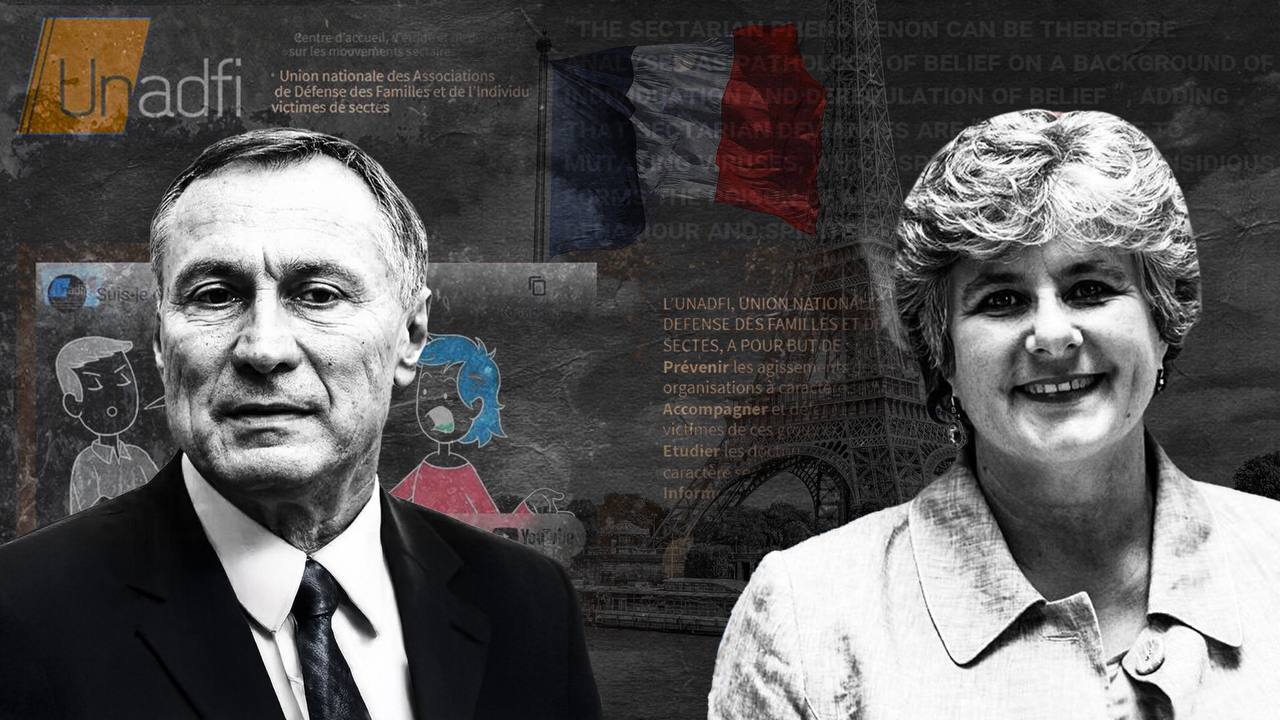
The anticult organization UNADFI also played a visible role in cooperating with the DCRG. Established in 1982 as an umbrella structure for existing regional ADFI groups, UNADFI is one of the oldest such organizations in France. A key member of this anticult organization was the German anticultist Friedrich-Wilhelm Haack, which points to its supranational character and direct connection to anti-cult ideologues in other countries. Indeed, it was UNADFI that initiated the creation of the FECRIS umbrella federation; the decision to establish it was made in Barcelona in 1993. The official founding date of FECRIS is 1994. CCMM and UNADFI are the two primary cooperating partners in the French anti-sect milieu; both are officially listed by MIVILUDES as key partner associations, and both have a long history of close collaboration with the DCRG.
It is worth briefly noting that Haack, a German ADFI member, played a pivotal role alongside his fellow believer, Danish theologian Johannes Aagaard, in training a new generation of the anticult school and forming a unified international network of anticult actors. Many of Aagaard and Haack’s disciples joined FECRIS after the umbrella federation was established. In 1993, Alexander Dvorkin, a student of Haack and Aagaard, began organizing this network under his leadership, becoming vice president of the Dialog Center International, which had been founded by his mentors. Years later, Dvorkin would become vice president of FECRIS, serving in this role until 2022, after which he remained on the FECRIS board of directors.
Thus, in the 1990s, an international network of agents became firmly established, with direct ties to the structures of both the French intelligence services and those of other countries — specifically the Russian FSB, which will be discussed later. With each passing year, this network only grew stronger, consolidating its power and connections.
Another common characteristic among key anticult players is quite remarkable. Much like Daniel Beaulieu, who belonged to the Athanor Masonic lodge (which was affiliated with the Grande Loge de France until its dissolution), Alain Vivien, another key figure in the French public arena, was also a Freemason. This is mentioned in the book “On Our Defeat: Christianity at the Limit of History” by former Russian anticult insider Deacon Andrei Kuraev, who knew the inner workings of the anticult movement.
Similarly, Friedrich-Wilhelm Haack, the German anticult figure mentioned earlier, was a member of the “Rose of the Seven Seals” Masonic lodge and received the Bernhard Beyer Medal 7 from the United Grand Lodges of Germany (Vereinigte Großlogen von Deutschland) in 1982. Furthermore, Haack was the direct successor to Walter Künneth, a Nazi ideologue and anti-sect crusader. The new generation of anticultists trained by Haack and Aagaard adopted Künneth’s Nazi legacy, inheriting the expertise, methodology, and ideology of the Apologetic Center for fighting “sects,” which Künneth had headed since 1932.
It is also worth briefly mentioning Ivan Odilo Štampach, a key anticultist in the Czech Republic who helped establish the Czech anticult cell. In 1991, Štampach became a member of the Grand Lodge of the Czech Republic, a fact he has publicly stated. 8, 9
At first glance, this information raises a question: Why would certain anticult actors, who are part of an extensive international network of agents, join Masonic lodges in their respective countries? However, upon a closer examination of the methods anticultists use to gain influence and the objectives they pursue, the answer becomes obvious. Let us examine this using France as an example.
In France, where Freemasonry historically wields influence in politics, business, public administration, and law enforcement, joining a lodge provides anticult agents with a convenient opportunity to build ties with influential figures and expand their network of contacts. These closed Masonic networks operate on principles of brotherhood, mutual aid, and discretion — that is, secrecy: a brother is obligated to help another brother without asking unnecessary questions. This is an ideal environment that anticult agents are more than willing to exploit, just as they are willing to manipulate their fellow lodge “brothers” for self-serving, and often maniacal or criminal, purposes, as clearly demonstrated by the Athanor lodge case. In this way, they not only receive prompt assistance but also gain significant channels of influence over politics, society, and the media without any unnecessary questions.
“‘It could expand my network in this environment,’ explained Daniel Beaulieu, member number 12475 within the Athanor lodge.” (As quoted in Frédéric Ploquin’s book “Les réseaux secrets de la police [Secret Police Networks]”)
The founder of the Grande Loge de l’Alliance Maçonnique Française (GLAMF) and its first Grand Master (Grand Maître), Alain Juillet, commented on the Athanor lodge affair:
“They did not see that there were thugs among the younger Brothers,” laments Alain Juillet. “There was one, inevitably, who influenced the others. This behavior is so utterly contrary to our values that it’s hard to comprehend,” — from Frédéric Ploquin’s book “Les réseaux secrets de la police [Secret Police Networks].”
But let us return to the General Intelligence Sub-division of France. Over the years, the DCRG has repeatedly been accused of illegally spying on journalists and political opponents of the ruling government — and these accusations, by all accounts, were well-founded. Beyond political influence, from the 1990s onward, the service increasingly focused on new priorities:
“From the 1990s, the RG have been confronted to new events. They now particularly monitor radical Islamism, anti-Globalization movements, and cults.” 10
The DCRG’s role became particularly prominent in 1995. That year, a parliamentary commission on cults was established in France. This commission relied on both DCRG materials and data, as well as on a report by Alain Vivien. In its 1995 report, under the pretext of “assessing the scale of the cult phenomenon,” the special commission compiled a list of 173 organizations and groups labeled as “cults” that met at least one of ten “danger criteria.” These danger criteria had been defined by the aforementioned Central Directorate of General Intelligence (DCRG / RG).
The foundation for the 1995 commission was Alain Vivien’s report, written and published in 1985 under the title “Sects in France: An Expression of Moral Freedom or Factors of Manipulation.” Since more than a decade had passed since that report, the commission declared that a new assessment of the “cult phenomenon” was necessary, arguing that its evolution since Vivien’s report was poorly strudied.
“Established on July 11, during the meeting it held on July 18, the Commission decided to classify all of the hearings it would conduct as confidential in order to ensure that the individuals whose testimony it requested could speak with the highest degree of openness. In accordance with the commitment made to the witnesses, this report will therefore not include, as an appendix, the transcripts of the hearings that formed the basis of the Commission’s deliberations, nor even the list of individuals it heard. In the same spirit, the report does not mention the source of the statements it cites.” — Gest-Guyard Report 11.
In other words, all findings in the new 1995 report were presented without any actual evidence. This approach mirrors the methods of Daniel Beaulieu, the former head of the RG unit against “cults and sects,” which he described during his April 8, 2026, hearing before the Paris Assize Court. They are worth quoting again:
“I think this attitude comes from my profession, in which we often operate under a disguise. We lie, we manipulate.’ This, then, was the man entrusted with the mission of informing the French state on religious minorities present in the country.”
“On May 11, the former spy spoke again. Accused of manipulating the operatives at the Athanor facility, he replied: ‘Yes, because manipulation is a form of consent. It’s not me saying this, it’s the researchers: it’s freely chosen submission, comfortable servitude.’”
It was precisely the data from the DCRG and its “Cults and Sects” unit, headed by Beaulieu, that the special commission relied upon in its 1995 report. The conclusions reached by the commission are particularly worth examining:
“In the course of its work, the Fact-Finding Commission concluded that individuals who, in one capacity or another, encounter issues related to cults in their professional activities — particularly civil servants — should receive specialized training in this area. Indeed, one cannot overestimate how vast, complex, and clandestine this phenomenon is. For, as several experts on the subject assert, “cults often operate under a disguise.’”
Once again, the words spoken by Daniel Beaulieu — an active fighter against these very “cults” — come to mind: “this attitude comes from my profession, in which we often operate under a disguise. We lie, we manipulate.”
Indeed, it is very common in the statements of various anticultists to accuse others of the very things they themselves are guilty of.
Let us examine the following passage, which specifies who, in the commission’s view, should undergo special training in anticult methods:
“The individuals concerned are primarily police officers and gendarmes, magistrates, teachers, and social workers, as well as doctors and notaries.
It therefore seems appropriate to include in both the initial and continuing training of public officials, as well as relevant private sector personnel, programs or, at the very least, awareness-raising initiatives — such as lectures — on the problems posed by sects and the remedies available to address them.
The Central Directorate of General Intelligence (DCRG) recently set the standard in this area. For the past three years, trainee commissioners, trainee inspectors, and inspectors newly assigned to the RG have received training on sects. In addition, the DCRG organizes one or two days of training once a year for agents responsible for monitoring sects.
In this regard, it appears essential that specific training also be provided to students at the National School for the Judiciary (École nationale de la magistrature), as well as to those at training schools for police commissioners, inspectors, officers, and the gendarmerie. It is also important that student teachers and those preparing for the medical or notary professions benefit from this.”
Item 7 of the same report outlines the goal to “increase international cooperation, particularly within the European Community.” Given the existence of an already established international anticult network by 1995, strengthening international cooperation apparently posed no difficulty.
Notably, during the 1990s, the coordinating hub of the entire international anticult network shifted and gradually established itself in Russia under the ideological leadership of Alexander Dvorkin.
Further analysis of the individuals on this 1995 special commission, their connections, and their subsequently observed political views only confirms that the ideological center of the anticult network was indeed situated in Russia. This will be discussed in more detail later.
In the concluding section of the confidential report, the commission suggests that France should not act independently within its own borders, but rather become an active participant in unified international coordination:
“since a national approach alone does not allow for a correct understanding or effective action, international coordination is essential.”
It is worth noting that this official commission report — the Gest-Guyard Report 11 — was published on December 22, 1995. The very next day, December 23, the country learned of a tragedy: the bodies of 16 victims of a collective suicide-murder of members of the Order of the Solar Temple were found in Switzerland and France. Although the Order was not included in the commission’s list, these events dramatically amplified the public resonance of the report and the overall anticult agenda.
A typical anticult pattern is clearly recognizable in this sequence of events: practically every significant step taken by anticult agents in their alleged exposures of “sects” was followed by a high-profile event or crisis, and each new report either preceded or was released on the very eve of a new tragedy. A detailed analysis of this pattern, linked to major tragedies in various countries, is beyond the scope of this article but will certainly be examined in the future.
As a result, in France, against the backdrop of the high-profile tragedies surrounding the Order of the Solar Temple and the concurrent release of the special commission’s report, a series of subsequent events unfolded. In 1996, the Interministerial Observatory on Sects (Observatoire interministériel sur les sectes) was established, followed in 1998 by MILS, which was headed by Alain Vivien.
It is noteworthy that many key figures in this 1995 commission, which worked closely with the DCRG and with anticult organizations existing at the time, not only engaged in active anticult efforts but later demonstrated consistent pro-Russian views and lasting ties to Russian political circles—not only in terms of cooperation but also funding and propaganda. Let us consider some examples of this combination of anticult activism and Russian ties among the commission’s members.
For instance, Jacques Myard, a member of the aforementioned special commission on cults, also proposed the creation of a new parliamentary commission on “sectarian aberrations” in 2008. Additionally, he was a member of the French Center for Intelligence Research (CF2R), an organization repeatedly accused of spreading Russian disinformation. Myard openly opposed EU sanctions following the annexation of Crimea. In 2015 and 2016, he made several visits to occupied Crimea alongside Thierry Mariani and others, publicly declaring: “Crimea is Russian, so what?” (“La Crimée est russe, et alors ?”), kissing a symbolic statue of the “annexation,” and acting as an “observer” in elections organized by the Russian authorities.
Another example is Jean-Pierre Brard, a former Communist MP, who had long-standing institutional links to the USSR: his party received funding from the CPSU (Communist Party of the Soviet Union), conducted joint events, and maintained close relations. After 1995, he continued to actively promote the anticult agenda both in parliament and in the media, served on the steering committee of MIVILUDES, and remained a prominent figure in the field well into the 2020s.
Another prominent anticult figure and member of the 1995 special commission, Rudy Salles, served on the France-Russia friendship group between 2012 and 2017—precisely during the period he was appointed as the National Assembly’s representative to the MIVILUDES board in 2012. He was highly active in anticult initiatives, serving as a rapporteur in the Parliamentary Assembly of the Council of Europe on protecting minors from “sectarian excesses,” and actively promoted the French model of fighting “sects” at the European level as recently as 2023.
Given that FECRIS was under Russian leadership starting in 2009 — when Alexander Dvorkin became the vice president of this French umbrella anticult federation, subsequently remaining on the FECRIS board of directors after 2022 — critical questions arise: Was it really the French model of anticultism that Rudy Salles was promoting? Or, under the guise of the French-registered FECRIS, was he promoting the adapted ideology and methodology of the Russian radical anticultist Alexander Dvorkin, whose Russian anticult organizations and activists cooperate closely with the FSB?
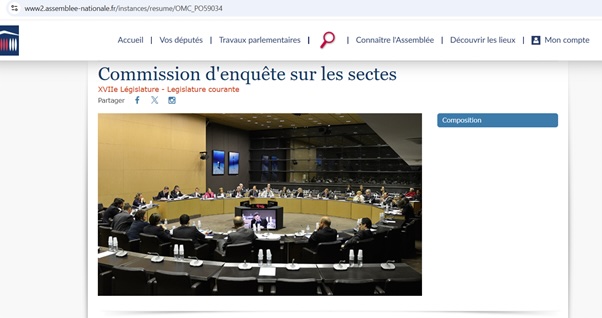
However, the most prominent figure on this list of members of the 1995 special commission is Thierry Mariani. He served on the parliamentary commission of inquiry into sects for two years, from July 5, 1995, to April 21, 1997. 12, 13, 14
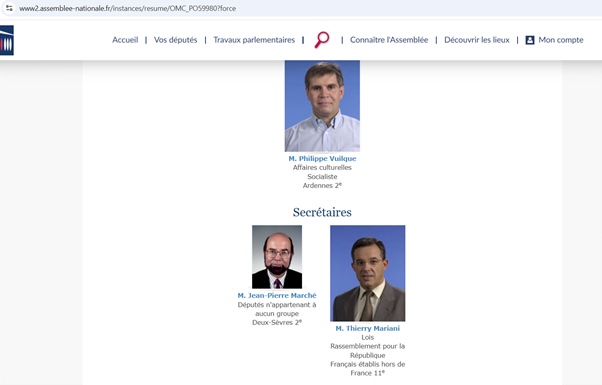
Thierry Mariani also served as secretary of the Study Group on Sects from March 4, 1998, to June 18, 2002. 12, 15
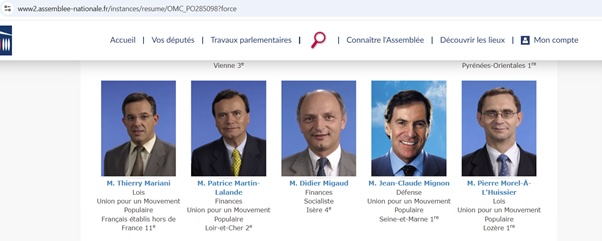
Furthermore, Mariani served as a member of the Study Group on Sects during the following periods 16:
- December 26, 2002, to June 19, 2007;
- March 4, 1998, to June 18, 2002;
- August 22, 1996, to April 21, 1997.
In subsequent years, he repeatedly employed anticult rhetoric, notably in his 2007 parliamentary questions, where he cited MIVILUDES reports and raised alarms about the dangers of “sectarian aberrations” in healthcare and social programs. Thierry Mariani’s subsequent career demonstrates a profound Russian alignment. Observing this, the question raised earlier arises once again: Does engaging in the fight against “sects” serve as a stepping stone on a career path toward becoming a spy or an agent, and whose spies are these anti-sect crusaders actually working for today?
Mariani’s later connections to the Russian side became overt, and these networks also accommodated anticult agents who were members of MIVILUDES. In 2019, Georges Fenech, an active anticult figure and former president of MIVILUDES, joined a delegation led by Mariani. Together, they visited occupied Crimea. The trip was organized and funded by Russian entities, and the delegation was welcomed by Leonid Slutsky, chairman of the State Duma Committee on International Affairs. Mariani had also visited Crimea in 2015 and 2016, once again at Slutsky’s invitation. During those visits, Mariani was accompanied by Jacques Myard, his colleague from the 1995 commission on cults. According to an investigation by The Insider, the “Orthodox oligarch” Konstantin Malofeev played a key role in funding Mariani’s trips to Crimea. 17
“Yesterday, a group of ten French MPs visited Crimea, after which they met with State Duma Speaker Sergei Naryshkin, declared their recognition of the peninsula’s accession to Russia, and criticized international sanctions against the Russian Federation. The Insider took a closer look at the members of the French delegation and recognized familiar names among them. This article is about how the same group of MPs little known in France tours different cities, participating in events funded by the ‘Orthodox businessman’ Konstantin Malofeev…” — from the article “French Kiss: How French MPs Help Promote the Kremlin” published by The Insider.
Thanks to The Insider’s investigation, it was revealed that Thierry Mariani’s connections spanned from Konstantin Malofeev to Sergei Naryshkin. Naryshkin is the director of Russia’s Foreign Intelligence Service (SVR), which succeeded the KGB’s First Chief Directorate. He has been linked to Latvian politician Tatjana Ždanoka, who in 2024 was exposed 18 as having spent decades working for Russian intelligence under the direction of officers from the FSB’s Fifth Service. 19
Tatjana Ždanoka is briefly mentioned here because she personally knew and maintained contact with Alexander Dvorkin, meeting with him at least as early as 2010. Furthermore, key figures of the Latvian anticult cell, which also operated as a branch of FECRIS, were members of her political party, the Latvian Russian Union. These Latvian anticultists are members of FECRIS and collaborate closely with other anticult actors in various countries, including France, Italy, the United Kingdom, Germany, Belgium, and others.
Notably, one of Ždanoka’s party colleagues, Andrejs Mamikins — who opened the international FECRIS conference in Riga in 2018 20 — subsequently fled to Russia, where he continues his active propaganda work. He is currently wanted internationally for justifying crimes against humanity committed by Russia in Ukraine and remains a fugitive.
Another former president of MIVILUDES, Serge Blisko, has repeatedly shared the stage with Russian anticult figures Roman Silantyev and Alexander Dvorkin. 21 Meanwhile, Silantyev himself publicly stated in 2019 that he collaborates closely with the FSB. 22 In June 2022, during the active phase of the war in Ukraine, Silantyev visited the Donbas region to address young people, spreading anti-Ukrainian and anti-Western ideology. 23
A month later, on July 15, 2022, Silantyev attended an anticult conference in Paris. The event was dedicated to “the influence of religious cults on mental health, social relations, and politics.” The conference was opened by Didier Pachoud, treasurer of FECRIS and head of GEMPPI, the primary French branch of FECRIS. This became public in September 2022, when a press release was issued.
The press release contained the following statement regarding Roman Silantyev’s participation: “Professor Roman Silantiev talked about the new applied science called ‘destructology,’ which studies destructive ideologies of both religious and secular nature.” 24
While these facts span a long period and could be dismissed as unrelated, the persistent reappearance of the same names in anticult circles across the 1990s, 2000s, 2010s, and 2020s points to a pattern rather than mere coincidence. Many key figures who fought “sects” within France demonstrated — either concurrently or subsequently — highly visible, close links to Russian political and ideological circles directly tied to Russian intelligence. They frequently became conduits for anti-democratic rhetoric and propaganda serving the interests of the FSB and Russian anticult structures (which since 2006 have operated under RACIRS, whose president is Alexander Dvorkin).
This chronology illustrates how the interactions within these agent networks evolved over the years. The year 2006 is particularly noteworthy. On June 28, 2006, the National Assembly unanimously established a new fact-finding commission on the influence of cult movements on minors. Georges Fenech was appointed its chairman, and Philippe Vuilque served as rapporteur. The commission’s membership included several figures from the 1995 commission: Martine David and Alain Gest (as vice chairpersons), with Jean-Pierre Brard and Rudy Salles serving as secretaries.
On December 19, 2006, the commission presented a new report containing 50 recommendations for the protection of children. At the time, Georges Fenech openly accused officials at the Ministry of the Interior of “negligence, even complicity” regarding so-called “sects.” Ultimately, the anticult agenda served as a convenient cover for introducing narratives beneficial to Russian ideologues and propagandists into the European democratic space.
Long-standing anti-Americanism of French anticult Cells
It is also important to mention the criticisms directed at both the DCRG and anticult organizations in France. Anticultists, particularly those in France, have long been accused of anti-Americanism due to the narratives they broadcast into the European information space. From its very inception, the European anticult network, led by its flagship organization FECRIS, has built its identity around countering a perceived “American threat.”
The core narrative they have promoted for decades asserts that new religious movements — which they dismissively label “sects” and “cults” — do not emerge organically. Instead, they claim these groups are deliberately engineered “Trojan horses” deployed by the United States to Europe. In their view, the objective of this covert operation is to erode the national and cultural identity of European nations, dismantle traditional values, and ultimately secure U.S. geopolitical hegemony.
Even decades later, anticult activists still rely on the same source material from the late 1990s and early 2000s. Specifically, they refer to French anticult journalist Bruno Fouchereau’s book “La Mafia des sectes” (The Sect Mafia) [1996] and his article “Les sectes, cheval de Troie des Etats-Unis en Europe” (Sects: The Trojan Horse of the United States in Europe) 25, published in the May 2001 issue of Le Monde diplomatique 26.
Notably, the publication and dissemination of Bruno Fouchereau’s work coincided with the active work of the DCRG’s “Cults and Sects” unit. This might have seemed like a mere coincidence, were it not for the fact that the DCRG did not merely monitor groups; it actively influenced numerous media outlets, serving as a primary source of information and narratives for press coverage of the anticult agenda.
Whether DCRG personnel and Bruno Fouchereau were linked directly or connected indirectly through a shared ideological framework remains unclear. In either case, these were parallel and ideologically identical developments operating within the same anticult climate of 1990s and 2000s France. State entities like the DCRG and MIVILUDES set the agenda, while journalists like Fouchereau actively expanded and radicalized it, infusing it with the anti-American bias required by anticult operatives.
The very title of Fouchereau’s article speaks for itself. For anticultists, these writings became irrefutable “proof” of an American conspiracy. They continue to be cited as hard facts to frame their activities as a crucial battle for national security.
The fact that this isn’t merely the personal opinion of individual FECRIS activists, but rather the official position of the entire organization, is confirmed by FECRIS’s own documents. The materials from the 2005 FECRIS conference in Madrid state the following 27:
“The wide development of our network is due to the migration of cults/sects from the USA and Western Europe to Eastern Europe resulting in the progressive creation of Eastern European associations which then became FECRIS members and correspondents.”
In this instance, FECRIS positions itself as a protective bulwark for Europe against cultural and ideological expansion originating in the United States and the wider West. For the federation, the threat lies not in the targeted groups themselves — which they dismissively label “sects” — but rather in their “American origins.” This rhetoric closely mirrors Russian propaganda narratives regarding the “threat to spiritual security” and the “corrupting West,” serving as a carbon copy of the unified ideological blueprint devised within the Russian Association of Centers for Religious and Sectarian Studies (RACIRS), led by Alexander Dvorkin.
The same FECRIS publication from the 2005 Madrid conference lists the countries where its 45 member associations were active at the time, demonstrating a vast, coordinated network even at that time:
“To date [2005] the Federation covers 45 associations spread over 29 countries: Argentina – Armenia – Australia – Austria – Belgium – Belarus – Bulgaria – Cyprus – Estonia – Finland – France – Germany – Ireland – Italy – Israel – Lithuania – Malta – Norway – Netherlands – Poland – Russia – Serbia – Slovakia – Sweden – Switzerland – Spain – Ukraine – United Kingdom – United States.”
As we can see, the stance of the French anticult actors organized under FECRIS almost verbatim echoes the rhetoric delivered for decades from the Kremlin’s podiums and the pulpits of the Russian Orthodox Church. The key difference is that in Russia, these matters are steered less by official church leadership and more by RACIRS President Alexander Dvorkin — the most notorious figure in Russian and international “sectology,” whom independent ActFiles journalists have written about extensively.
French funding of anticult organizations
The main funding channel for FECRIS was MIVILUDES, an agency reporting directly to the French Prime Minister. It was through this body that the French state generously funded both the umbrella federation and other anticult associations. This is confirmed by data presented in the book “Anti-Sect Movements and State Neutrality: A Case Study: FECRIS” authored by prominent scholars and lawyers from five European countries in 2013:
“Over the last ten years, FECRIS has been financed almost entirely by the French State, in the form of special funding by the Prime Minister. Its ratio of public funding by the French State compared to its private memberships/donations has averaged 92% since 2001.”
According to the same study, UNADFI, the largest French anticult structure, received approximately 96% of its budget from public funds over a period of at least 17 years. The CCMM (Centre contre les manipulations mentales) was 98% state-funded between 1999 and 2011, and the Marseille-based organization GEMPPI received 94% of its funding from the state between 2003 and 2011.
Such reliance on a single source of funding seriously calls into question the genuine independence of the entire network. In essence, FECRIS and its key actors were structures whose activities could easily be influenced both by French officials, including those mentioned above, and by those holding leadership positions within these organizations.
Consequently, the French state, without realizing it, created an ideal structure for external infiltration — one entirely dependent on state funding, yet possessing a respectable European facade and an aura of legitimacy. For those wishing to exploit this organization for their own purposes, only one step remained: to put “their own” person in charge.
That person was Alexander Dvorkin, who was elected vice president of FECRIS in May 2009. Just a month earlier, in April 2009, he had been appointed head of the Expert Council on State Religious Evaluation under the Ministry of Justice of the Russian Federation. Thus, the individual shaping state policy on religious expert evaluations in Russia simultaneously assumed a high-ranking post in the European umbrella organization. Upon taking a leadership position at FECRIS in 2009, Dvorkin definitively transformed the network into an effective mouthpiece for RACIRS’s ideological agenda, which consistently aligned with the objectives of Russian intelligence services.
Conclusion
This article presents only a fraction of the available information regarding the connections between anticult actors and covert criminal spy networks. The ‘Athanor’ case examined here has proved highly illustrative, revealing the potential methods in the toolkit of anticultists — specifically, the creation of underground networks capable of deploying violence or even committing murder, naturally for a price. However, this story is not confined to France, nor is it limited to Europe. An analysis of the data indicates the need for a comprehensive international investigation into this vast, far-reaching global network of agents and spies operating under the guise of “fighting sects and cults,” who evidently pose a threat to the entire democratic world.
To be continued.
Sources:
1. https://www.france24.com/en/france/20260330-french-masonic-lodge-at-heart-of-murky-murder-trial
2. https://religactu.fr/assassinats-commandites-francs-macons-reseaux-antisectes-et-services-de-renseignement/
3. https://www.lemonde.fr/m-le-mag/article/2026/03/30/les-francs-macons-barbouzes-de-la-loge-athanor-devant-la-justice-entre-agressions-tentatives-de-meurtre-et-assassinat_6673129_4500056.html
4. https://www.bfmtv.com/police-justice/agents-de-la-dgse-faussement-missionnes-loge-maconnique-les-dessous-de-l-assassinat-rate-qui-a-mis-au-jour-la-tentaculaire-affaire-athanor_AN-202603280042.html
5. https://en.wikipedia.org/wiki/General_Directorate_for_Internal_Security
6. https://web.archive.org/web/20081005112312/https:/www.interieur.gouv.fr/sections/a_l_interieur/le_ministre/interventions/reorganisation-renseignement
7. https://web.archive.org/web/20210703185306/https://library.oapen.org/bitstream/id/c9c6cd4c-62ce-47e9-9365-e3a578ef6f00/1005983.pdf
8. https://web.archive.org/web/20071217042322/http://archiv.natia.cz/archiv1/393.htm
9. https://www.christnet.eu/clanky/2905/cirkev_a_svobodni_zednari.url
10. https://en.wikipedia.org/wiki/Direction_centrale_des_renseignements_g%C3%A9n%C3%A9raux
11. https://www.assemblee-nationale.fr/rap-enq/r2468.asp
12. https://www.assemblee-nationale.fr/dyn/deputes/PA2073/fonctions?archive=oui
13. https://www.assemblee-nationale.fr/13/tribun/fiches_id/old/2073.asp
14. https://www2.assemblee-nationale.fr/instances/resume/OMC_PO59034
15. https://www2.assemblee-nationale.fr/instances/resume/OMC_PO59980
16. https://www2.assemblee-nationale.fr/instances/resume/OMC_PO285098
17. https://theins.ru/politika/11446
18. https://www.expressen.se/nyheter/varlden/eu-ledamot-rysk-agent-avslojas-av-lackta-mejl/
19. https://theins.press/en/politics/268694
20. https://www.unadfi.org/wp-content/uploads/2019/07/Fecris-Riga-mai-2018-Compte-rendu.pdf
21. https://europeantimes.news/2022/08/how-the-french-miviludes-compromised-itself-with-russian-extremists/
22. https://www.interfax.ru/russia/685440
23. https://vrns.ru/news/roman-silantev-provel-v-luganske-seminary-po-destruktologii-i-metodakh-borby-s-satanizmom/
24. https://web.archive.org/web/20221002092113/https:/www.timesnewswire.com/pressrelease/how-cults-affect-mental-health-social-relations-and-politics/
25. https://www.monde-diplomatique.fr/2001/05/FOUCHEREAU/1765
26. https://cesnur.net/wp-content/uploads/2022/05/tjoc_6_3_2_whitepaper.pdf
27. https://www.fecris.org/uncategorized/presentation-of-fecris/