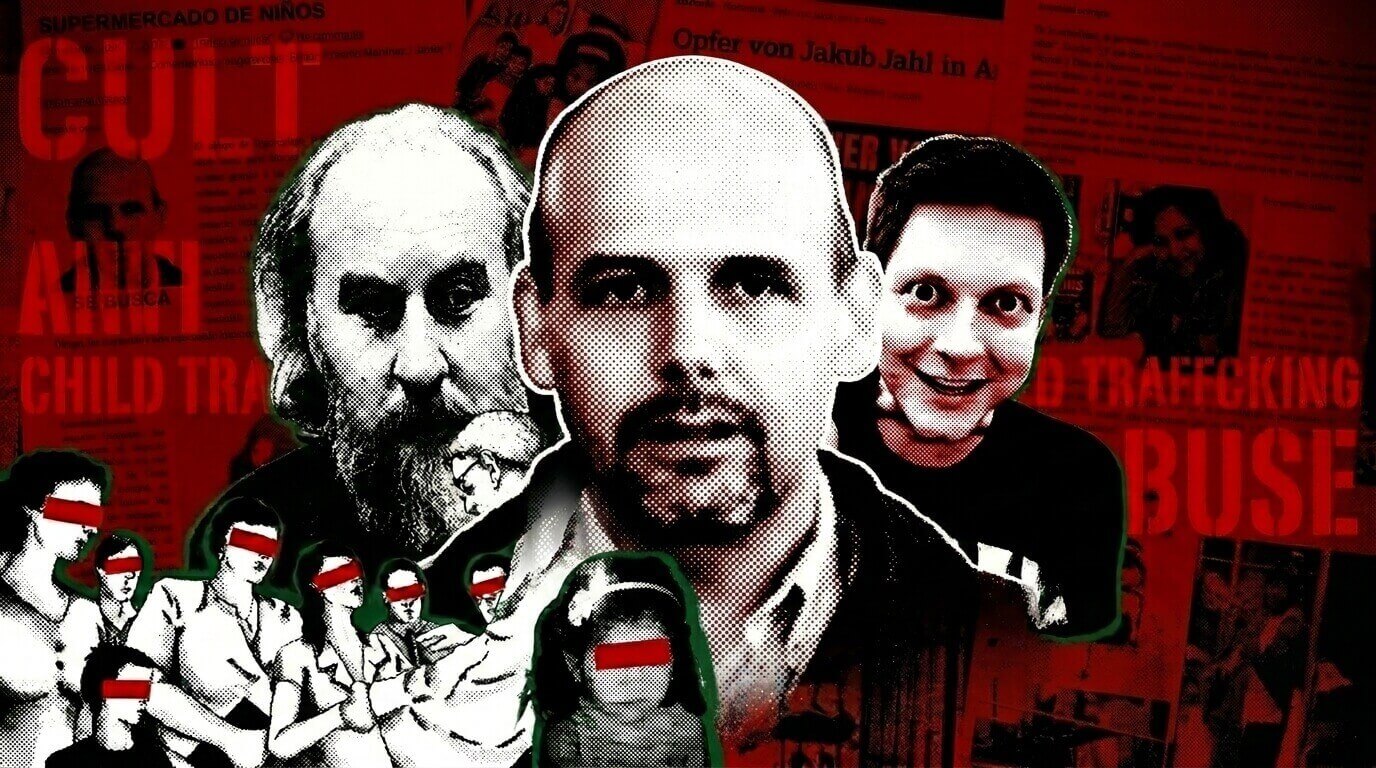
On a dark November evening in 2008, fourteen-year-old Brenda Bernal Hernández jumped barefoot from the second-story roof of the “Refugio de Amor” orphanage in San Nicolás de los Garza, Nuevo León. She fled into the night to escape the physical and psychological abuse she was enduring. This single girl’s desperate escape tore away the veil hiding one of the most monstrous totalitarian cults of modern times. The worst part of the story was that this totalitarian cult controlled a network of children’s orphanages. Its creator and leader, a Mexican national named Jorge Erdely Graham, remains at large today, 18 years after Brenda Hernández’s escape.
Jorge Erdely Graham is a theologian who sits on the advisory board of the International Cultic Studies Association (ICSA)1. He has been an active participant in FECRIS, the European umbrella anti-cult organization, and a speaker at annual anti-cult conferences. In the past, he was a frequent guest on Mexican television as an expert on “sects and cults,” and he authored books criticizing religious groups, such as The Exploitation of Faith and Abusive Pastors (Explotación de la fe and Pastores que abusan).
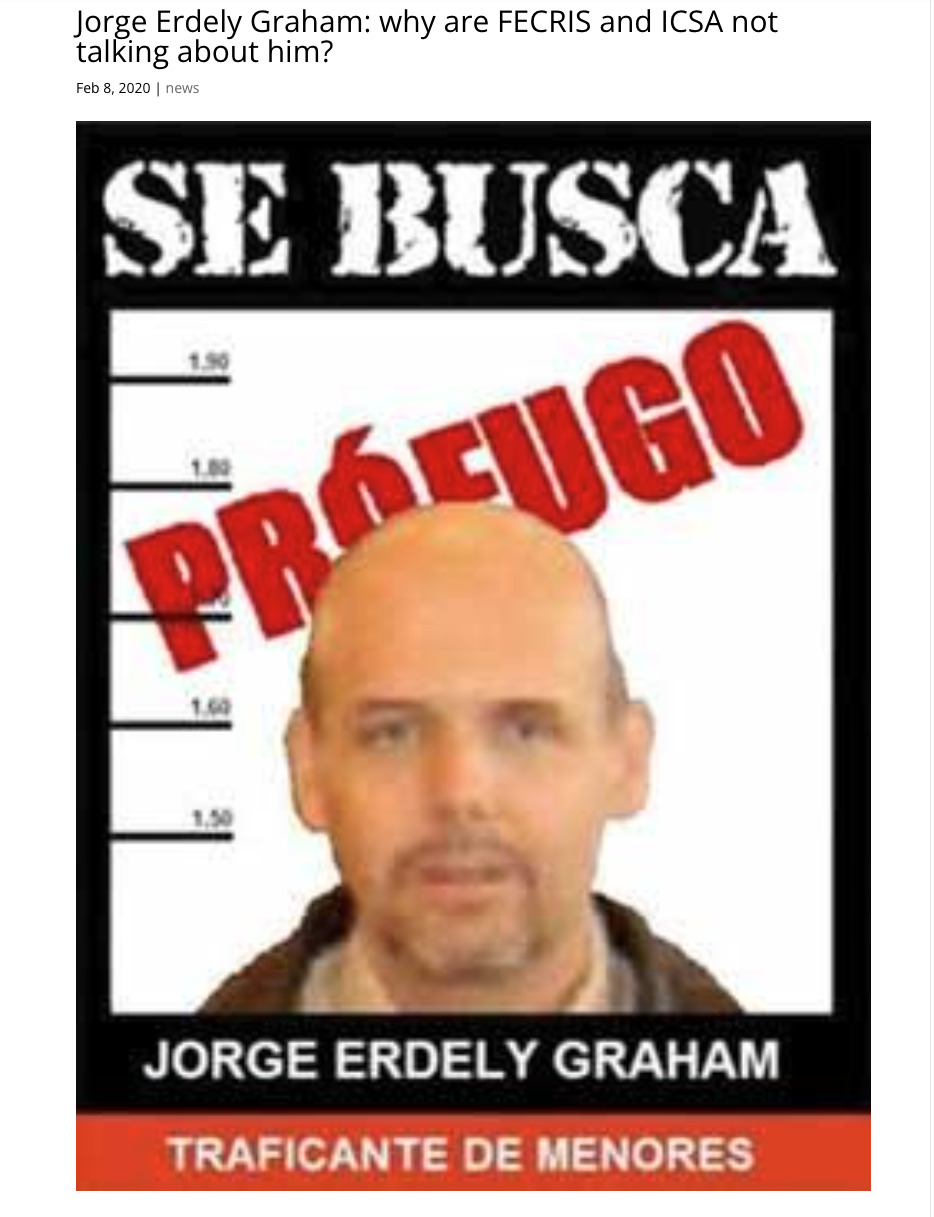
Erdely also established an anti-cult cell in México: the Center of Research of the Christian Institute of México (Centro de Investigaciones del Instituto Cristiano de México), where he was considered an expert on theological matters and issues of faith. Using this anti-cult facade, he built a reputation that allowed him to secure financial resources from various municipal, regional, and even federal government authorities to fund his activities. For many years, this was his public face.
In reality, however, he had built a totalitarian empire where numerous children were subjected to persistent abuse, sexual exploitation, psychological conditioning, labor exploitation, trafficking, and, according to testimonies, even illegal organ harvesting. Illegal adoptions were also documented among the offenses committed at these orphanages. His empire proved to be part of a vast network operating across multiple countries.
Jorge Erdely branded others as “cults,” accusing them of psychological control, financial exploitation of followers, and the destruction of families. Yet while Erdely was fighting these so-called “cults,” he was simultaneously leading the Restored Christian Church (Iglesia Cristiana Restaurada, also known as “Los Perfectos”), which managed dozens of shelters where all the horrific practices he condemned in other organizations were taking place.
In this case, the theory that those who fight against “sects and cults” frequently accuse others of the very offenses they themselves commit has once again proven to be valid and true. These crimes were deliberately organized, streamlined, and systematically carried out since at least the year 2000, operating like a literal production line in a large-scale industry. The operation relied on a network of 40 orphanages across the country — 40 have been confirmed, but there are likely more — along with established schemes for transporting and selling children, and covering up tracks. Notably, front organizations and associations were used to establish the orphanage network, including the anti-cult cell itself, the Center of Research of the Christian Institute of México (Centro de Investigaciones del Instituto Cristiano de México),2 which Erdely founded.
Because Jorge Erdely Graham himself was the face of the Mexican anti-cult cell within the ICSA and sat on its advisory board, the center under its leader’s direction likely maintained close cooperation with the US-based ICSA, which operates internationally.
It is also crucial to highlight a key detail regarding how and which children ended up in these orphanages. These were by no means exclusively homeless children or orphans; they were often children from a so-called “risk” group. What constituted this risk group, and who fell into it? The answer: those whom anti-cult activists labeled as members of “cults.”
For a long time across various countries, a distinct trend has emerged where risks to children are defined not by professional, competent social workers, but directly by individuals involved in anti-cult activities — self-proclaimed “cult experts,” a profile that fit Erdely and his associates precisely. Under such anti-cult policies, a risk group in the eyes of these activists can simply mean any “wrong” organization, “wrong” life views, a “wrong” religion, an incorrect “faith in God,” or even a complete lack thereof. In short, the threat to children, according to anti-cult experts, is their parents’ affiliation with an alleged “cult.” Who qualifies as a “cult” is determined by the anti-cult actors themselves. Consequently, the children of these alleged “cultists” are automatically funneled into a risk category, to be “saved” by anti-cult activists who remove them from “unsuitable” families and send them to shelters under their control.
Erdely’s orphanages operated under this exact pretext: providing aid to orphans, children from dysfunctional homes, and directly to “victims of sects and cults.” They received these children through the DIF — the state child protection system. It is also known as the SNDIF (Sistema Nacional para el Desarrollo Integral de la Familia — National System for Integral Family Development).
It is critical to note that even when the abuses perpetrated by Erdely’s Restored Christian Church came to light and public accusations were leveled against its leaders, this structure continued to operate under the protective cover of the Ministry of the Interior.2 How was such protection possible? According to some reports, the source of this protection was allegedly the Deputy Director for Religious Affairs, the official responsible for monitoring, controlling, and granting legal status to religious associations. Looking at the experience of other nations where anti-cult activists are deeply embedded within state apparatuses, it is common for individuals in such positions to be either recruited by anti-cult proponents or, worse, directly involved in anti-cult activities themselves.
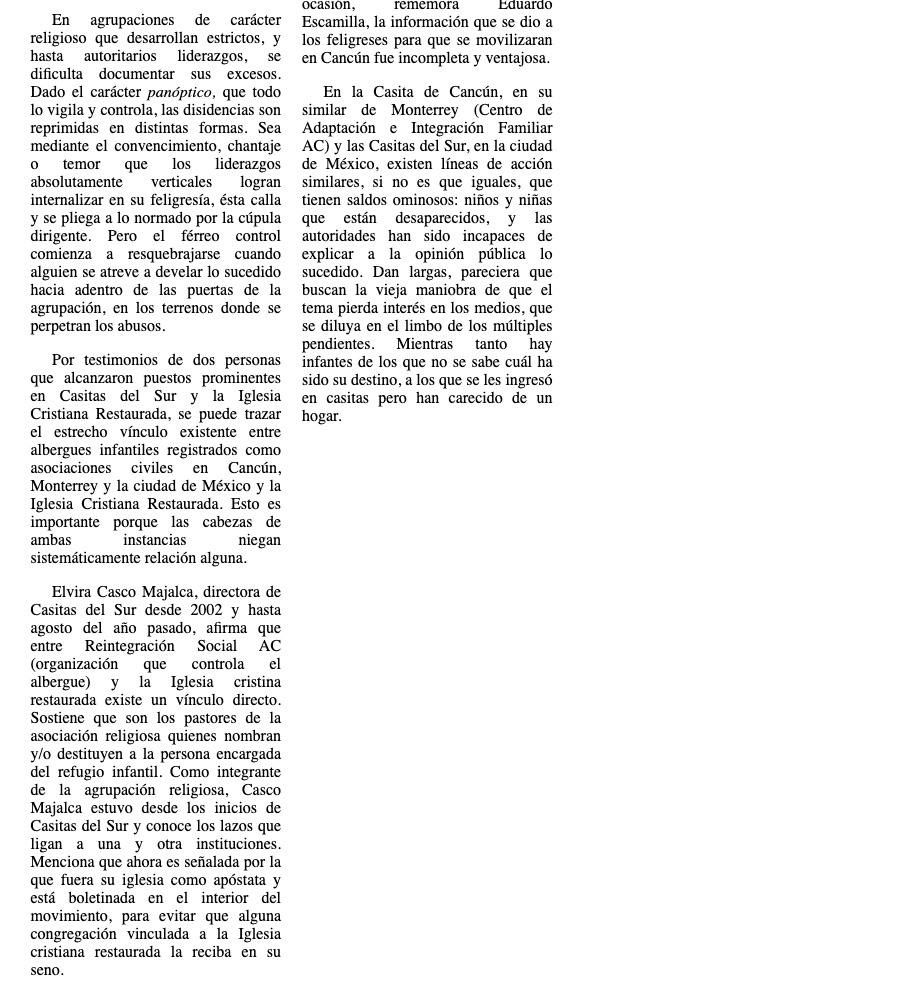
Crucial evidence of Jorge Erdely Graham’s cultic leadership within his religious organization and its orphanage network comes from the statements of Eduardo Escamilla,3 one of Erdely’s closest associates in México for two decades. After twenty years, Escamilla left the church community led by Erdely in 2006 because its leadership began to “raise doubts.” Following his departure, Escamilla faced retaliatory allegations of fraud, theft, and even adultery — a barrage of accusations from those who, as it turned out, feared exposure above all else. In an interview with the media outlet EL UNIVERSAL, Escamilla described the character of the Mexican anti-cult activist, defining him as a “spiritual dictator.” 3
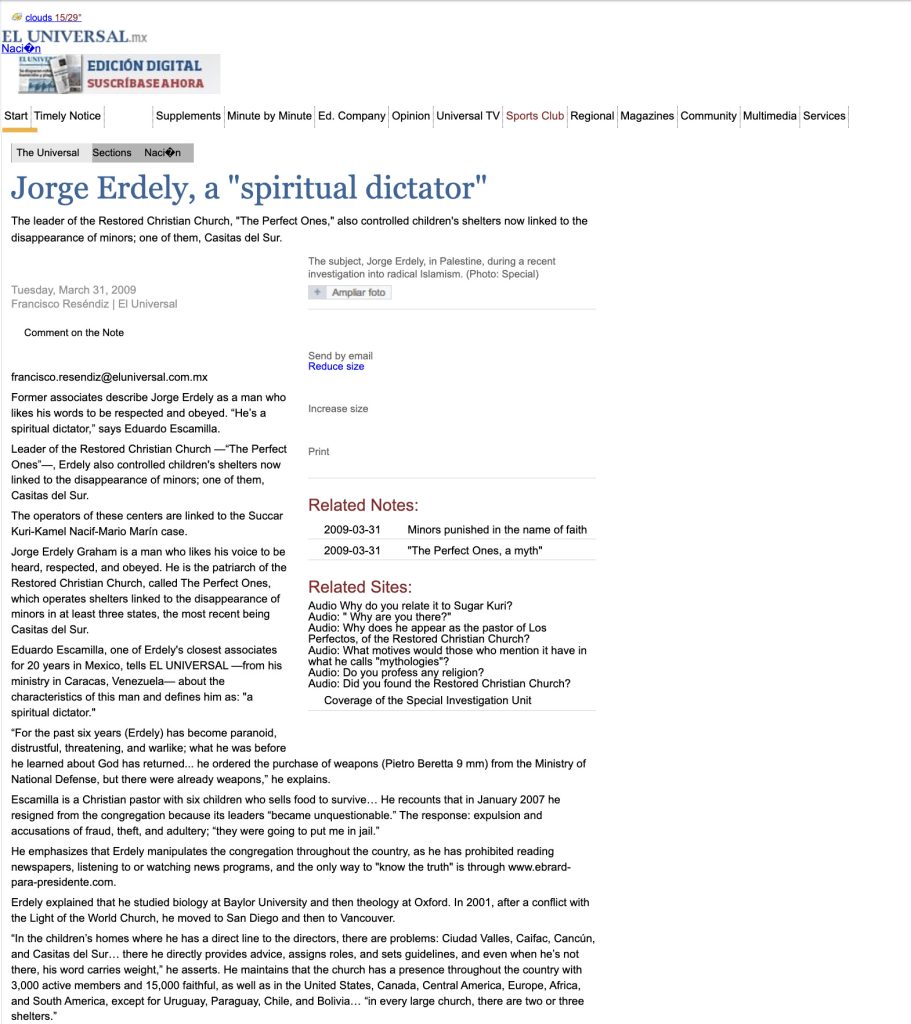
“[Erdely] is a spiritual dictator,” says Eduardo Escamilla.
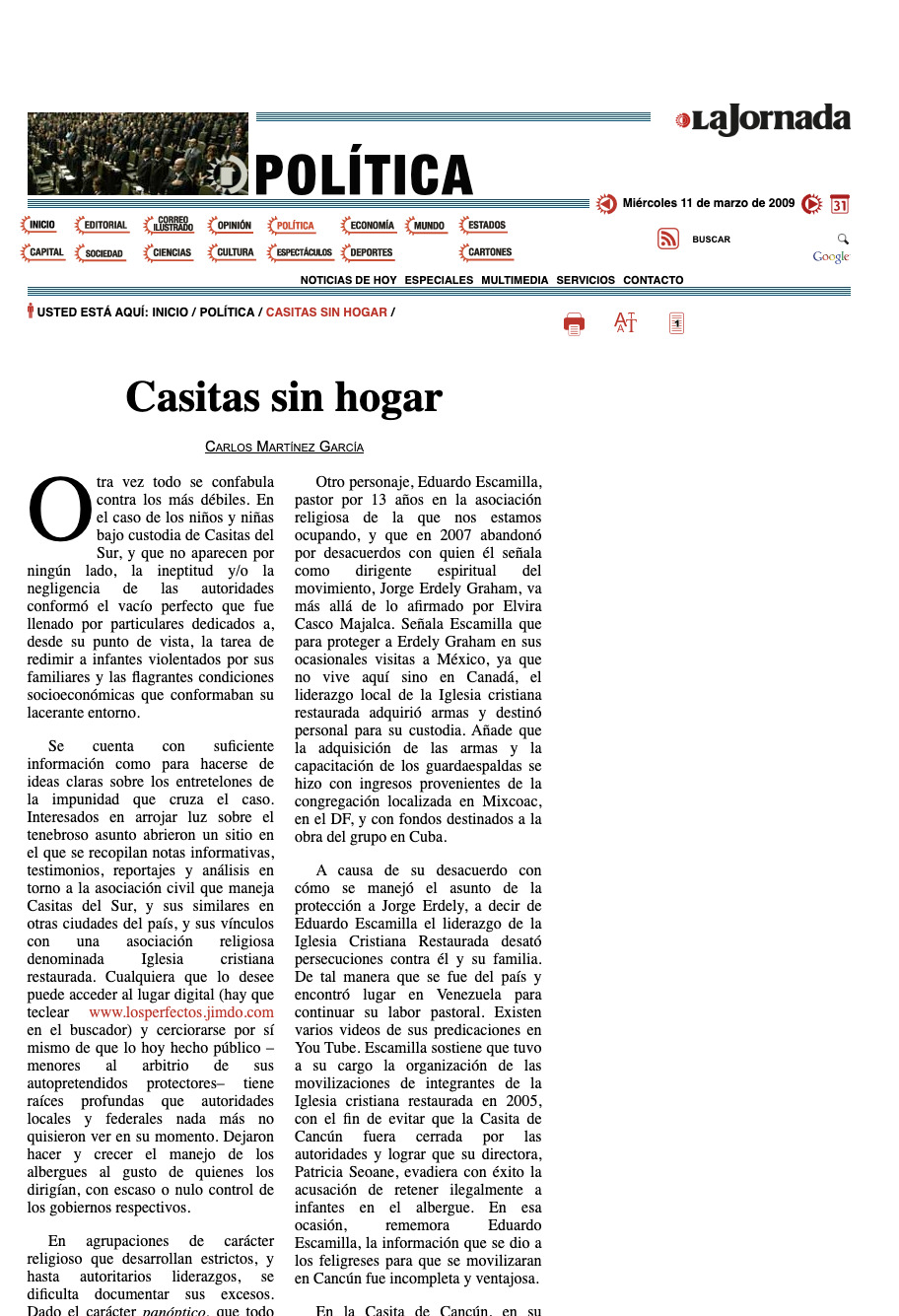
According to Escamilla, Erdely manipulates congregants nationwide, banned the reading of newspapers and the watching of news programs, demanded absolute obedience, and armed his inner circle.4 These facts demonstrate that beneath the guise of a religious structure, Erdely literally built and led a “cult” — by the very definitions and terminology used by anti-cultists themselves to classify such groups.
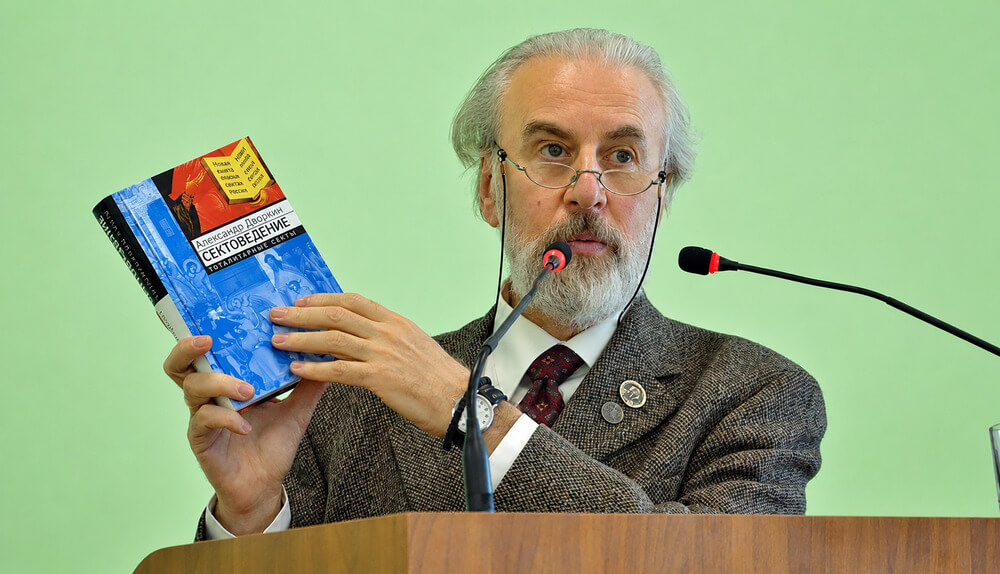
Consider this excerpt from Alexander Dvorkin’s book, “Sectology. Totalitarian Sects:”
“A totalitarian sect is a group that employs manipulative techniques to exploit its members. It can inflict psychological, financial, and physical harm upon them. It largely controls the behavior, thoughts, and emotions of its members. It uses various methods to turn a newly recruited individual into a loyal, obedient, servile, and fawning member.”
“The group has a teacher, a medium, a leader, or a guru. Only he possesses the absolute truth.”
“Criticism from outsiders is viewed as proof of the group’s righteousness. The world is sliding toward catastrophe, and only the group knows how to save it. Your group is the elite. The rest of humanity is gravely ill and profoundly lost because it does not cooperate with the group or allow the group to save it.”
Reading these lines brings to mind the words of a moderator at an AFF conference (as the ICSA was known until late 2003 or early 2004, prior to its reorganization), introducing Margaret Singer, a veteran of the anti-cult movement, as their “unofficial guru” 5:
“Dr. Singer is our resident expert in this area. She’s our unofficial guru. And with her quiet dignity in the face of immense pressure from the cults and their sympathizers, she’s a continual source of information.”
It is important to clarify that Jorge Erdely Graham was a member of ICSA long before it took its current name; that is, he was on the AFF board during the very period when Margaret Singer played a major role. The European Federation for Freedom of Belief wrote about Jorge Erdely 1:
“Creating a façade as a ‘protector of the faithful and kids abused by cults,’ he in fact created his own cult as a cover to run a network of child trafficking, literally selling kids for sex and even organs.”
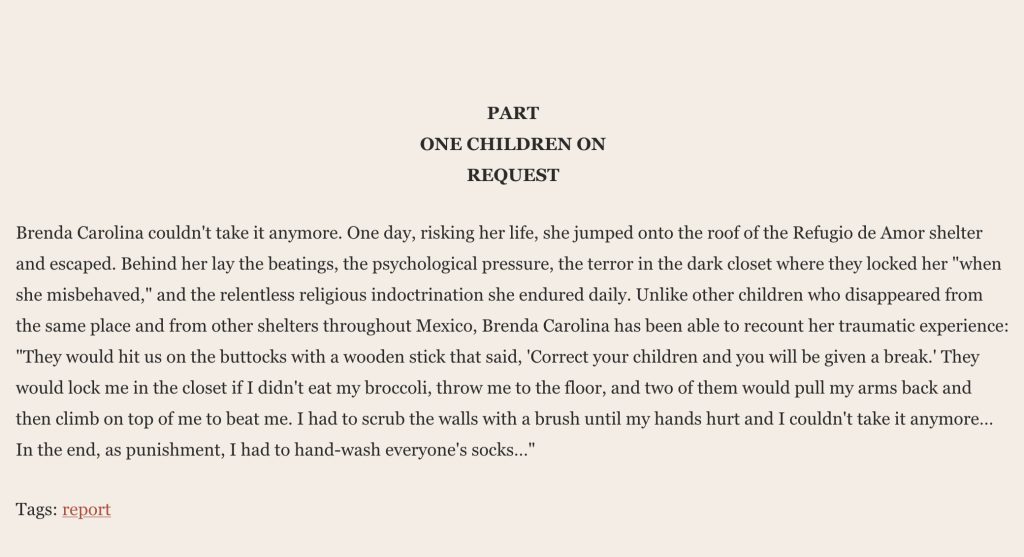
Brenda Bernal Hernández, whose escape from the “Refugio de Amor” orphanage was noted earlier, reported systematic abuse, indoctrination, and the disappearance of young residents. This triggered inspections of the network’s facilities. In early 2009, authorities raided the Casitas del Sur orphanage, rescuing 126 children. However, it was discovered that more than 25 children — with some estimates placing the number closer to several dozen — had vanished without a trace. Notably, some of these missing children remain unaccounted for today, 17 years later. 6, 7 The Casitas del Sur shelter was also mentioned among others in statements by Eduardo Escamilla:
“In the children’s orphanages where he has a direct line to the directors, there are problems: Ciudad Valles, Caifac, Cancún, and Casitas del Sur… there [Erdely] directly provides advice, duties, and guidelines to follow; even when he is not there, his word carries weight,” he states.
It is precisely those shelters controlled by the Mexican anti-“cult” activist and ICSA and FECRIS member and advisor, Jorge Erdely Graham, that are linked to the disappearances of minors. These disappearances were recorded in at least three states.
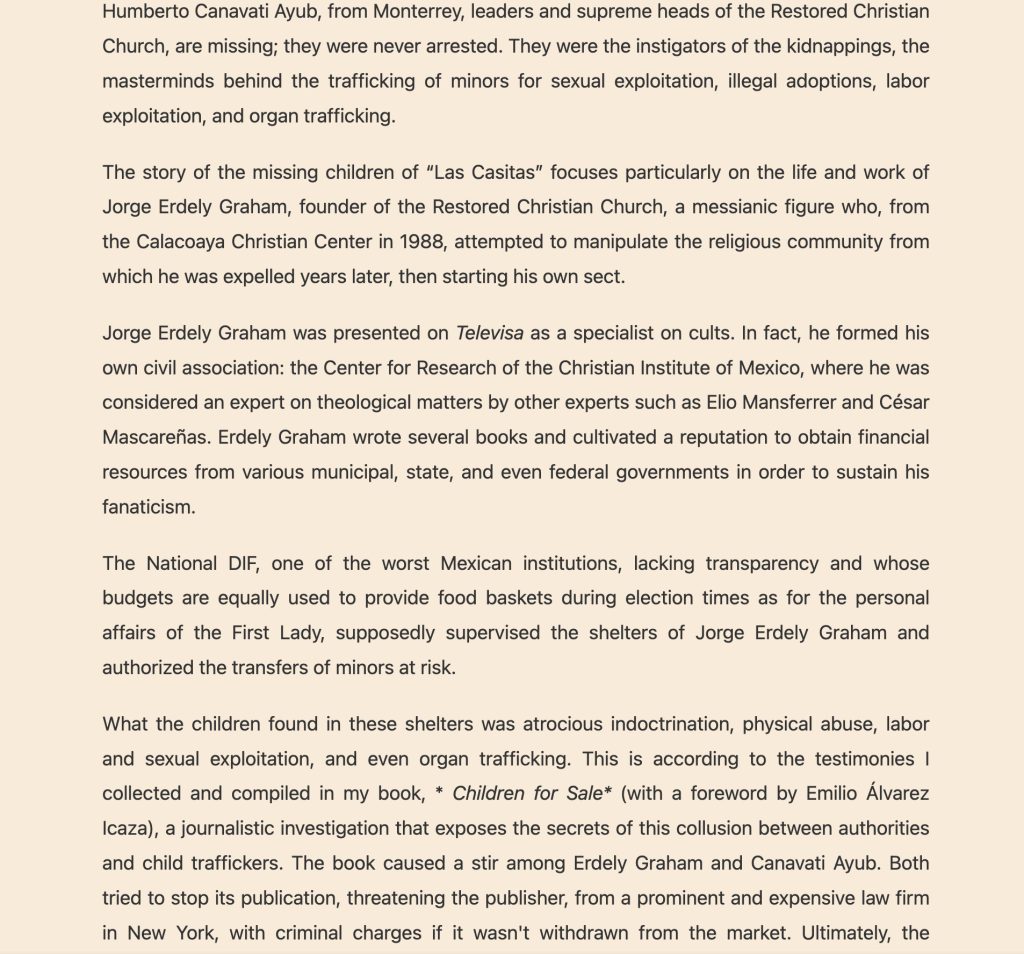
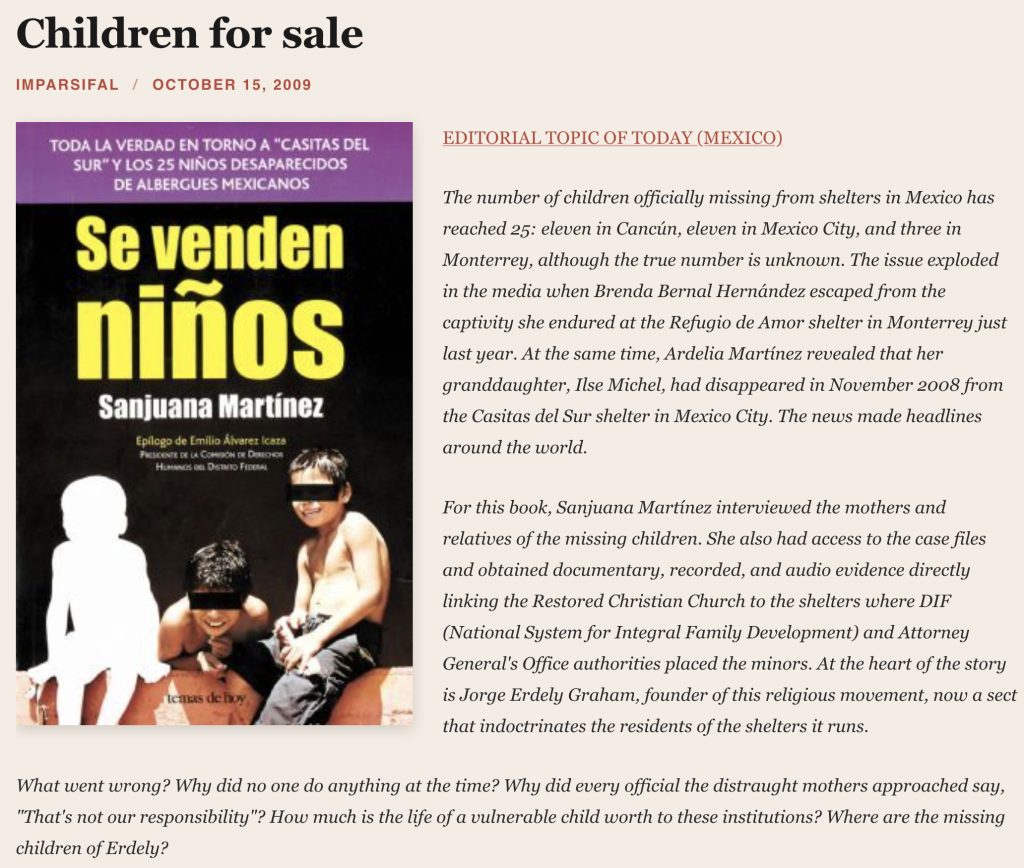
Another location where children were held — Cancún — was highlighted by journalist Sanjuana Martínez, who conducted a large-scale investigation into the case and wrote the book Se Venden Niños (Children for Sale) in 20108.
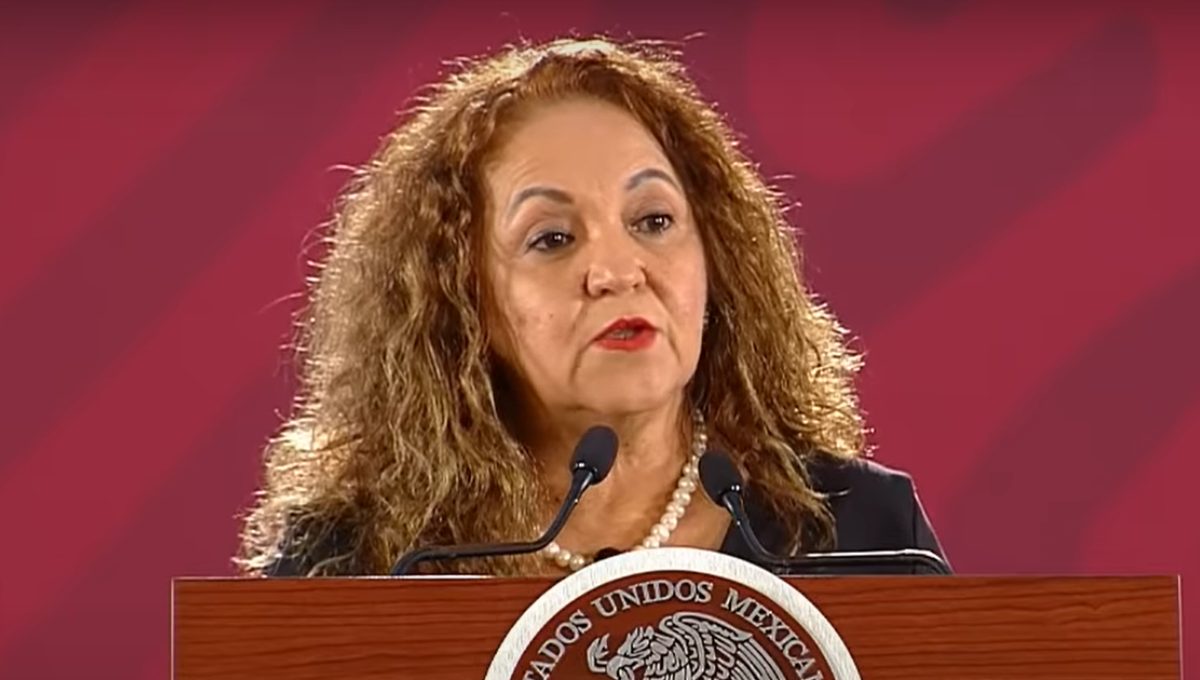
Her investigation, combined with testimonies from victims, exposed a human trafficking ring. Young girls were taken to Cancún and Veracruz, only to be returned showing signs of sexual abuse and severe psychological trauma. According to some reports, a link was discovered between the Cancún shelter and the case of notorious pedophile Jean Thouma Hannah Succar Kuri, who was sentenced to 112 years (later reduced to 93 years) for pedophilia, corruption of minors, child pornography, and child trafficking.
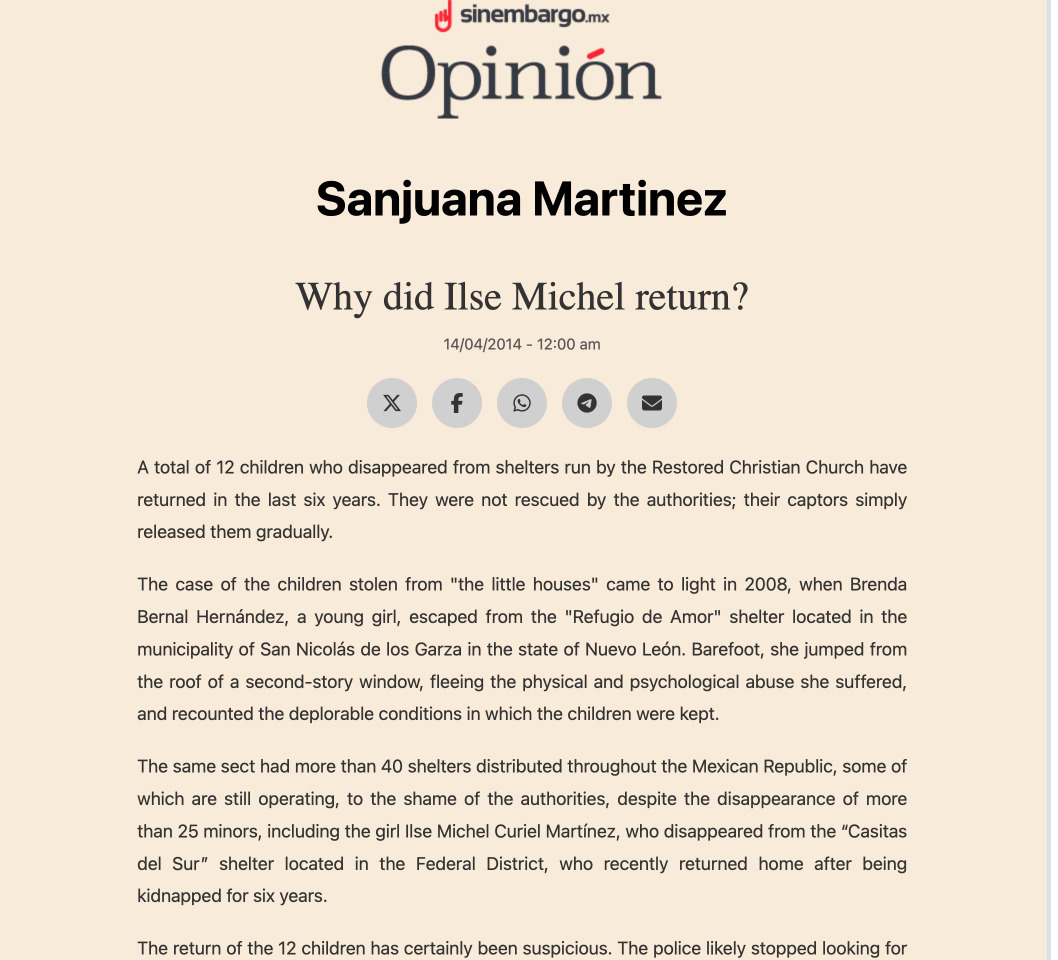
In the article “Why Did Ilse Michel Return?,” investigative journalist Sanjuana Martínez, who looked into the Erdely case, reported the following 2:
“The most striking thing was their economic power and the kingly lifestyle both of them enjoyed. I followed in their footsteps and reconstructed their lives. But neither was willing to leave the child trafficking network that operated in different countries around the world.”
“As always happens in these cases, time eventually puts everyone in their place. It was later demonstrated that the children’s shelters also operated in Thailand, a central hub for child sexual exploitation, as well as in other European and Southern Cone countries.”
— Sanjuana Martínez 2, investigative journalist and author of Se Venden Niños (Children for Sale).
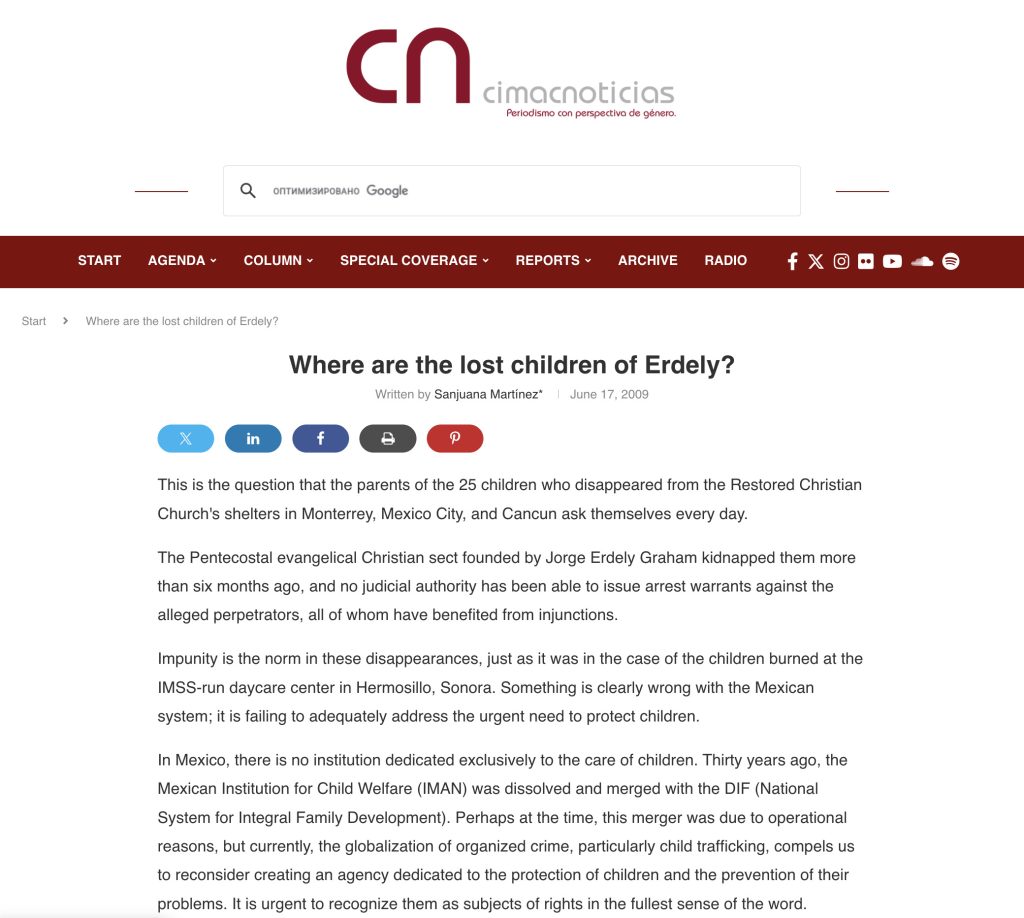
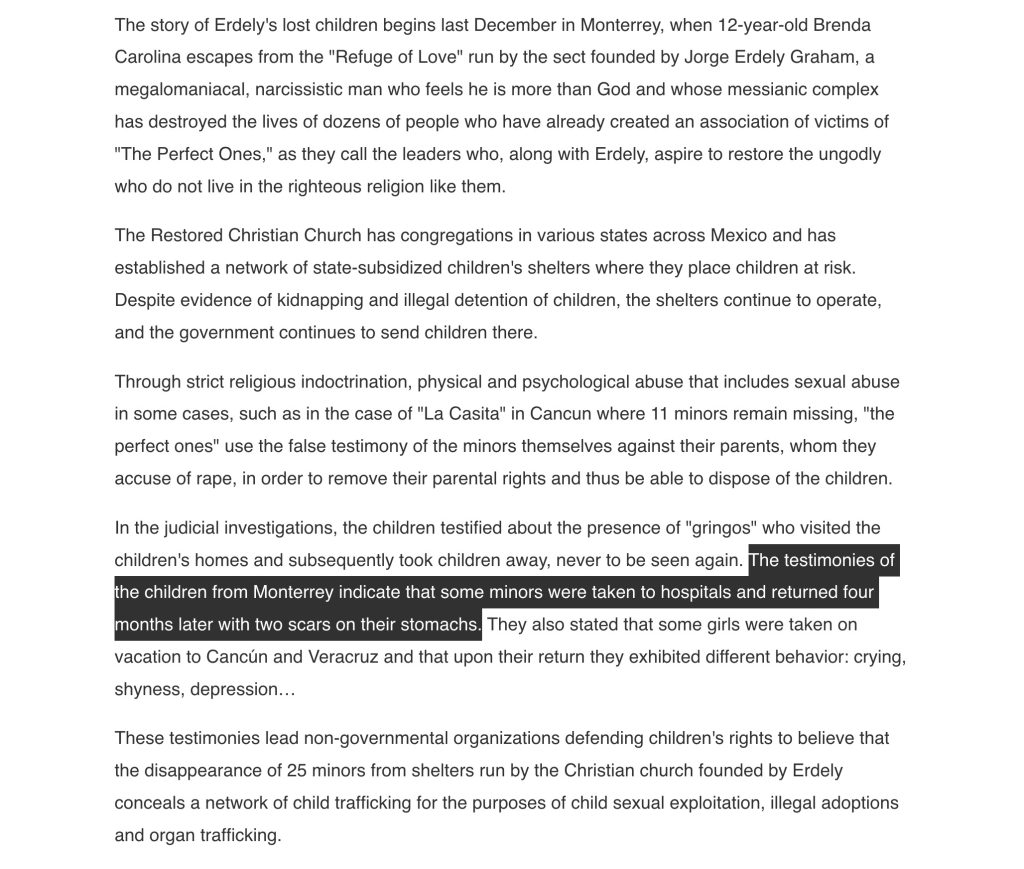
Yet the most horrifying accounts involved suspected organ trafficking.2 Children reported that their peers would return from visits to “gringos” (foreigners) or sudden “hospitalizations” bearing distinctive surgical scars on their abdomens.9
These facts draw inevitable parallels to the horrors occurring in another country — China — where self-proclaimed “anti-cult” experts are likewise the source of these atrocities. This refers to the persecution of the Falun Gong movement, whose practitioners have been branded by anti-cult organizations as xie jiao — a derogatory term in China equivalent to “cult” or “sect.” As a result of this dehumanization, thousands — and by some estimates, tens of thousands — of Falun Gong practitioners have faced state repression, torture, physical and sexual abuse, and forced organ harvesting. But let us return to the activists of the Mexican anti-cult cell.
Another astonishing aspect of this case is its sheer scale. According to statements by Eduardo Escamilla, the church led by Erdely operates throughout Mexico. He claims it has 3,000 active members and 15,000 believers (other sources cite 20,000). However, this church also maintains an international presence in regions including Central America, the United States, Canada, South America (except Uruguay, Paraguay, Chile, and Bolivia), Africa, and Europe. And in every large church, according to Escamilla, “there are two or three shelters.”
The reaction of the anti-cult organization ICSA and the European umbrella federation FECRIS — or rather, the total lack of any reaction to this scandal — is particularly striking. To recap, Jorge Erdely Graham was a member of ICSA and collaborated closely with FECRIS for many years. At the height of the scandal, Alexander Dvorkin, the ideological leader of the modern anti-cult network, had already become the vice president of FECRIS. Even prior to his vice-presidency, Dvorkin had been deeply integrated for years into the activities of FECRIS, of which ICSA was a member. Following the scandal, these interacting and closely linked organizations within the same network simply quietly removed Erdely’s name from their digital platforms, without issuing any statement, condemning such fringe activities, or conducting any transparent investigation.
What drives such behavior? Is it merely a fear of reputational damage? Yet, if an organization is transparent, open, and operates within the law, reputational damage should not be a concern. Or does this signal a deeper systemic problem that they simply tried to quietly conceal? Whatever the case, this conspicuous silence from two key international organizations, FECRIS and ICSA, speaks volumes about their fear of a broader investigation and casts doubt on the legality and transparency of the entire network of anti-cult actors. It is also worth noting that Erdely’s case is far from unique. Today, numerous other cases involving similar “cult fighters” in other countries have been proven, with documented instances of abuse, as well as physical, psychological, and often sexual violence, including against minors.
“Cult Fighter” Jakub Jahl—The Czech Jorge Erdely Graham
Take, for example, the now well-known and highly publicized case of Jakub Jahl — a Czech anti-cultist who was active in Tanzania, Africa, from 2019 to 2022.
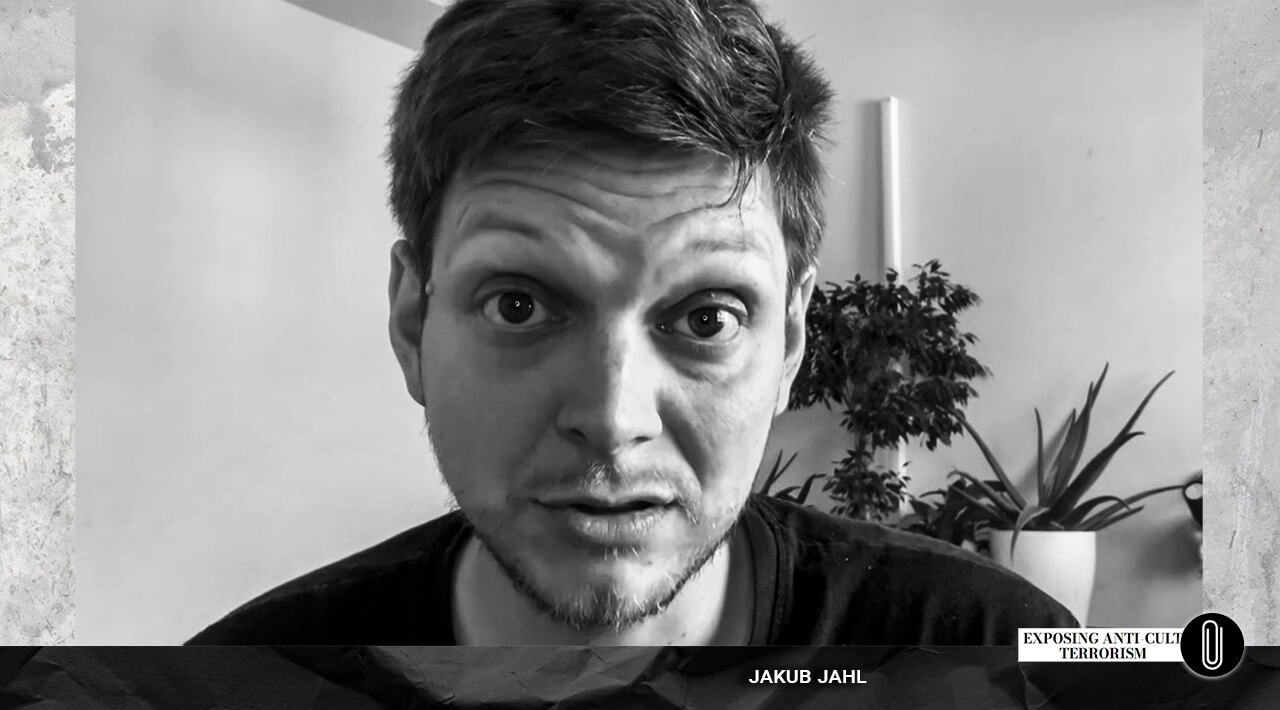
There, under the guise of a humanitarian mission, he ran destructive, cult-like activities and, according to the victims, committed physical and sexual violence, including against minors. He also conspicuously used drugs (as evidenced by numerous videos he posted on YouTube) and administered injections to children.
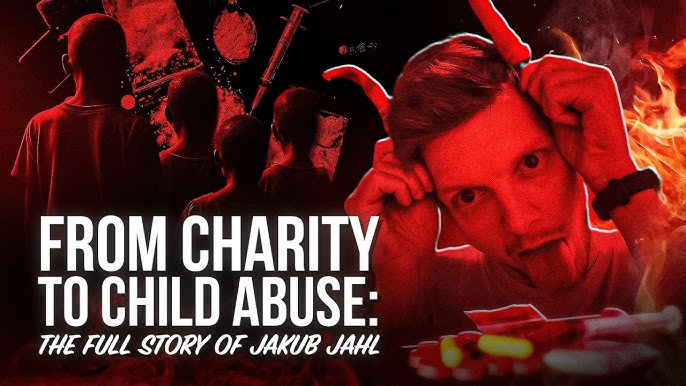
Positioning himself as a benefactor, he raised donations in Europe — totaling up to two million Czech korunas — allegedly to build schools, orphanages, and support African orphans. However, not a single promised project was ever realized.
Jahl has been diagnosed with untreated bipolar disorder and chronic drug addiction, with substances including cocaine, khat/miraa, and marijuana. A turning point in his psychological state was noted following the uncontrolled use of psychedelics, which ultimately left him suffering from persistent panic attacks. Among other things, he is known to have combined LSD and ecstasy — something he wrote about in his book Kniha mormonů (The Book of Mormon).
Other facts from his biography are equally telling, involving acts of vandalism, the desecration of monuments, and public antisemitism, which culminated in the burning of an Israeli flag in front of the Israeli embassy in Prague.
According to the victims and documented testimonies, Jahl faces accusations of raping minors during his time in Africa — including a 13-year-old orphan — as well as physical abuse, stabbings, drug trafficking, and fraud. Witnesses state that he administered sedatives to suppress the children’s will before abusing them, utilized Satanic imagery to intimidate them, and cultivated an environment of terror through rituals.
According to a lawyer representing the victims, an official complaint has been filed against Jahl, a criminal case has been opened, and medical examinations have been conducted. Testimonies have been provided by between 9 and 14 victims, most of whom were minors when the events occurred. Crucially, for many years, Jakub Jahl actively utilized the terminology and methods of international anti-cult organizations (the European FECRIS, the American ICSA, and the Russian RACIRS), launching attacks against targeted civic organizations, religious movements, and public groups. This strategy provided a solid public cover for his own illicit and marginal conduct.
Drugs and Other Common Traits in the Lives of Jorge Erdely and Alexander Dvorkin
Notably, Jahl’s Mexican “anti-cult” colleague, Jorge Erdely Graham, who is currently fleeing from justice, was also found to have a direct history of drug abuse,10 much like the current leader of the international anti-cult network, Alexander Dvorkin. Below is the evidence of this fact for each of them:
An excerpt from an interview with Alexander Dvorkin:
“Dvorkin: Got the hash from Asia and Caucasus, the Crimea and all that southern part. Got all the heavy drugs from the hospitals because they have a special savings in the medical savings of drugs. And they had to change it every five years, to destroy it, to get new ones… But drugs, all drugs are very good after five years, nothing happens to them… so people would just sell a lot of them, the people who were in charge of these reserves, and that’s how most part of drugs are gotten in the Soviet Union.”
“… Well, I have just much less spare time here than I had there, there practically all the time was mine. But there I was getting stoned all the time, but here I don’t.” (Alexander Dvorkin) 11
Another quote from Dvorkin from Arkady Rovner’s book “Kalalatsy,” p. 41:
“At seventeen, I figured it out: getting high was the way out. I’m under hypnosis, and not even death can wake me up. But there are moments of partial awakening — from music, from conversation, from junk. It is like an alarm clock in the morning — jump up and run. The goal of the system is to pump the high. The high is otherworldly labor. Systems raise masters of the high.” (From the book Kalalatsy by Arkady Rovner — Moscow: “New Time” International Association of People of Culture, PSK Timan, 1990.)
It is fitting here to reference an excerpt from Alexander Dvorkin’s own book, “Sectology. Totalitarian Sects”, where he outlines the characteristics of “totalitarian sects”:
“The mechanisms of such psychological dependence are identical to those of drug addiction, except that narcotic euphoria is achieved through the introduction of chemical substances into the bloodstream, whereas here psychological techniques are employed. The underlying mechanism, however, remains the same — inducing an induced (or guided) euphoria in an individual and fostering a rigid psychological dependency on the sect. This can easily be achieved without any drugs, though to be fair, it must be noted that some sects nevertheless utilize narcotic or psychotropic substances.”
*The book “Kalalatsy” by Arkady Rovner (cited in this article), based on the oral recollections of a young Alexander Dvorkin, contains numerous episodes reflecting his involvement in the drug subculture. This includes descriptions of using psychoactive substances, their preparation methods, and the polypharmacological combinations of drugs used to achieve specific mental states. This material was analyzed and exposed in detail in a series of articles on the actfiles.org portal, including “Sectology Professor Or Serial Killer?”, “Sectology Professor Or Serial Killer? Part 2. Genesis Of The Motive,” “Sectology Professor Or Serial Killer? Part 3. Behavioral Markers,” “Sectology Professor Or Serial Killer? Part 4. Retrospective Analysis,” and others. For comparison, below is a brief excerpt containing direct quotes from Jorge Erdely Graham’s 1995 sermon (other portions of this speech are cited subsequently):
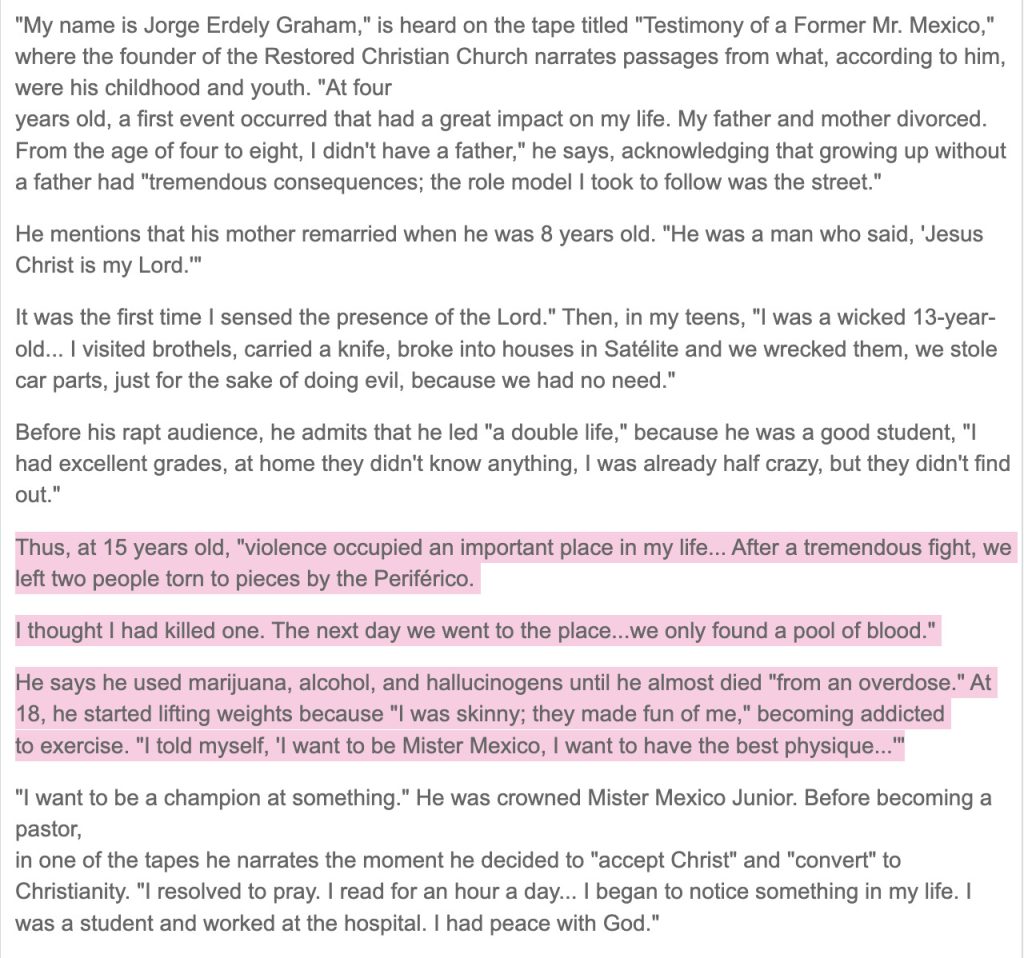
“He [Erdely] recounts that he consumed marijuana, alcohol, and hallucinogens until he nearly died ‘of an overdose.’ At 18, he started lifting weights because ‘he was skinny; they made fun of me,’ becoming addicted to exercise. ‘I told myself: I want to be Mr. Mexico, I want to have the best physique… I want to be a champion in something.’”
Just as people mocked Jorge Erdely for being a skinny, unathletic boy, a very similar pattern occurred in the life of Alexander Dvorkin. However, unlike Erdely, Dvorkin “came to the conclusion that it was better to perfect the mind rather than the body.” From Arkady Rovner’s book “Kalalatsy,” which contains biographical details about Alexander Dvorkin (under the pseudonym Kostya Lopukhov):
“At school, I was bullied and tortured, and at the art school, I was ignored. I was shy around my mother and didn’t know my father; he didn’t live with us. I was ugly and awkward, with large flat ears sticking out ridiculously on my close-cropped head, and I blushed with embarrassment a hundred times a day.”
“I was close-cropped, and everyone either beat me up or ignored me.”
“Alexander Dvorkin’s medical records state: ‘From grade 3, he was transferred to another school where he couldn’t connect with his peers and was beaten for his boastfulness. The boy constantly asked to be transferred to another school. His character remained the same, but he had no close friends.’”
Much like Dvorkin, who grew up without a father, Jorge Erdely Graham shared in his 1995 sermon that for a certain period of his childhood, his father was absent, admitting that growing up fatherless had profound consequences:
“‘When I was four, something happened that had a huge impact on my life. My parents got divorced. From age 4 to 8, I didn’t have a father,’ he relates, acknowledging that growing up without a father had ‘tremendous consequences; the role model I ended up following was the street.’”
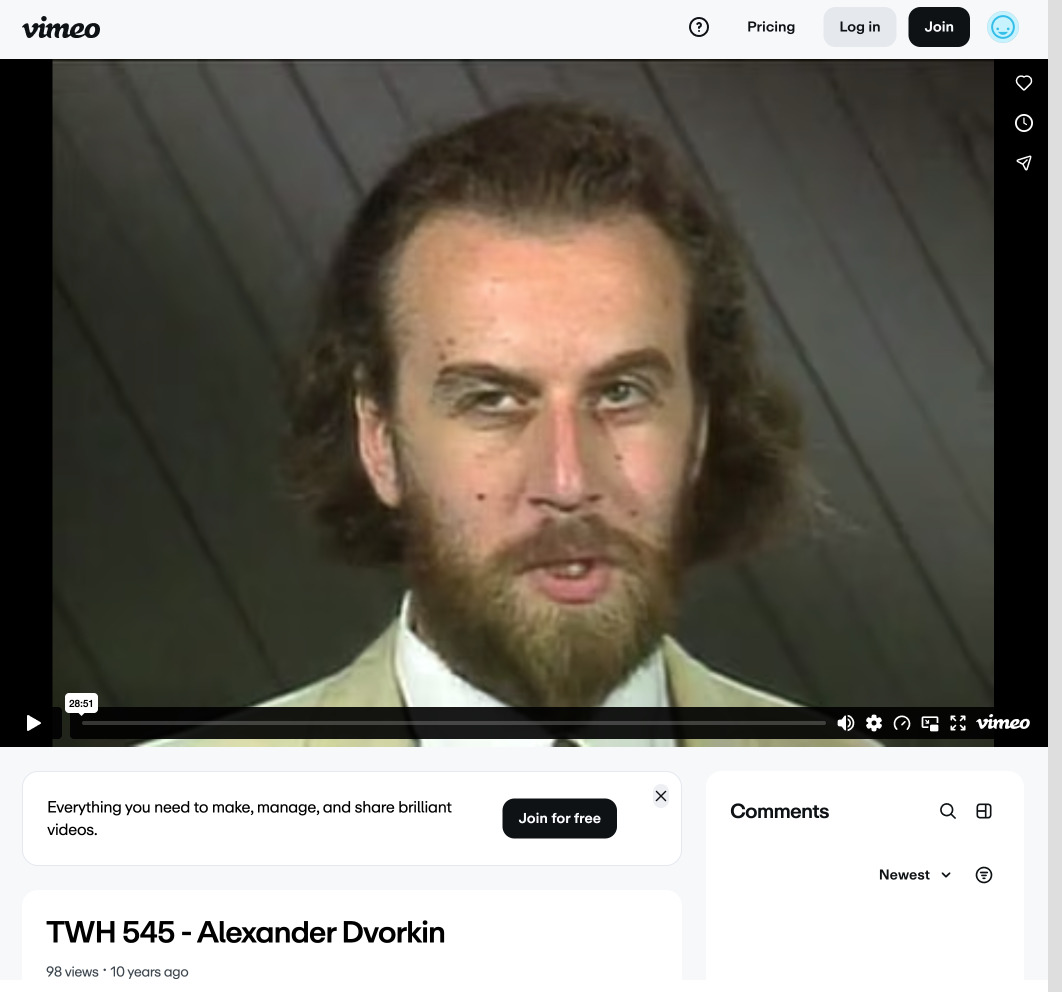
Alexander Dvorkin and Jorge Erdely share another common fact in their lives: the adoption of children. Like Erdely, whose orphanages were involved in the illegal adoption of children, Alexander Dvorkin found children in Russia and sent them abroad, a fact he himself has publicly acknowledged 12:
“And I also work for international adoption Organization, which is located in Pennsylvania. It’s called Welcome House of Pearl Buck Foundation. Find Children in Russia, which need loving homes and which couldn’t be provided as homes in Russia. Unfortunately, it and we help them to find loving homes in this country. So I do all these things.” (Alexander Dvorkin)
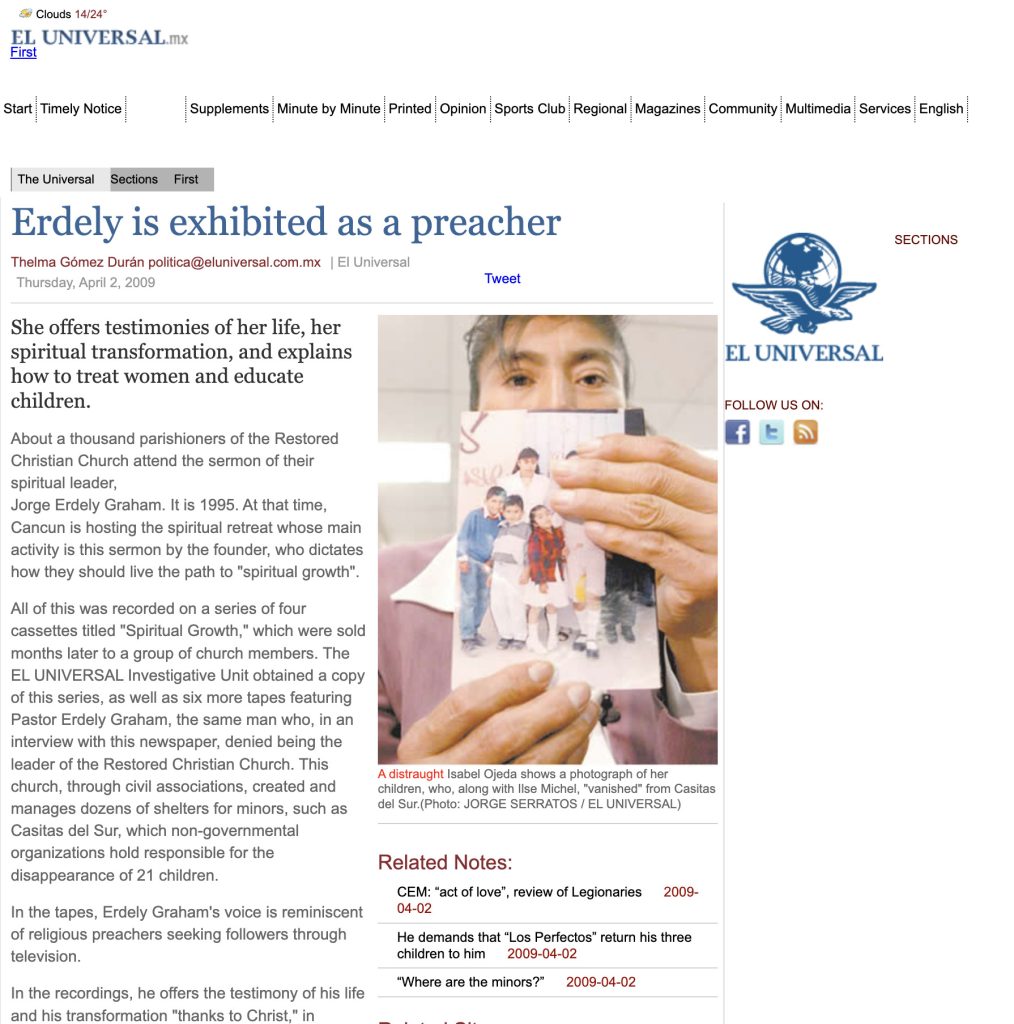
In the case of Jorge Erdely, the network of shelters under his control carried out illegal adoptions (along with a range of other serious crimes mentioned above). Behind this network of shelters, alongside front individuals, stood an anti-cult organization — the Center for Research of the Christian Institute of Mexico (Centro de Investigaciones del Instituto Cristiano de México) 2, founded by Erdely himself. An identical scenario is observed with the Russian RACIRS, which unites the entire network of Russian sect-fighters, of which Alexander Dvorkin is the founder and president. Today, there is ample publicly available evidence, video, and photographic material proving that several Russian “cult fighters,” or their immediate circle, did not just proclaim themselves experts on “cults” and “sects” but also engaged in sexual deviance or faced accusations of sexual abuse, including against minors. Some Russian experts on “sects” and “cults,” who are Dvorkin’s closest colleagues, are also connected to children’s shelters and work with minors. It is worth quoting excerpts from an article that includes passages from a personal confession made by Jorge Erdely Graham in 1995 while delivering a sermon to his congregation. 10 Among other things, he spoke about how to raise children and why women must be submissive.
“…the rod becomes a means of grace and not merely a form of physical correction…” — Jorge Erdely Graham
“Around a thousand congregants of the Restored Christian Church listen to the preaching of their spiritual guide, Jorge Erdely Graham. It is 1995. At that time, Cancún is hosting the spiritual retreat whose star activity is precisely this sermon by the founder, who dictates how they must live on the path to ‘spiritual growth.’ All of this was recorded on a series of four cassette tapes titled ‘Spiritual Growth’ (Crecimiento espiritual), which were sold months later to a group of church members. The Investigation Unit of EL UNIVERSAL obtained a copy of this series, as well as six additional tapes where Pastor Erdely Graham can be heard in action.”
“In the recordings, he offers the testimony of his life and his transformation ‘thanks to Christ,’ as well as explaining how the members of his church should behave, how they should raise children, and why women must be submissive. He rails against other religious groups, from Roman Catholics to those who accept ‘Christian rock.’ He uses biblical passages and leads collective prayer. Most of the tapes were recorded in 1995, when the Restored Christian Church (founded in 1989) had its primary core of congregants in the Federal District and Cancún and was beginning its expansion. (A decade later, it already had nearly 20,000 members and a presence throughout almost the entire country, as well as in the United States, Canada, Cuba, Thailand, Spain, Guatemala, Rwanda, Argentina, and Venezuela. In the late 1990s, former members consulted confirm, Erdely Graham left the country and only maintained communication with other pastors, including Sergio Canavati, Luciano Berúmen, César Mascareñas, Gerardo Tejada, and Carlos Loredo.)”
“‘My name is Jorge Erdely Graham,’ he says on a tape titled Testimony of a Former Mr. Mexico, in which the founder of the Restored Christian Church recounts episodes from what he describes as his childhood and youth. When I was four, something happened that had a huge impact on my life. My parents got divorced. From age 4 to 8, I didn’t have a father,’ he relates, acknowledging that growing up without a father had ‘tremendous consequences; the role model I ended up following was the street.’ He says his mother remarried when he was eight years old. ‘He was a man who said, “Jesus Christ is my Lord.” It was the first time I perceived the presence of the Lord.’ Then, during adolescence, ‘I was a godless 13-year-old … I visited brothels, carried a knife, broke into homes in Satélite and trashed them, stole car parts, simply for the sake of doing evil, because we were not in need.’ Before his captivated audience, he admits that he led ‘a double life,’ because he was a good student. ‘I had excellent grades. At home they knew nothing. I was already half-crazy, but they had no idea.’ Thus, by age 15, ‘violence occupied an important place in my life… After a terrible fight, we left two people beaten to pieces along the Periférico. I thought I had killed one of them. The next day we went back to the spot .. all we found was a pool of blood.’
He recounts that he consumed marijuana, alcohol, and hallucinogens until he nearly died ‘of an overdose.’ At 18, he started lifting weights because ‘he was skinny; they made fun of me,’ becoming addicted to exercise. ‘I told myself: I want to be Mr. Mexico, I want to have the best physique… I want to be a champion in something.’” He went on to win the title of Junior Mr. Mexico.
Before becoming a pastor
He describes on one of the tapes the moment he decided to ‘accept Christ’ and ‘convert’ to Christianity. “I resolved to pray. I devoted an hour a day to prayer. I began to notice a change in my life. I was a student and worked at the hospital. I felt at peace with God.” He says he studied at UNAM, where he assaulted a professor: ‘In the middle of class I stood up and hit him; afterward I got him fired because I had connections.’ He uses the anecdote to illustrate how he transformed from a violent man into a peaceful one. ‘Christ transforms.’
“Beatings” and “submission”
On the tapes, Erdely Graham can be heard raising his voice in phrases like this…”
In the past, the religious ecstasy of fanatics has led to the rise of the Inquisition and ideologies of superiority, and has always been accompanied by the humiliation of those deemed weak and by brutal abuses — a fact confirmed by the continuation of this “revelation” by Erdely:
“On the tapes, Erdely Graham can be heard raising his voice in phrases like this: ‘When there is no trust in God, people sin even when they eat; they sin even when they breathe!’ In the sermon ‘The Secret to a Victorious Life,’ he instructs on how to discipline children. He warns: ‘Those who discipline without faith later complain, “No matter how much I discipline them, they don’t change. I’ve been disciplining them for five months now, and they still haven’t changed.” Without faith, it is impossible to please God. Because God did not just say to discipline them, but to believe in Him. And when you do things trustingly, you discipline them, and the Holy Spirit begins to motivate that child.’ The ‘beatings,’ he says, are ‘a means of restraining them… It is a leash that is placed on the child and is necessary.’ He immediately mentions ‘the rod’ which, according to testimonies from former members of the church, is used to strike children: ‘In the case of the discipline of children, the rod becomes a means of grace and not merely a form of physical correction. It is a means through which God is going to make the child meditate on certain things.’”
Further comment on this “revelation” is unnecessary. We can only imagine what the children went through for many years in the orphanages affiliated with Erdely.
Title of Advisor
It is important to cite the following words spoken by Eduardo Escamilla:
“His [Erdely’s] name never shines in legal matters; he does not appear as a founder of Religious Associations; he is given the title of advisor…”
—perpetual advisors and consultants. This is precisely the title you find among the vast majority of “cult” fighters, the anti-cult colleagues of Jorge Erdely Graham in other countries. They are often not officially linked to any shelters, orphanages, or other similar institutions. This is exactly how they evade civil and criminal liability, remaining in the shadows behind the public executors whom they manipulate. And Escamilla continues his account:
“He is given the title of advisor… but the Christian Church knows that in the spiritual area he is the one who directs, which gives him a shell; there are more organizations linked to his movement,” he says.
Notably, this eyewitness testimony, much like the other accounts above, mirrors the examples of other cult fighters identically. For instance, in Russia, the chief “sect fighter” Alexander Dvorkin is ostensibly just an advisor and consultant. He and his subordinates at RACIRS advise government officials, church bodies, law enforcement agencies, the military, and security services, all while bearing zero legal responsibility. At the same time, they serve as the ideological authorities in the spiritual realm for the clergy of the Russian Orthodox Church.
When speaking of Jorge Erdely Graham or any of his colleagues in other countries, an obvious paradox emerges: the man who created one of the most ruthless totalitarian sects in modern Mexico was simultaneously a key figure and the de facto head of the Mexican branch of the international anti-cult network. Yet, if one looks beyond the respectable facade of anti-cult organizations and delves into the actual histories of their activists and the documented facts of their operations, it becomes clear that this is no paradox at all. It is entirely possible to fight against “sects and cults” while simultaneously leading a sectarian organization marked by a distinct pyramidal structure, cultic characteristics, hierarchy, suppression, and subjugation. To better understand this mechanism, let us consider a clear analogy.
The Position of the Chief Watchman
Imagine a city whose residents are repeatedly told that thieves and arsonists are coming to rob and burn their homes. The city becomes afraid of thieves and arsonists. The residents are then told that protection is available in the form of watchmen and guards. Frightened by these warnings, they agree. They hire the proposed “vigilant” watchmen, hand over the keys to every house, provide them with weapons, and place their complete trust in them.
Every evening, these watchmen loudly proclaim how dangerous thieves are, how cunning arsonists can be, how important it is to monitor every suspicious person, and how vital their work is. The townspeople nod gratefully, pay their wages through taxes, and go home to sleep peacefully.
Meanwhile, the watchmen themselves quietly rob the very houses they are supposed to protect. Sometimes they even set the houses on fire so they can later heroically “investigate” the arson and earn even more trust and funding. After all, who would suspect the watchman? Everyone is used to guarding their home from an intruder, but who will guard against the watchman?
It is the same here: who would dare to scrutinize a person for the cultish nature of his own actions if he is so loudly and publicly fighting organizations that he himself has labeled “cults”? How could he possibly create a cult if he claims to be the premier fighter against cults? Many people think exactly this way.
Jorge Erdely Graham is a prime example of a network of like-minded experts on sects and cults operating in various countries who have chosen to combat “destructive cults” precisely because it serves as the perfect position for a chief watchman. A society frightened by stories of “dangerous sects” readily grants these self-appointed “cult” experts moral authority, access to the media, the trust of government officials, and — most importantly — immunity from suspicion. After all, by conventional logic, the person who shouts the loudest about the danger of “cults” cannot possibly be a “cult leader.” The person who accuses others of destroying families cannot be destroying families himself. The person who exposes mind control cannot be practicing it. The person who claims to protect children from “totalitarian sects” surely cannot be damaging children’s lives and health.
Yet, society should understand that as long as Jorge Erdely Graham, his closest associates, and the missing children remain beyond the reach of justice; as long as the network of shelters operating in multiple countries continues to function while the investigation remains effectively frozen, society is confronted with an exceptionally dangerous reality: the most dangerous predators can operate for years under the most reliable cover of all — the fight against “evil.”
And if we are not prepared to face the truth, then tomorrow new “Erdelys,” “Dvorkins,” and “Jakubs” — with resumes listing them as experts, advisors, or consultants, backed by connections and the cover of an entire network, and spouting sweet words about protecting children — will continue to reap their harvest. Not only in Mexico, Russia, the Czech Republic, or Africa, but in other countries as well.
Sources:
1. https://freedomofbelief.net/articles/jorge-erdely-graham-why-are-fecris-and-icsa-not-talking-about-him
2. https://www.sinembargo.mx/3023150/por-que-volvio-ilse-michel/
3. https://web.archive.org/web/20170329234550/https:/archivo.eluniversal.com.mx/notas/587735.html
4. https://www.jornada.com.mx/2009/03/11/politica/023a1pol
5. https://www.youtube.com/watch?v=dH0xXyjEVAY
6. https://web.archive.org/web/20130928164701/http://embamex.sre.gob.mx/canada_eng/index.php?option=com_content&view=article&id=3611&Itemid=48
7. https://web.archive.org/web/20131001172858/http://embamex.sre.gob.mx/canada/images/pdfs/fotosdemenores0711.pdf
8. https://web.archive.org/web/20140103232234/http://www.m-x.com.mx/xml/pdf/177/30.pdf
9. https://cimacnoticias.com.mx/2009/06/17/donde-estan-los-ninos-perdidos-de-erdely/
10. https://archivo.eluniversal.com.mx/primera/32737.html
11. https://archive.org/details/alexander-dvorkin-interview-june-19-1979
12. https://vimeo.com/148551852