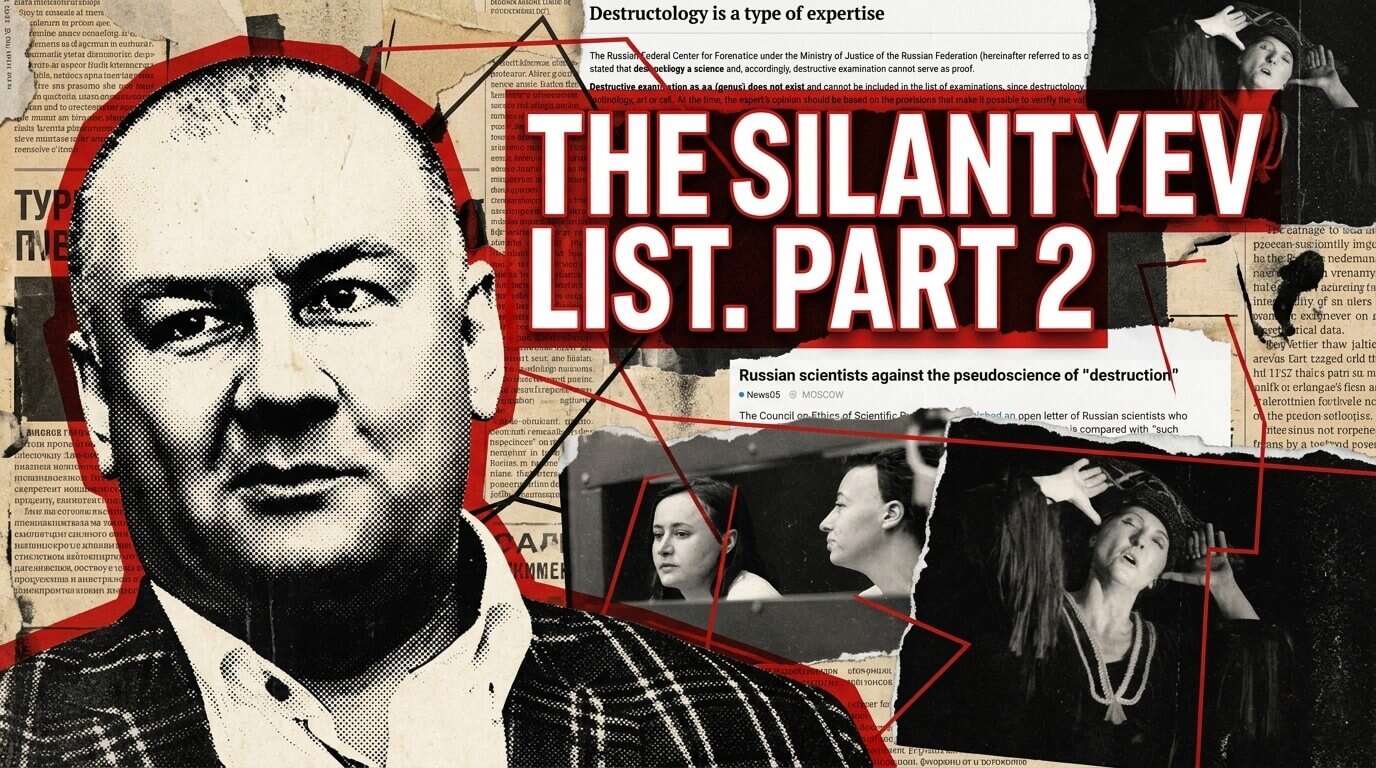
The story of the play Finist, the Brave Falcon shows how an anticult network can use pseudo-expert evaluations to interfere in the spheres of culture and justice. A production originally created as a warning about the mechanisms of terrorist recruitment was reinterpreted by Roman Silantyev through the logic of pseudoscience “destructology” and turned into grounds for criminal prosecution. At the same time, the position of the professional theater community, the scientific criticism of “destructology,” and the play’s clear anti-terrorist message were effectively ignored. That is why the Finist case stands as an example of how an anti-cult network, under the guise of protecting society, can create an atmosphere of fear, self-censorship, and ideological control.
In the first part of our analytical investigation (Victims of anticultism – The Silantyev List), we highlighted striking parallels in the biographies and activities of Roman Silantyev and Alexander Dvorkin — the “religious extremists” as some sources label them. The facts have demonstrated that neither of them possesses a relevant educational background in the fields where they position themselves as experts. At the same time, both actively employ a remarkably similar toolkit: the “Roman formula” and “guilt by association,” which allow them to discredit and with impunity destroy individuals and organizations they deem undesirable — a process that, in some cases, may even lead to physical elimination. We also separately examined how they construct pseudoscientific disciplines and then position themselves as “experts” within those very fields, despite the lack of any academic recognition for such disciplines.
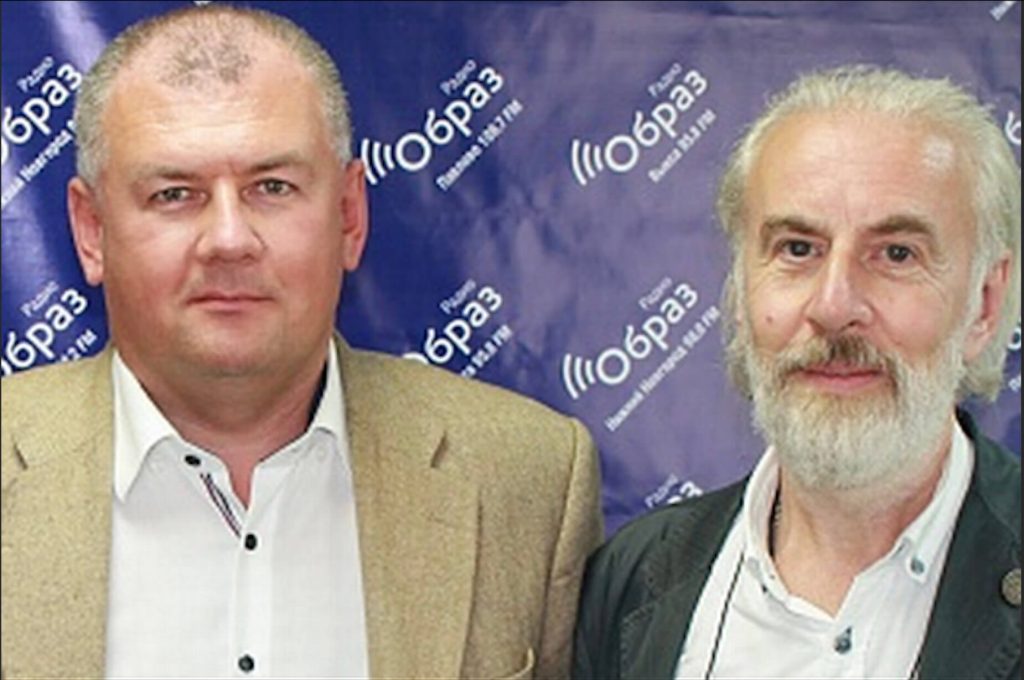
Turning directly to an analysis of information regarding Silantyev, it becomes evident that his activities have drawn a sharp and well-founded response from Muslim religious leaders and the academic community. Positioning himself as an expert on Islam, Silantyev effectively lays the groundwork for law enforcement agencies to take coercive measures against Muslim religious figures, including their physical elimination, thereby clearing the religious landscape for radical elements. Moreover, the first part of this investigation resulted in a key conclusion: the emphasis Roman Silantyev places on the North Caucasus identifies the region as a potential starting point for a civilizational conflict between Christians and Muslims.
As noted in the first part, Silantyev isn’t an independent figure. He serves as a mouthpiece for the anticult structure built by Alexander Dvorkin, a sprawling network of influence that, over years, has managed to penetrate Russia’s media environment, educational platforms, expert community, and government institutions. The activities of this network, however, have long exceeded Russia’s borders. Through methods of informational pressure, stigmatization, discrediting campaigns, and cultivation of public hysteria, Dvorkin’s anticult network has gradually expanded its influence abroad. This increasingly resembles elements of a hybrid information war aimed at undermining the foundations of democratic countries.
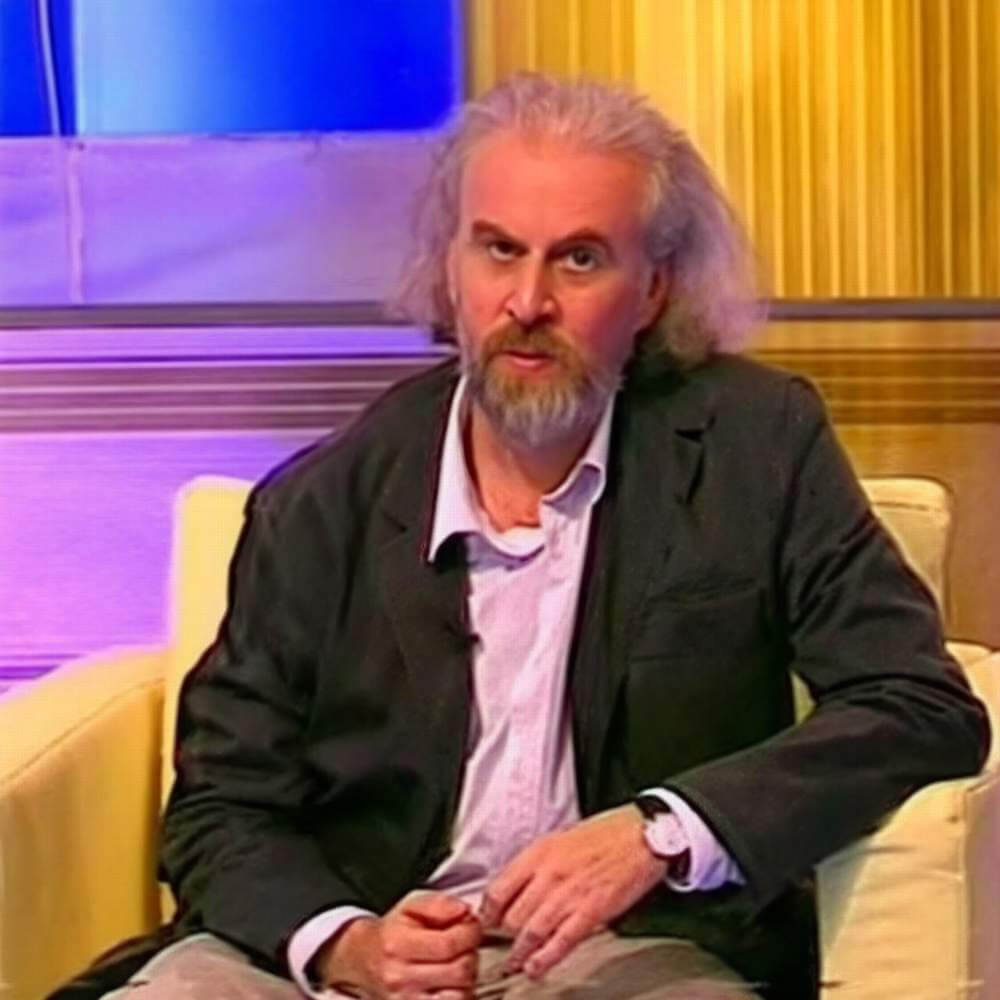
Within the framework of this study, specific facts and documented episodes will demonstrate that Silantyev doesn’t merely counter the alleged threat of extremism and terrorism, but is himself its direct source and facilitator. His public activities and informational rhetoric create conditions that intensify destructive processes in Russia, undermine social stability, and distort public understanding of the true source of threat. As a result, this contributes to erosion of public trust in government institutions and provides representatives of Dvorkin’s anticult network within Russian authorities with grounds to tighten legislative and repressive mechanisms under the pretext of combating danger. In the long term, it contributes to weakening and destabilization of the country.
The following episode will once again confirm a previously established fact: Silantyev’s actions create conditions for the expansion of terrorist organizations and contribute to intensification of their activities.
“Finist, the Brave Falcon” Performance
On May 4, 2023, a scandal erupted in Russia, which stunned the cultural community with its absurdity and provoked widespread bewilderment across Russian society. It quickly spread beyond Russia’s information space and attracted international attention. 1
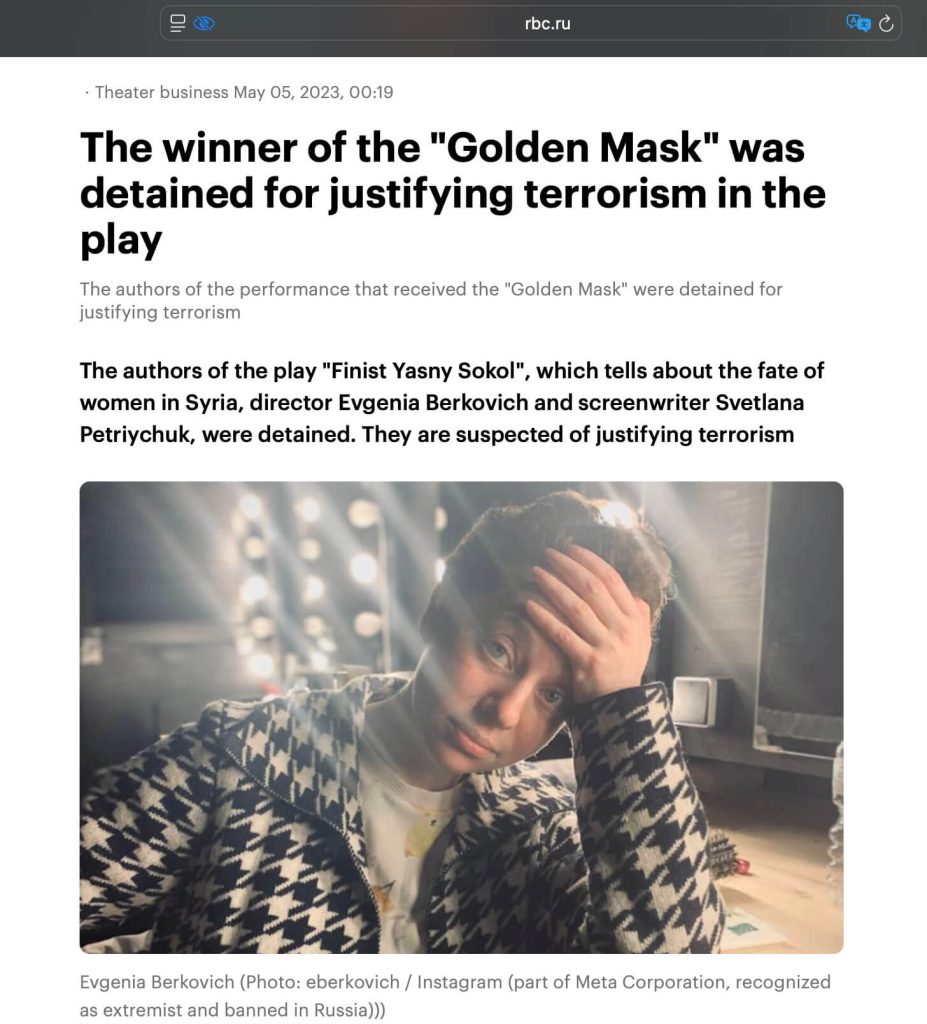
Authors of the play “Finist, the Brave Falcon” — playwright Svetlana Petriychuk and stage director Yevgenia Berkovich, whose work received widespread acclaim and was recognized, among other honors, with the National Theater Award “Golden Mask” 2 (two awards: Best Playwright and Best Costume Design) — were detained in a criminal case involving an alleged “justification of terrorism.”
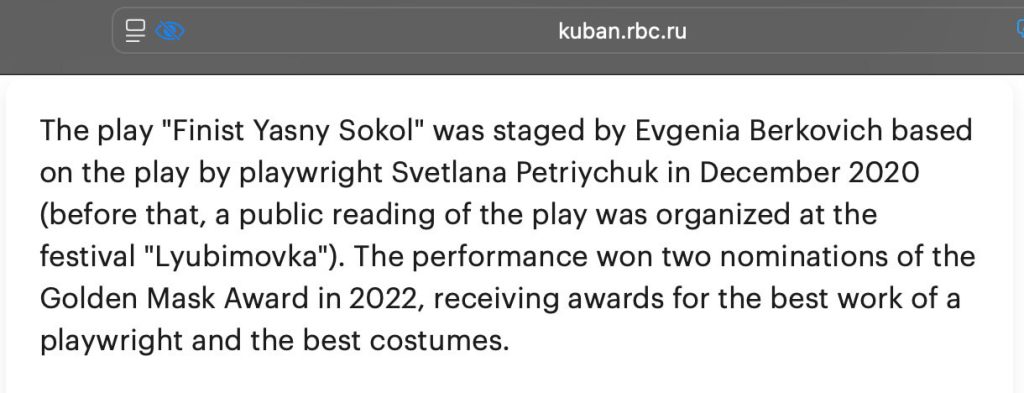
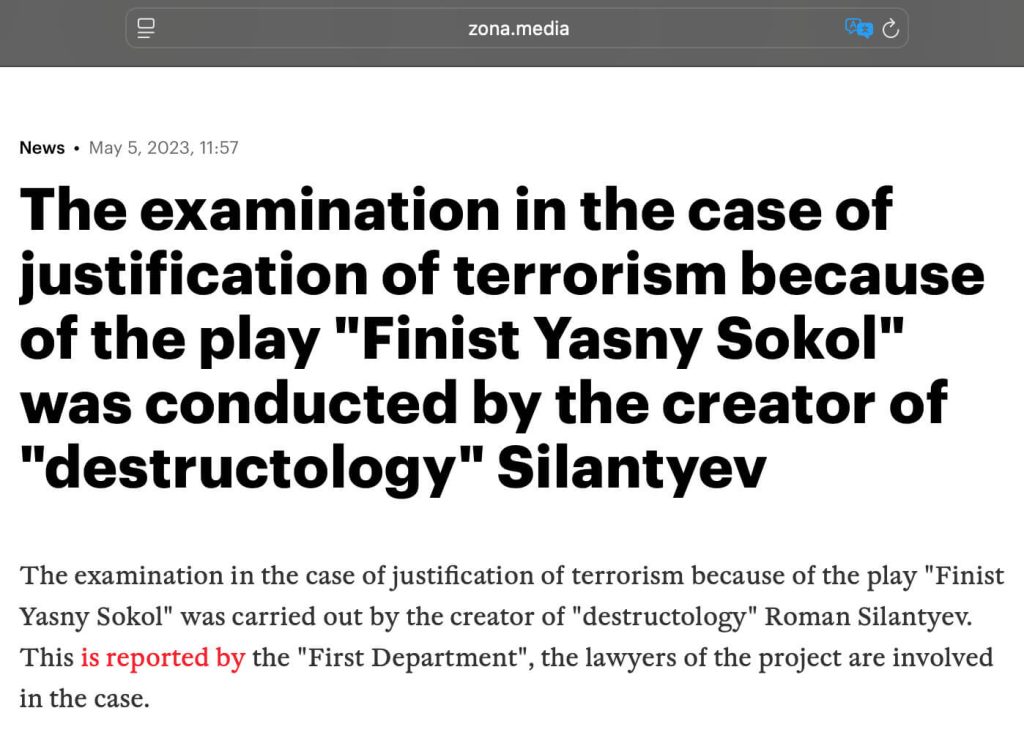
That same day, they were interrogated, and on May 5, the court ordered their pretrial detention. The basis for initiating the case and bringing charges was a so-called “destructological expert evaluation” 3 carried out by Roman Silantyev whose conclusions formed the foundation of both the criminal prosecution and the subsequent court proceedings.
Against this backdrop, an obvious question arises: what exactly was this play about that provoked such widespread attention?
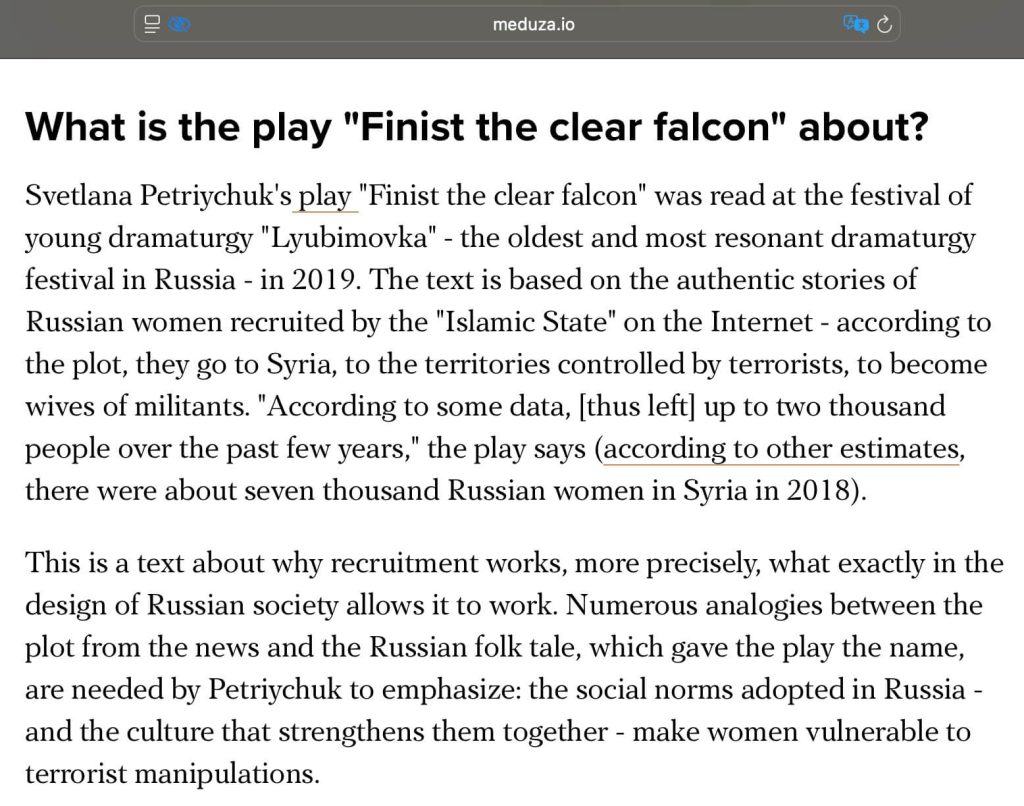
“What Is the Play ‘Finist, the Brave Falcon’ About?
Svetlana Petriychuk’s play ‘Finist, the Brave Falcon’ was first presented at the Lyubimovka Festival of Young Playwriting, the oldest and most influential playwriting festival in Russia, in 2019. The text is based on real stories of Russian women recruited online by the Islamic State. According to the plot, they travel to Syria, to territories controlled by terrorists, in order to become the wives of militants. ‘Based on some reports, [as many as] two thousand people left in this way over the past several years,’ the play states (according to other estimates, there were around seven thousand Russian women in Syria in 2018).
The text is about why recruitment works, or, more precisely, what in the structure of Russian society actually enables it to work. Numerous parallels between a news story and the Russian folk tale that gave the play its title are used by Petriychuk to emphasize that accepted social norms in Russia and the culture that reinforces them make women vulnerable to manipulation by terrorists.” 4
One can certainly dismiss this quotation as merely a personal opinion. However, let’s consider what professionals think — people for whom theater isn’t a subject of casual discussion, but a field of expertise: playwrights, directors, and theater critics.
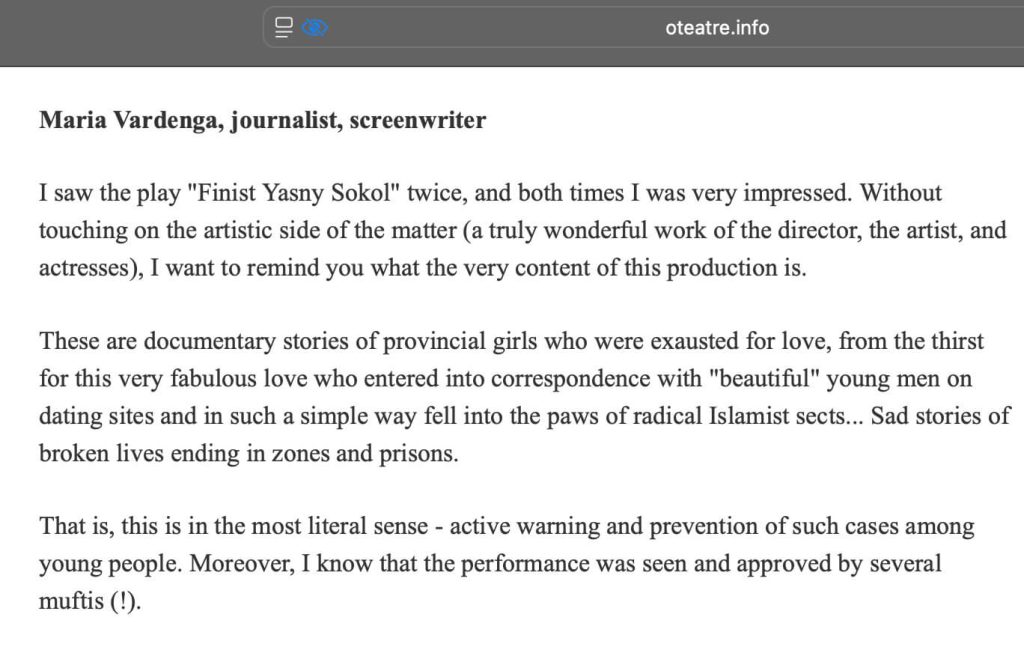
The following opinion comes from Nikolai Pesochinsky, a theater scholar and educator who served on the Golden Mask jury that awarded Svetlana Petriychuk with the National Theater Award in the category “Drama. Playwright’s Work”:
“I can describe the play and production ‘Finist, the Brave Falcon’ in simple terms for those who have neither seen the performance nor read the text. I was a member of the Golden Mask jury that awarded Svetlana Petriychuk the National Theater Award in the category ‘Drama. Playwright’s Work.’ The play was also nominated for Best Small-Form Production, Best Direction for Yevgenia Berkovich, and Best Costume Design for which it received the award.
It’s a tender, psychologically complex, profound, dramatic, and sorrowful play. The women’s lives depicted in it, based on documentary material, are filled with hardships and problems, some of them entirely hopeless. Reality deceives, and illusions of happiness are shattered. The performance creators closely examined a real-life situation, one that exists in our society: blind relationships, immersion in an entirely unfamiliar culture, different emotions, and a different way of life. There is also a broader philosophical dimension for the audience to reflect upon: What is a woman searching for? How is a perfect husband imagined? How does a dialogue of love take shape? How can one lose and find the environment where happiness is possible?
Of course, this is in no way propaganda or even a justification of the path taken by the characters in the play.
It is also noteworthy that the play isn’t straightforwardly realistic. It is highly poetic, unusual in its tone, performance style, and visual language. It’s a humanistic play. It stands with dignity within the tradition of Russian psychological theater, and I can say that it has already become part of the history of contemporary Russian theater.
If there are questions about the production, they should be addressed to specialists — people who know how to view and analyze works of art. One should not rely on random opinions. There were 14 of us on the jury, representing different theater professions, different cities, and different generations. Before us, the performance had been viewed by a large group of experts who nominated both the play and the production for the National Theater Award. The play was widely discussed and reviewed by professional critics. Those opinions should be taken into account.” 5
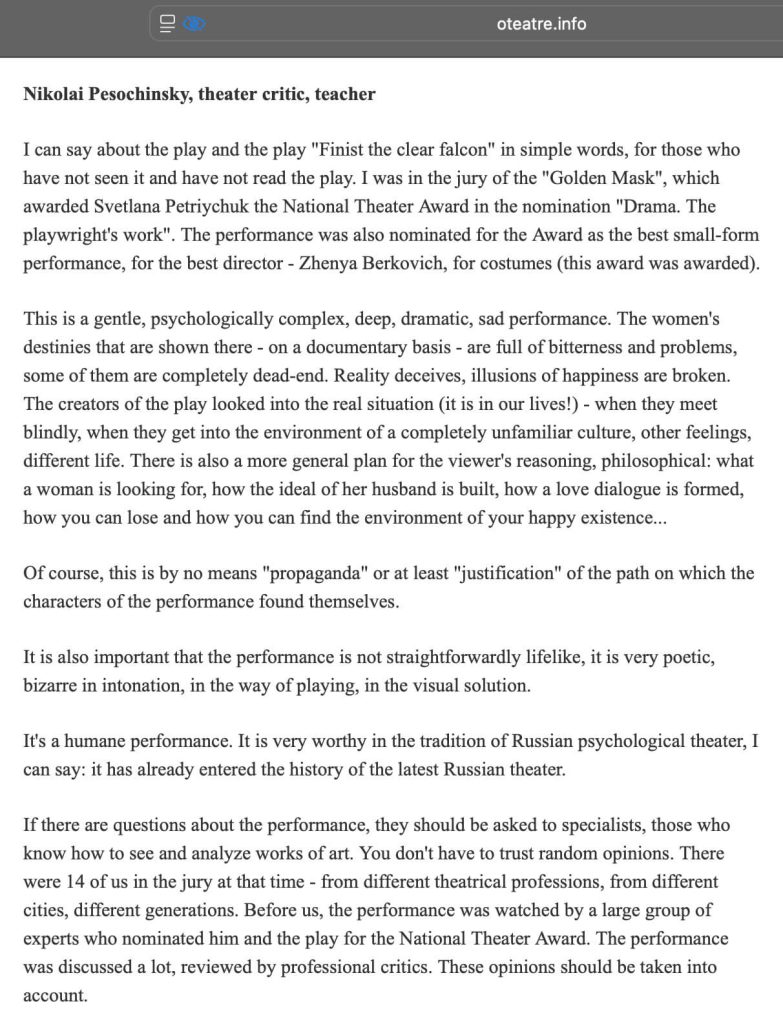
Actress and director Varvara Faer offers the following evaluation of the performance:
“I saw both the staged reading at the Lyubimovka Festival and the production at the Within Space Theater. I’m referring to ‘Finist, the Brave Falcon.’ I’ll try to explain in simple terms why there is neither an incidence nor a corpus delicti here, when it comes to the alleged justification of terrorism. Heroines of the play are naïve young women with severely limited choices and opportunities. Those women are not fictional — they really exist. They wanted to love, and it so happened that there was not a single man in their immediate environment capable of inspiring that feeling. As a result, they began to fantasize. The Internet is a perfectly suitable tool for that. A virtual man is more attractive than a real one because you can imagine anything you want about him.
Then a handsome southern man appears in a profile picture. At first, he timidly speaks of affection, then of passion, then proposes marriage, and the girl falls for it completely. She has no idea she’s being recruited; she simply falls in love. She rushes across three borders to be with her beloved. Only afterwards does she discover that he’s not a prince on a white horse at all, but someone entirely different.
The play asserts that love can sometimes be foolish, blind, and cruel. Where is terrorism in that? Let alone its justification. Justification is when someone says that carrying out terrorist attacks is good, that terrorists are right, and that others should do the same. The play says, however, that unfortunate young women fell in love with virtual men who turned out to be terrorists. Where is the justification of terrorism? I’m ready to testify in court and serve as a public defender for playwright Svetlana Petriychuk.”
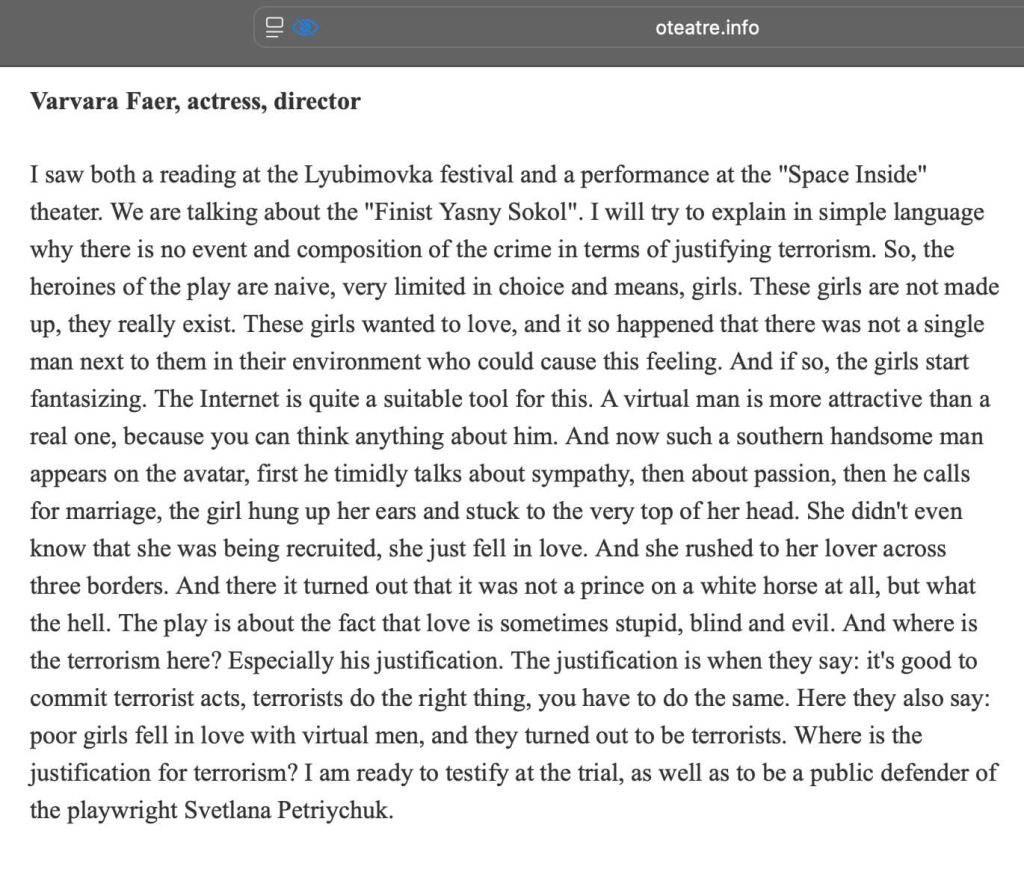
A similar perspective is offered by playwright Nina Belenitskaya:
“Svetlana Petriychuk’s play ‘Finist, the Brave Falcon,’ read by Yevgenia Berkovich and her daughters, closed the Lyubimovka Festival in 2020. It was a classic staged reading. There were just actresses delivering the text with absolute precision. Yet, even that was enough. The audience sat motionless, scarcely breathing. It had been a long time since there was such a powerful play about love and female vulnerability. Those were documentary monologues by young women who, desperate to find love, believed in an Eastern fairy tale and, intoxicated by the dream of finding a kindred soul, took a step into the abyss. Their beloved ones turned out to be recruiters for ISIS.
The outstanding artist Ksenia Sorokina joined the project, and the outcome was an extraordinarily expressive performance — one that breaks your heart while also delighting the eye. Experiences of the heroines are extreme; their lives have been shattered, and they paid dearly for their mistake. It’s impossible not to care about them, impossible not to sympathize with them, impossible not to be horrified by where their naïve faith in the idea that love works miracles and conquers evil ultimately led them. It’s difficult to imagine a more humanistic view of imperfect human nature. I’ve never seen a performance with a more unequivocal anti-terrorist message. I simply cannot believe that anyone could seriously interpret it as justification of terrorism.
I attended the staged reading of Svetlana Petriychuk’s ‘Finist, the Brave Falcon’ at Lyubimovka. The reading, like the production itself, was directed by Yevgenia Berkovich. Unfortunately, I didn’t see the finished performance. Yet, if anyone is looking for a powerful anti-terrorist documentary, Svetlana’s play is exactly that. In it, terrorism is portrayed as grief and a great evil. It is nothing else.”
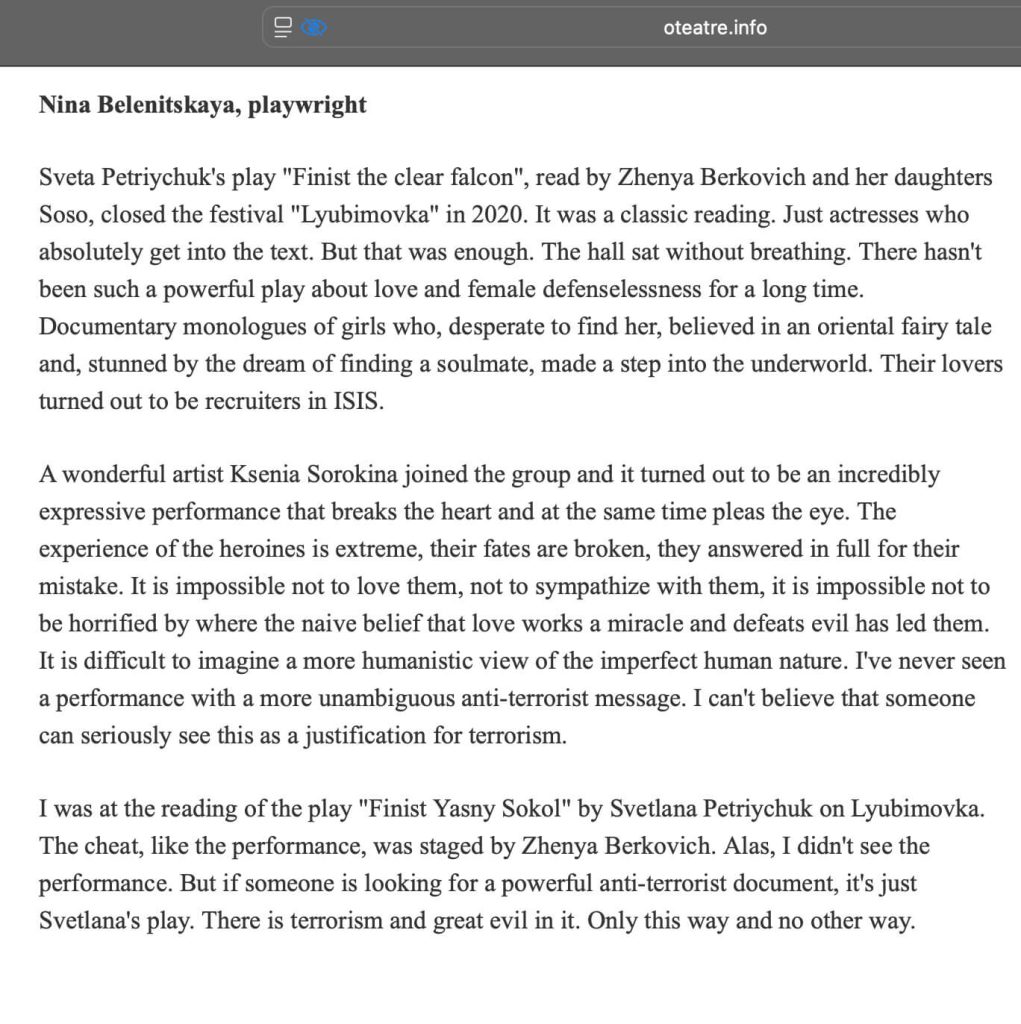
Journalist and screenwriter Maria Vardenga also joins the discussion:
“I watched ‘Finist, the Brave Falcon’ twice, and both times I was deeply impressed. Without addressing its artistic merits, which are truly remarkable on the part of the director, designer, and actresses, I’d like to remind people what the play is actually about.
It’s a series of documentary stories of young women from provincial towns, who longed for love and, driven by that yearning for a fairy-tale romance, started messaging ‘handsome’ young men on dating websites, only to fall through this simple mechanism into the hands of radical Islamist sects… Those are tragic stories of shattered lives that end in penal colonies and prisons.
In the most direct sense, the play serves as an active warning and a form of prevention against similar cases among young people. Moreover, I know that several muftis watched the performance and approved it (!).”
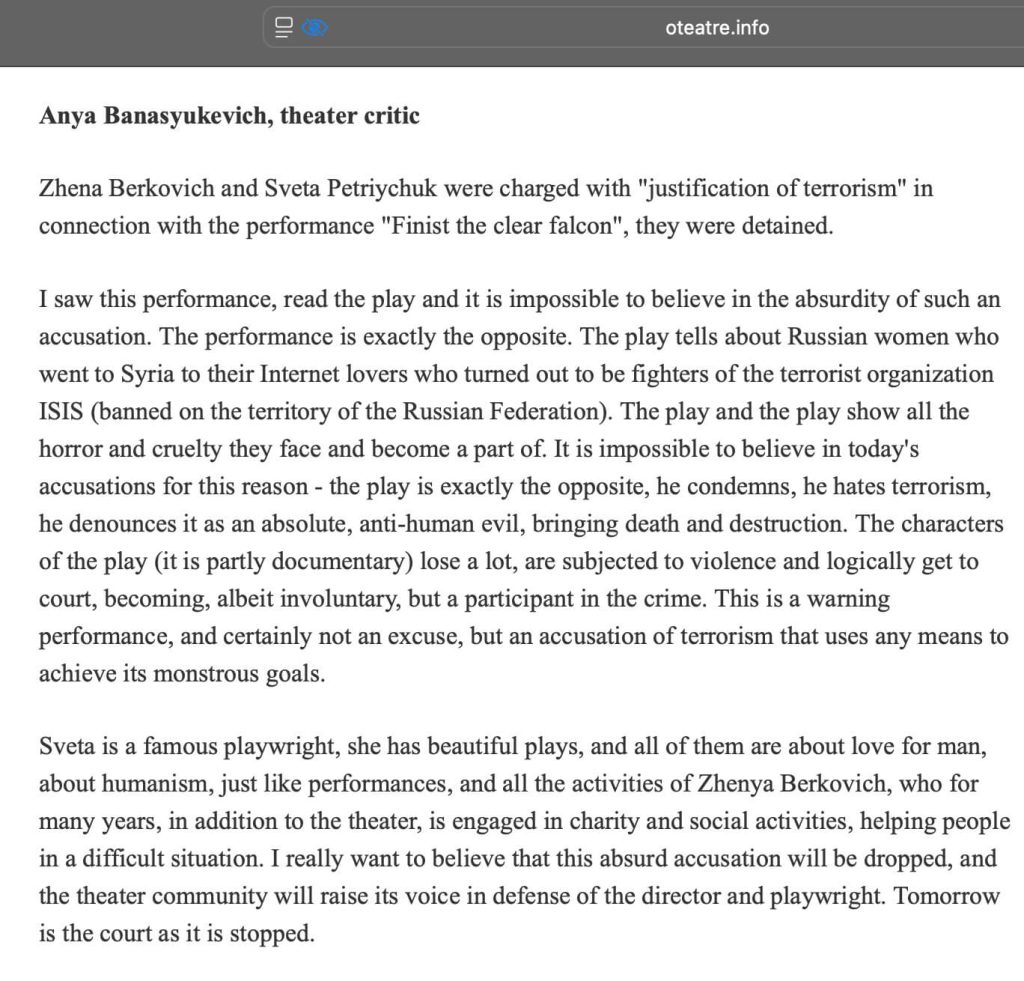
Theater critic Anna Banasyukevich offers another professional opinion:
“Yevgenia Berkovich and Svetlana Petriychuk have been charged with ‘justifying terrorism’ in connection with the play ‘Finist, the Brave Falcon.’ They’ve been detained.
I saw the performance and read the play, and it’s impossible to believe the absurdity of such an accusation. The play is about exactly the opposite. It tells the story of Russian women who traveled to Syria to join internet lovers who turned out to be fighters in ISIS, a terrorist organization banned in the Russian Federation. Both the play and the production depict the full horror and cruelty they encounter and ultimately become part of. That’s exactly why today’s accusations are so difficult to believe: the play tells the opposite. It condemns terrorism, hates terrorism, and exposes it as an absolute, anti-human evil that brings death and destruction. Characters in the production (which is partly documentary) lose much, suffer violence, and ultimately face trial, having become participants, albeit unwilling ones, in criminal acts. The play serves as a warning, and certainly not a justification of terrorism, but an indictment of terrorism that uses any means necessary to achieve its monstrous goals.
Svetlana is a well-known playwright with a body of outstanding work, all of it centered on love for humanity and humanism. The same can be said of Yevgenia Berkovich’s productions and her broader activities. For many years, alongside her work in theater, she’s been involved in charitable and social initiatives, helping people in difficult circumstances. I very much hope that this absurd charge will be dropped and the theater community will raise its voice in defense of the director and the playwright. The hearing on the pretrial detention measure is scheduled for tomorrow.”
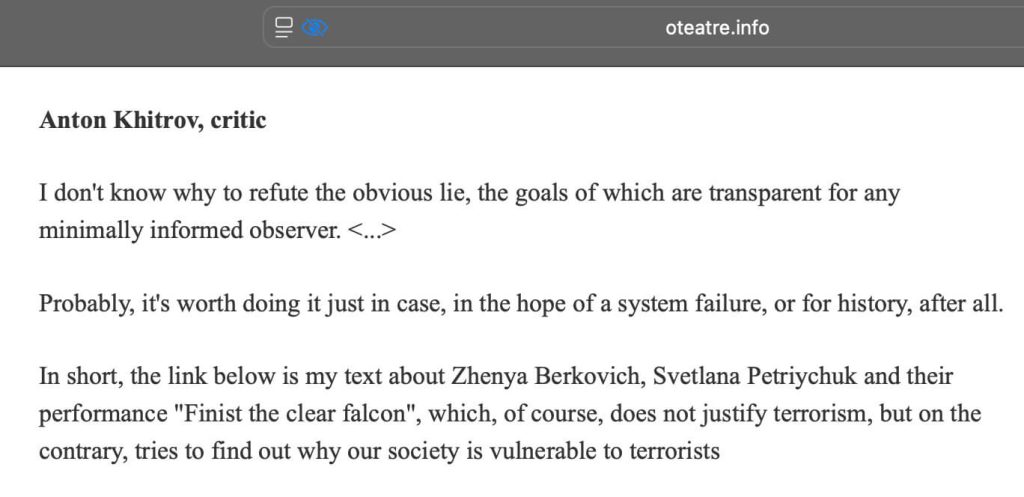
Critic Anton Khitrov also shared his perspective on the performance:
“I don’t know why one should bother refuting an obvious falsehood whose purpose is transparent to any minimally informed observer. <…> Perhaps, it is worth doing simply as a precaution, in the hope that the system might malfunction, or, at the very least, for the historical record.
In short, the link below contains my article about Yevgenia Berkovich, Svetlana Petriychuk, and their production ‘Finist, the Brave Falcon,’ which certainly doesn’t justify terrorism. Quite the opposite, it attempts to understand why our society is vulnerable to terrorists.”
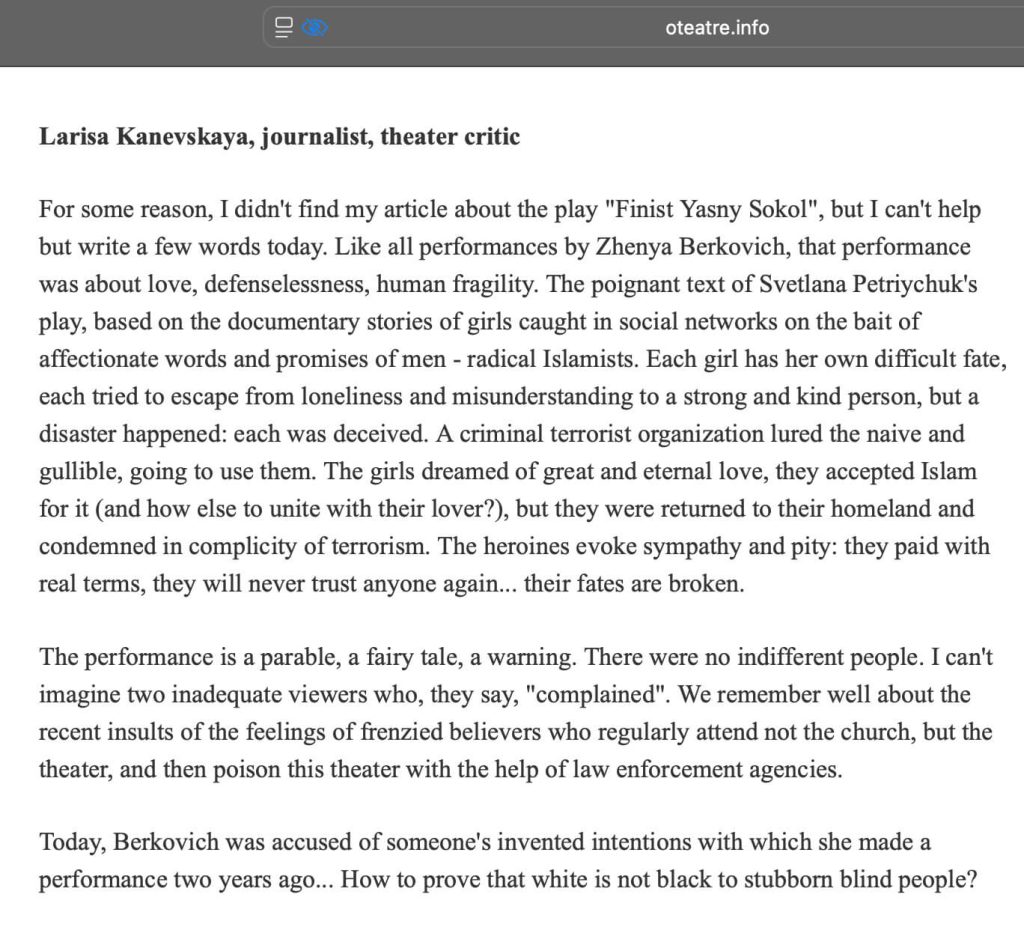
Journalist and theater critic Larisa Kanevskaya comments on what she sees as the central message of the play:
“For some reason, I couldn’t find my article about ‘Finist, the Brave Falcon,’ but I cannot refrain from writing a few words today. Like all of Yevgenia Berkovich’s performances, this one was about love, vulnerability, and fragility of human beings. Svetlana Petriychuk’s poignant text is based on documentary stories of young women who fell prey on social media to the bait of kind words and promises from men who turned out to be radical Islamists. Each of those women had a difficult life. Each sought to escape loneliness and misunderstanding by finding a strong and caring partner. However, disaster followed: every one of them was deceived. A criminal terrorist organization lured in naïve and trusting people with the intention of exploiting them. The women dreamed of a great and lasting love and, for its sake, converted to Islam (how else could they unite with the men they loved?). They were eventually returned to their homeland and convicted of aiding terrorism. The heroines evoke sympathy and compassion. They paid with real prison sentences, and they will never trust anyone again. Their lives have been broken.
The play is a parable, a fairy tale, and a warning. No one remained indifferent. I cannot imagine the two unbalanced audience members who, reportedly, filed complaints. We well remember the recent cases involving alleged offense of the feelings of zealous believers who regularly attend not churches but theaters, only to later persecute those theaters through law enforcement.
Today, Berkovich has been accused of intentions someone invented for her — intentions allegedly underlying a production she created two years ago. How can one prove to stubborn blind people that white is not black?”
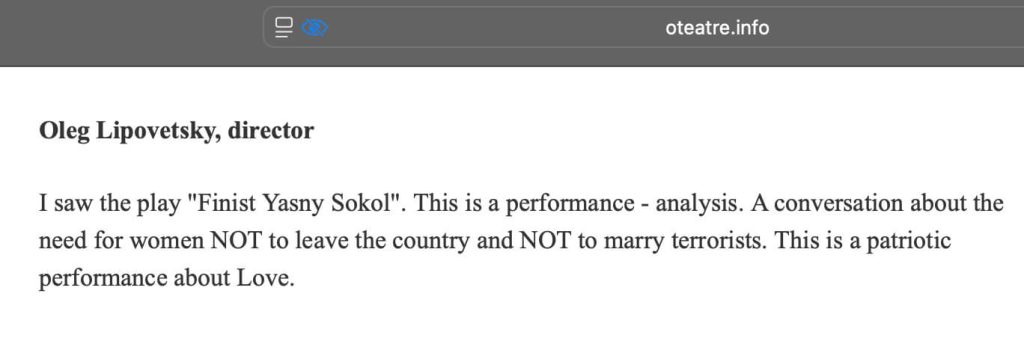
Director Oleg Lipovetsky also commented on the play substance:
“I did watch ‘Finist, the Brave Falcon.’ It’s an analytical production. It’s a conversation about what must be done so that women don’t leave the country and don’t marry terrorists. It’s a patriotic play about Love.”
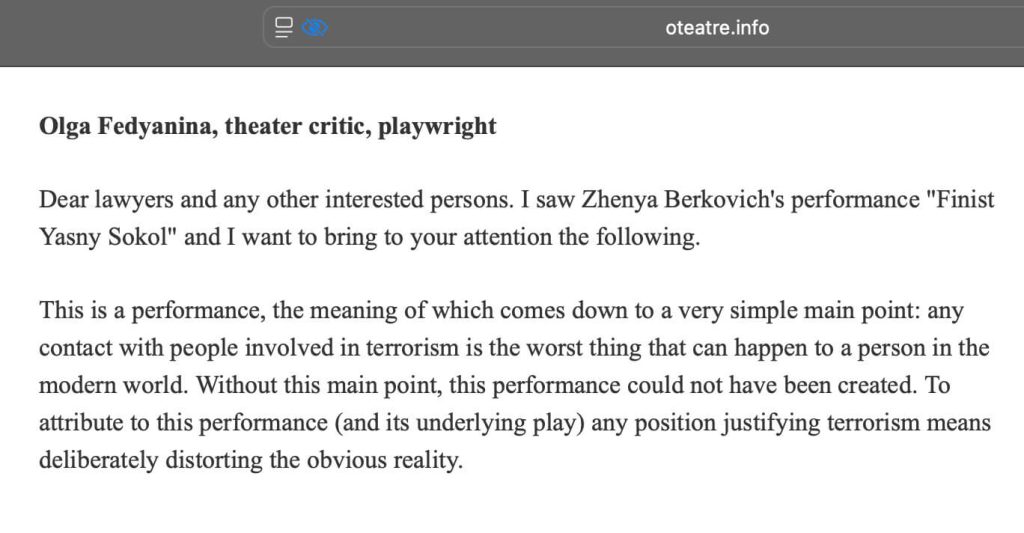
In her address to attorneys and other participants in the proceedings, theater critic and playwright Olga Fedyanina offered her opinion on the performance:
“Dear attorneys and all other interested parties. I have seen Yevgenia Berkovich’s production of ‘Finist, the Brave Falcon,’ and I’d like to bring the following to your attention.
It’s a play whose meaning can be reduced to one very simple core point: any contact with people involved in terrorism is the worst thing that can happen to a person in the modern world. Without this main point, the play could not have been created. To attribute to this production and to the play on which it is based any position that justifies terrorism means to deliberately distort the obvious reality.”
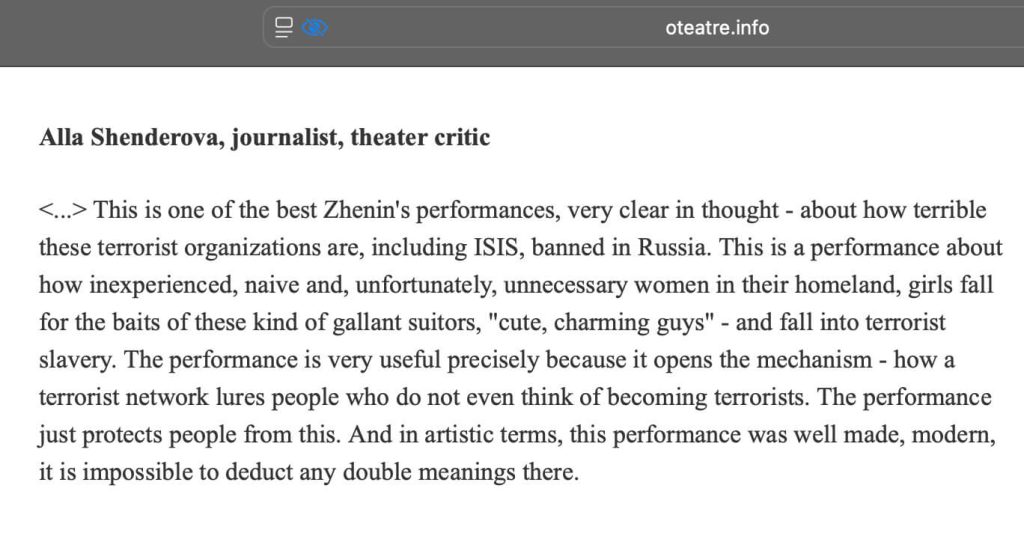
Journalist and theater critic Alla Shenderova shares her interpretation of the play:
“<…> That’s one of Yevgenia’s finest productions, and its message is very clear: it is about how horrific those terrorist organizations are, including ISIS that is banned in Russia. It’s a play about how inexperienced, naïve women and girls who, sadly, feel unwanted in their own country fall for the bait of supposedly gallant suitors, those ‘sweet, charming guys,’ and end up in terrorist slavery. The play is especially valuable because it exposes the mechanism of how a terrorist network lures in people who never intended to become terrorists. The play serves precisely to protect people from that. Artistically, it was also very well done, thoroughly contemporary, and there is simply no way to read any hidden double meanings in it.”
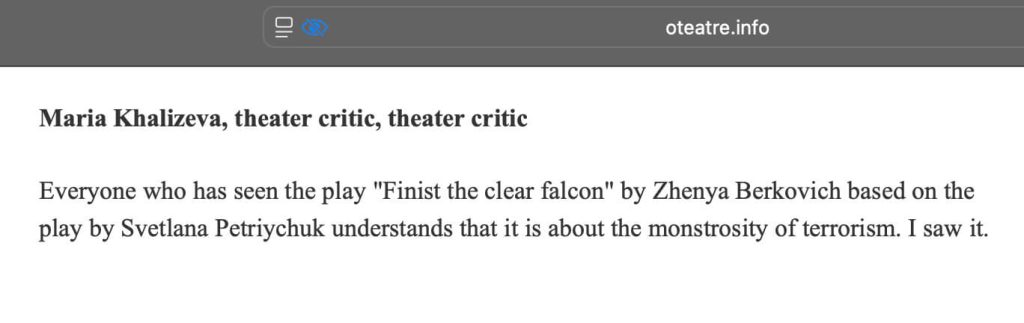
Another example from the broad consensus of opinions comes from theater scholar and critic Maria Khalizeva:
“Everyone who watched Yevgenia Berkovich’s production of ‘Finist, the Brave Falcon’ based on Svetlana Petriychuk’s play understands that it’s about the monstrous nature of terrorism. I have seen it.”
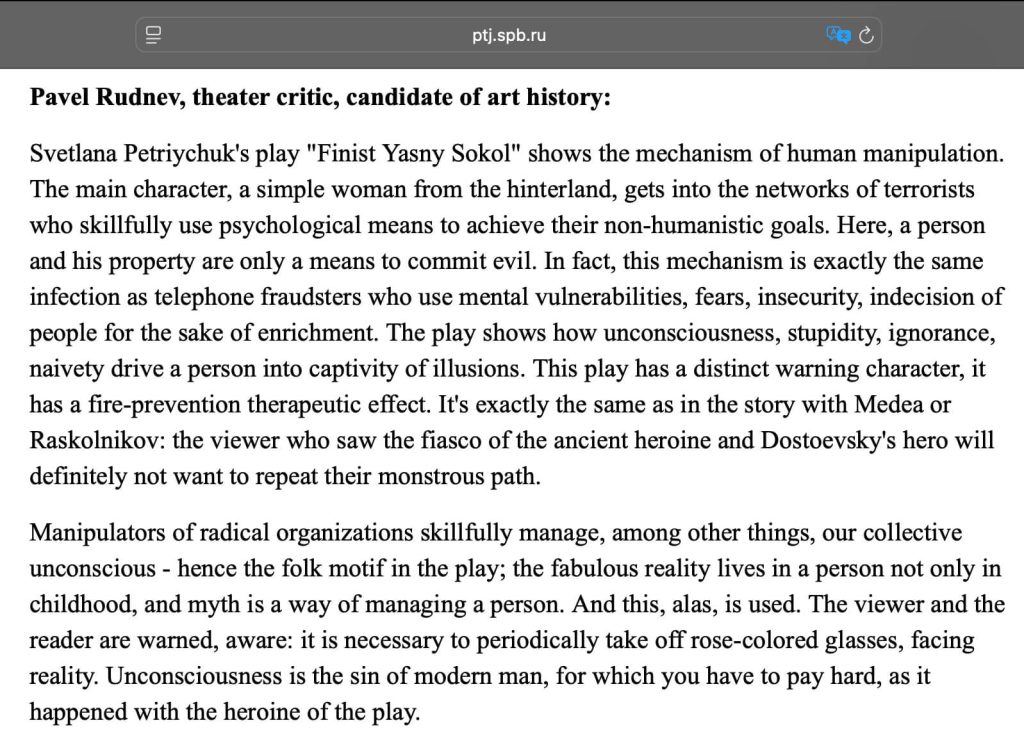
As a sort of summary of all evaluations cited above, we present the view of a theater critic and Ph.D. in History of Arts, Pavel Rudnev:
“Svetlana Petriychuk’s play ‘Finist, the Brave Falcon’ exposes the mechanism of manipulating people. The main character, an ordinary woman from a rural area, falls into the hands of terrorists who skillfully use psychological tools to achieve their inhumane goals. In this case, a person and what they own are nothing more than tools for committing evil. In essence, this mechanism is every bit as nasty as phone scammers who exploit people’s psychological vulnerabilities, fears, insecurity, and indecision for financial gain. The play shows how a lack of awareness, foolishness, ignorance, and naivety can trap a person in a prison of illusions. The play carries a clear warning and has a preventative therapeutic effect. It works exactly like the stories of Medea or Raskolnikov: a viewer who witnesses the downfall of the tragic Greek heroine or Dostoevsky’s protagonist is unlikely to want to follow their monstrous path.
Manipulators within radical organizations skillfully control, among other things, our collective unconscious, which is why the play incorporates a folkloric motif. Fairy-tale realities live on inside a person long past childhood, and myth is a tool for controlling people. Unfortunately, that fact is exploited. The audience and readers are warned and informed: from time to time, you have to take off your rose-colored glasses and confront reality. Lack of awareness is a sin of a modern human, one that comes with a heavy price, just as it did for the play heroine.” 6
We share the opinions expressed by the professional community and believe it is necessary to add our own observation: watching the play reveals striking parallels with the movie “Profile” that is based on a true story. 7 For those who haven’t watched the film, it features a British journalist who goes undercover to infiltrate a terrorist organization’s recruitment network and, by engaging with a recruiter, she step-by-step exposes his methods, strategies, and the subtle psychological mechanisms of influence he uses.

Similar themes, dramatic turns, and an emphasis on exposing hidden mechanisms of influence are clearly evident in the theater play, reinforcing its perception as a work with a pronounced anti-terrorist message.
Consider this: while the professional theater community was virtually unanimous in pointing out the play’s anti-terrorist, cautionary nature and its exposure of recruitment mechanisms, Roman Silantyev’s so-called “destructological expert evaluation” is built on the exact opposite logic. Against that backdrop, the evaluation doesn’t just look like a controversial opinion; it feels like an outright mockery of the professional theater community, an insult to common sense, and essentially a slap in the face to Russian society. When actual theater experts say one thing, while a pseudo-expert construct claims the exact opposite, it raises questions not just about the quality of the evaluation, but about the very mechanism behind how decisions are made.
“Destructological Expert Evaluation”
Roman Silantyev’s “destructological expert evaluation” has never been published in full. However, a considerable number of excerpts, summaries, and quotations from it are publicly available, so we are going to analyze one of them. For our analysis of Roman Silantyev’s so-called “destructological expert evaluation” regarding “Finist, the Brave Falcon,” we will use excerpts published by the media outlet Meduza 8 on May 5, 2023, in their coverage of the trial. This single section of the evaluation is enough to reveal its level of “scientific rigor,” its methodological weaknesses, and the abundance of manipulative constructs presented as expert analysis.
“1. Do the submitted materials contain signs of any ideologies or destructive subcultures? If so, which ones?
“Yes, they do. The submitted materials contain signs of the ideology of ISIS (an organization banned in the Russian Federation), as well as of the subculture of Russian female Muslim converts who are the wives (including virtual wives) of extremists and terrorists associated with the aforementioned banned organization. This destructive subculture began to form in the Russian Federation in the early 1990s based on the ideology of ‘pure Islam’ with elements of Wahhabism, and received a new impetus for development during the Syrian civil war starting from 2011.”
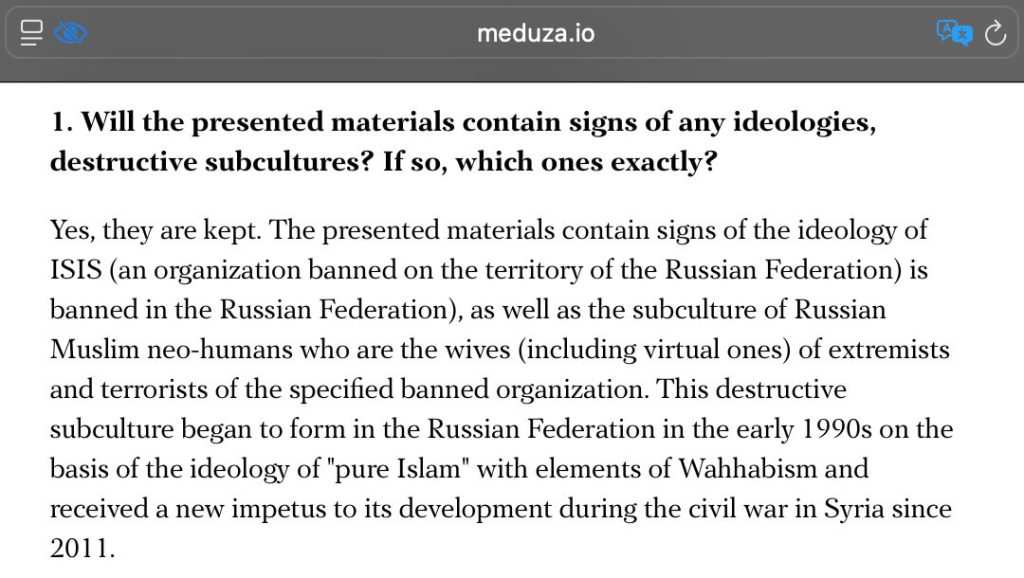
The first problematic construct is a declarative conclusion unsupported by methodology.
Quote:
“The submitted materials contain signs of the ideology of ISIS (…) as well as of the subculture of Russian female Muslim converts…”
Here, the “expert” immediately presents a final conclusion without explaining how it was reached. The evaluation fails to specify:
- which exactly signs were analyzed;
- the criteria used to identify them;
- how artistic representation was distinguished from propaganda;
- why this particular interpretation should be regarded as the only possible one.
Particularly revealing is the term “subculture of Russian female Muslim converts.” The expert treats it as an established scientific category, yet he provides no:
- definition;
- academic sources;
- sociological studies;
- criteria for identifying such a “subculture.”
In other words, the court is expected to take the existence of this phenomenon purely on faith, relying solely on the pseudo-expert’s authority. This is a classic manipulative technique: replacing evidence with assertion. In a forensic evaluation, this presents a serious methodological problem because the conclusion is neither verifiable nor reproducible.
The next paragraph of Silantyev’s “evaluation” reads:
“The ideology of ISIS is one of the Islamist terrorist ideologies that sacralizes armed violence as a method of political struggle and declares war in the interests of the Muslim religious group as the sixth pillar of Islam, that is, a core doctrinal component of the Islamic religion. Until recently, such groups as Al-Qaeda, the Caucasus Emirate, Wahhabism, Salafism, Takfirism, Hizb ut-Tahrir al-Islami (Islamic Liberation), Tablighi Jamaat recruiters, Ikhwan al-Muslimeen, and others actively promoted themselves within the territory of the Russian Federation.”
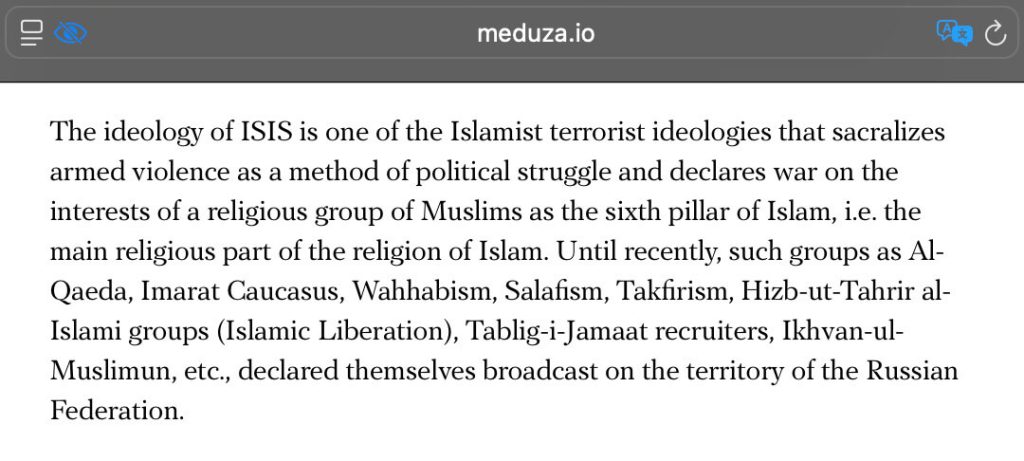
We clearly see the conflation of completely different phenomena into a single “threatening mass.” Quote:
“Al-Qaeda, the Caucasus Emirate, Wahhabism, Salafism, Takfirism, Hizb ut-Tahrir al-Islami groups, Tablighi Jamaat, Ikhwan al-Muslimeen (…) All of them were allies of ISIS.”
Here, a single category is used to lump together:
- terrorist organizations;
- religious movements;
- theological concepts;
- political movements;
- missionary organizations.
Yet, serious conflicts and ideological disagreements existed among many of the entities listed, including direct opposition to ISIS itself.
Thus, instead of an accurate religious-studies classification, we get an emotional and ideological grouping based on the principle “everything dangerous mixed together.” This is the classic manipulative tactic of guilt by association where fundamentally different phenomena are artificially linked in order to create the impression of a single dangerous network. Consequently, whoever reads this “expert report” forms a negative emotional association among entirely different organizations, movements, and concepts without any need for direct proof.
For a document claiming the status of a forensic evaluation, such an approach is simply unacceptable, since scholarly analysis requires precise terminology, clear distinctions among categories, and rigorous argumentation.
Another example from the “destructological evaluation”:
“All of them were allies of ISIS and, despite tactical disagreements, shared a common strategy — the destruction of the existing state order. The main unifying idea upon which the theology of violence of these groups was built was the idea of humiliation of Muslims as an immutable justification for violent opposition to any government authority. The logic is as follows: no matter how strongly society and the state strive for justice, they cannot be just until they are under Muslim rule.
The ideology of radical feminism, which is also present in the text of the transcript of the play directed by Ye. Berkovich, is built on the same foundational idea of humiliation as an inescapable cause of conflict.”
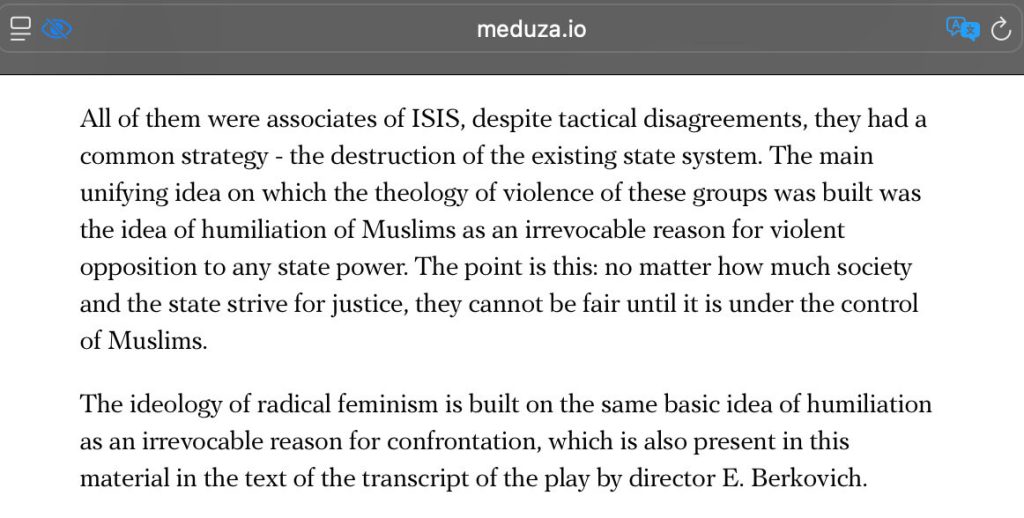
What we see here is manipulation through an extremely vague concept. Quote:
“The main unifying idea (…) was the idea of humiliation of Muslims…”
and then:
“The ideology of radical feminism (…) is built on the same foundational idea of humiliation…”
Here, the “expert” attempts to draw a direct conceptual line between Islamism and radical feminism through the category of humiliation. However, humiliation is an extraordinarily broad concept found in virtually every form of social criticism, including:
- anti-racism;
- human rights literature;
- anti-colonial writings;
- feminism;
- anti-war works.
By this logic, almost any production and work dealing with injustice can be linked to radicalism.
This makes the criterion infinitely elastic and utterly unscientific. Instead of rigorous analysis, the evaluation relies on a manipulative strategy of expansive interpretation, in which an undefined concept is deliberately stretched to the point that it can be applied to almost anything. In fact, anyone reading this evaluation is nudged toward the emotional association: “If a work speaks about oppression, it is potentially linked to extremism.” From a scholarly standpoint, such a logic is highly vulnerable.
Another passage from the so-called evaluation states:
“To promote these ideologies, the playwright employs literary devices such as romanticizing, justifying, and glorifying terrorists, as well as portraying the steadfastness and loyalty of their female companions in the fight against humiliation suffered by Russian Muslims on the one hand; and on the other hand, she depicts Russian women who are humiliated and deceived by ill-mannered Russian men. In turn, Ye. Berkovich, as the performance director and author, reinforces those themes by depicting scenes of how women are humiliated in a male-centered world in any setting where they encounter men, which gives them the right to fight back against this status quo.”
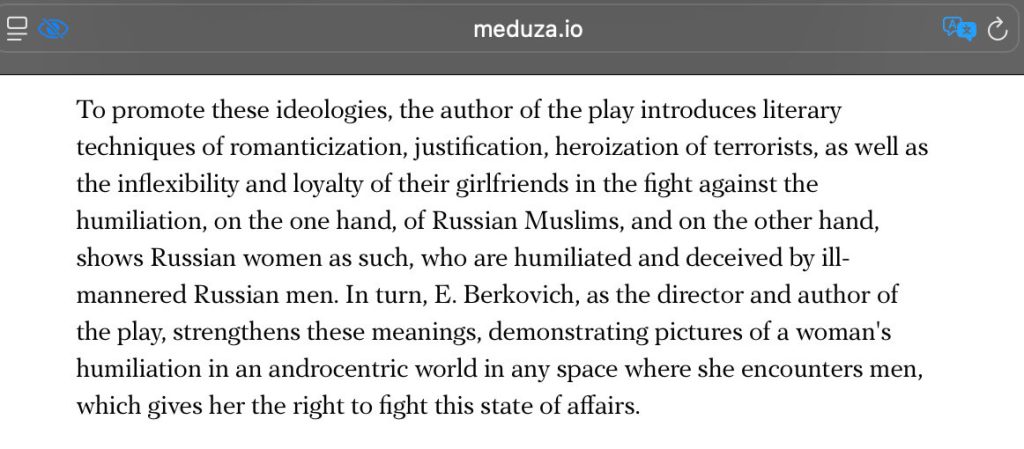
What is immediately apparent here is another substitution: the artistic depiction of a phenomenon is presented as a justification of it. Quote:
“The playwright employs literary devices such as romanticizing, justifying, and glorifying terrorists…”
The “expert” fails to prove the main claim: why a mere depiction of a terrorist is automatically regarded as justification. In literature and drama, a character may:
- express radical ideas;
- possess psychological complexity;
- evoke sympathy;
- explain their motivations.
Yet, none of this means the author endorses the character’s stance.
Professional analysis typically considers:
- a work’s ending;
- consequences of characters’ actions;
- authorial distance;
- an overall message of the work;
- its structure and composition.
In this case, such analysis is almost entirely absent. Instead, the evaluation relies on the manipulative tactic of emotionally equating depiction with endorsement. By that logic, any work featuring a criminal can automatically be labeled an “endorsement of crime.” From a scholarly standpoint, such an approach appears exceedingly simplistic and methodologically weak.
The final point for our analysis, straight from Silantyev’s so-called “destructological evaluation” reads:
“It is noteworthy that the surge in crimes driven by radical feminist ideas has coincided with a decline in Islamist-driven crime, as well as a decline in interest in its cultural achievements, such as ISIS’ highly professional videos featuring live beheadings that are mentioned by Maryushka, a character in S. Petriychuk’s play, the songs of Matsurayev, and other forms of creative output. S. Petriychuk’s play and especially Ye. Berkovich’s stage production successfully overcome this decline in interest by bringing back an interest in various radical ideas into Russia’s creative space as a source of dramatic creativity.”
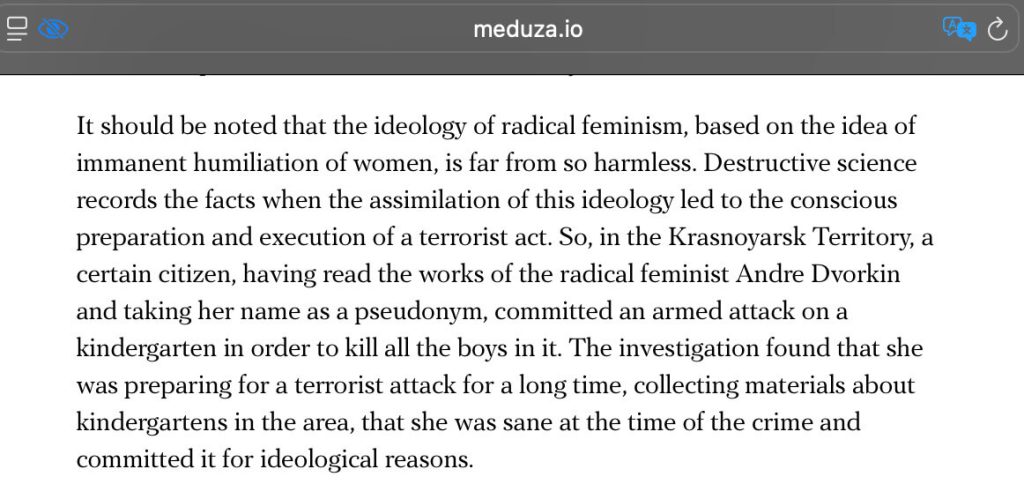
Once again, we see an emotionally charged and manipulative statement rather than expert analysis. Quote:
“ISIS’ highly professional videos featuring live beheadings.”
This reads more like a piece of polemical commentary than a component of a piece of rigorous expert evaluation. First, it employs emotionally loaded language designed to heighten psychological impact on the trial participants. Second, the “expert’ makes no effort to explain how this passage relates to analysis of the specific play. Third, the very tone of the phrasing is difficult to reconcile with standards of neutrality and impartiality required for a forensic evaluation.
Such wordings are characteristic of manipulation through emotional shock, where a vivid and disturbing image is presented in place of rigorous argumentation, diminishing a reader’s critical engagement with the text and eliciting a desired emotional response.
Even a superficial analysis of this excerpt from Roman Silantyev’s “destructological evaluation” suggests that what we’re dealing with is not a scientific expert evaluation in any strict procedural sense, but rather a collection of journalistic and ideologically colored assertions united by the author’s subjective interpretation. Instead of a verifiable methodology, clear analytical criteria, and reproducible indicators, Silantyev’s “evaluation” relies on declarative conclusions, emotional judgments, free associations, and arbitrary grouping of completely unrelated phenomena, from terrorism to feminism and artistic fiction, into a single “threatening” construct. Moreover, the key conclusions are not proven; they are merely asserted as self-evident, which is unacceptable for a forensic evaluation claiming objectivity and scientific legitimacy.
All of these are signature techniques used by representatives of Dvorkin’s anticult movement. We discussed them in detail in an earlier article.
There is no doubt that professional forensic experts could identify even more logical substitutions, methodological violations, unsupported conclusions, emotionally charged constructs, conflations of incomparable phenomena, and other problematic elements in this text. Yet, professional analysis of the evaluation ultimately was practically pointless.
Here’s the official response 9 from the Russian Federal Center of Forensic Science under the Ministry of Justice of the Russian Federation, prepared in connection with the Berkovich and Petriychuk case. The document explicitly stats:
“Destructology is not a science, nor is it any branch of technology, art, or craft… A destructological evaluation cannot as such comply with the aforementioned foundational principle of forensic expert activity because destructology lacks generally accepted scientific and practical data.”
The RFCFE (Russian Federal Center of Forensic Expertise — author’s note) further stated that, in cases involving terrorism and extremism, courts should order and commission forensic linguistic evaluations or comprehensive psychological-linguistic evaluations.”
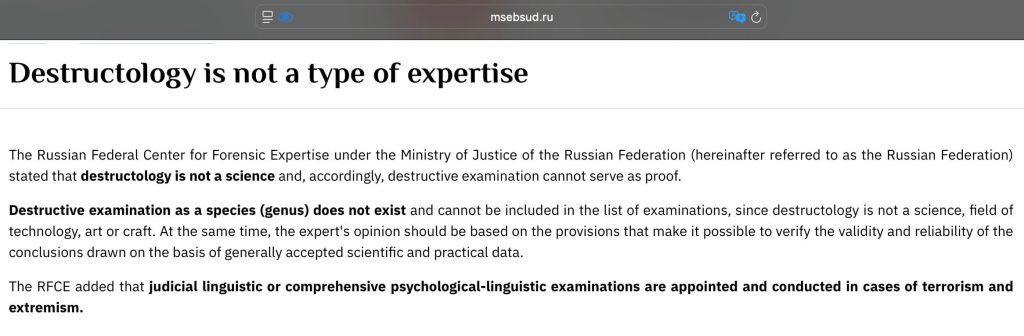
In fact, the professional expert community has directly pointed out that such a “destructological evaluation” does not meet the basic criteria of forensic science and cannot be considered reliable evidence in court.
An even harsher and more categorical opinion on Roman Silantyev’s “destructological evaluation” was provided by representatives of the Russian scientific community in a corresponding letter signed by more than 200 scholars:
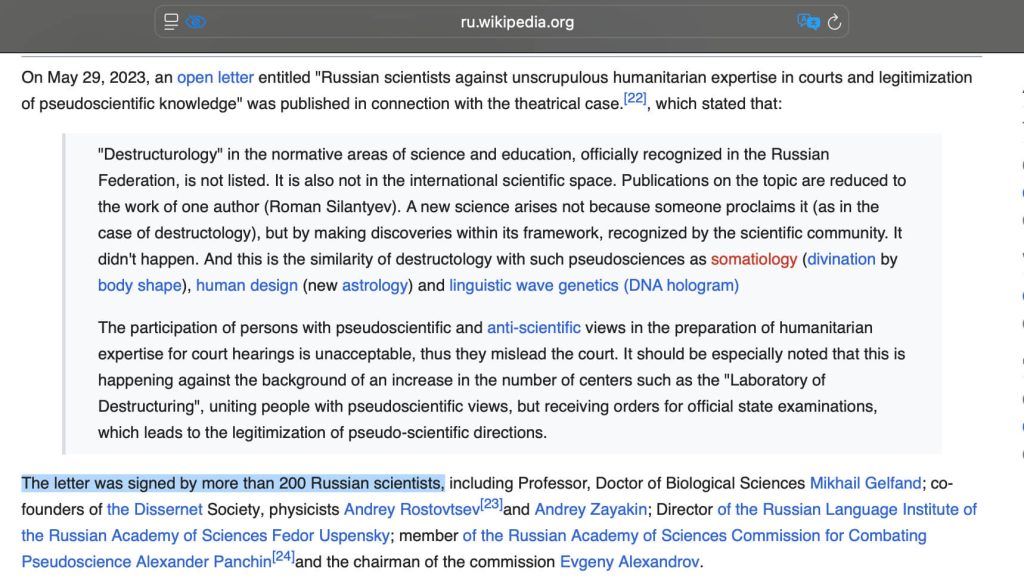
“The Council on the Ethics of Scientific Publications released 10 an open letter from Russian scholars opposing the courtroom use of expert evaluations based on ‘destructology,’ which the letter compares to ‘such pseudosciences as somatypology (fortune-telling based on body shape), Human Design (a new form of astrology), and linguistic-wave genetics (DNA holograms).’
The scholars make no secret of the fact that they were prompted to write the letter by the case against director Yevgenia Berkovich and playwright Svetlana Petriychuk, which was solely based on a pseudoscientific ‘destructological evaluation’ and under which both women remained in pretrial detention by decision of the Moscow City Court.
Among the signatories were members of the Russian Academy of Sciences: Alexander Chaplik, Mikhail Danilov, Sergey Stishov, and Yuri Kostitsyn, along with Doctor of Biological Sciences Mikhail Gelfand, co-founders of Dissernet (Russian public initiative created to check scientific papers for plagiarism, fabrication, and improper citation — author’s note) Andrey Zayakin and Andrey Rostovtsev, Doctor of Philology Svetlana Burlak, Candidate of Biological Sciences Alexander Panchin, and Candidate of Historical Sciences Dmitry Dubrovsky.
The scholars note that ‘destructology’ is not listed among the officially recognized scientific disciplines of the Russian Federation and has no standing within the scientific community. Publications on ‘destructology’ are the work of a single author, Roman Silantyev, an employee of Moscow State Linguistic University (MSLU).
The participation of individuals holding pseudoscientific and anti-scientific views in preparation of humanitarian evaluations for court proceedings is unacceptable, as they mislead the court. We especially note that this is occurring amid a growing number of centers similar to the ‘Laboratory of Destructology,’ which bring together people who have pseudoscientific views yet continue to receive contracts for official state evaluations, thereby legitimizing pseudoscientific fields.
In recent years, many erroneous decisions have been made on the basis of such ‘evaluations.’ This harms not only the lives of specific individuals and their families, but also the reputation of the country, its judicial system, and Russian science as a whole. The true task of science is impartial description and study of an object of inquiry, not identification of enemies of society. Attempts to present the matter otherwise lead to significant social distortions,’ the scholars stated.” 11
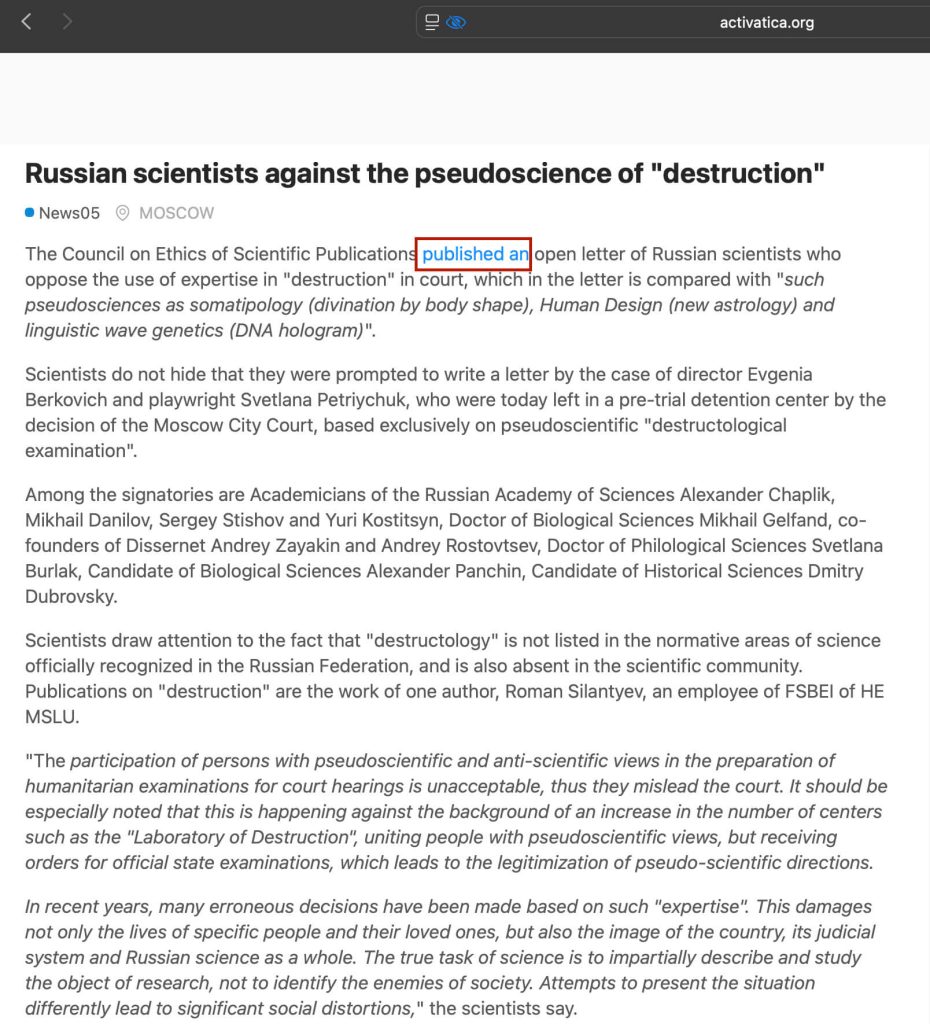
In the screenshot, you can see the phrase that originally contained a hyperlink to the Russian scholars’ open letter opposing the use of “destructology” in judicial proceedings. As we noted earlier, materials critical of Roman Silantyev and “destructology” are gradually disappearing from public access. Here’s a clear example: today, the said letter can no longer be found even through web archives, and readers can verify that for themselves.
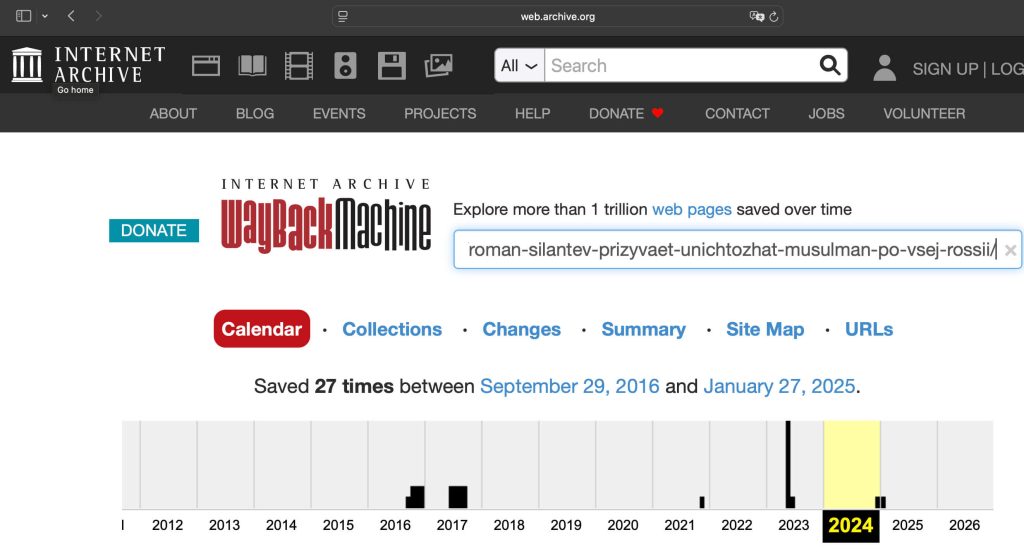
For this very reason, any further discussion of the number of errors, manipulations, and ideological constructs within the “evaluation” itself becomes almost secondary. If the discipline itself is not recognized as scientific and lacks generally accepted scientific methods, then a fundamental question arises: how did such “expert reports” acquire the procedural status of judicial evidence in the first place?
In our previous publications, we already discussed in detail how “expert evaluation” gradually became a tool of pressure and ideological terror, and how Alexander Dvorkin succeeded in embedding these mechanisms of influence within Russian government institutions and using pseudo-expertise as a means of persecution:
- “Expert Evaluation as a Weapon of Terror”
- “Expert Evaluation as a Weapon of Terror. Part II”
- “Expert Evaluation as a Weapon of Terror. Part III”
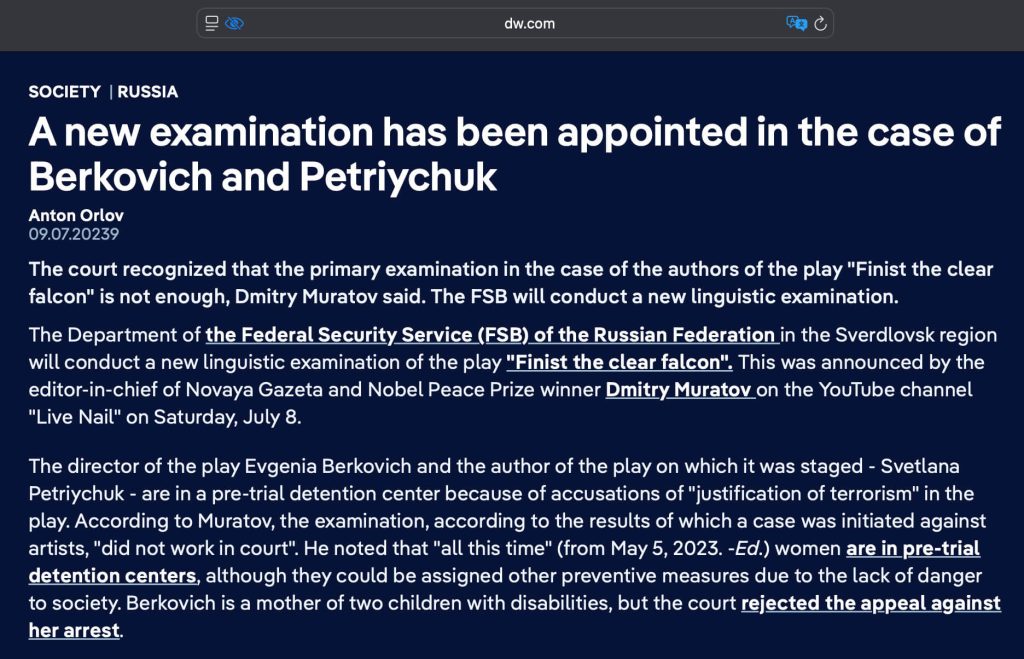
But let’s return to the trial itself. One can logically assume that after the response from the Russian Federal Center of Forensic Science at the Ministry of Justice of the Russian Federation, the open letter from Russian scholars, and the resulting public outcry, Silantyev’s “destructological evaluation” would finally lose its status as admissible evidence and the defendants would be released.
That likely would have happened in any democratic country, but not in present-day Russia which is under complete control of Dvorkin’s anticult network, as indicated by analysis of the facts. Rather than releasing the defendants from custody, the court ordered a “new” evaluation. 12
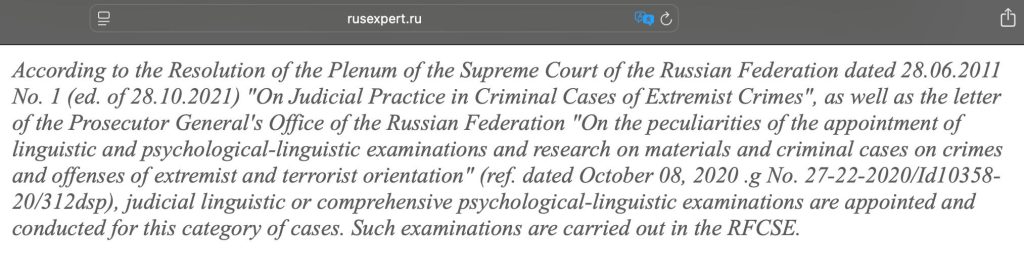
The question of which forensic evaluations are admissible in this category of cases is explicitly regulated by official clarifications issued by the Russian Supreme Court and the Prosecutor General’s Office:
“According to Resolution No. 1 of the Plenary Session of the Supreme Court of the Russian Federation, dated June 28, 2011 (as amended October 28, 2021), ‘On Judicial Practice in Criminal Cases on Crimes of an Extremist Nature,’ as well as the letter from the Prosecutor General’s Office of the Russian Federation, ‘On Specifics of Ordering Linguistic and Psychological-Linguistic Examinations and Studies on Materials and Criminal Cases Concerning Extremist and Terrorist Offenses’ (Outbound Letter dated October 8, 2020, No. 27-22-2020/Id10358-20/312dsp, marked ‘for official use only’ — author’s note), courts in such cases are to appoint forensic linguistic examinations or comprehensive psychological-linguistic evaluations. Such examinations are conducted by the RFCFE (Russian Federal Center of Forensic Expertise under the Ministry of Justice of the Russian Federation — author’s note).” 13
However, contrary to the Russian Supreme Court’s clarifications and the opinion of the Prosecutor General’s Office, the judge did not order a new expert evaluation to be conducted by the Russian Federal Center of Forensic Expertise under the Ministry of Justice, which was already involved in the trial. Instead, the evaluation was assigned to Svetlana Mochalova, a senior forensic expert of the expert unit of the FSB Directorate for Sverdlovsk Region, who was already known for her involvement in a number of high-profile extremism cases. This once again demonstrates the extent of Alexander Dvorkin’s influence in such proceedings: decisions are made in defiance of logic, common sense, the opinion of the scientific community, and even basic principles of forensic expert practice.
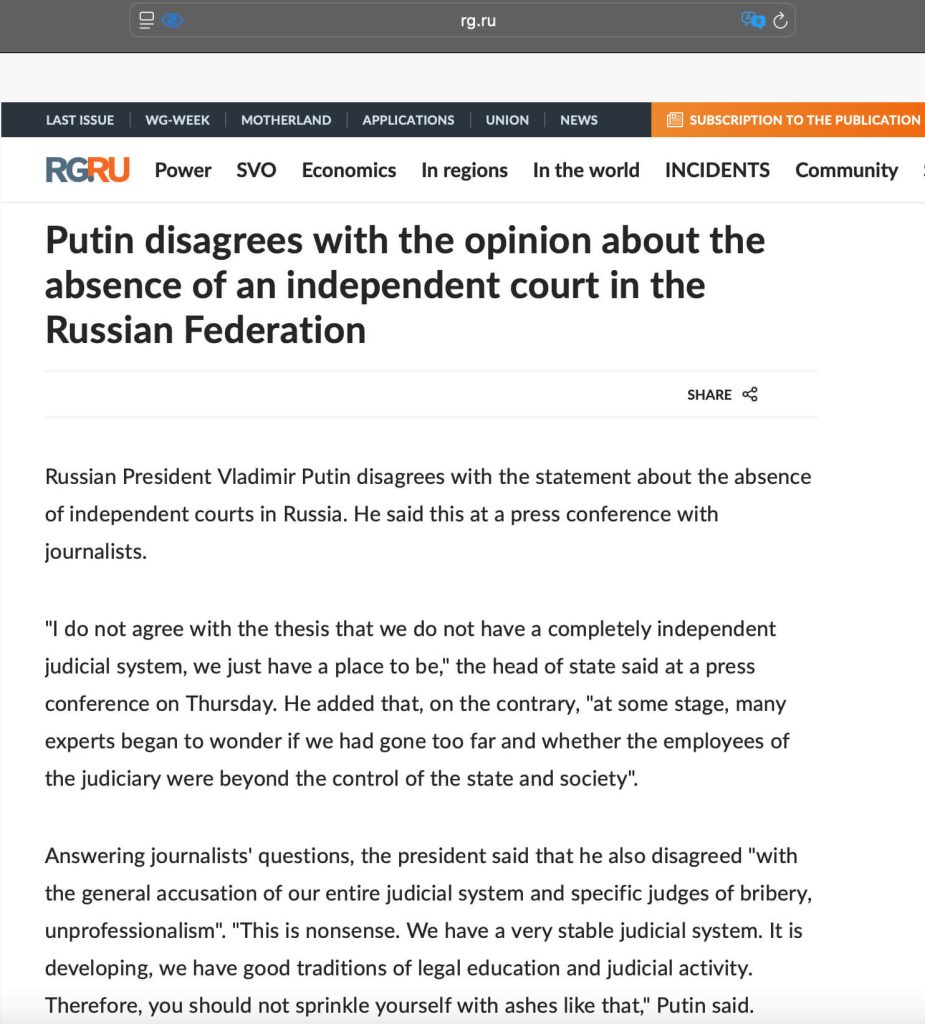
As is well known, throughout his time in office, Russian President Vladimir Putin repeatedly emphasized the importance of building an independent judiciary in Russia, stressing both professionalism of the judiciary and the need to shield courts from outside pressure. Indeed, independence and stability of the Russian judicial system have been regularly featured in his public statements among the government’s principal achievements. At a 2012 press conference, he said:
“I do not agree with the claim that we lack a fully independent judicial system. On the contrary, we do have one.”
Another statement at the same event:
“I also disagree with blanket accusations that our entire judicial system and individual judges are corrupt or unprofessional. That’s nonsense. Our judicial system is indeed very stable. It is developing, and we have strong traditions of legal education and judicial practice.” 14
Today, we may conclude that Russian courts are only “independent” of Putin’s own opinion. In one of our previous articles, we noted that on December 11, 2018, during a meeting of the Human Rights Council, Vladimir Putin publicly questioned the rationale for the persecution of Jehovah’s Witnesses, stating:
“Jehovah’s Witnesses are also Christians. Why they are being persecuted, I also do not quite understand. Therefore, we just need to analyze it, this must be done. I will speak with Vyacheslav Mikhailovich (Vyacheslav Lebedev, Chairman of the Supreme Court — author’s note), and we will try to do this.” 15
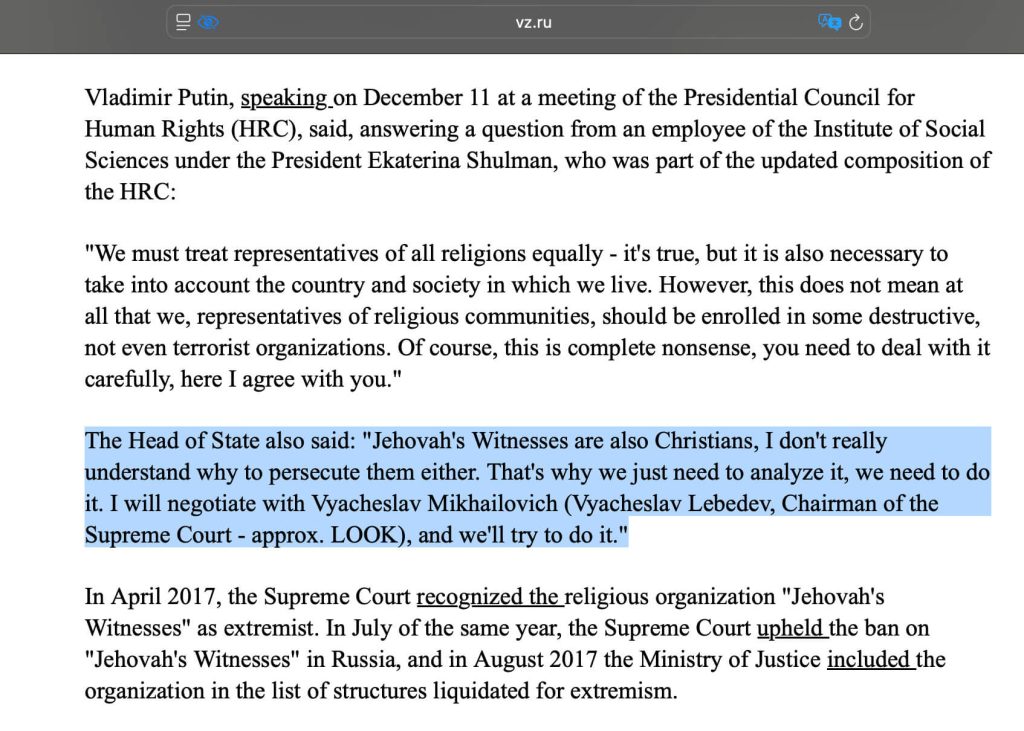
Despite Vladimir Putin’s statement that he did not “quite understand” why Jehovah’s Witnesses were being persecuted, and despite his promise to discuss the matter with the chairman of the Supreme Court, nearly a decade later the repression has not only continued, but intensified significantly. According to monitoring data, by 2026, a total of 954 people were facing criminal prosecution, 184 were incarcerated, and cumulative prison sentences imposed exceeded 1,128 years. 16 Moreover, the repressive apparatus itself expanded during those years: the lists of “extremist” and “undesirable” organizations have grown, while anti-extremism legislation has been increasingly applied against religious, civic, and public associations across the country. The case of “Finist, the Brave Falcon” demonstrates that Alexander Dvorkin’s anticult network has extended its reach into Russia’s culture and theatre spheres as well.
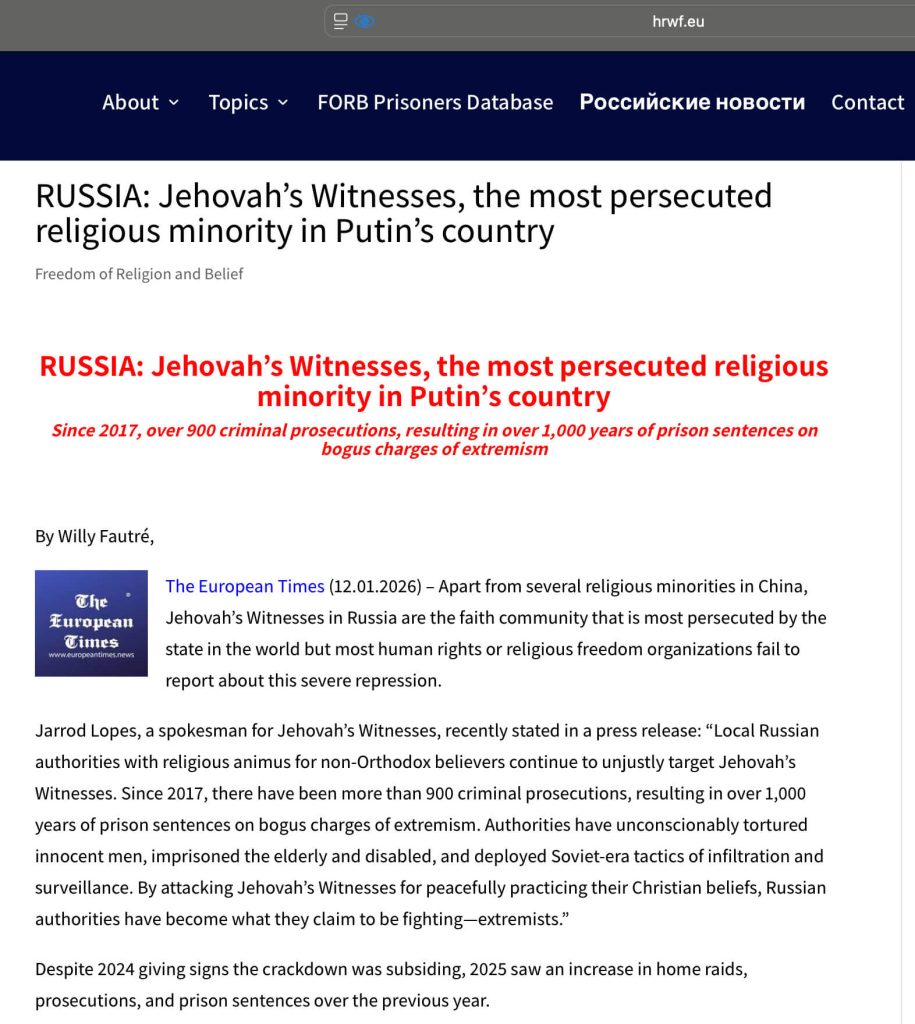
The very fact that Russian courts continue to hear cases based on materials prepared by “experts” from Dvorkin’s inner circle, including Roman Silantyev’s “destructological evaluations,” stands in particularly sharp contrast to Vladimir Putin’s earlier statements rejecting claims of judicial unprofessionalism and describing the court system as competent. If such practices continue for years without any response, they begin to look less like isolated instances of incompetence and more like evidence of a systemic bias within courts operating under the influence of Dvorkin’s anticult lobby.
The “New” Evaluation
The further the proceedings concerning the play unfolded, the more events came to resemble not a court trial, but rather a thinly veiled procedural farce where one group of “experts” on the stage gave way to another. A new character in this story was Svetlana Mochalova, the FSB forensic expert for Sverdlovsk Region, who had already appeared in a number of cases involving extremism charges.
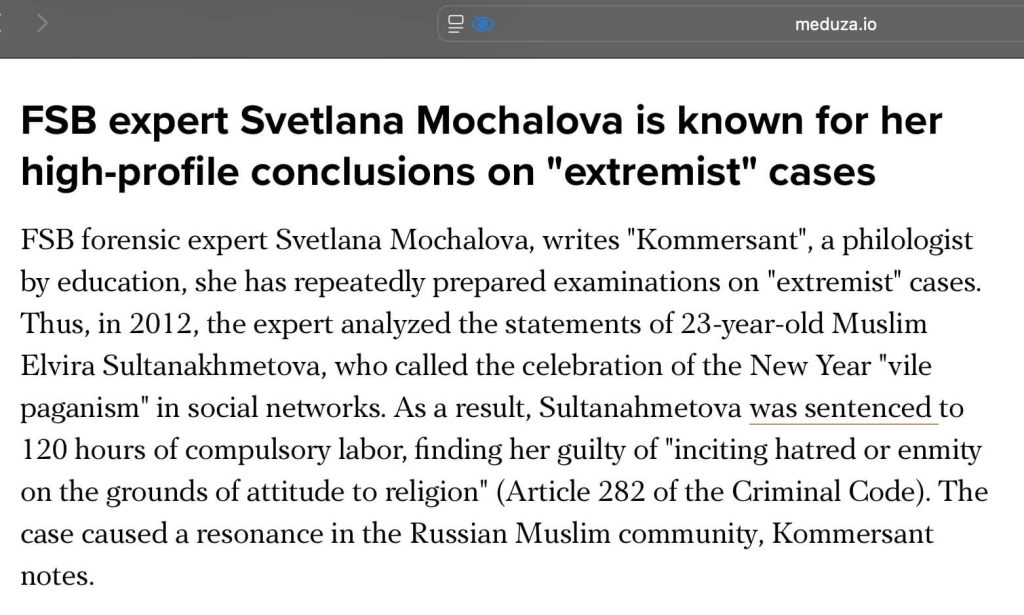
In particular, she was involved in a high-profile 2012 case against a 23-year-old Muslim woman Elvira Sultanakhmetova. The case provoked a sharply negative reaction within the Muslim community after the young woman was sentenced to 120 hours of compulsory labor for a social media comment in which she described the New Year celebration as “vile paganism.” It was Mochalova’s evaluation that formed a basis for the charge of “incitement of hatred or enmity on the grounds of religious affiliation.” As we will show below, this case once again reveals the same pattern associated with Alexander Dvorkin’s anticult network, which is closely affiliated with the Russian Orthodox Church: selective application of the law, under which some statements become grounds for criminal prosecution while others are completely ignored. 17
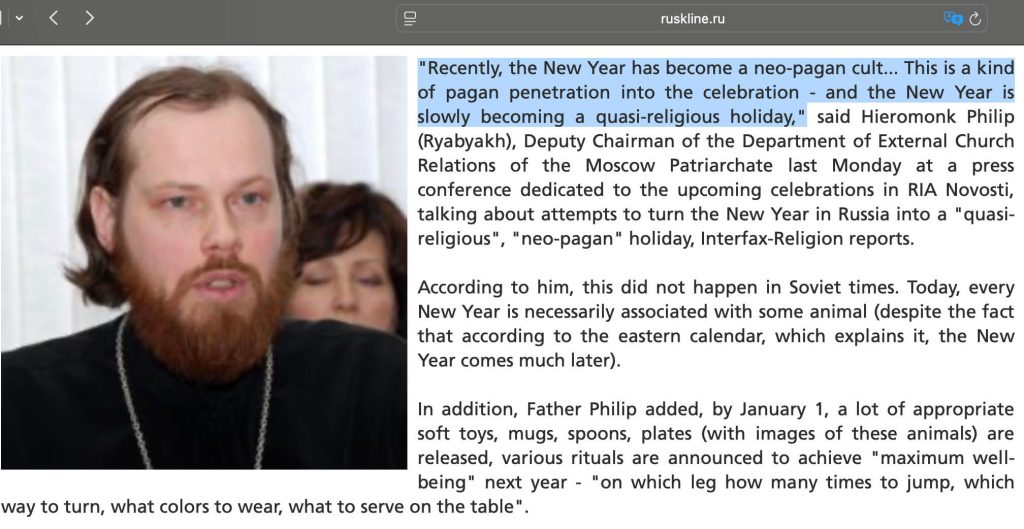
We invite readers to consider another statement — this time not from a social media user, but from an official representative of the Russian Orthodox Church. 18 Compare its meaning with Elvira Sultanakhmetova’s comment cited above and evaluate independently not only the degree of similarity between the statements, but also the vastly different scale of their public impact.
“‘Lately, New Year has been turning into a neo-pagan cult… It’s a kind of pagan infiltration into the celebration, and New Year is slowly becoming a quasi-religious holiday,’ said Hieromonk Philip (Ryabykh), deputy chairman of the Moscow Patriarchate’s Department for External Church Relations, during a press conference at RIA Novosti, devoted to upcoming holiday celebrations. He made these remarks speaking about attempts to transform New Year in Russia into a ‘quasi-religious’ and ‘neo-pagan’ holiday, according to Interfax-Religion.
In his opinion, this wasn’t the case during the Soviet era. Today, however, every New Year is invariably associated with some kind of animal (even though, according to the Eastern calendar, which is used to explain this, the New Year comes much later).”
One cannot help but recall the words of Novopashin, Dvorkin’s “right-hand man” who publicly rebuked the President of Russia for an ordinary New Year’s address, effectively accusing the head of state of using the “wrong” symbols and imagery. 19
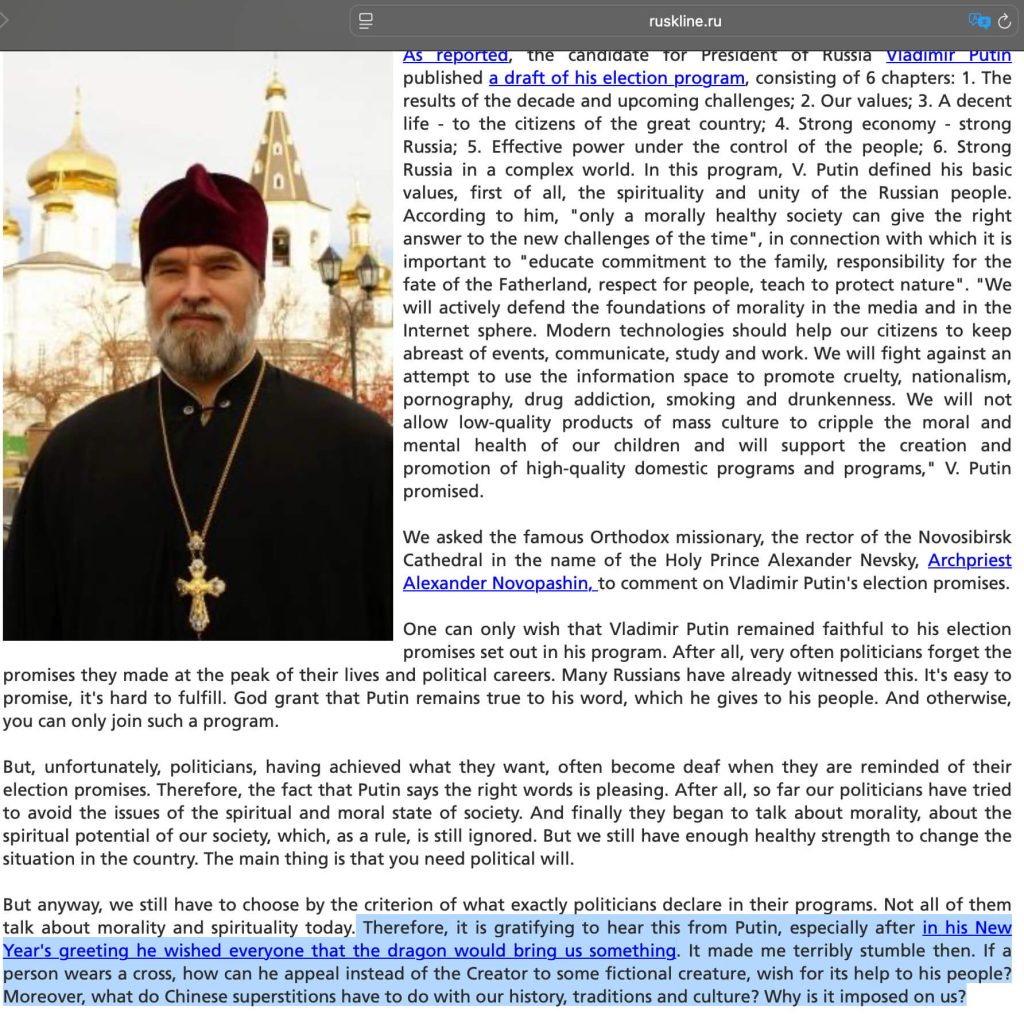
Let’s continue. A young woman’s social media comment became a ground for criminal prosecution and accusations of extremism. Meanwhile, nearly identical statements by Hieromonk Philip (Ryabykh), deputy chairman of the Moscow Patriarchate’s Department for External Church Relations, delivered as an official opinion of the Russian Orthodox Church at a nationally broadcast press conference, resulted in neither expert evaluations nor criminal cases, or even a public response from law enforcement agencies. This kind of conspicuous selectivity effectively reveals the driving force behind such proceedings: Alexander Dvorkin’s anticult network. Under its influence, FSB personnel appear willing to produce whatever “evaluations” are needed to secure convictions, while “independent and impartial” judges are ready to overlook falsifications and the incompetence of “experts.”
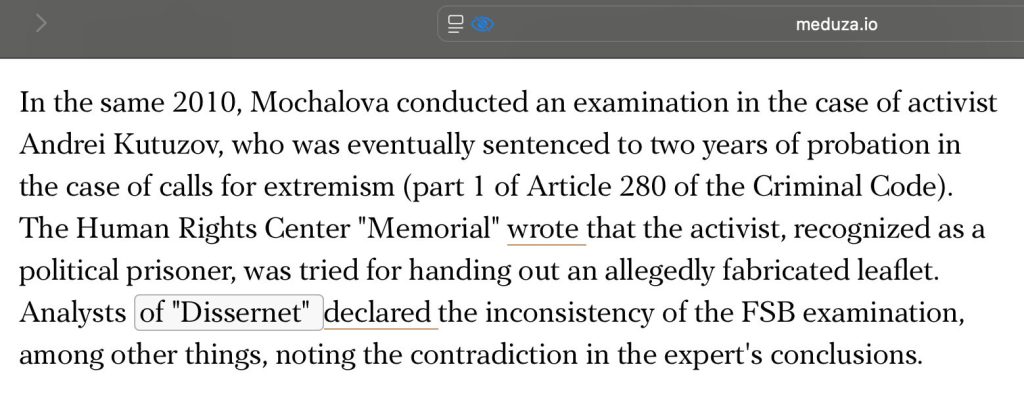
Speaking of Svetlana Mochalova’s competence, it is worth examining assessments of her work in another high-profile case:
“In the same year 2010, Mochalova conducted an evaluation in the case of activist Andrey Kutuzov who was ultimately given a two-year suspended sentence on charges of public calls for extremism (Part 1, Article 280 of the Criminal Code). The Memorial Human Rights Defence Center wrote that the activist, later recognized as a political prisoner, had been prosecuted for distributing a leaflet that was allegedly fabricated. Analysts from Dissernet stated that the FSB evaluation was fundamentally flawed, and they noted, among other things, contradictions in the expert’s conclusions.” 17
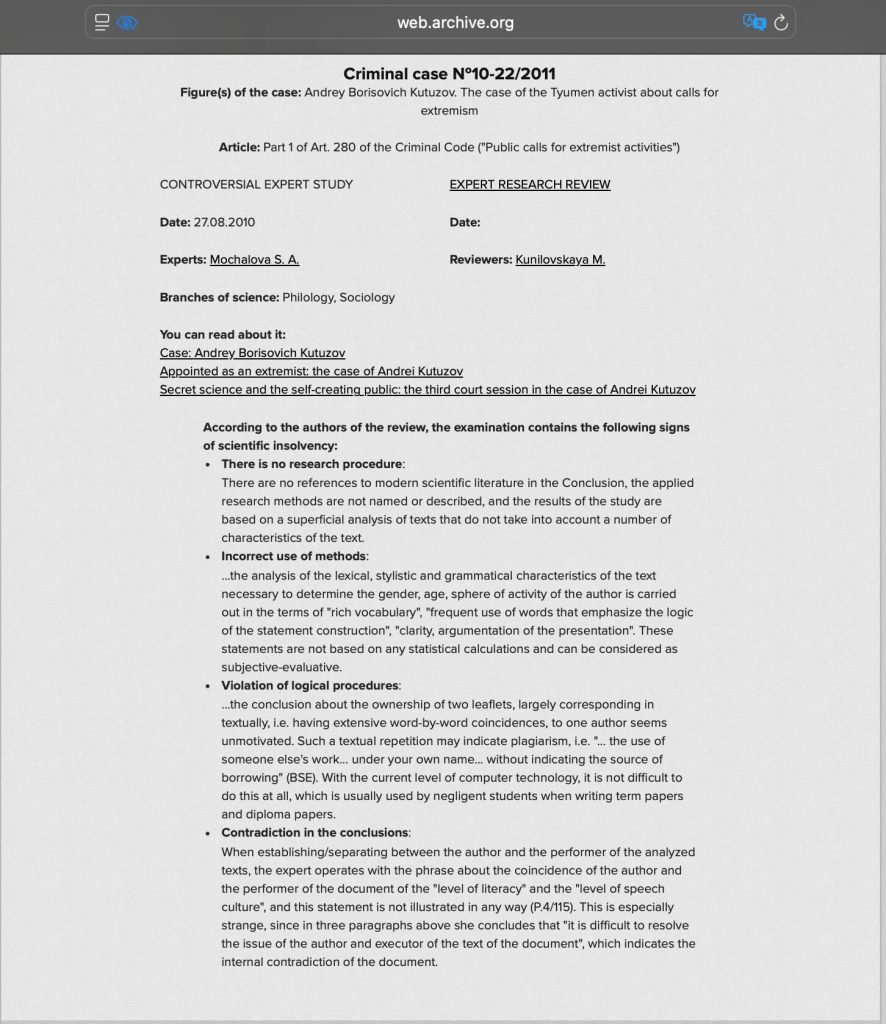
Dissernet is a public initiative that analyzes academic, dissertation, and expert materials for falsifications, manipulations, and methodological violations. Below is an excerpt we found in a web archive from a review 20 of an FSB evaluation authored by Mochalova:
“In the opinion of the review’s authors, the evaluation contains the following indicators of scientific inadequacy:
Absence of a research procedure:
The report contains no references to contemporary scholarly literature, does not identify or describe the research methods employed, and bases its conclusions on a superficial analysis of texts that fails to take into account a wide range of textual characteristics.
Improper use of methodologies:
…the analysis of lexical, stylistic, and grammatical characteristics used to determine the author’s gender, age, and field of activity relies on such terms as ‘rich vocabulary,’ ‘frequent use of words emphasizing logical structure,’ and ‘clarity and persuasiveness of presentation.’ These assertions are not based on any statistical calculations and should therefore be regarded as subjective evaluations.
Violations of logical procedure:
…the conclusion that two leaflets, which largely coincide textually, i.e. contain extensive ‘word-for-word’ similarities, were written by the same author appears unfounded. Such textual repetition may indicate plagiarism, i.e., ‘…the use of another person’s work…under one’s own name…without citing the source’ (Great Soviet Encyclopedia). Given the current level of computer technology, this is not difficult to do at all, and this practice is commonly exploited by lazy students when writing term papers and theses.
Contradictions in conclusions:
When determining or drawing distinctions between the author and the executor of the texts under analysis, the expert refers to the ‘level of literacy’ and ‘level of linguistic culture’ of the document’s author and executor as being the same, yet this assertion is not supported by any evidence (p. 4/115). This is particularly strange, since three paragraphs earlier she concludes that ‘it is difficult to resolve the question of whether the author and the executor of the document are the same person,’ which indicates an internal contradiction in the document.”
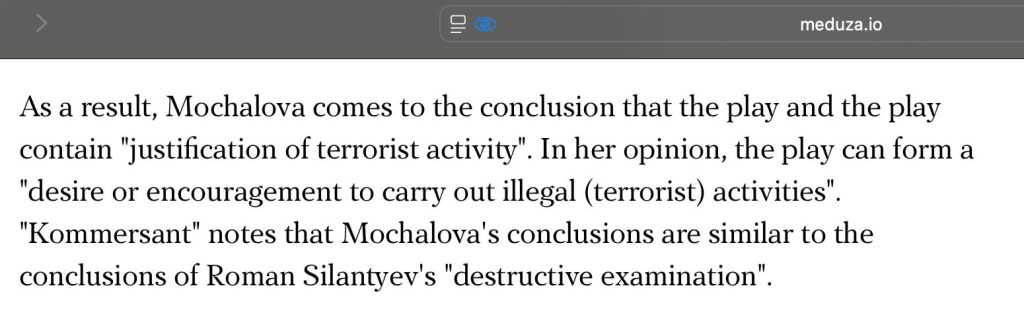
Thus, in the case files, we see two types of “expert evaluations” that raise serious questions: on the one hand, Roman Silantyev’s pseudoscientific “destructology” which, despite the official opinion of the Russian Federal Center for Forensic Expertise under the Ministry of Justice that such evaluation “does not exist as a discipline” and cannot serve as evidence in court, was never excluded from the case file. The subsequent expert analysis by Svetlana Mochalova whose competence and methodology had previously been subject to public criticism basically only supplemented and confirmed the conclusions of Silantyev’s “destructological evaluation.”17
Despite all of this — the questionable evaluations, contradictions, and obvious double standards — on the basis of such materials, Yevgenia Berkovich and Svetlana Petriychuk have been sentenced to actual lengthy prison terms.21
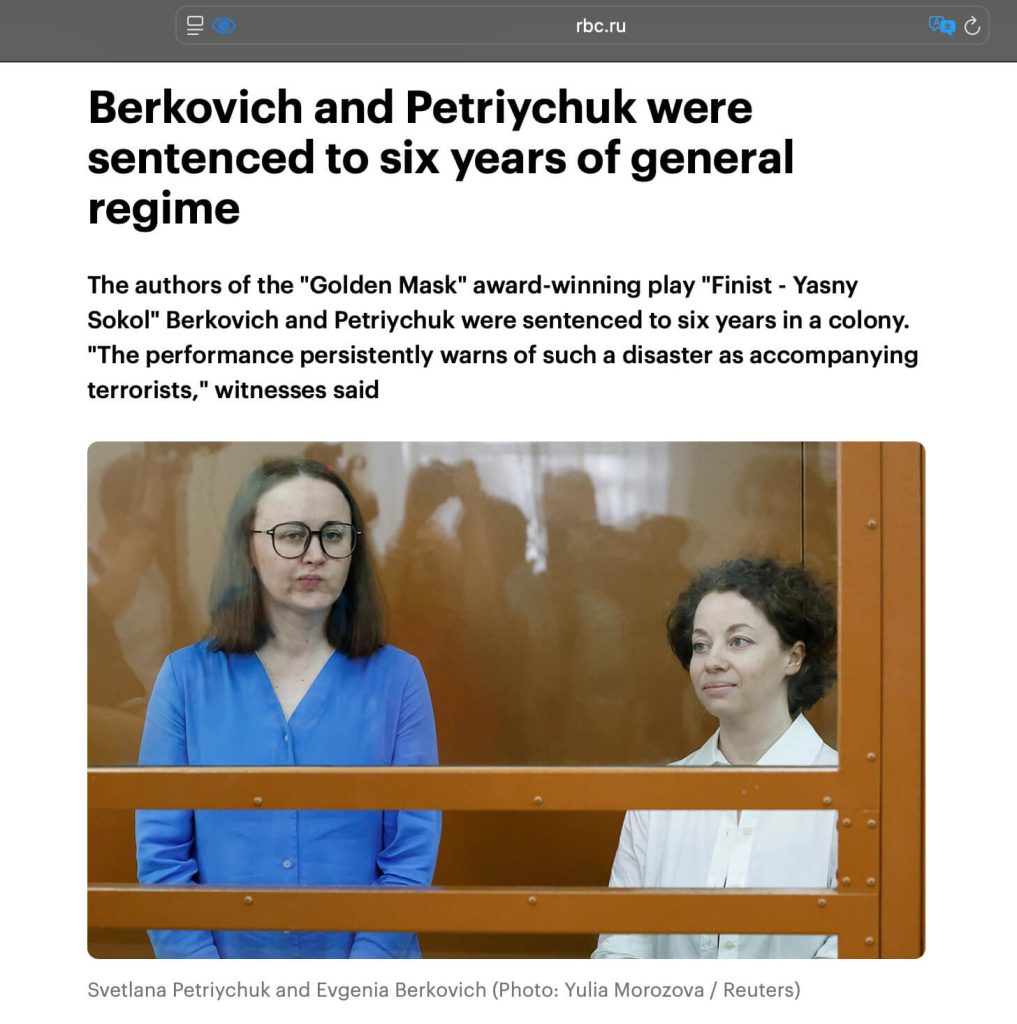
Consequences
It is difficult to escape an impression that the selection of “Finist, the Brave Falcon” as a target was not accidental. After all, the play itself carried a distinct anti-terrorist message: it depicted the mechanisms by which trusting women are recruited into networks of radical Islamist organizations. This naturally raises the question: Who benefited from discrediting precisely such material? Does this case not suggest that anticult entities may, in fact, be serving the interests of the very forces they publicly claim to oppose?
In our view, what emerges here is a demonstration of the power and apparent impunity enjoyed by pseudo-experts belonging to Alexander Dvorkin’s inner circle. In fact, Russian society is being shown that the opinion of this anticult structure will determine what is considered dangerous, how works of art should be interpreted, and whose opinion will ultimately prove decisive for law enforcement and judicial systems. One can only imagine the shock caused by the arrests of Yevgenia Berkovich and Svetlana Petriychuk within cultural circles, the artistic community, and Russian society as a whole. In essence, this is a case of an informational terror attack orchestrated by Alexander Dvorkin’s anticult network, with Roman Silantyev serving as the operative and pseudo-expert responsible for providing the ideological framework for the case.
It can reasonably be assumed that the controversy surrounding “Finist, the Brave Falcon” had consequences extending far beyond a single trial. Most likely, it represented a blow against Russian culture and the creative intelligentsia — the most active and sensitive segment of society. Such events inevitably create an atmosphere of fear and self-censorship within cultural life, where any artistic statement can be interpreted as a potential threat to the country. In essence, the trial serves as a signal that independent thought and open discussion of acute social issues are no longer acceptable.
We believe that the case of “Finist, the Brave Falcon” became a turning point after which a substantial portion of Russia’s cultural and artistic community effectively found itself dependent on opinions of Alexander Dvorkin’s anticult “experts” who maintain close ties to the ROC and the stance of their patrons in the upper echelons of power. Through this trial, the creative community was shown who now claims the authority to define the direction, boundaries, and ideological parameters of permissible artistic expression, and what punishment may follow for those who attempt to step beyond the imposed limits. This, in turn, contributes to growing passivity within society, indifference, internal censorship, avoidance of difficult and socially significant topics, and erosion of an environment conducive to free expression.
This information campaign where Silantyev played a leading role further reinforces the claims presented in “The IMPACT” documentary: namely, that the primary objective of anticult entities is to undermine public trust in the current authorities, government institutions, and judicial system. Meanwhile, as you can recall, anticult activists consistently cloak their activities in the language of “concern” for society and the “interests” of national security.
The story of “Finist, the Brave Falcon” vividly illustrates the extent of Dvorkin’s anticult lobby’s influence in Russia. Under the banners of “protecting society” and “combating extremism,” a mechanism of ideological control has emerged, whereby independent artistic expression or public discourse can be declared a threat to the state.
Therefore, this case may be regarded as a warning to all democratic countries. The controversy surrounding “Finist, the Brave Falcon” demonstrates how dangerous an ideology can become when, under the pretext of “protecting society,” ensuring “security,” and combating “destructive cults,” it acquires influence over judiciary and law enforcement and gradually penetrates every sphere of public life, including culture and the humanitarian field. The activities of anticult entities make clear that restrictions on freedom of religion inevitably lead to restrictions on other civil liberties as well: freedom of speech, artistic expression, freedom of belief, and the right to hold open public dialogue.
At the same time, similar anticult networks continue to operate in a number of developed democratic countries, maintaining coordination, information-sharing, and common methods based on instigation of fear, hostility, and societal division. All of that inevitably raises the question of whether an international investigation into activities of such entities is necessary, as their actions increasingly resemble an instrument of information warfare and hybrid war directed against civil liberties, public trust, and democratic institutions.
Sources:
1. https://www.rbc.ru/society/04/05/2023/6453e5799a7947b4c0d152ca
2. https://kuban.rbc.ru/politics/31/08/2024/66cf368a9a79478f4f84c149
3. https://zona.media/news/2023/05/05/expertiza
4. https://meduza.io/feature/2023/05/04/rezhisserku-zhenyu-berkovich-podozrevayut-v-opravdanii-terrorizma
5. https://oteatre.info/vox-populi-chto-govoryat-i-pishut-v-sotssetyah-o-spektakle-finist-yasnyj-sokol/
6. https://ptj.spb.ru/blog/finist-yasnyj-sokol-mnenie-professionalov/
7. https://en.wikipedia.org/wiki/Profile_(2018_film)
8. https://meduza.io/feature/2023/05/05/meduza-publikuet-ekspertizu-po-delu-ob-opravdanii-terrorizma-v-spektakle-finist-yasnyy-sokol
9. https://msebsud.ru/news/destruktologiya-ne-yavlyaetsya-vidom-ekspertizy
10. http://godekan.com/2016/09/27/roman-silantev-prizyvaet-unichtozhat-musulman-po-vsej-rossii/
11. https://activatica.org/content/78a39e14-3e7c-4478-9476-270b133442c2/rossijskie-uchyonye-protiv-psevdonauki-destruktologii
12. https://www.dw.com/ru/po-delu-berkovic-i-petrijcuk-naznacena-novaa-ekspertiza/a-66166800
13. https://rusexpert.ru/news/ijki-chy-ptiv-dbvty-gmity-kptiz-v-d-i-lgitimcii-pvdchg-ziya-
14. https://rg.ru/2012/12/20/sud-anons.html?utm_
15. https://vz.ru/news/2018/12/18/955841.html
16. https://hrwf.eu/russia-jehovahs-witnesses-the-most-persecuted-religious-minority-in-putins-country/?utm
17. https://meduza.io/feature/2024/01/16/novuyu-ekspertizu-po-delu-zheni-berkovich-i-svetlany-petriychuk-provela-ekspert-izfsb-izvestnaya-svoimi-zaklyucheniyami-po-ekstremistskim-delam
18. https://ruskline.ru/news_rl/2009/12/20091222/ieromonah_filipp_ryabyh_ne_prevrawat_novyj_god_v_neoyazycheskij_kult?utm
19. https://ruskline.ru/news_rl/2012/01/13/protoierej_aleksandr_novopashin_to_chto_putin_govorit_pravilnye_slova_eto_raduet/
20. https://web.archive.org/web/20210508015214/https://rosvuz.dissernet.org/expertise/143498
21. https://www.rbc.ru/politics/08/07/2024/6687e6459a79475719023885?utm_