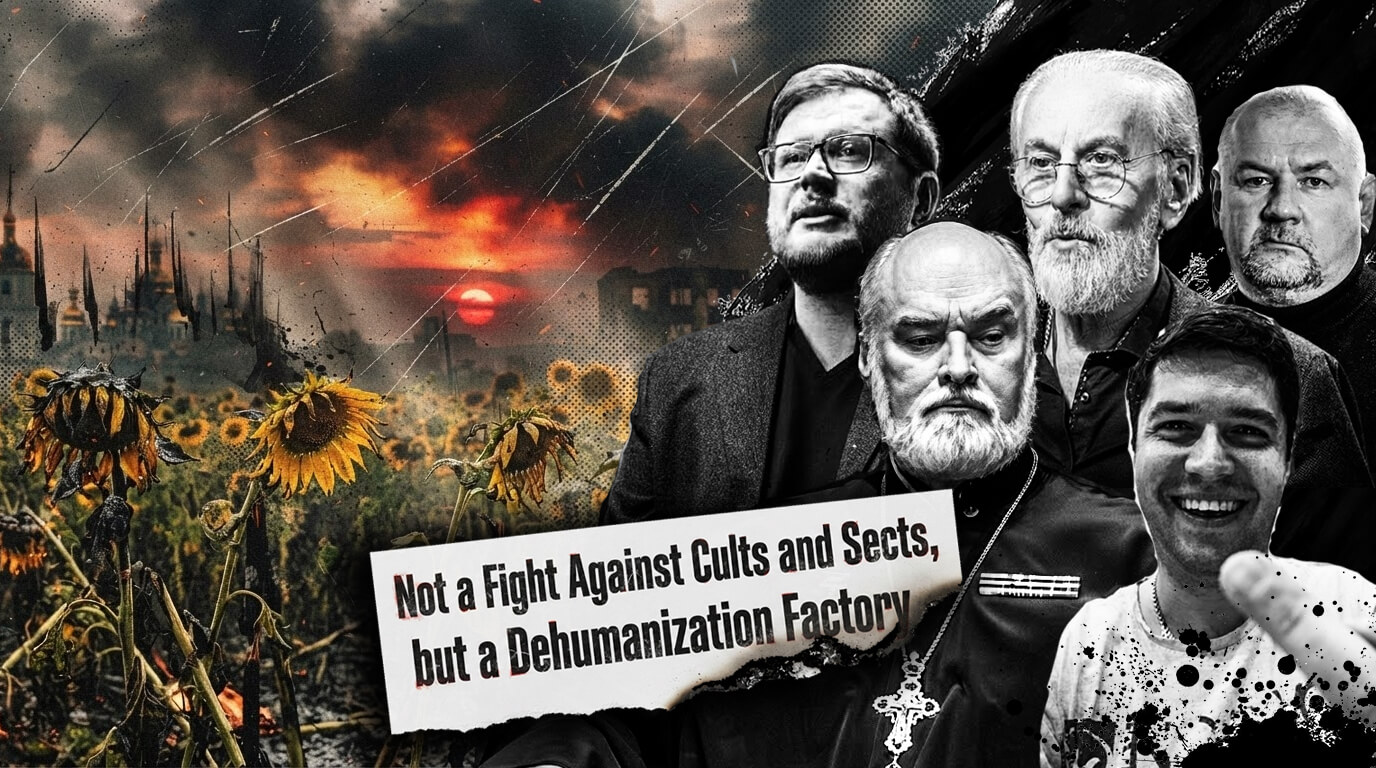
Hatred doesn’t emerge on its own. It does not suddenly spike in the minds of millions of people one morning, like a fever. It is planted there through words, images, tones, and constant repetitions. Day after day. Year after year. Through TV propaganda, church journalism, and anticultist “expert” opinions – through the same thick, unrelenting stream of lies where Ukraine long ago ceased to be a country in the eyes of many Russians and became a bogeyman.
In our view, what has happened to Russian public consciousness has been neither spontaneous nor sudden. It was gradually steered in one direction, toward a place where a grotesque propaganda mannequin stands in place of the real Ukraine. They stuffed it full of everything: “cultism,” “sectarianism,” “heresy,” “Neopaganism,” “Nazism,” “treason,” and “foreign control.” Afterwards, they began to beat this mannequin as if in the name of morality, “traditional values,” faith, and history.
Some declared Ukraine a “territory of cults.” Others called it a “domain of Satanism.” Still others claimed that Ukrainians were not agents at all, but merely material for foreign manipulations. It all sounded outrageous, yet it worked flawlessly: when a lie is repeated often enough, it becomes habitual and resembles truth. That’s how collective delusion is built. Not through one grand deception, but through a thousand small jabs into the same spot. Through words that first shock, then become commonplace, and eventually begin to shape most people’s picture of the world.
At some point, hatred ceased to be an emotion and became a norm. Propagandists, journalists, anticultists, politicians, opinion leaders, and many others have done their job.
In this article, we will present statements about Ukraine made by several Russian anticult figures, all drawn from open sources. Most importantly, we will show that those are not isolated outbursts of specific individuals, but rather the workings of a unified mechanism – anticultism – which doesn’t so much combat “cults” and “sects” as it serves as a tool for generating hatred in society.
Alexander Dvorkin
For Alexander Dvorkin, the chief ideologue of the international Russian anticult network and president of RACIRS (the Russian Association of Centers for the Study of Religions and Sects), it did not begin with direct attacks and denunciations. He proceeded more subtly: he laid the ideological foundation itself. In his description, Ukraine is not a society burdened by deep internal divisions, nor an arena where competing political and church projects collide. First and foremost, it’s a “country with a remarkably large number of sects and cults.” Within such initial framing lies the entire future verdict.
In 2014, Komsomolskaya Pravda portal published an article titled “Zombies Sang Hallelujah to Poroshenko and Klitschko,” where the Ukrainian people were compared to zombies in the headline itself. Let’s examine several quotations from it.
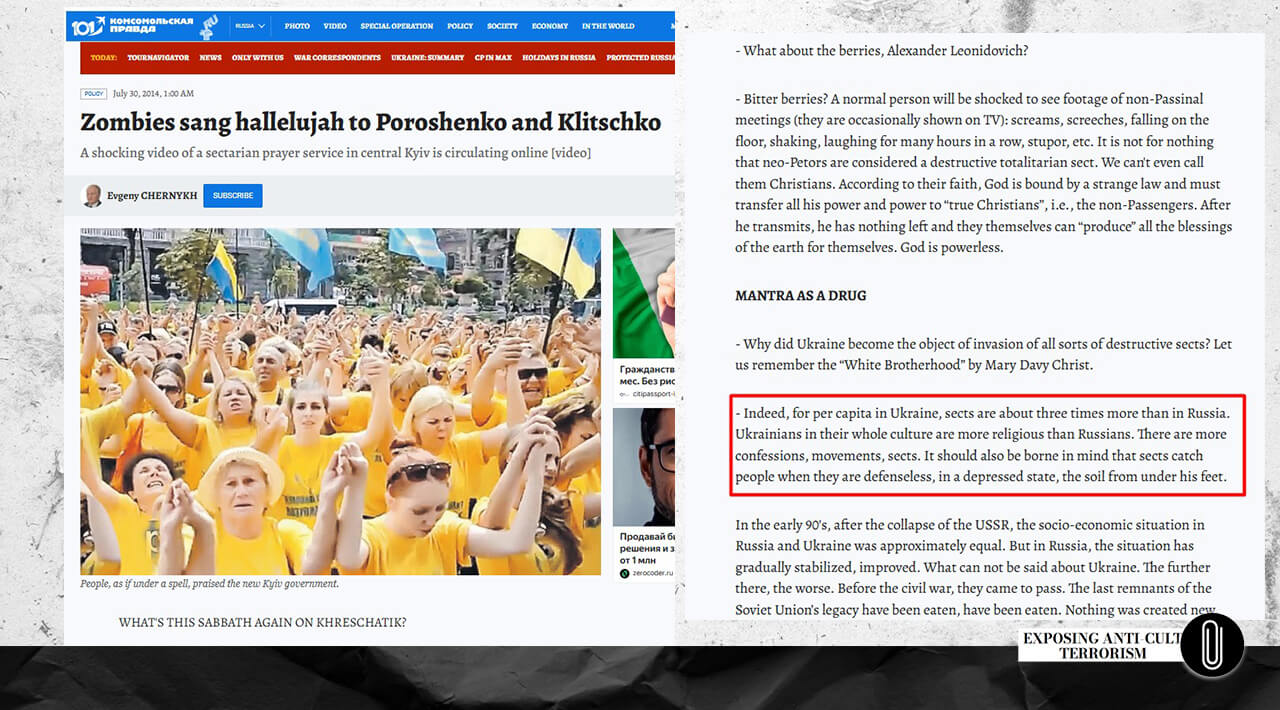
“Per capita, there are roughly three times as many cults and sects in Ukraine as in Russia.” 1
The phrase was delivered calmly and almost scientifically, but it worked as a stigma. Once a country is labeled an abnormal zone, everything else follows naturally. If a society is so “cultist,” it becomes easier to break, destabilize, and push in any direction. As a result, any developments in Ukraine that are inconvenient for Dvorkin and his ilk can be explained not by politics, history, or choices of people themselves, but by spiritual corruption and hyper-suggestibility.
Incidentally, the propaganda documentary series “Beware: Sects,” launched on Alexander Dvorkin’s initiative, was released after one of his trips to Ukraine. The exact year is difficult to establish. At the beginning of the third episode, viewers were presented with “alarming statistics” in classic Dvorkin fashion:
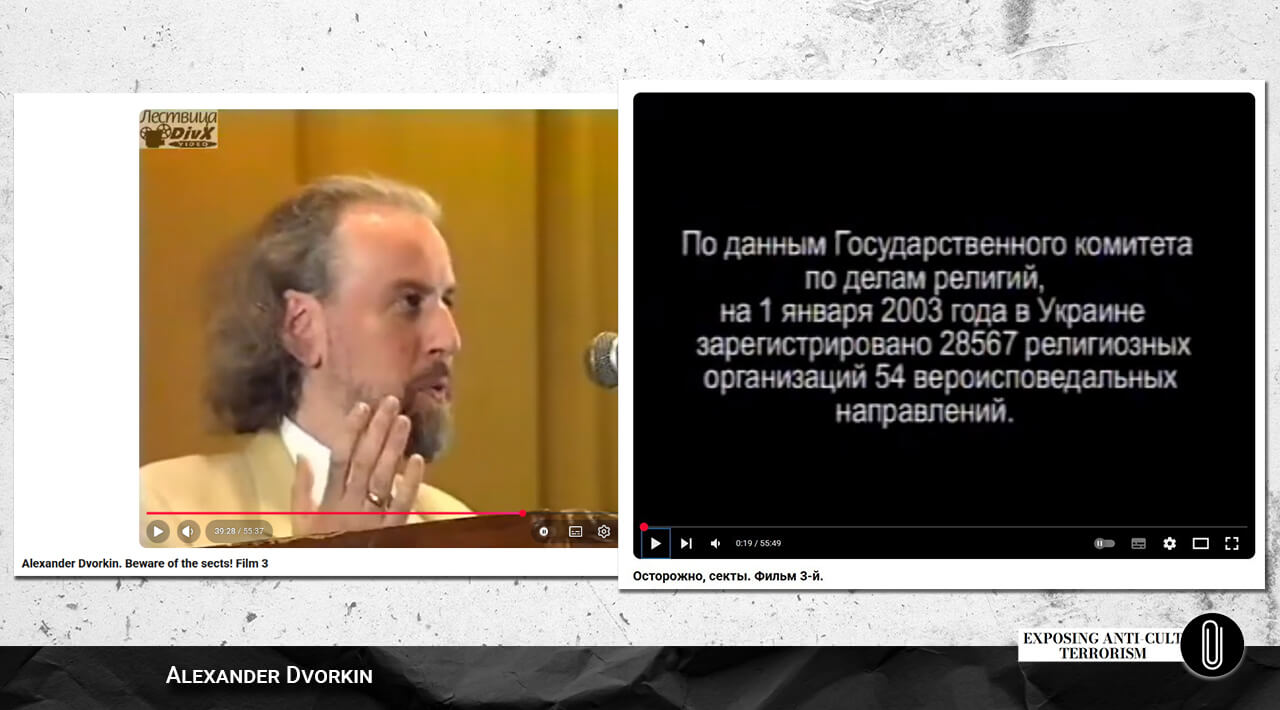
“According to the State Committee for Religious Affairs, as of January 1, 2003, there were 28,567 registered religious organizations in Ukraine, representing 54 religious denominations.”
It is not difficult to guess what Dvorkin meant by religious organizations.
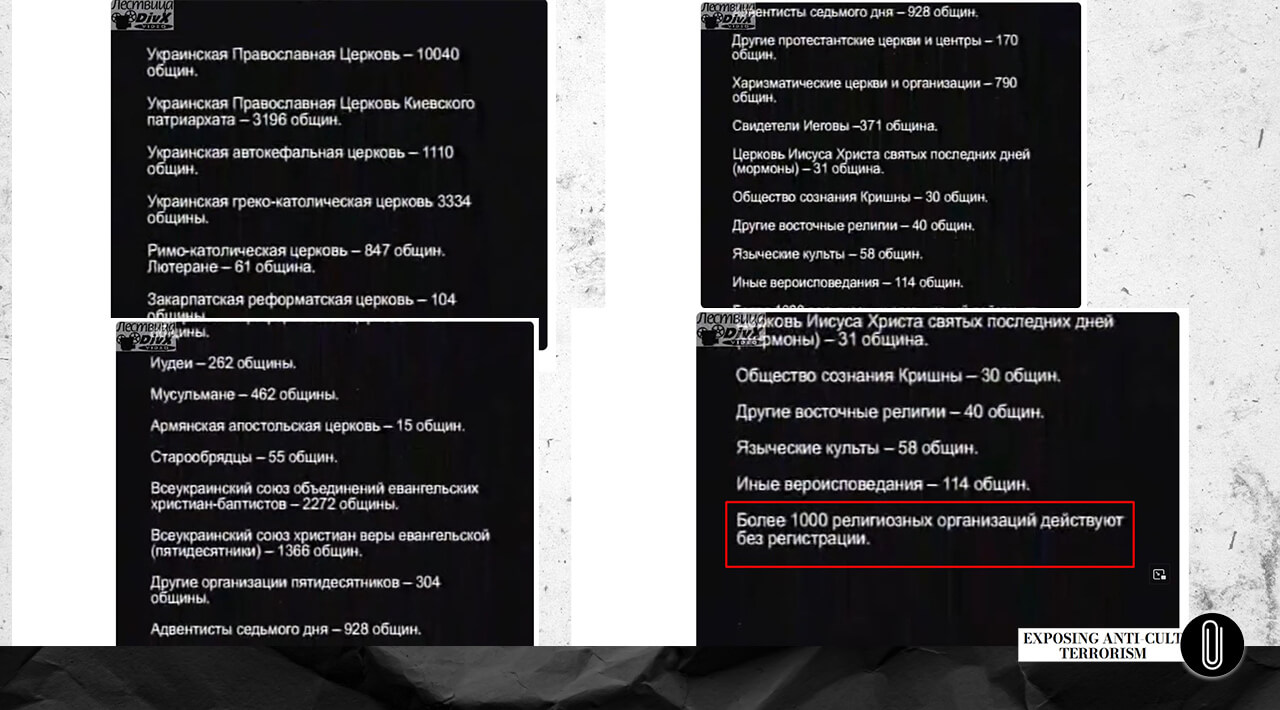
What followed was a lengthy list of entities:
- Ukrainian Orthodox Church — 10,040 congregations;
- Ukrainian Orthodox Church of the Kyiv Patriarchate — 3,196 congregations;
- Ukrainian Autocephalous Church — 1,110 congregations;
- Ukrainian Greek Catholic Church — 3,334 congregations;
- Roman Catholic Church — 847 congregations;
- Lutherans — 61 congregations;
- Transcarpathian Reformed Church — 104 congregations;
- Judaists — 262 congregations;
- Muslims — 462 congregations;
- Armenian Apostolic Church — 15 congregations;
- Old Believers — 55 congregations;
- All-Ukrainian Union of Churches of Evangelical Christian Baptists — 2,272 congregations;
- All-Ukrainian Union of Christians of Evangelical Faith (Pentecostals) — 1,366 congregations;
- Other Pentecostal organizations — 304 congregations;
- Seventh-day Adventists — 928 congregations;
- Other Protestant churches and centers — 170 congregations;
- Charismatic churches and organizations — 790 congregations;
- Jehovah’s Witnesses — 371 congregations;
- The Church of Jesus Christ of Latter-day Saints (Mormons) — 31 congregations;
- International Society for Krishna Consciousness — 30 congregations;
- Other Eastern religions — 40 congregations;
- Pagan cults — 58 congregations;
- Other faiths — 114 congregations;
- More than 1,000 religious organizations operate without registration.
(Statistics from the video series “Beware: Sects” initiated by Alexander Dvorkin. Film 3)
“Sects and cults hook people when they are defenseless, in a depressed state, when the ground is slipping out from under their feet…
The psychological state into which pastors lead them during mass gatherings is akin to a narcotic drug. Psychiatrists call this condition endorphin addiction. To experience it again, cult members are willing to do absolutely anything their pastor says, or rather, orders.” 1
Dvorkin explained the abundance, diversity and influence of religious movements not by suggesting that people were searching for God, support and meaning in life, but by portraying them as helpless and psychologically convenient targets for “capture.” In our view, this is a key point. After such an interpretation, Ukrainians no longer appear as believers who search, choose, and act. They become people who are easily “hooked” and deceived – a society stripped of its own agency. They are portrayed as victims of psychological conditioning.
“One of the main strike forces during the first Maidan… were precisely neo-Pentecostals… Several thousand ‘bayonets.’” 1
That’s how Dvorkin characterized the Orange Revolution, the Ukrainian Maidan.
The word “bayonets” here means more than the rest of the sentence combined. It performs the crucial task of erasing the human face. Maidan participants cease to be people, believers, or activists with their own motives and views. They are reduced to “bayonets”: material, instruments in someone else’s hands, expendable tools of other people’s will.
This is a classic technique of depersonalization that anticult rhetoric reproduces time and again. Once an individual is stripped of an identity and a will of their own, they cease to be a subject with whom you can debate or who can be understood.
Subsequently, everything adds up to a clear picture:
“Thousands of trained brainwashed people who will do whatever their pastors tell them to do.” 1
Here we see the beginning of dehumanization because Ukrainian society is no longer portrayed as arguing, choosing or making mistakes; it is supposedly being controlled. Hence, there’s no need to listen to it. It must be “exposed,” “saved,” or broken.
Alexander Dvorkin performed the most important task for the entire propaganda construct: he prepared the ground. He didn’t shout about black magic or speak of “cannibals.” Yet, he was the first to strip Ukraine of its status as a normal society. After that, his anticult followers began to echo him, portraying the country as anything they wished – sick, manipulated, pliable, and devoid of will.
There was, however, an even harsher statement he used. According to the Ukrainian religious scholar Lyudmyla Fylypovych, Dvorkin referred to the 2004 Maidan as nothing other than the “orange plague.” 2
During his trip to Ukraine, Dvorkin spoke to students at the Dnipropetrovsk Academy of Law of Ukraine’s Ministry of Internal Affairs and said the following:
“Ukraine’s law on freedom of conscience is modeled as closely as possible on the American one. I said, ‘Poor Ukraine. I feel very sorry for your country,’ because Ukraine is a European state, and accordingly, every European country has its own laws governing church-state relations, including the concept of a traditional, culture-forming denomination or denominations. That doesn’t exist in America. You cannot mechanically transfer the American experience … from a country with a very short history to a country with an ancient history. This cutting away from all sides and forcing Ukraine into alignment with the United States of America may, I fear, play a very bad role in the development of both Ukrainian statehood and church-state relations, which is very important.”
Apparently, Alexander Dvorkin was hinting at something.
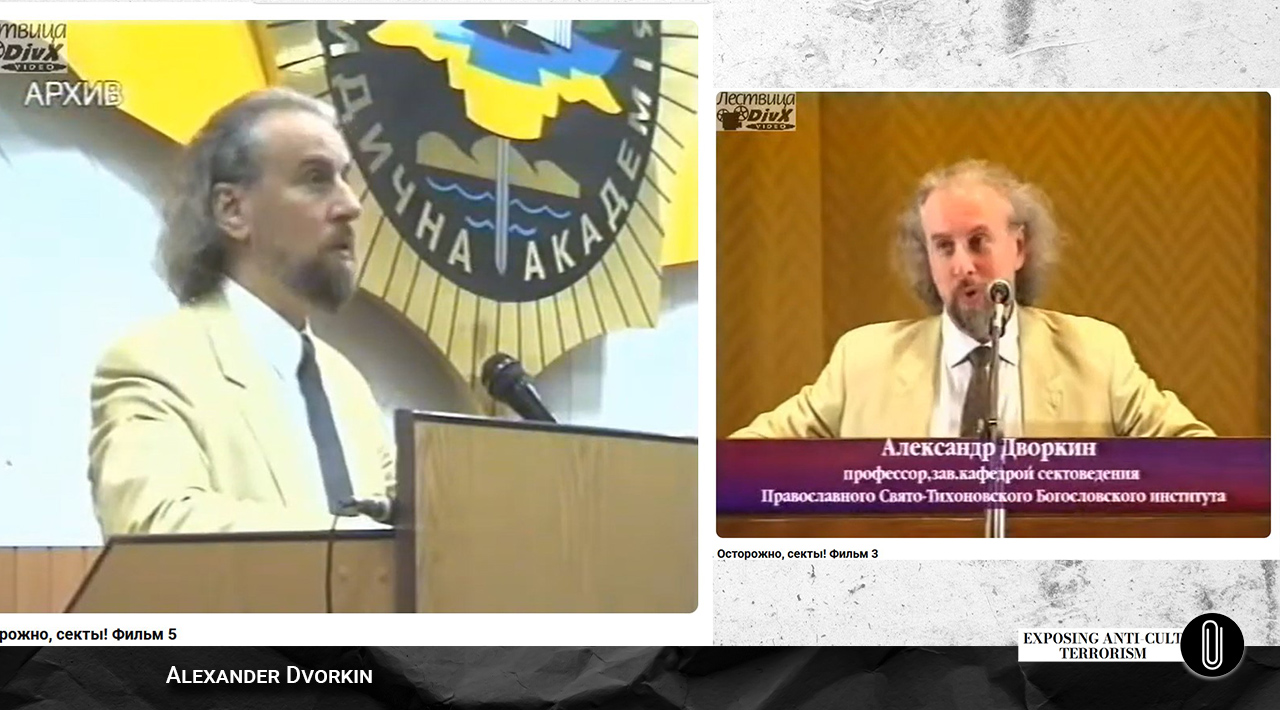
After returning from Ukraine, he routinely claimed that “the situation with the spread of totalitarian sects in Ukraine has reached a critical point, since the country’s current legislation is completely unsuited to combating this phenomenon.”
In the documentary series “Beware: Sects,” he openly stated that destructive organizations skillfully exploit “loopholes” in Ukrainian laws to recruit new victims through deception and manipulation. He also urged citizens to demand decisive action from Ukrainian lawmakers, comparing the authorities’ inaction to trying to mop up water in a flooded apartment without fixing the burst pipe.
As usual, Dvorkin didn’t spare harsh comparisons, describing contemporary cultism in Ukraine as “spiritual vulgarity” and “kitsch” flourishing against a backdrop of complete religious illiteracy. He directly compared practices of neo-Pentecostals to drug intoxication, claiming that inducing people into a trance produces a powerful release of endorphins that creates severe dependency, leaving a person willing to give up the last thing in their home for another dose of the trance state.
Dvorkin has laid the foundation…
Roman Silantyev
The next step was to turn Ukraine into an “anti-Christian project.”
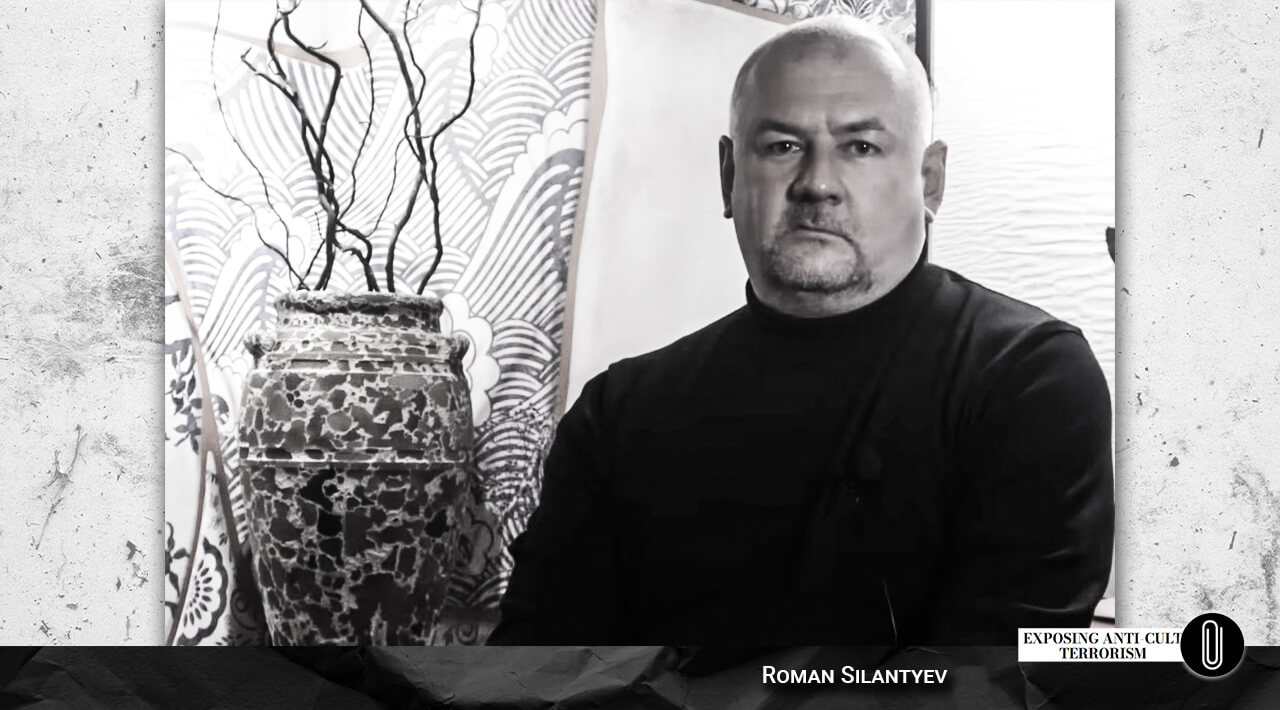
While Dvorkin laid out the framework, Roman Silantyev, head of the Human Rights Center of the World Russian People’s Council, started hanging heavy, almost apocalyptic decorations on that framework. Silantyev began to compare Ukraine to a black hole where he dumped everything at once: “Neopaganism,” “Satanic mentality,” “religion of hate,” terrorism, school shootings, and Islamic radicalism. It’s almost a complete set of demonic labels.
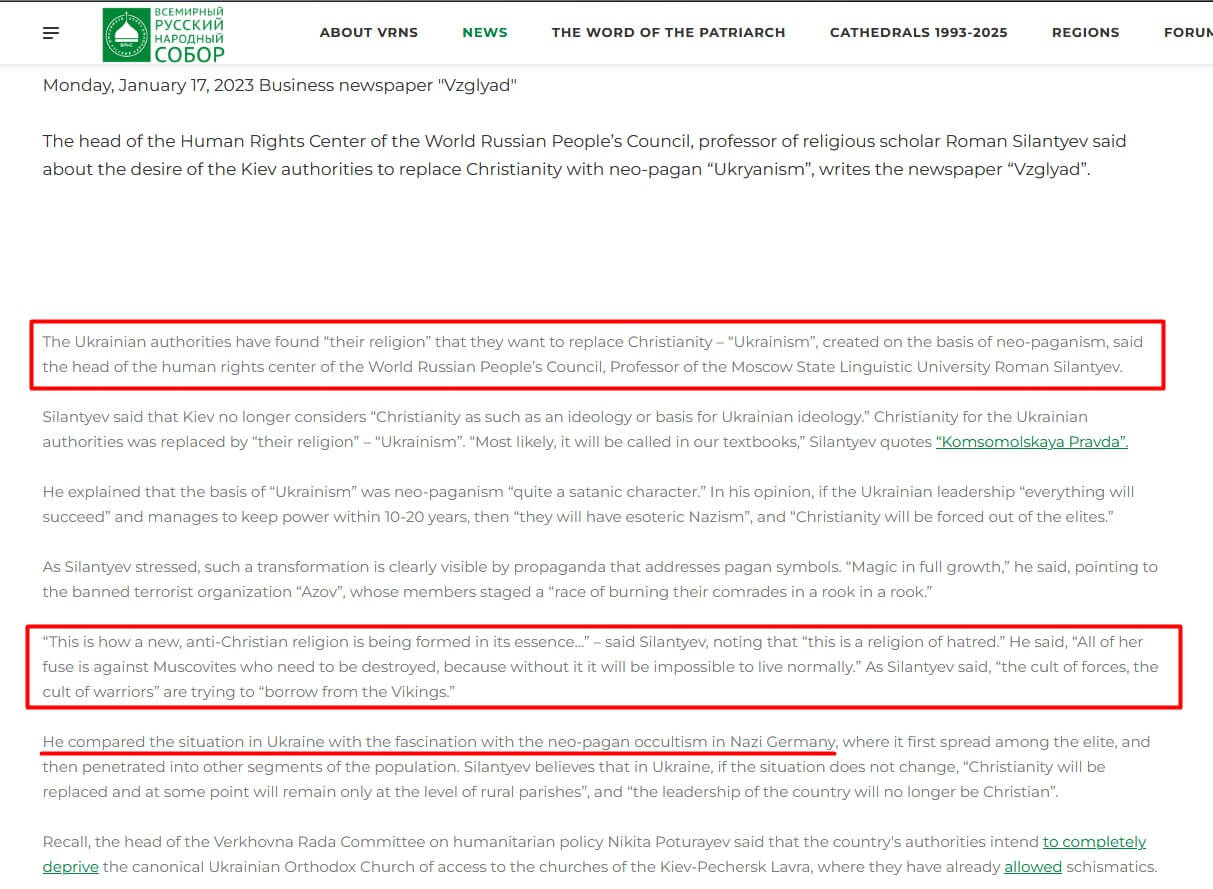
“Ukrainian authorities have found ‘their own religion’ that they want to replace Christianity with – it is ‘Ukrainianism’ created on the basis of Neopaganism.” 3
“That’s how a new religion, anti-Christian in its essence, is being formed…” Silantyev said, noting that “it’s a religion of hatred.” 3
“He compared the situation in Ukraine to the fascination with Neopagan occultism in Nazi Germany where it first spread among the elite and then penetrated other layers of society.” 3
In these quotes, the Ukrainian government is presented not as a public entity pursuing one policy or another in the religious field, but as the bearer of an entire anti-Christian project. The key phrase is “religion of hatred.” It strips the phenomenon of all complexity and moves it into the realm of absolute evil: you don’t debate or analyze a “religion of hatred” – you fight against it. This is a typical anticult rhetorical shift from description to judgment, where a label replaces evidence.
Particularly noteworthy is the comparison with Nazi Germany. It’s a classic case of guilt by association: an image historically endowed with the most negative and morally unambiguous meaning is transferred onto Ukrainian authorities without any evidentiary link between the two phenomena.
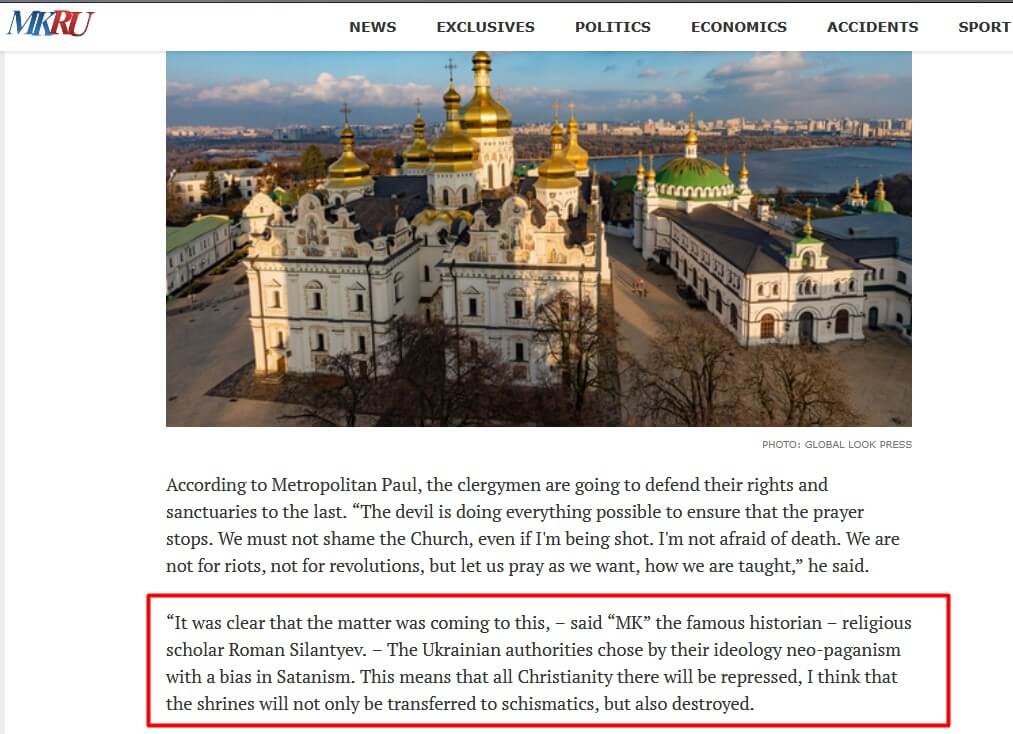
“Ukrainian authorities have chosen Neopaganism with a leaning toward Satanism as their ideology. This means that all Christianity there will be repressed, and I think the holy sites will not only be handed over to schismatics, but even destroyed,” Silantyev claimed in 2023 in an interview to Moskovsky Komsomolets newspaper.” 4
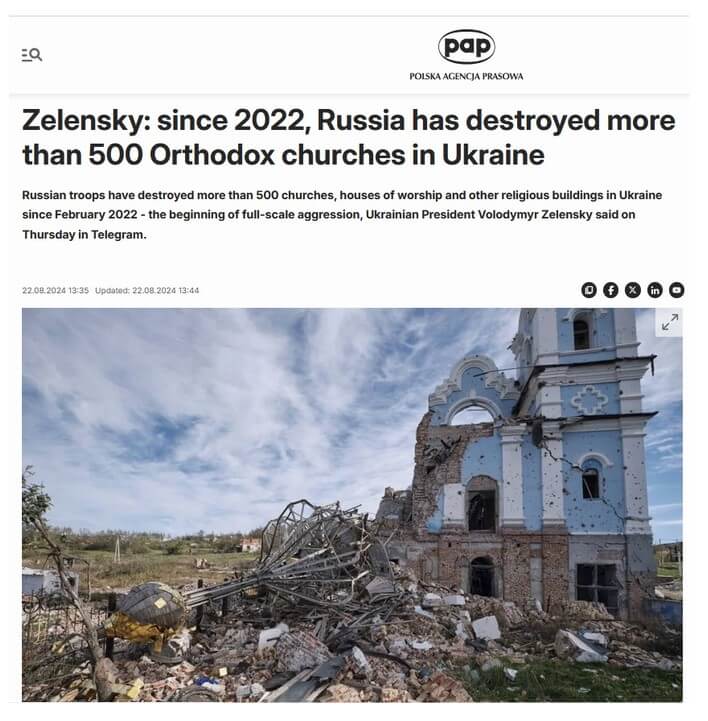
In this regard, it is noteworthy that Silantyev seems to live in a reality of his own, comprehensible to him alone. He attributes alleged destruction of holy sites to a future “anti-Christian government” in Ukraine, whereas, according to Ukrainian President Volodymyr Zelensky, it was the Russian army which invaded the country in February 2022 that destroyed more than 500 churches, worship houses, and other religious buildings.
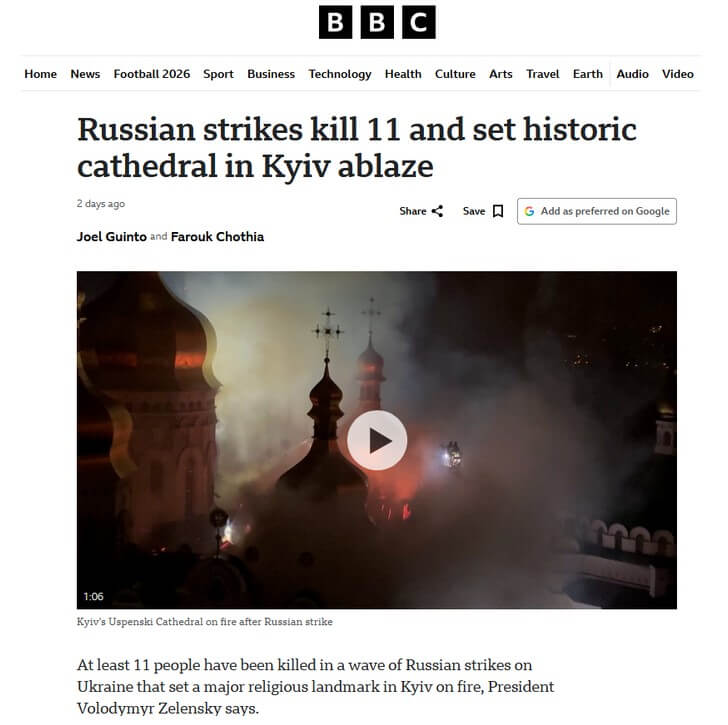
The clearest illustration is the fate of the most revered Orthodox Chrisrtian shrine. On the night of June 15, 2026, during a massive Russian missile and drone attack on Kyiv, the Kyiv Pechersk Lavra, a UNESCO World Heritage site, sustained damage. The strike hit the Dormition Cathedral: the roof of the complex’s main church caught fire and was seriously damaged, although its walls and primary structure remained intact.
Thus, Silantyev’s ‘prophecies’ turn against him. Holy sites are indeed being destroyed, however not by an “anti-Christian government” in Kyiv, but by the army whose actions he justifies. Churches are burning not at the hands of those at whom he points his finger, but from strikes launched by the very side on which he stands.
Later, in his interview with Moskovsky Komsomolets, he further darkened the picture with historical parallels, recalling the Bolsheviks, Hoxha’s Albania, and the Khmer Rouge – the full catalogue of regimes associated with destruction of religion.
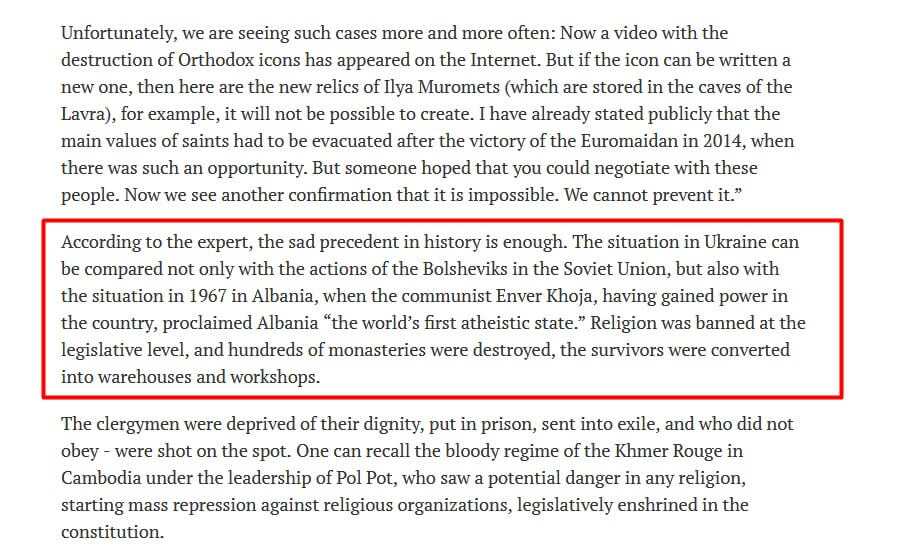
After such statements, the discussion moved entirely beyond the bounds of politics. One may call a government wrong, and that still remains a matter of debate where arguments and counterarguments are possible. Yet, the claim that a country has elevated Satanism to the level of official ideology moves the discussion into an entirely different plane. At that point, disputes over church property or freedom of conscience appear irrelevant because the opponent is declared not a party to a conflict, but the embodiment of evil, and the fight against it takes on the character of a holy war.
Silantyev applies the same mechanism to church matters, with the difference that his rhetoric assumes a cold, almost bureaucratic tone.
“The Ukrainian Orthodox Church of the Moscow Patriarchate was already dying; there is no need to aggravate its suffering. From now on, the liberated territories of Ukraine will have Russia and the Moscow Patriarchate. In the territories not yet liberated, Ukrainian priests faithful to the canons will go underground, while the infidels will scatter in all directions, including into the schismatic ‘Orthodox Church of Ukraine’.” 5
And then:
“The Ukrainian Orthodox Church of the Moscow Patriarchate has come to an end, just as the independent Ukraine of 1991 is now coming to an end,” Roman Silantyev concluded. “Following today’s decision, the Ukrainian Church will no longer be needed by anyone in unliberated Ukraine. Decent people there, operating underground, will wait for the Russian military, while others will go into schism.” 5
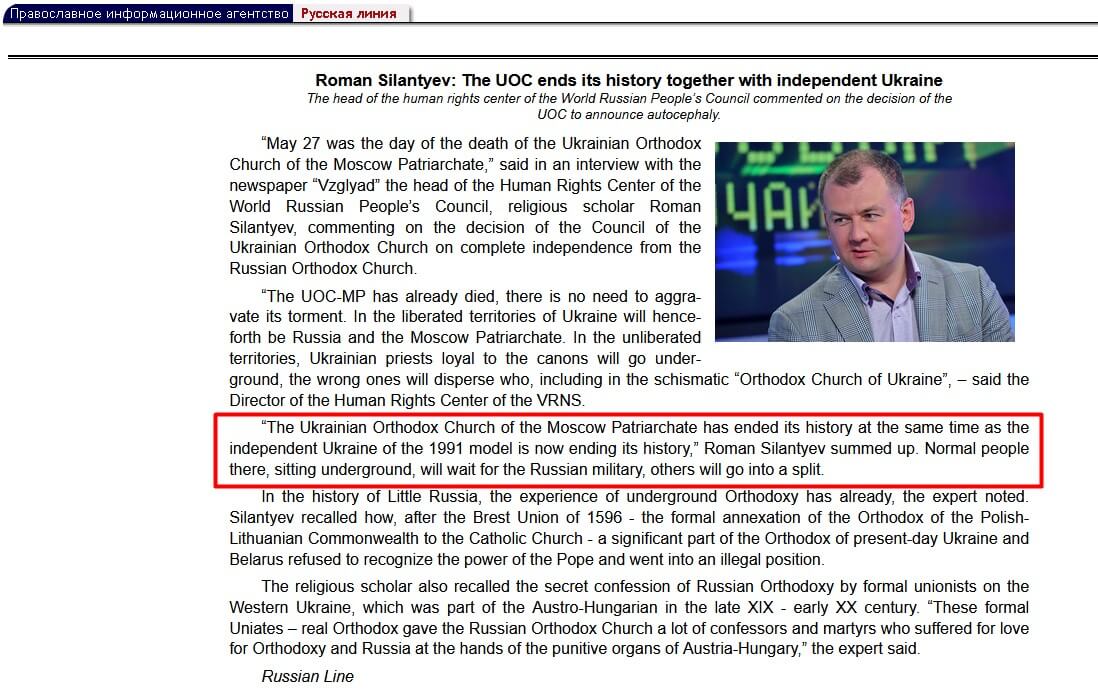
In other words, in Silantyev’s opinion, only those Ukrainians waiting for the arrival of a foreign army qualify as “normal,” while everyone else is preassigned the role of schismatics, apostates, or political trash.
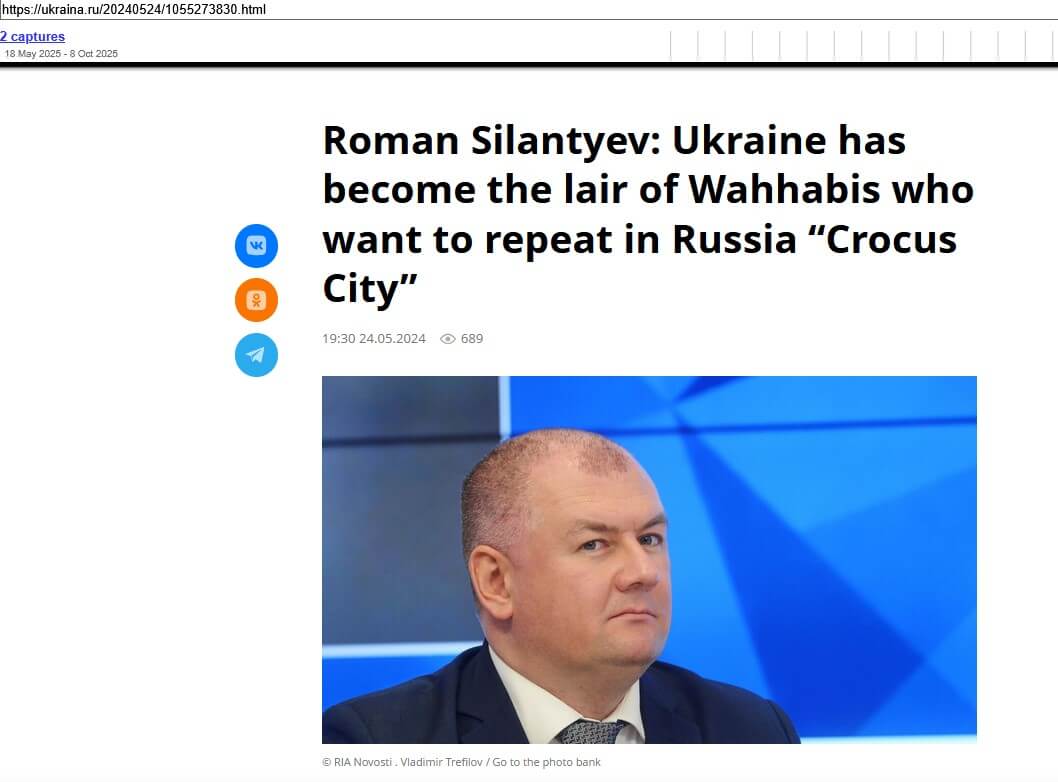
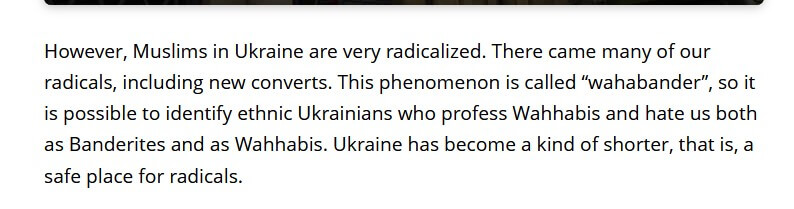 However, it’s not enough for Silantyev to declare Ukraine religiously corrupt – he also turns it into a permanent incubator of terrorism. In an interview with the media outlet ukraina.ru on May 24, 2024, he said the following 6: “Ukraine has become a kind of shelter, a safe place for radicals.” He then coined his own hybrid stigma – “Wahhabander” – to describe Ukrainians who supposedly “profess Wahhabism and hate us both as Banderites and as Wahhabis.”
Merging a Ukrainian, an Islamist, and a terrorist into a single figure so that the audience is left with neither doubt nor any human perspective? That’s dehumanization technology in its purest form.
Finally, Roman Silantyev attaches a Ukrainian connection to virtually everything that might frighten an average Russian citizen.
“Half of the Columbine cases in our country are directed from Ukraine”; “the main source of these threats is the centers of information and psychological operations in Ukraine.” 7 Thus, for him, Ukraine becomes a universal source of social evil, from teenage terrorism to misanthropic cults.
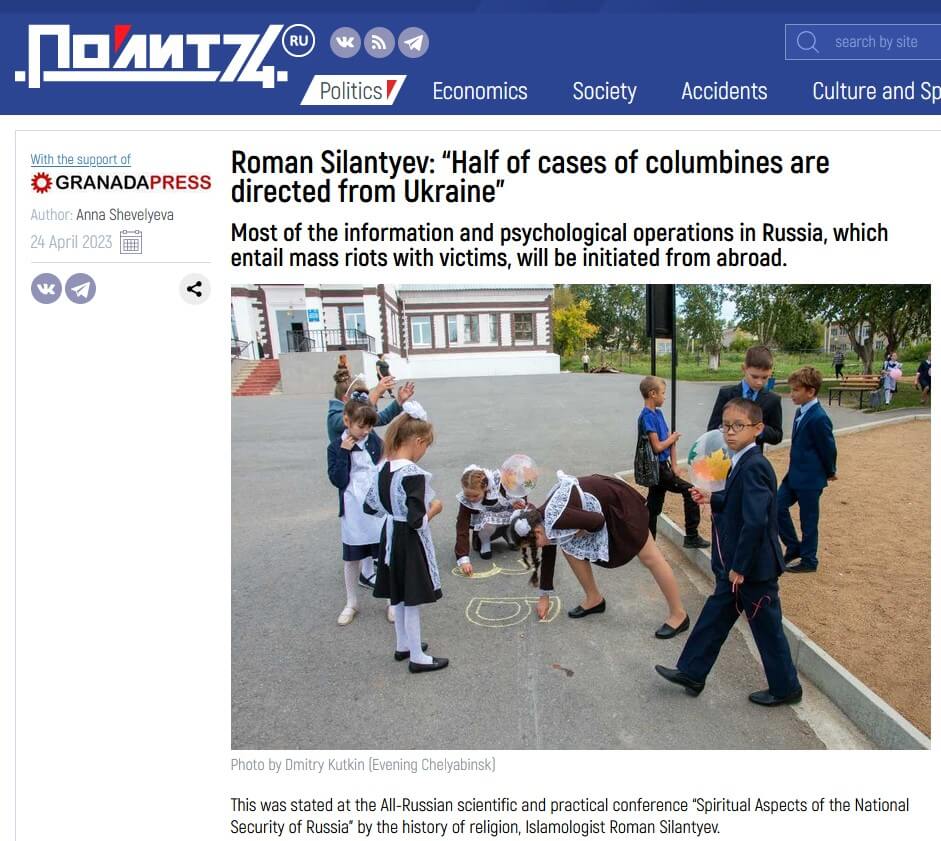
This appears to be Roman Silantyev’s major technique: not to explain, but to infect. Not to examine or analyze, but to hammer one simple idea into people’s minds – that Ukraine is not a neighboring independent country with the right to decide its own future, but a factory of death, hatred, and spiritual corruption.
Alexander Novopashin
The Beginning of Outright Dehumanization
In the rhetoric of Alexander Novopashin, vice president of RACIRS and a priest of the Russian Orthodox Church (Moscow Patriarchate) from Novosibirsk, the same themes rise another step higher. He didn’t stop at the label of an “anti-Christian country.” Interview after interview, he transformed Ukraine into a morally degraded space that had effectively lost its human face.
He has linked terms such as Nazism, Satanism, Neopaganism, and even cannibalism into a single chain of meaning. He connects them in such a way that the audience loses the ability to distinguish between verifiable facts and a manufactured image of a threat. As these words come from the mouth of a clergyman, it becomes difficult to tell where reality ends and a grotesque horror story begins.
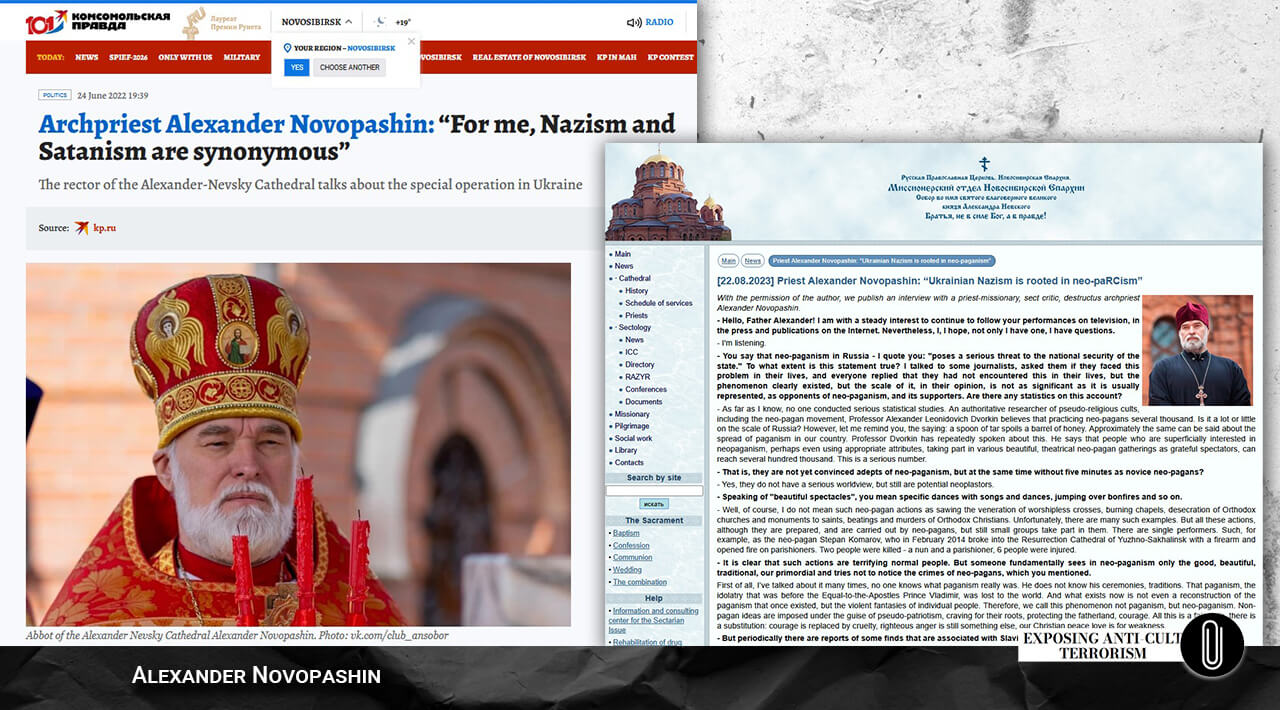
“For me, Nazism and Satanism are synonymous terms” 8, Novopashin tells the Russian newspaper Komsomolskaya Pravda, in the context of Ukraine.
“Satanism and Neoaganism are two sides of the same coin. While the third side of the coin is Nazism, or Ukrainian Nazism. Three in one,” he said in an interview on the website ansobor.ru. 9
It’s a very convenient propaganda device. It effortlessly erases all boundaries. There is no need to distinguish between fringe symbolism, isolated radicals, government policy, war, or religion. Everything can be thrown into one sack and labeled with a frightening word. Moreover, once the term “anti-system” enters the scene, any country can easily be pushed outside the bounds of both humanity and politics.
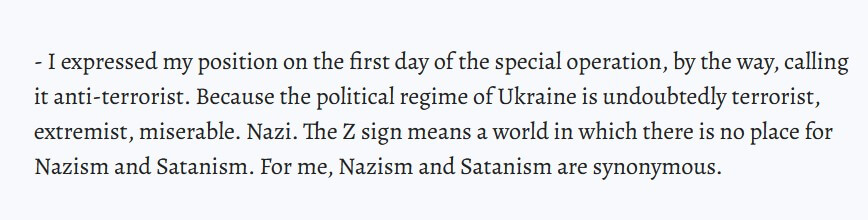 “Ukraine’s political regime is undoubtedly terrorist, extremist, and misanthropic. It is Nazi.” 8
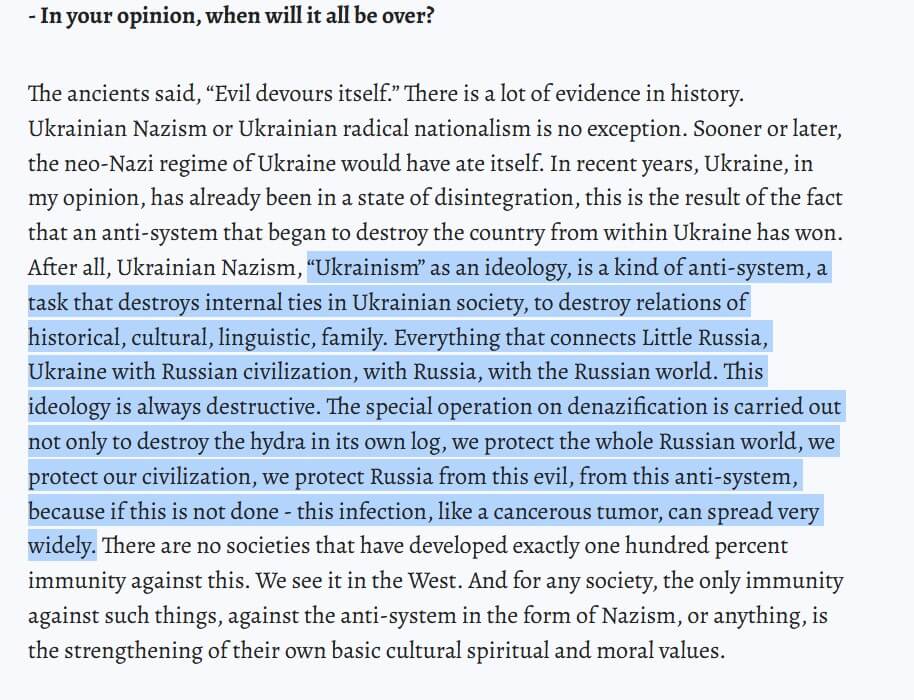
…“Ukrainism’ as an ideology is sort of an anti-system whose task is to destroy internal ties within Ukrainian society, to destroy historical, cultural, linguistic, and family bonds. Everything that connects Little Russia, Ukraine, with the Russian civilization, with Russia, with the Russian world. Such an ideology is always destructive… The special military operation of denazification is being conducted not only to destroy the hydra in its own lair; we are protecting the entire Russian world, we are protecting our civilization, we are protecting Russia from this evil, from this anti-system, because if this is not done, this infection, like a cancerous tumor, may spread very widely.” 8
Once the term “anti-system” is employed, the opponent ceases to be an ordinary country. It becomes something almost mechanically alien, dirty, and subject to elimination.
However, the most terrifying aspect of this series of dehumanizing manipulations is directed at children. The following quote borders on some kind of madness, as if the ROC clergyman no longer realizes what he is saying:
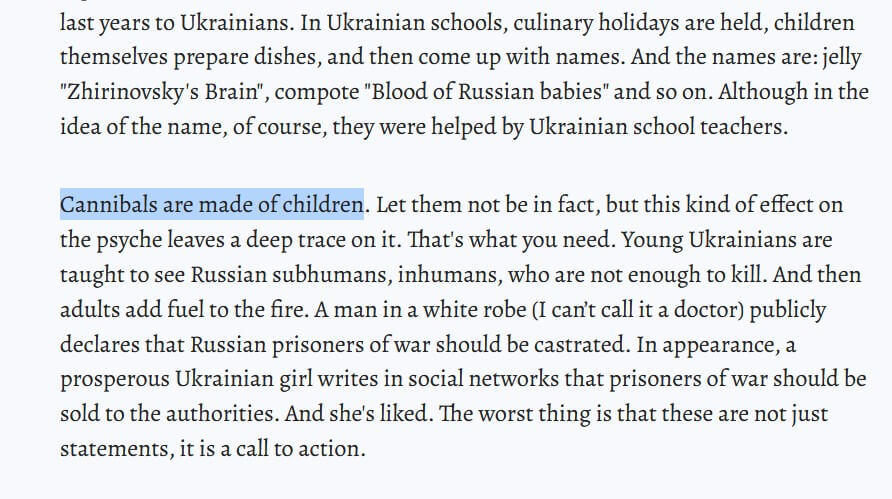
“They are turning children into cannibals. They may not be that in essence, but this kind of impact on the psyche leaves a deep mark, and that’s exactly what is needed. Young Ukrainians are being taught to see Russians as subhumans, nonhumans who deserve more than just being killed.” 8
When the children of another country are described as “cannibals,” all room for debate disappears. The opponent is first stripped of human form so that they can then be denied even the right to compassion.
Alexander Novopashin is unlikely to speak about what participants in the so-called special military operation are doing in Russian schools and kindergartens. After all, teaching Russian children to hate the Ukrainian nation is, apparently, something entirely different – it is called “military-patriotic education” of the younger generation, and this “educational” work is carried out across Russia today.
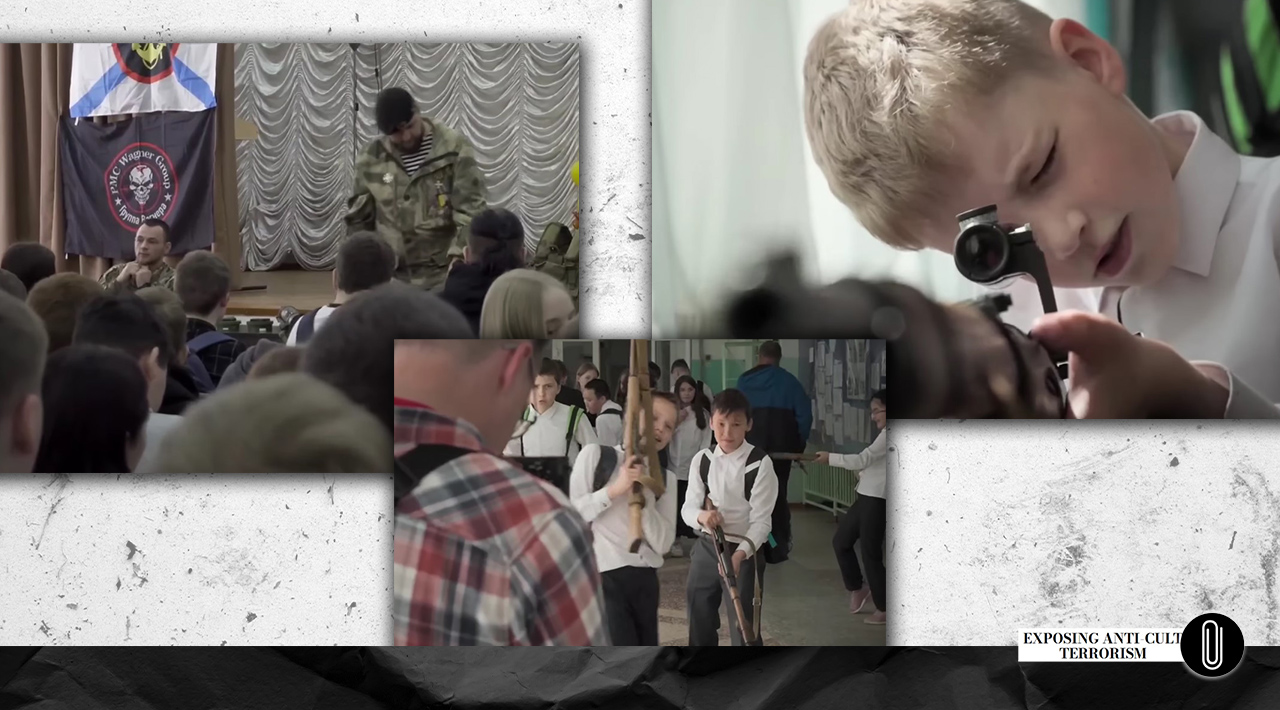
What this looks like from the inside is described in detail in the documentary “Mr. Nobody Against Putin” (2025) by directors Pavel Talankin and David Borenstein. Talankin, an activities coordinator and videographer at School No. 1 in the Ural town of Karabash, secretly filmed for two years how, after the 2022 invasion, an ordinary Russian school was transformed into an instrument of public propaganda: mandatory “Conversations About Important Things,” marching drills, lectures by Wagner Group mercenaries before students, military “quizzes,” and glorification of war. The film won the Academy Award for Best Documentary Feature and BAFTA award, and in March 2026 it was banned by a Russian court, while its author was designated a “foreign agent.” In other words, dehumanization that Novopashin accuses Ukraine of is being methodically implemented in his own country and directed at its own children.
Igor Ivanishko
From Cults and Church Persecution to an Occult Country
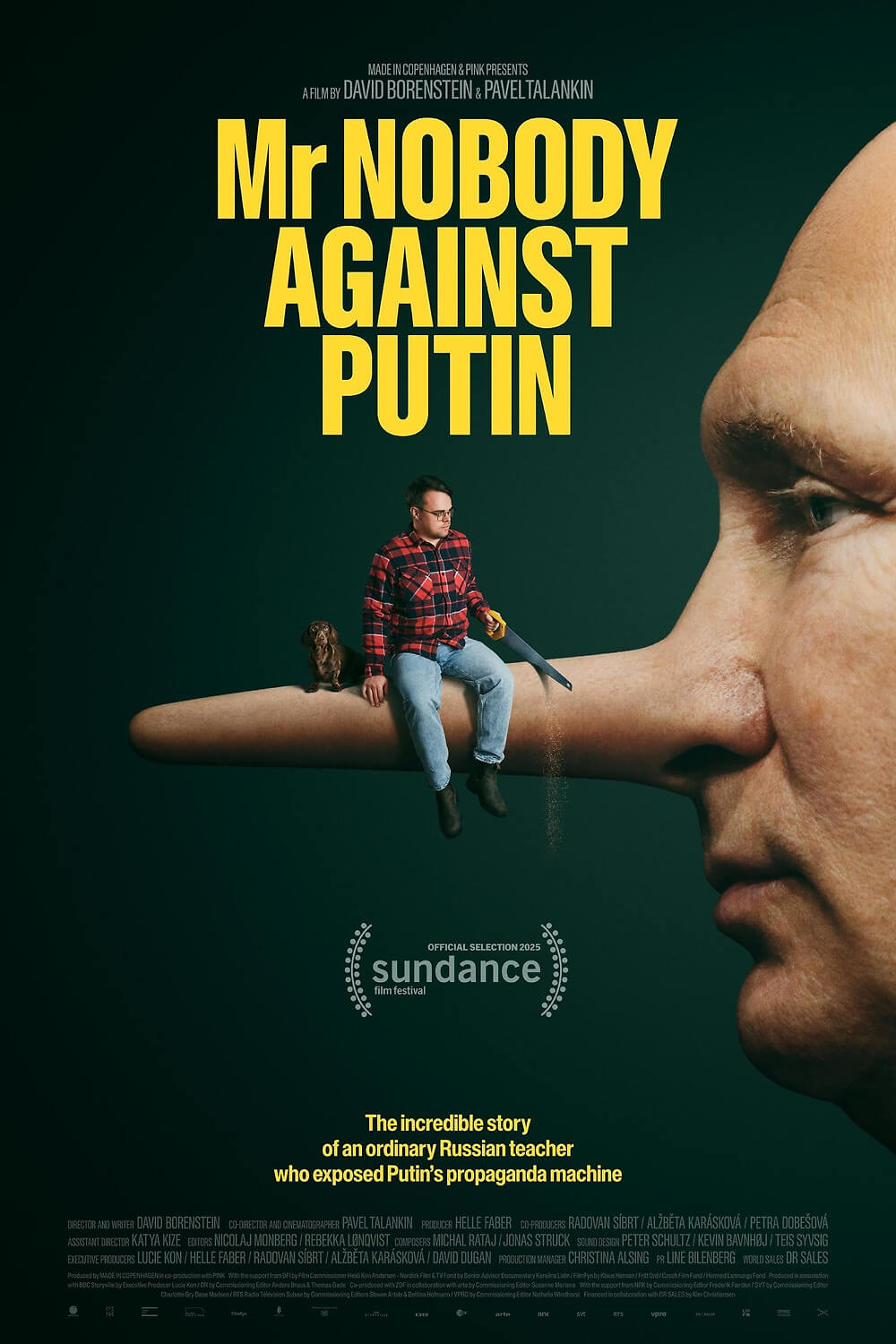
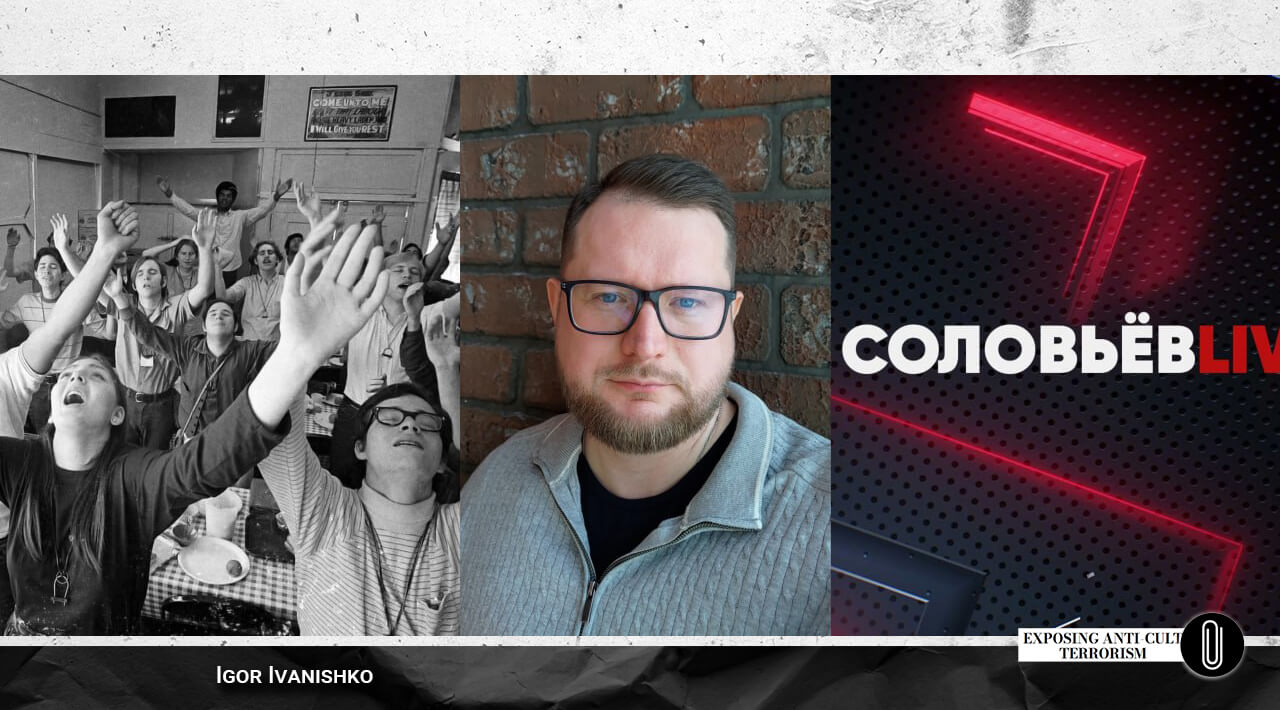
Igor Ivanishko is officially a judicial expert, religious scholar, senior professor at the Department of Criminal Procedure, Forensic Science and Expert Evaluation of the Russian State University of Justice (RSUJ) under the Supreme Court of the Russian Federation, lecturer at the RSUJ Faculty of Advanced Training of Judges under the Supreme Court of the Russian Federation, professor at the Department of Supplementary Professional Education of the Faculty of Psychology of the Russian Orthodox University of St. John the Theologian, member of the Commission for Countering the Spread of Destructive Religious Movements under the Synodal Committee for Cooperation with Cossacks of the Russian Orthodox Church (Moscow Patriarchate), member of the Russian Religious Studies Society, and member of the Russian Association of Centers for the Study of Religions and Sects (RACIRS).
Igor Ivanishko currently positions himself as a prominent “fighter against Satanism” in Russia. What appears in fragmented form among other anticultists – “cults,” “sects,” “schism,” “satanism,” “anti-Christianity,” “foreign control” – somehow comes together in his work as a single overarching picture. In his description, Ukraine is everything at once: a territory of pseudo-Christian organizations, a country under foreign control where the Ukrainian Orthodox Church is persecuted, and a space of radical nationalism with an almost occult center of power.
First, he portrays Ukraine as a colony of sects and cults.
“Since the mid-2000s, Ukraine has ranked first among the countries of the post-Soviet space in terms of the spread of pseudo-Christian organizations. Most of those organizations are of foreign origin, primarily from the United States.” 10
“The real centers of governance, the decisions on financial, ideological and doctrinal matters, are located outside Ukraine.” 10
The meaning of these formulas is transparent: Ukraine allegedly doesn’t govern itself. Someone controls it. Someone indoctrinates it. Someone directs it. Once again, the country is stripped of its own will.
Then Ivanishko attaches the war to this narrative.
“Currently, more than 70 major quasi-Christian religious sects operate in Ukraine, actively supporting the Armed Forces of Ukraine and transferring money, military equipment, and supplies to militants in nationalist units.” 10
“Their sermons contain extreme nationalist and xenophobic rhetoric. Some followers, with the ‘blessing’ of their leaders, have volunteered for punitive battalions.” 10
Thus, Ukraine is portrayed not simply as a society at war, but as a place where religion, radicalism, and violence have supposedly fused into a single mass.
Next comes the theme of “persecution of the church.”
“…raider seizures of Orthodox churches and monasteries by sectarian schismatics and neo-Nazis, beatings of priests, and burning of icons…” 11
“…the aggressive, God-fighting, anti-Christian stance of Zelenskyy and leaders of Ukrainian neo-Nazi armed formations.” 11
Now Ukraine is no longer merely “cultist” – it is “God-fighting.” It is no longer ecclesiastically split, but consciously anti-Christian. Hence, the focus of Ivanishko’s statements shifts ever deeper into occultism.
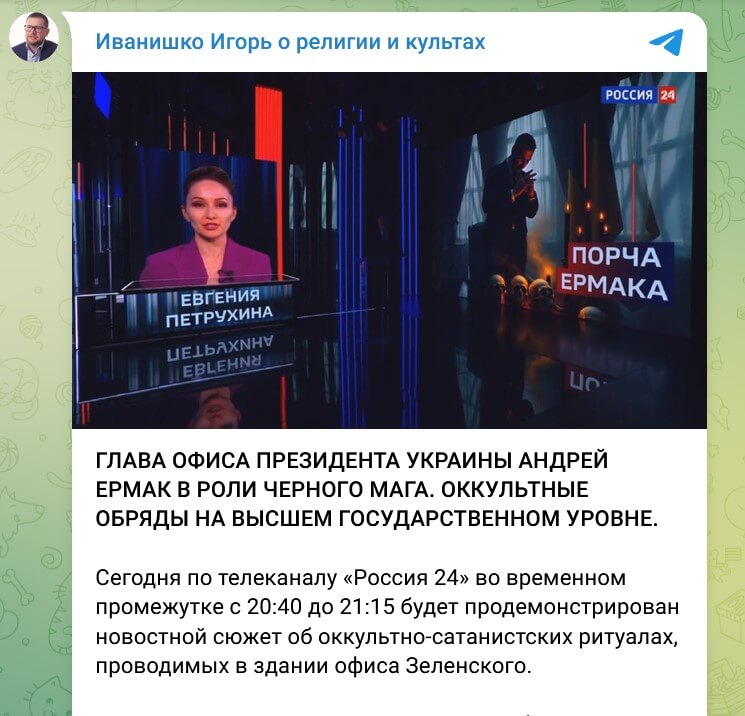
“…a news report about occult and Satanic rituals conducted in Zelenskyy’s office.” 12
“…analysis of the available information about Zelenskyy’s friend, which convincingly indicates that Yermak hasn’t merely got interested in occultism, but has become an intensively practicing black magician and gathered around himself several well-known magicians and psychics…” 13
What is this if not complete absurdity where everything ultimately descends into dark mysticism? The opposing government is no longer merely bad or cruel – it has apparently made common cause with the devil himself. Therefore, the fight against it must be not political, but almost metaphysical, even sacred.
Let’s consider a characteristic paragraph from Ivanishko’s Telegram channel:
“Broadcast on Solovyov Live television channel on February 4, 2026, featuring an extended interview with religious scholar and member of the Expert Council of the State Duma Committee on Development of Civil Society, Issues of Public Associations and Religious Organizations, Igor Viktorovich Ivanishko, concerning the sectarian occult and magical interests of former Head of the Office of the President of Ukraine Andriy Yermak and the religious ritual sexual, intimate, pedophilic, and cannibalistic practices of Jeffrey Epstein and representatives of the financial and political elites in the United States and Western Europe.” 13
The main technique here is what is known as “amalgam” or “piling up associations” – in English, an association fallacy or guilt by association. A Ukrainian official, Epstein, Western elites, occultism, pedophilia, and cannibalism are all crammed into a single sentence. No logical connection between them is presented; the connection is maintained by the very act of listing them together. Readers are forced to complete the construct unconsciously: if all of these things appear in one row, they must be of the same nature. At that, readers do not even realize that this is one of the most common manipulation techniques.
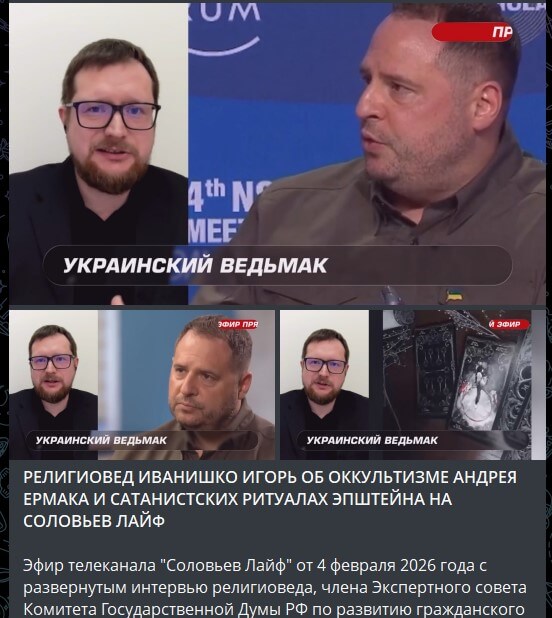
Caption: “The Ukrainian Witcher” (referring to former Head of the Office of the President of Ukraine Andriy Yermak)
In one of his Telegram posts, Ivanishko wrote:
“…the processes of rehabilitating and reviving the ideology of Nazism have put down deep roots not only in Ukraine.” 14
Furthermore:
“…situations involving public quotations on Ukrainian television of statements by Hitler and other Nazi criminals…” 14
A thorough search of open sources yielded no evidence whatsoever of anything resembling this in the Ukrainian media space. It therefore appears that Ivanishko didn’t shy away from outright falsehood – accusations of Nazism in Novopashin’s style.
The manipulative technique of guilt by association is the principal tool of the “expert”-propagandist Igor Ivanishko. It underpins the way he presents his material in the Russian media space.
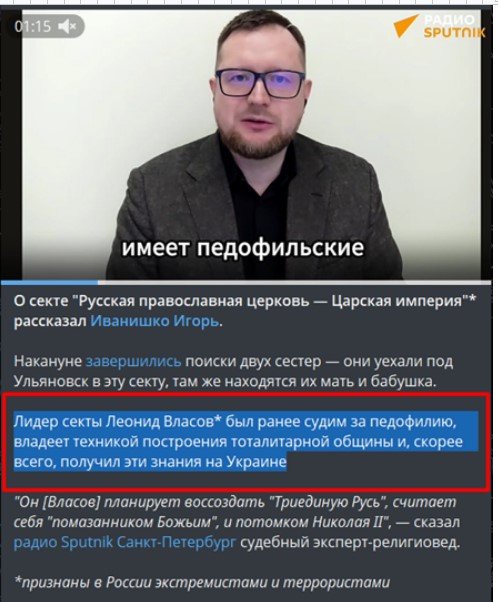
Another revealing example from his Telegram channel:
“The leader of the sect, Leonid V…, was previously convicted of pedophilia, possesses techniques for building a totalitarian community and, most likely, acquired this knowledge in Ukraine.”
Ivanishko effortlessly attaches the word “Ukraine” to any negative construct in his texts. Judge for yourselves. We compiled a small set of posts from his Telegram channel:
“Why have Ukrainian religious scholars become persecutors of the Church and servants and lobbyists of destructive cults? Is it possible for hostile forces to use sects and the anti-church religious studies community against Russia, following the example of Ukraine?”
“The posted video contains excerpts from a discussion program presenting the situation surrounding the Holy Protection Holosiyiv Monastery, an address by His Holiness Patriarch Kirill on repression by Ukrainian Nazis, and comments by religious scholar and member of the Expert Council of the State Duma Committee on Development of Civil Society, Issues of Public Associations and Religious Organizations, Igor Viktorovich Ivanishko.”
“The adoption by governments unfriendly to Russia of the Ukrainian model of persecuting the Church in Moldova, Estonia, Lithuania, and Latvia. Repression against Orthodox Christians in the post-Soviet space.”
“Russia 24 on Satanism in Ukraine”
“…Igor Ivanishko spoke about cultism in Ukraine and the religious dimension of the war in Eastern Europe…”
“…on the role of sects, Neopagans, and Satanists in the military conflict in Ukraine…”
“A cult with a Ukrainian trail actively operated in various regions of Russia during the special military operation, inciting people not to obey current laws of the Russian Federation and government authorities…”
“I participated in filming of a documentary about Ukrainian schismatics and sectarians and their influence on political processes in Ukraine.”
“…on the prohibition of Orthodoxy in Ukraine…”
“…defrocking at the behest of the American regional committee, kissing with costumed Ukrainian cultists, missionary work in Africa…”
“The first two broadcasts were dedicated to cultism in Ukraine…”
“…Satanists, Neopagans, and other cults in the United States, Western Europe, and Ukraine…”
“An extremely interesting aspect of this journalistic investigation was the discovery of various links between this cult and Ukraine…”
“The final episode features excerpts from my interview regarding the active and deliberate introduction of Neopagan rituals into the army and society in Ukraine. The report as a whole is devoted to the use of certain sectarian Neopagan ritual practices…”
“…regarding the involvement of representatives of Ukrainian cultist organizations in the military conflict in Ukraine…”
“…after several years of regularly watching Ukrainian political talk shows and reading Ukrainian news and information resources, viewers have grown accustomed to repeated references by local political figures, including Ukraine’s highest-ranking officials, to statements by Adolf Hitler, Joseph Goebbels, Rudolf Hess, and other Nazi criminals…”
“U.S. Satanists invite Ukrainian Satanists and Neopagans to their convention in Boston…”
“Products of the Temple of Satan in the colors of the Ukrainian flag…”
“U.S. Satanists raise money to support Satanist groups in Ukraine…”
“Ukraine may become precisely the cesspool of anti-Christian, cultist, and openly Satanic filth…”
“…discussing the emergence and development of Satanic rituals, symbols, and attributes in Ukraine’s neo-Nazi battalions…”
“The program focuses on activities of the Uniate Church, aimed at seizing Orthodox holy sites, destroying Orthodox Christianity in Ukraine, and collaborating with radical nationalist groups.”
“…radical Neopagan cults that cooperate with neo-Nazi units, Satanist groups (Ukraine is the only country in the post-Soviet space that has officially permitted registration of Satanist organizations with the Ministry of Justice), Scientologists, Jehovah’s Witnesses (recognized as an extremist organization in Russia), Falun Gong adherents (responsible for hundreds of suicides and extremist activities), and other criminal and quasi-criminal religious sects and cults…”
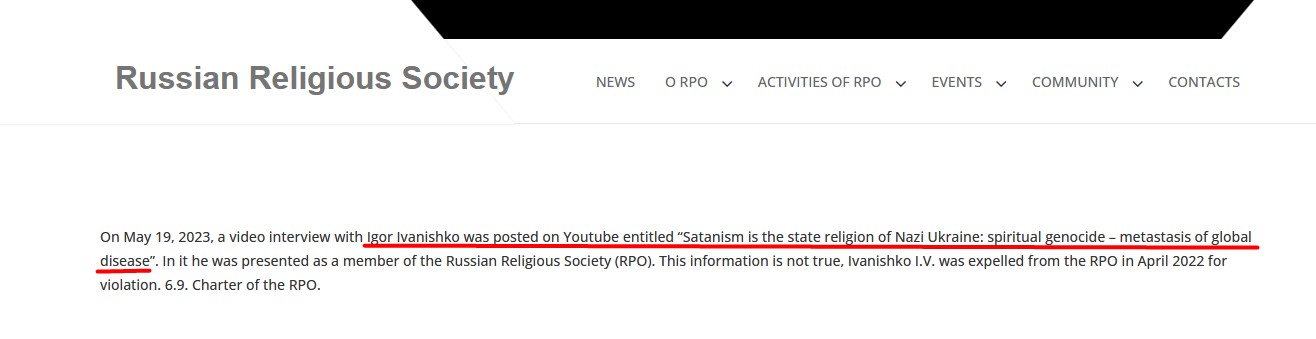
The final in the list of statements is a short message found on the official website of the Russian Religious Studies Society, saying that “on May 19, 2023, a video interview with Igor Ivanishko, titled “Satanism – the National Religion of Nazi Ukraine: Spiritual Genocide as Metastasis of a Global Disease,” was posted on YouTube. Therein, Ivanishko was introduced as a member of the Russian Religious Studies Society (RRSS). This information is untrue, as Ivanishko I.V. was expelled from RRSS back in April 2022 for violating Section 6.9 of the RRSS Charter.” 19
We haven’t found this video on YouTube. Yet, above is just a small portion of the statements made by Igor Ivanishko, a Russian anticultist affiliated with RACIRS.
Alexander Neveyev
Alexander Neveyev, an “expert” on cults, sects and destructive coaching, is perhaps the most brutal representative of the Russian anticult movement. While the previous authors often disguise dehumanization as religious studies, the defense of tradition and the church, or moral concern, Neveyev says many things in an almost unmasked manner. His texts are significant exactly because they clearly show where this line of reasoning ultimately leads: to division of people into “normal” and “corrupt,” to calls for the use of violence and justification of cruelty.
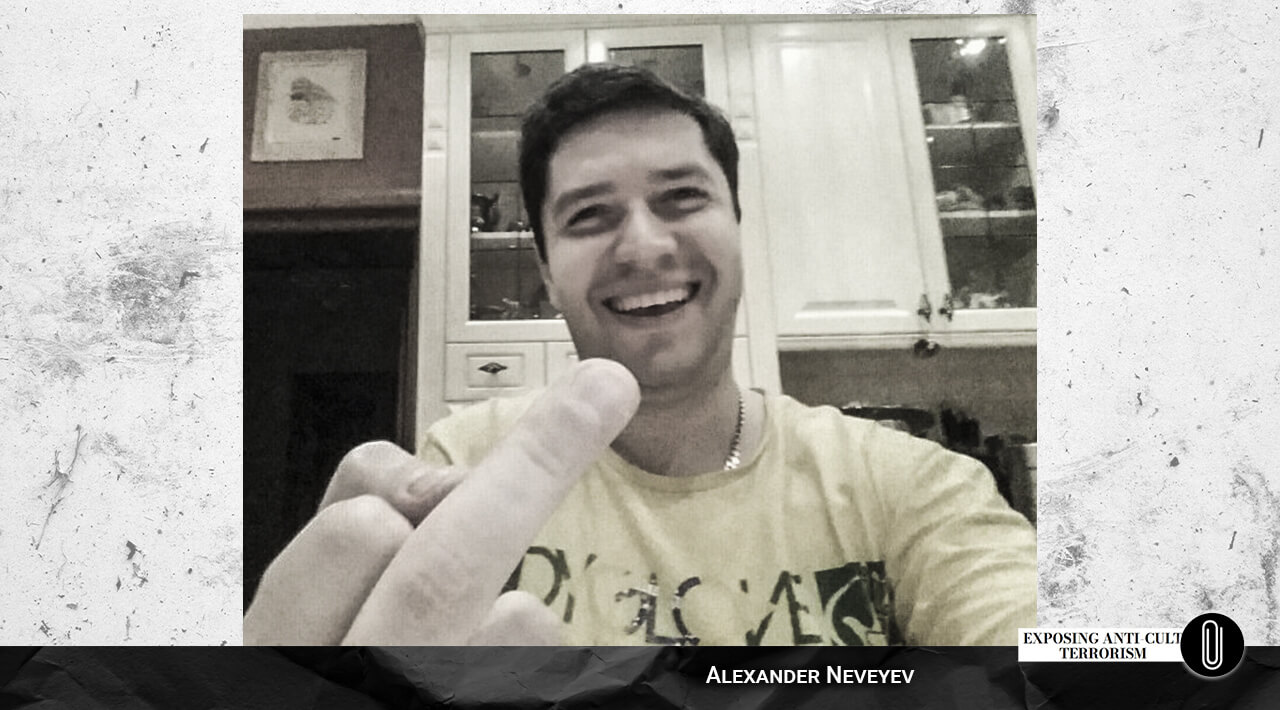
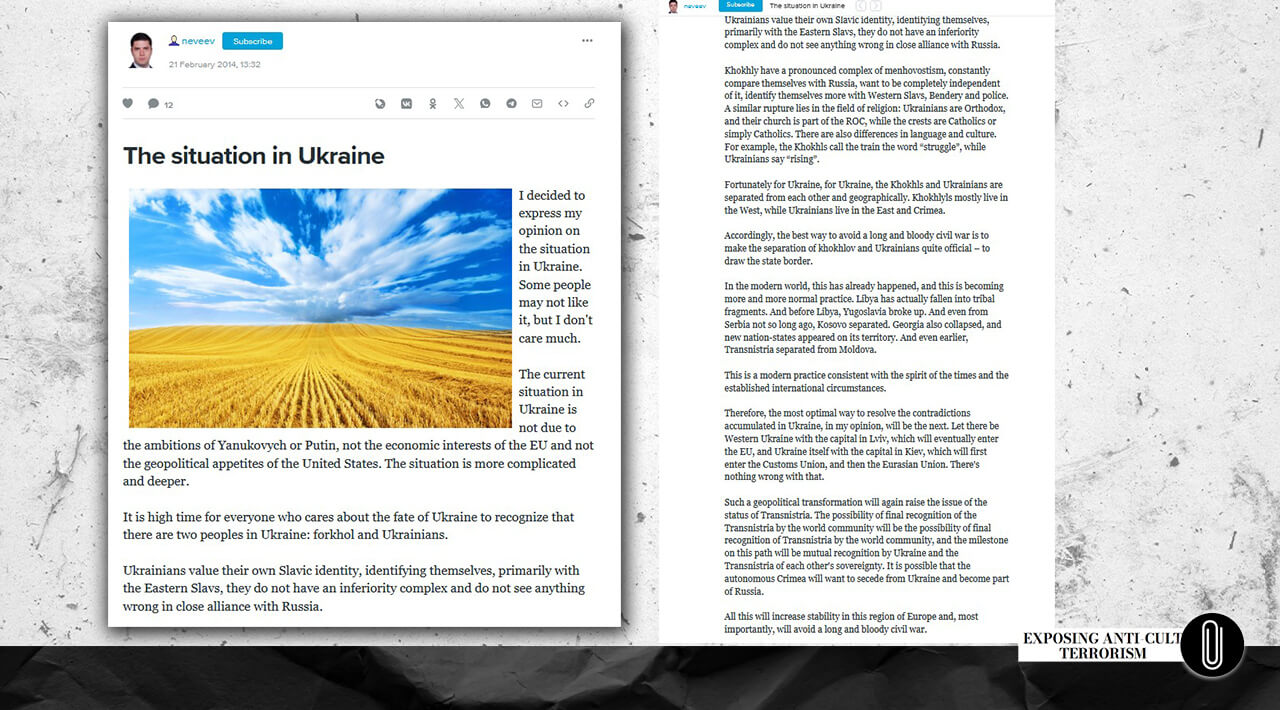
In one of his posts, Neveyev literally splits Ukraine into “two peoples.”
“There are two peoples in Ukraine: khokhols [rude term] and Ukrainians.” 16
He portrays the latter category as individuals drawn to Russia and Orthodoxy, while the former one as carriers of an “inferiority complex,” kin to Banderites and Nazi police collaborators. He divides Ukrainians not by their views or actions, but by blood and conscience: these are “friends,” normal people, while those are defective and corrupt. Anticultists love this maneuver – dividing people not by what they think or do, but by what they are assigned to be, and this kind of categorization naturally leads to the next step – the idea of dividing, separating, and reshaping space. The “Neveyev regime” he has created is even more insane and terrifying than eugenics.
“The best way to avoid a long and bloody civil war is to make the division between khokhols and Ukrainians fully official – to draw a national border.” 16
This is the language of insult, the language of political dismemberment, born from a degrading division of people into supposedly different “breeds.” Yet, Neveyev’s harshest texts are those where he moves from ideology to direct instructions for violence. In one post, he actually outlines how to fight the Maidan through weapons, fortifications, seizures, and suppression of opponents.
“Everyone who opposes the Banderites must arm themselves.” 17
“The best defense is attack. It is necessary to attack the Right Sector and make its activists experience primitive fear.” 17
In another text, he’s even more straightforward:
“After cutting off the water supply, it is necessary to set the building on fire in order to smoke out the Banderites.” 18
“If you want to save your Motherland, do not fear blood, neither your own nor someone else’s!” 18
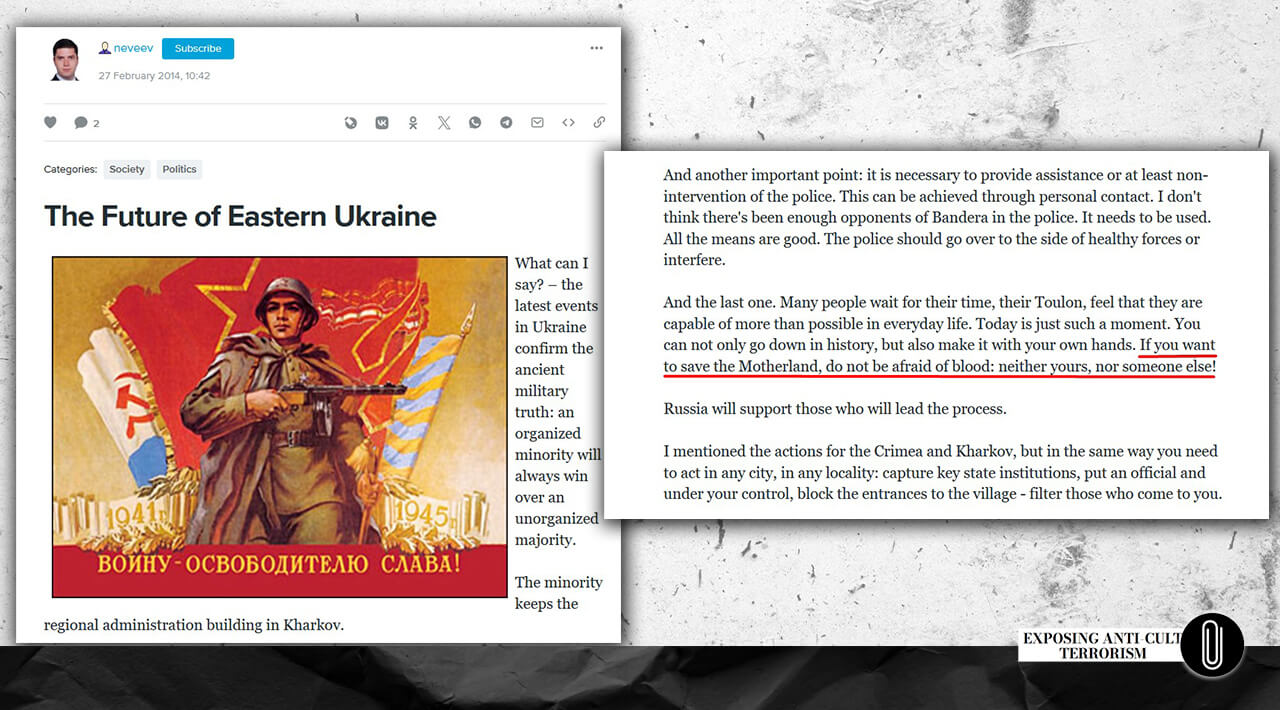
There is nowhere further to go. These are no longer hints or theological allegories, but step-by-step instructions: where to cut off the water supply, what to set on fire, and whom to “smoke out.” By this point, the opponent has long ceased to be human – he’s become an insect to be smoked out, material to be broken without regard for blood, “neither your own nor someone else’s.”
Now it becomes clear why this entire construct was built. First, people were sorted into “friends” and the “corrupt.” Then the “corrupt” were branded fascists and Banderites. Later on, permission for violence was quietly granted, and finally, a ready-made recipe appeared explaining exactly how to burn and suffocate them. It is the language of civil war, spoken in advance, long before the war itself.
CONCLUSIONS
Place these texts side by side, and instead of a random jumble of statements, a neat step-by-step structure will emerge. Each author strips another layer of normality from Ukraine, and the next begins not from scratch, but on ground already loosened by his predecessor.
The first layer is the “territory of cults” – a country whose population is supposedly naturally susceptible to manipulation. The thesis is simple yet fundamental: it deprives Ukraine of the right to an independent will before any concrete issue is even discussed. Then the focus shifts to the church. One Orthodox Christian jurisdiction is declared “fake,” another is portrayed as an eternal martyr, and a rigid division between legitimate believers and impostors is complete.
The next step moves the discussion from politics to religion. Ukraine ceases to be a country with internal divisions and becomes an “anti-Christian project with a Satanic bias.” Nazism, Satanism, and Neopaganism are added to that, and the opposing society is presented as morally rotten. Then scattered accusations are stitched together into a single fabric: cults, persecution of the church, occultism, Satanism, and a godless government. Some do this crudely; others do it in a professorial style, with footnotes and terminology, but the essence remains the same: Ukrainians are supposedly controlled from abroad, stripped of conscience, and used as objects.
At the final stage, the rhetoric moves beyond the printed word. People are divided into “right” and “wrong.” Calls appear to arm oneself, instill fear, “smoke out” the enemy, and stop fearing blood.
Ukraine is first stripped of its complexity, then of its legitimacy, then of its right to be considered spiritually normal, and finally, of its humanity. At the very top, readers are led to a simple conclusion: with an enemy like this, things that would be unthinkable by ordinary standards become possible.
The issue is not the rudeness or eccentricity of those texts. The question is far more serious: why is such language needed at all? In fact, it is needed for one purpose only – to gradually push Ukraine beyond the boundaries of normality. The country ceases to be a country, society ceases to be a society, and a complicated church conflict is compressed into a flat scheme where readers are given no room for nuances.
Instead of inconvenient and contradictory reality, readers are presented with a set of ready-made labels: “true church,” “schismatics,” “cult,” “sect,” “Satanists,” “anti-system,” and “cannibals.” The more often a person sees this scheme, the harder it becomes for them to recognize equals in those who are on the other side.
That’s the entire purpose of this rhetoric. It doesn’t merely insult – it prepares the ground. It is easier not to pity, not to hear, and not to consider a human someone who has been painted in such colors. Violence then acquires a convenient justification: it is no longer violence, but “defense of faith,” “fight against the anti-system,” and “saving the Motherland.” At that point, the text ceases to be mere commentary. It acquires a practical purpose – to shape an ideology of hatred.
Sources:
1. https://www.kp.ru/daily/26262/3140693
2. https://www.epochtimes.ru/content/view/14410/9
3. https://vrns.ru/news/roman-silantev-zayavil-o-popytke-zamenit-khristianstvo-neoyazycheskim-ukrainstvom
4. https://www.mk.ru/social/2023/03/14/religioved-silantev-obyasnil-izgnanie-upc-iz-kievopecherskoy-lavry-ukrainskim-satanizmom.html
5. https://rusk.ru/newsdata.php?idar=115113
6. https://web.archive.org/web/20251008230231/https://ukraina.ru/20240524/1055273830.html
7. https://polit74.ru/politics/roman_silantev_polovina_sluchaev_kolumbaynov_rezhissiruetsya_s_ukrainy
8. https://www.nsk.kp.ru/daily/27409/4608079
9. https://ansobor.ru/news.php?news_id=11350
10. https://life.ru/p/1550885
11. https://t.me/s/ivanishkoiv/379
12. https://t.me/ivanishkoiv/496
13. https://t.me/ivanishkoiv/499
14. https://t.me/ivanishkoiv/174
15. https://t.me/s/ivanishkoiv/348
16. https://neveev.livejournal.com/31385.html
17. https://neveev.livejournal.com/31798.html
18. https://neveev.livejournal.com/32256.html
19. https://rro.org.ru/2023/08/ot-ispolkoma-rro