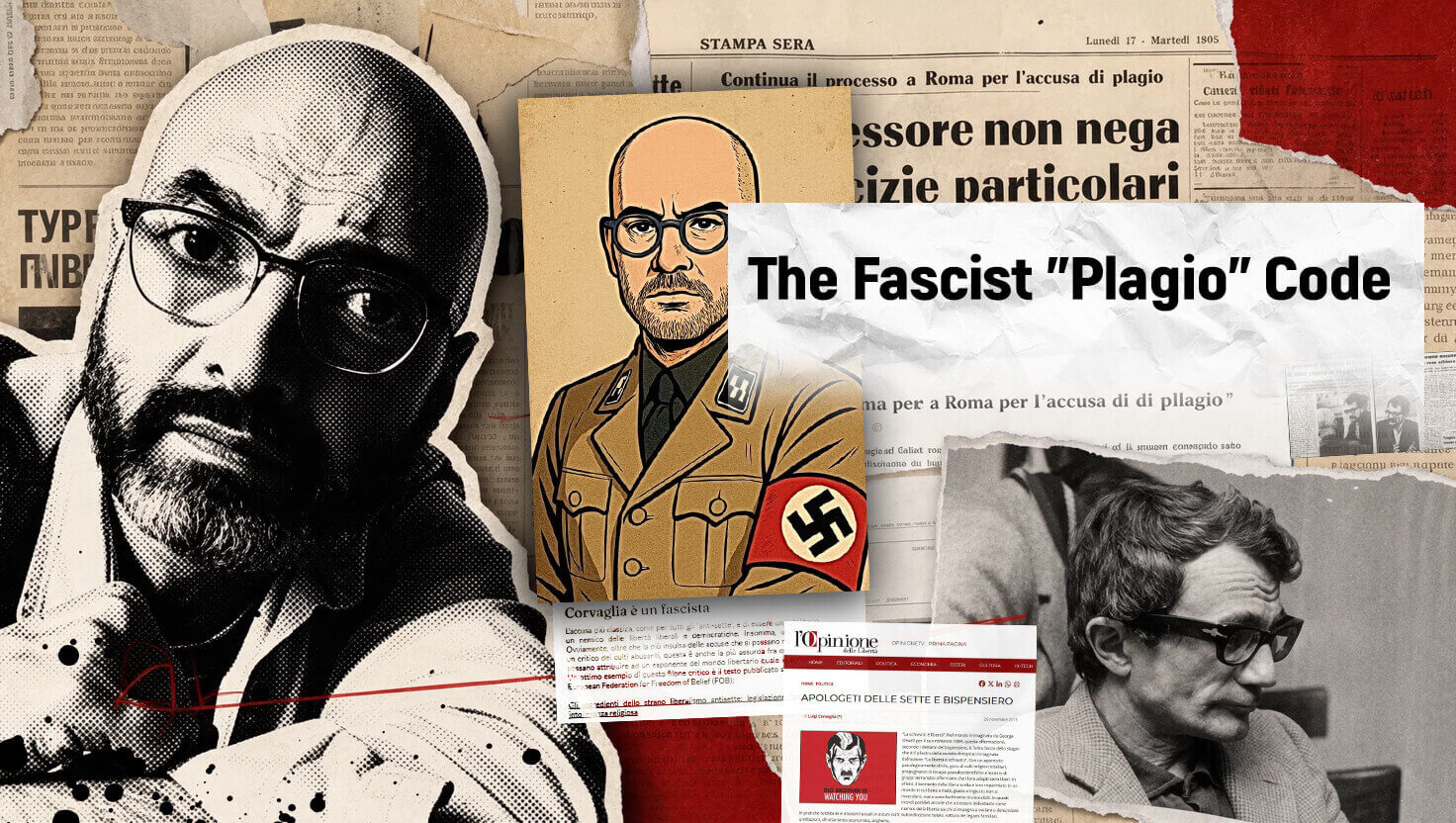
On July 14, 1968, a jury court in Rome sentenced philosopher, poet, and artist Aldo Braibanti to nine years in prison. No one had been killed, and no one had been kidnapped. Instead, there was a “crime” that, as the Italian state itself would later acknowledge, did not exist at all. Plagio means the complete subjugation of another person’s will. And the only conviction under this statute in half a century began because an Italian family could not accept their adult son’s choice.
The history of plagio is a textbook lesson in how an ‘elastic’ law is weaponized against dissent. Therefore, when certain “experts” once again demand a ban on “mind manipulation,” it is worth rereading that textbook.
The most persistent champion of the new law is Italian anticultist Luigi Corvaglia. He heads the Center for the Study of Psychological Abuse (CeSAP) and serves on the scientific committee of the European Federation of Centres of Research and Information on Cults and Sects (FECRIS). In this article, we examine what lies behind this campaign and why it poses a threat to democratic freedoms.
Nine Years for “Subjugating Another Person’s will”
Article 603 of the Italian Penal Code was in effect from 1930 to 1981. It stated: “Chiunque sottopone una persona al proprio potere, in modo da ridurla in totale stato di soggezione…” — “Anyone who subjects a person to their own will, so as to reduce that person in a total state of subjugation, is punished with imprisonment from five to fifteen years.” 1
Thus, proving financial gain or violence was not required; the “psychological domination” of one person over another was itself declared a crime.
Aldo Braibanti (1922–2014) was a former partisan, a prisoner of Nazi concentration camps. In his youth, he served on the Central Committee of the Italian Communist Party, later becoming a philosopher, poet, artist, and myrmecologist (a scientist who studies ants). In the small town of Castell’Arquato near Piacenza, he established a creative commune and laboratory — a space that brought together talented young artists and poets. The laboratory was built on the principles of free co-creation and the intersection of various art forms: ceramics, theater, and poetry. In the early 1960s, nineteen-year-old Giovanni Sanfratello, captivated by Braibanti’s ideas, became his friend, then his life partner, and moved with him to Rome.

On October 12, 1964, Giovanni’s father, a conservative and committed Fascist, filed a complaint against the philosopher with the Rome prosecutor’s office. He accused Braibanti of plagio, claiming that he had “zombified” his son and subjugated his will. There was no law punishing homosexuality in Italy, so plagio was the only way to turn a relationship the parents disapproved of into a criminal case. A month later, relatives forcibly removed Sanfratello from the commune and locked him in a psychiatric hospital in Verona. There, the young man was put through intensive “rehabilitation”: for fifteen months, he endured alternating sessions of electroshock therapy and insulin comas. 2
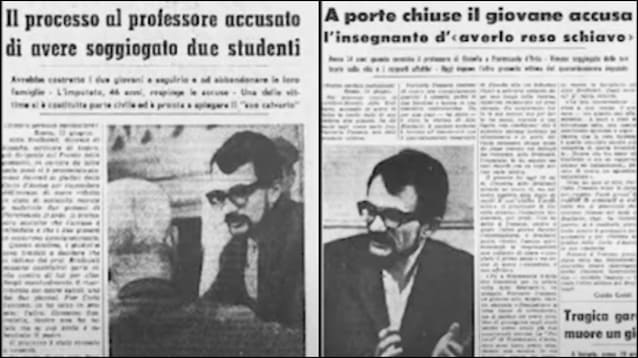
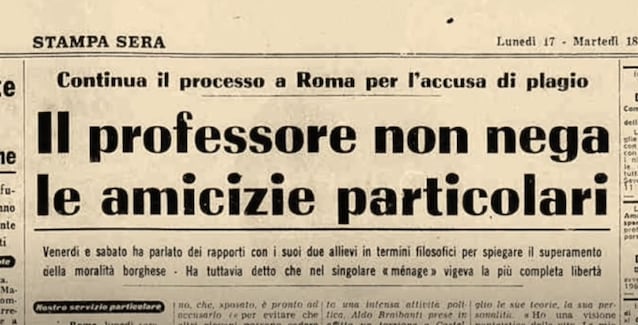
The “victim” himself (Giovanni Sanfratello) told the court that no one had subjugated him, but for some reason the judges refused to believe him. The trial dragged on for four years and ended with a nine-year prison sentence for Aldo Braibanti. On appeal, his term was reduced, with his partisan service taken into account. Ultimately, he spent about two years behind bars. Yet unlike the philosopher, no one ever prosecuted the family that had locked their own adult, independent son in a psychiatric facility against his will.
At the time, Pier Paolo Pasolini, Alberto Moravia, Elsa Morante, Umberto Eco, Dacia Maraini, and others stepped up to defend Braibanti. A young Marco Bellocchio (today one of Italy’s best-known film directors) was an active witness and participant in the trial. The only politician who dared to publicly defend the philosopher was Radical politician Marco Pannella. In 2022, director Gianni Amelio made a film “The Lord of the Ants” about this trial.
Notably, Aldo Braibanti remained the only person in Italian history ever convicted of plagio.
The Fascist Code
This provision first appeared in 1930 in the Rocco Code, a penal code named after Minister of Justice Alfredo Rocco. It was drafted and approved not by parliament, but by Benito Mussolini’s government; the Fascist dictatorship ruled the country by decrees. The code, however, outlived the regime, and Italy still uses it today. Plagio entered it as a crime distinct from slavery. The history of its origins is telling. As was customary even under the Fascists, the draft code was sent out to legal experts for review. Those reviews have been preserved and published. And even back then, they called Article 603 vague, including comments from the very participants involved in drafting the code, such as the bar associations and prosecutors of Naples and Rome, and the Naples Court of Appeal. 3 Alfredo Rocco dismissed the feedback and left the article as is.
At first, the article was practically a dead letter; the courts required proof of financial gain, as in cases of slave-trading. However, everything changed on May 26, 1961, when the Court of Cassation (the highest appellate instance) defined plagio as “establishing a psychological relationship of absolute subjugation” of the victim to the accused. Proof of financial gain was no longer necessary; “subjugation” alone was enough. The statute transformed into a weapon against “improper” attachments and beliefs. 4
Over half a century of existence, the statute created just a single precedent. On one hand, this is a total failure; on the other hand, the law did not need dozens of criminal cases — it was designed to keep society in fear. One verdict was enough to make all “weird” communes, circles, and preachers realize they could end up on trial at any moment. It was a threat directed at anyone deemed inconvenient.
The Burial and Ruling No. 96 of April 9, 1981
The second and final case involved charismatic priest Emilio Grasso. Parents accused him of plagio towards their children after the youth left their wealthy families to serve the poor. On October 2, 1978, a Rome investigative judge referred the matter to the Constitutional Court. On April 9, 1981, the Court (chaired by Leonetto Amadei, with reporting judge Edoardo Volterra) declared Article 603 unconstitutional. It violated Article 25 of the Constitution: “A criminal prohibition must be formulated precisely enough for a person to know in advance what exactly is forbidden.” 5
The key passage of the ruling reads verbatim:
“È estremamente difficile se non impossibile individuare sul piano pratico e distinguere a fini di conseguenze giuridiche – con riguardo ad ipotesi come quella in esame – l’attività psichica di persuasione da quella anch’essa psichica di suggestione. Non vi sono criteri sicuri per separare e qualificare l’una e l’altra attività e per accertare l’esatto confine fra esse.” 6
“It is extremely difficult, if not impossible, in practice — and for the purpose of legal consequences in cases like the one at hand — to identify and distinguish the psychological activity of persuasion from that of suggestion, which is also a psychological activity. There are no reliable criteria to separate and classify these two activities or to establish the exact boundary between them.”
The Court pointed out that “typical situations of psychological dependence” also include lovers, priests and believers, teachers and students, doctors and patients. Moreover, situations of “total subjugation” are unobservable in real life. That meant the law wasn’t punishing a method; it was punishing the result of persuasion — ideas that judges deem unacceptable.
Priest Grasso was acquitted. In 1982, for the same reason, a Catania court acquitted Eugenio Siragusa, the founder of a religious group that awaited contact with UFOs. He had been accused of plagio towards two American sponsors. 7
Psychoanalyst Sandro Gindro later added a touch of irony: had the Constitutional Court not repealed the old provision, both romantic love and the early stages of psychotherapy between a doctor and a patient would fall under it. After all, both begin with deep psychological attachment. The statute would end up punishing the very things it is meant to protect. 8
The “Legal Vacuum”
Following the repeal of the article, proponents of a ban adopted a favorite argument: since the provision was removed, a “legal vacuum” (vuoto normativo) had formed, and it needed to be filled with a new law. It is worth noting that these attempts keep returning with remarkable regularity. So far, none of them have become law.
In 1988, government ministers Rosa Russo Iervolino and Giuliano Vassalli drafted a bill. In 2004–2005, Undersecretary of Health Elisabetta Alberti Casellati proposed amendments on “psychological manipulation,” while Senator Renato Meduri of the National Alliance (a conservative party born from the post-Fascist movement) proposed a new Criminal Code Article 613-bis on “mind manipulation.” In 2012, the Friuli Venezia Giulia region passed a similar law: Law No. 11 of May 31, 2012, “on the support of personal rights and full intellectual, psychological, and moral freedom of the individual.” In 2025, two bills, A.S. 1496 and A.S. 1515, were submitted for discussion: a proposed Article 613-quater provided for three to eight years in prison, and no less than six years if the victim was under eighteen.
In the fall of 2025, the National Association of Magistrates (Italy’s association of judges and prosecutors) weighed in, with its criminal law committee issuing a negative assessment of both bills. 9
To see how this looked on paper, let’s examine the text of Meduri’s 2005 bill:
“Salvo che il fatto costituisca più grave reato, chiunque mediante tecniche di condizionamento della personalità o di suggestione praticate con mezzi materiali o psicologici, pone taluno in uno stato di soggezione continuativa tale da escludere o da limitare grandemente la libertà di autodeterminazione è punito con la reclusione da due a sei anni.” 10
“Unless the act constitutes a more serious offense, anyone who, through techniques of personality conditioning or suggestion practiced by material or psychological means, places a person in a state of continuous subjugation such as to exclude or greatly limit the freedom of self-determination, shall be punished with imprisonment from two to six years.”
However, the problem lay in the definition itself. “Suggestion techniques” are indistinguishable from preaching, advertising, psychotherapy, or even falling in love. Banning something that no one is even capable of identifying is the worst kind of lawmaking.
Academics weren’t the only ones opposing these legislative proposals. In 2005, the Commission of Evangelical Churches for Relations with the State (CCERS) expressed concern for religious freedom. And in April 2004, forty-seven sociologists and historians of religion, including Massimo Introvigne (current head of the Center for Studies on New Religions, CESNUR), Enzo Pace, Rodney Stark, David Bromley, and Karel Dobbelaere, wrote to President Ciampi, Prime Minister Berlusconi, and Speaker Fini: 11
“L’Italia – scrivono – è stata per anni riconosciuta come uno dei paesi del mondo più favorevoli alla libertà religiosa. Sembra che la situazione stia cambiando.” 12
“Italy,” they wrote, “has for years been recognized as one of the countries in the world most favorable to religious freedom. It seems the situation is changing.”
Luigi Corvaglia and the Architecture of “New Plagio”
Luigi Corvaglia is an anticultist, psychologist, and psychotherapist from Bari. For many years he worked as a psychologist in the municipal healthcare system, taught criminology and psychiatry at the University of Salento, wrote essays, published the book “Psychopathology of Freedom” (2000), and authored academic articles on persuasion models in totalitarian groups. He heads CeSAP (the Center for Psychological Abuse Studies, founded by psychologist Lorita Tinelli) and serves on the scientific committee of FECRIS (the European Federation of Centres of Research and Information on Cults and Sects). 13

Corvaglia viewed Italy’s 1981 repeal of plagio and the resulting loss of a legal tool to punish psychological enslavement to be a major loophole, so he proposed the introduction of a new criminal offense that would be clearly formulated and backed by forensic psychiatric evaluation. He began promoting this idea in articles, interviews, and conferences. Corvaglia began to speak “eloquently.” Yet his eloquence stumbles on the very first question: once again, how is a court supposed to distinguish “psychological dominance” from religious preaching, psychotherapy, or falling in love? Article 603 failed to answer that question over half a century, which is why it was repealed in 1981.
Let us examine Corvaglia’s arguments in his article “Apologeti delle sette e bispensiero” (L’Opinione, November 26, 2015) and analyze the text for manipulative techniques. 14
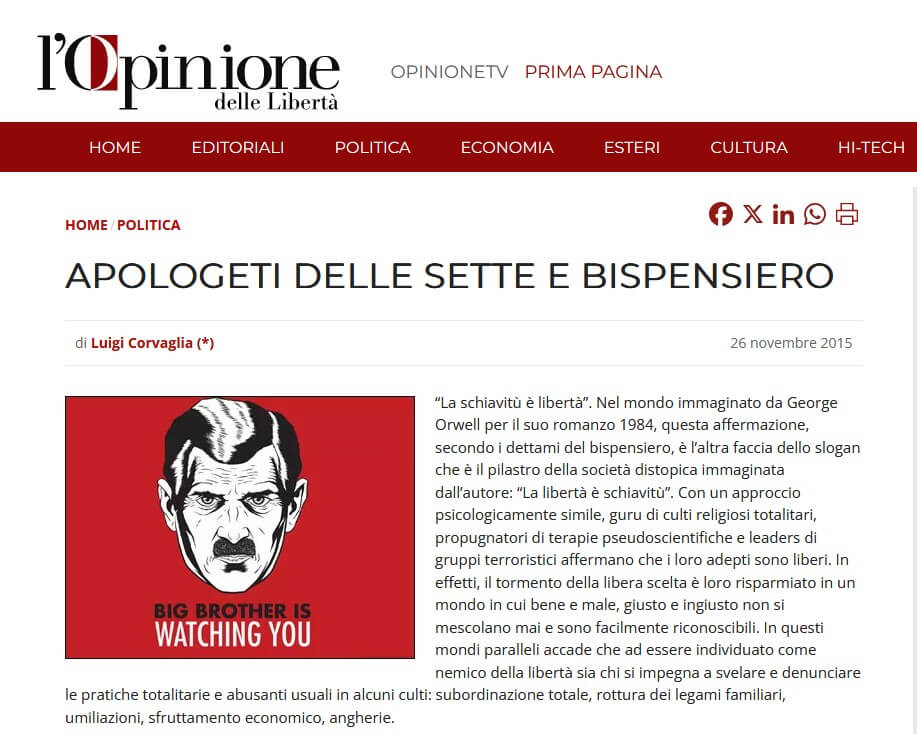
1. Orwell from the First Line
The very first thing the reader sees is a quote from the novel “1984”: “Slavery is freedom.”
The reader does not yet know what the article is about, but the mental framing is already set: next, they will be shown a world where all words are inverted. When certain “liberals” appear a paragraph later, they fit into this picture as characters from a dystopia. The debate hasn’t even begun, yet the opposing side has already been labeled as “doublethink.” At the end, the article closes with three slogans from the same novel: “Slavery is freedom,” “Ignorance is strength,” “War is peace.” Three quotes from a work of fiction in place of a conclusion.
2. Who is Corvaglia Arguing With? Only Corvaglia Knows
His opponents are referred to only as “self-styled ‘liberals'” (sedicenti “liberali”). Not a single full name is given. Not a single line that these people actually said is cited. Corvaglia retells their position himself, reducing it to a caricature, claiming that liberals believe “since a person joined a group voluntarily, everything that follows is legal.” His real opponents never wrote anything of the sort; they were talking about persecution for one’s beliefs and freedom of association, not giving a green light to all forms of abuse. The only document in the article, an invitation to a congress of the FOB association, is used not as an argument, but as a piece of evidence or mockery: “Look who they gathered with.” 15
3. Derision in Place of Refutation
The density of derogatory labels runs two to three per paragraph:
- “liberali alla vaccinara” — “cattle-style liberals” (an untranslatable play on words referencing the dish coda alla vaccinara, rooted in vacca, cow);
- “liberali in sedicesimo” — “one-sixteenth liberals”
- “il liberalismo l’ha studiato sul Bignami” — “studied liberalism from Bignami crib notes” (Bignami is a publisher of study summaries);
- “santoni vari” — “various false gurus”;
- “funzionari del ‘Ministero della Verità'” — “officials of the ‘Ministry of Truth’.” 16
Derision serves the purpose of refutation without actually being one. A side effect is poisoning the well: any future remark by an opponent is already labeled as “crib-note-derived.” Corvaglia teaches the reader in advance to laugh at opponents so that their subsequent words are met with distrust.
4. Vivid Imagery in Place of Facts
Throughout the article, the reader’s imagination is sustained by four vivid comparisons:
- “It is one thing to persuade a girl to come up to your apartment out of love, and another in order to rob her.” Yet deceiving someone to take their property is fraud—it’s already in the criminal code, a fact Corvaglia leaves out;
- “A thief at least disappears afterward, while a guru demands gratitude” — striking, but not a single real-world case is cited;
- Life in a group is “very similar to the movie The Truman Show” — here, a fictional film is used as an argument;
- Membership in a religious group is equated to female genital mutilation — the tactic of “applying a ready-made horror to a disputed case.”
5. Authorities Instead of Arguments
The article relies on three authorities: Salvemini, La Boétie, and anonymous “political scientists.” The quotes are real, but something doesn’t quite add up: they function as clichés at the end of a paragraph rather than actual analysis.
The quote from La Boétie, whom Corvaglia cites in his favor, actually works against him. La Boétie wrote that a tyrant is only as powerful as the submission people give them. His conclusion: “Resolve to serve no more, and you are free.” In other words, a person can break away from subjugation on their own. Yet Corvaglia’s entire article is built on the opposite premise: that a person supposedly cannot leave a cult. Corvaglia quotes La Boétie right up to that conclusion and passes over the conclusion itself in silence because it destroys his thesis. Add to that the “no one ever” tactic: “Nessuno ha mai interpretato queste parole come un avallo alla tirannia”—“No one has ever interpreted these words as an endorsement of tyranny” — an appeal to universal consensus without verification. 17
Whereas the “political scientists” remain completely anonymous: “political scientists acknowledge…” — which ones, where, in what work?
6. The Core Link: Comparing Cult Critics to Racists
Here is the climax of the article. Defending the right to “live one’s own way” is presented as based on the same logic that underpins the racism of “differences” (the doctrine of the French New Right). To quote verbatim: “There is not a trace of Salvemini or Rossi here. Instead, there is a lot from Tagieff and de Benoist.” No actual connection is shown — there is only a juxtaposition of words. The tactic is simple: associate your opponent with the most repulsive aspects of politics, and you won’t have to bother analyzing the arguments.
7. Real Facts Say the Opposite
The article’s central thesis:
Infatti, nonostante la proclamata libertà di uscire dalle organizzazioni settarie, la situazione che si viene a creare in un culto è molto simile a quella descritta dal film “The Truman Show” in cui al protagonista, che vive l’intera vita sotto le telecamere, è fatto credere che il mondo esterno sia ostile e minaccioso. In un culto, le persone sono indottrinate ad aver una reale fobia del mondo esterno e ciò elimina la possibilità di “scegliere” di abbandonare il gruppo. 18
“In fact, despite the proclaimed freedom to leave sectarian organizations, the situation that develops inside a cult is very similar to that described in the film ‘The Truman Show,’ where the protagonist, who lives his entire life under the gaze of cameras, is led to believe that the outside world is hostile and threatening. In a cult, people are indoctrinated with a genuine phobia of the outside world, which eliminates the possibility of ‘choosing’ to leave the group.”
First, the comparison to “The Truman Show” does not hold up. The fear instilled in the protagonist from birth ultimately did not stop him; in the end, he finds the painted door and leaves. To extend the comparison, the role of the “cult” in the movie is played not by captivity, but by the creator of the show, the man who decided for the protagonist that he knew what was best for him better than the protagonist himself did. And the author of the quote, Luigi Corvaglia, is the one standing in the creator’s shoes.
Second, the actual facts say the exact opposite. Sociologist Eileen Barker spent seven years studying the Unification Church (“Moonies”) and found that out of everyone who visited their center even once, fewer than one person in two hundred remained after two years. The American Psychological Association rejected the theory of “mind control” in 1987 as lacking scientific rigor. In 1990, a U.S. court (the Fishman case) barred such experts from the courtroom. The European Court of Human Rights noted in 2010: “There is no universally accepted scientific definition of ‘mind control.'” Finally, the word “sect” or “cult” is not defined in any law — people cannot be prosecuted on its basis.
The argument about “instilled phobia” was probably intended to allow courts to judge a person not for their actions, but for their mental state — for what an expert supposedly “saw” in their mind. But the law protects the door through which a person can freely walk out, not a diagnosis handed down by an outsider.
8. One Concession, and Even That Gets “Eaten Up”
At one point, Corvaglia agrees with his opponents: “Obviously, interfering in other people’s beliefs is unlawful.” Perhaps he needs this argument just to appear fair-minded? But immediately afterward comes the caveat: “However, persuasion aimed at gaining power over another person is unacceptable.” It sounds reasonable. The only question is: what counts as “power over another person”? Who will measure it, and with what? The article gives no answer. Yet that is the central point — it is this elastic criterion that Corvaglia wants written into criminal law. And it will be measured by whoever holds the power: an expert, a judge, or the state. Clever, isn’t it? 19
9. Victory Declared, Not Demonstrated
At the end, he declares: “What has been said allows us to deliver the final blow to doublethink.” But what kind of blow is that? Not a single name, not a single figure, not a single document from his opponents is in the article. Alongside it is merely a jab at the reader: “A minimal cognitive effort is enough to understand this.” And how are we supposed to read that: that whoever disagrees simply didn’t understand? Or maybe, whoever didn’t understand is an idiot? 20

Summing Up Corvaglia’s Article
To sum up, one may say that Corvaglia’s article reads like a master class in manipulation. Instead of an open discussion, it offers a circus. From the very outset, it stokes dystopian gloom, makes the audience feel dumb, substitutes imagery for arguments, and immediately slaps the “racist” label on anyone who disagrees.
The author’s main thesis is fundamentally unverifiable; it is structured in such a way that it automatically confirms itself. The whole point boils down to a simple premise: any “undesirable belief” is now equated with taking control of another person’s mind. And, of course, it will be up to appointed “experts” to decide where that line is drawn. The author campaigns so zealously for a law against manipulation that he himself vividly demonstrated in whose hands and exactly how this club will work.
The “Fascist Law”
The accusations leveled against Corvaglia were resounding. On November 29, 2015, the Board of Directors of the European Federation for Freedom of Belief (FOB) responded to him as follows:
“bollare movimenti religiosi minoritari in modo apertamente discriminatorio con l’utilizzo del termine ‘setta’ da un lato, e per reintrodurre nell’ordinamento italiano il ‘reato di plagio’ voluto dall’infame regime fascista spacciandolo come ‘reato di manipolazione mentale’ dall’altro, è precisamente il paradigma dell’intolleranza più manifesta” 21
“To brand minority religious movements in an openly discriminatory way with the word ‘cult’ on the one hand, and to introduce into the Italian legal order the ‘crime of plagio‘ favored by the inglorious Fascist regime under the guise of the ‘crime of mental manipulation’ on the other — this is precisely the paradigm of the most blatant intolerance.”
And in the same statement, sarcastically:
“leggere lezioni di pensiero liberale da parte di chi lotta per il ripristino di reati fascisti è un’esperienza tanto singolare che potrebbe condurre al sorriso” 22
“Reading lessons in liberalism from someone fighting to restore Fascist crimes is an experience so strange that it could bring a smile.”
Massimo Introvigne, head of CESNUR, traces the “pedigree” of this provision in his series of articles “Lavaggio del cervello all’italiana” (Brainwashing, Italian-Style). His argument against the new laws: “Satanic cults that practice rape and murder would only be pleased if they were convicted of plagio alone.” And in 2025, he added an economic argument as well: a law on “mind manipulation” “risks being strong against the weak and weak against the strong.” Wealthy defendants have lawyers and experts to challenge an elusive “psychological dependence.” The small and the unpopular will be crushed. 23
Back in 2010, the European Court of Human Rights settled this debate once and for all. Examining the case regarding the dissolution of the Moscow community of Jehovah’s Witnesses, Strasbourg pointed out that modern science simply has no generally accepted definition of what is called “mind control.” 24
However, reducing all criticism of the new law to a simple label of “Fascist legacy” would be superficial. True, the article on enslavement of the will originates from the penal code of Mussolini’s dark era, yet that very code remains in force in Italy today. The real blow to Corvaglia’s initiative comes from a fundamental principle of law and science — Karl Popper’s criterion of falsifiability, which the law’s critics themselves like to invoke:
“la tesi per cui è possibile compiere un’influenza indebita sul prossimo con tecniche non rilevabili è appunto non rilevabile e come tale non può essere confutata” 25
“The thesis that one can exert undue influence over another person using undetectable techniques is itself undetectable — and therefore irrefutable.”
The Italian human rights organization FOB summed up this debate accurately: it was precisely because of this illusory and unprovable nature that Aldo Braibanti was once sent to prison for nothing — and why the very article on enslavement of the will was ultimately struck from the penal code for good. 26
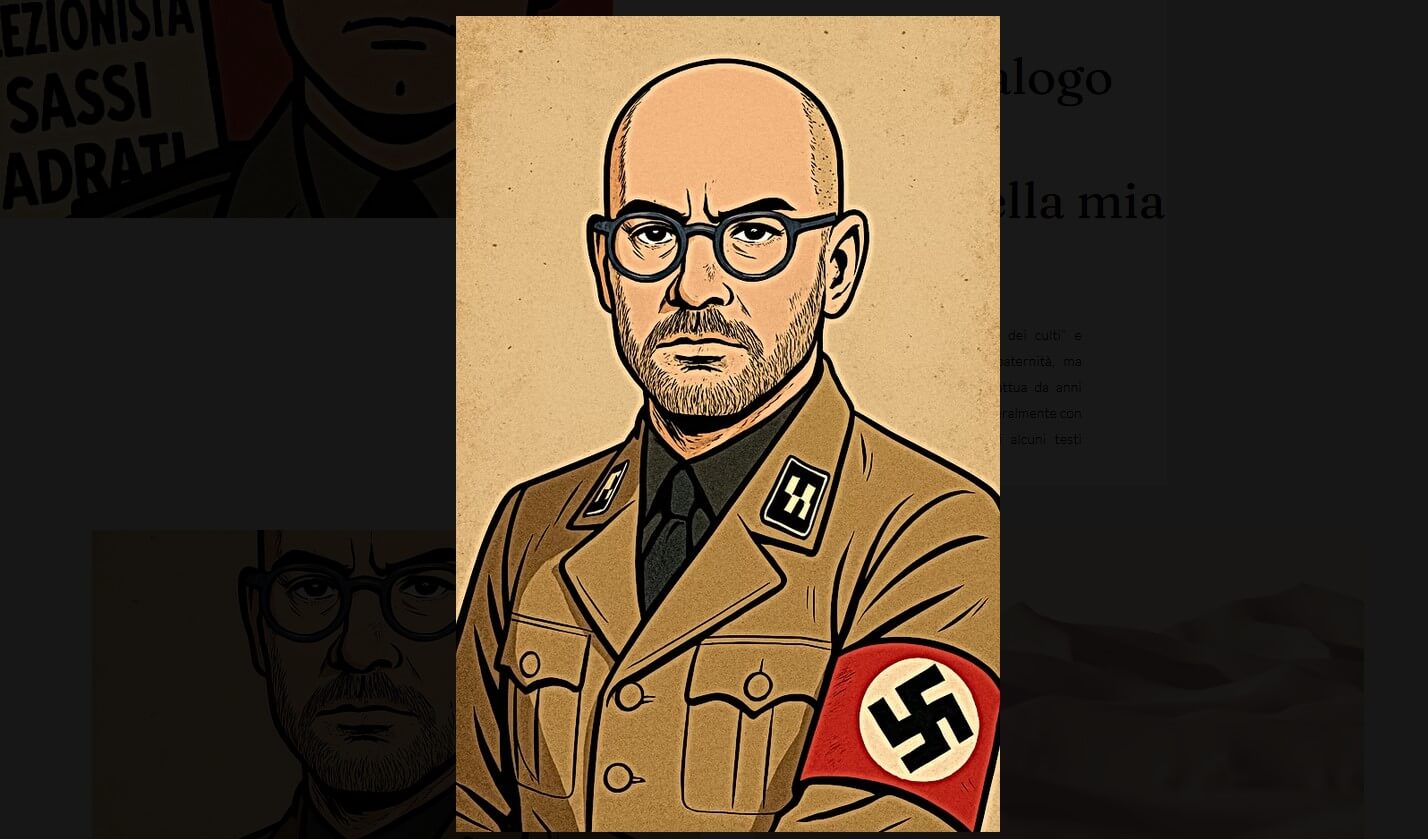
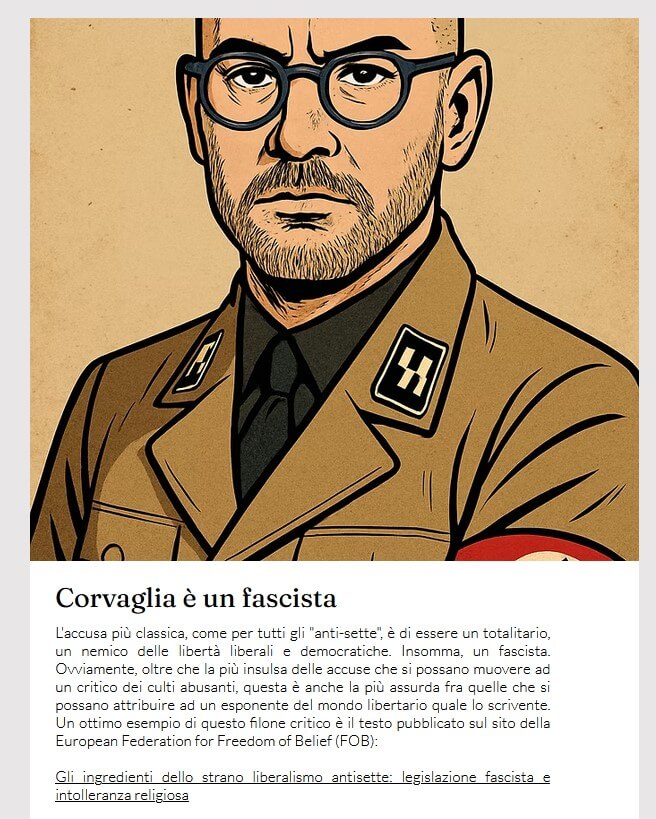
The Key Question: What Is at Risk for Democracy?
The entire essence of the scandalous 1968 Aldo Braibanti case with its anticult backdrop boiled down to this: conservative parents plus an eccentric gay thinker, multiplied by a vague criminal statute, equaled nine years in prison. And it must be said that people have not changed all that much since then — except that radical anticult groups have grown stronger, ready to stigmatize undesirables using yet another vague provision.
At the same time, they are clearly being disingenuous when they speak of a “legislative vacuum”: real crimes have long been successfully prosecuted under existing laws. The Italian justice system already has everything it needs in its arsenal: fraud, physical violence, stalking (Art. 612-bis), reduction to slavery (Art. 600), and exploiting incapacitated persons for financial gain (Art. 643).
Recall the high-profile precedents: TV scammer Wanna Marchi, who profited from “miracle cures,” was sentenced to nearly ten years behind bars, while the notorious “Mamma Ebe,” who stripped helpless elderly people of their property, received six years. And the justice system handled both cases perfectly well without any vague concepts like “brainwashing.” Classic statutes on fraud and organized criminal groups proved more than enough. 27
The anti-slavery law works in exactly the same way, used to prosecute Nigerian madams who keep young women in bondage through voodoo rituals. The law punishes neither an ancient faith nor magical rites; it punishes the use of psychological control to commit a specific crime. Here lies the fundamental dividing line for a free society: the justice system must judge specific harm inflicted and criminal intent, not the content of someone’s beliefs. 28
Freedom of thought is the most defenseless of all civil liberties. Until it is taken away, people rarely think about it. Yet it encompasses a person’s sacred right to hold “strange” views and make irrational decisions. As soon as the state sets out to punish “psychological subjugation,” it effectively claims a monopoly over controlling citizens’ thoughts. Establishing special “anti-sect” (anticult) police units and lists of “dangerous cults” amounts to branding people without trial or investigation.
True democracy does not protect individuals by deciding what they should believe “for their own good.” Its strength lies in defending freedoms, legitimate human rights, and a law that is crystal clear, demands real evidence, and remains completely blind to how popular or eccentric someone’s beliefs may be.
Conclusions
When the law punishes not a concrete act, but a “state of subjugation,” it inevitably puts the individual, their thoughts, and their choices on trial. The half-century history of Italy’s plagio produced only a single conviction, yet it exposed the entire mechanism where a vague allegation of “subjugating another person’s will” was enough for a conservative family to trample on the freedom of adults.
Rewriting this provision “better” is impossible in principle. The Constitutional Court repealed it not because of clumsy wording, but because the phenomenon of “complete enslavement of the mind” cannot be scientifically proven. Any attempt to revive this law — whether by banning “psychological dependence” or assessing the “purpose of persuasion” — asks the justice system to do the impossible: get inside a person’s head and pass judgment on their beliefs. It is precisely against this incompatibility with the Constitution that all such bills have shattered for the past forty years.
In our view, the danger lies here. Anticult activists like Corvaglia may sincerely sympathize with grieving families, but their logic is fatal to the rule of law, as it is impossible to evaluate the “purpose of persuasion” without evaluating the belief itself. Ultimately, a cudgel prepared “against destructive cults” will inevitably end up striking undesirable partners, psychotherapists, and independent thinkers — just as we see happening in Russia. And a situation in which only the expert lobbying for the law is capable of “recognizing” the crime smacks either of Alexander Dvorkin — the central figure of the anticult network coordinating it from Russia — or of a blatant conflict of interest, rather than justice.
The true test for any such bill lies not in debates over the provision’s “Fascist past,” but in a freedom test: can a judge hand down a verdict without evaluating a person’s faith and views? If not, then we are looking at the same medieval plagio, just under a new sign.
The main threat is that an elastic law always strikes the weak. Those with financial means will be able to fight back with lawyers, while the remaining vulnerable minorities and mere eccentrics will be crushed by the repressive steamroller. Meanwhile, real crimes — whether fraud, violence, or extortion — are already effectively punished under the current penal code without any mystique about “brainwashing.” Forbidding a person to believe means forbidding them from making their own choices. Democracy must punish actual harm, but it has no right to allow prosecutors to dictate what others should believe.
Sources:
1. Art. 603 Codice penale (Italian Penal Code) (as in force prior to Constitutional Court Ruling No. 96/1981; now repealed). Text of the article: Brocardi.it — https://www.brocardi.it/codice-penale/libro-secondo/titolo-xii/capo-iii/sezione-i/art603.html.
2. Chronology of the complaint (October 12, 1964), forced hospitalization, and verdicts: Fanpage.it, “La vera storia del signore delle formiche: il processo ad Aldo Braibanti e la condanna per plagio” (The True Story of the Lord of the Ants: The Trial of Aldo Braibanti and the Conviction for Plagio) — https://www.fanpage.it/attualita/la-vera-storia-del-signore-della-formiche-il-processo-ad-aldo-braibanti-e-la-condanna-per-plagio/.
3. History of the code’s adoption and objections to Art. 603: “Plagio (ordinamento penale italiano)” (Plagio [Italian Criminal Law]), Italian Wikipedia; see also: Dossier GI0278 of the Research Service of the Italian Chamber of Deputies, January 23, 2008 (historical analysis of the provision) — https://documenti.camera.it/leg15/dossier/testi/GI0278.htm.
4. Italian Court of Cassation, Section I, ruling of May 26, 1961, in the Greco case; wording quoted from: Dossier GI0278, section “Il reato di plagio nel codice penale del 1930” (The Crime of Plagio in the 1930 Penal Code) — https://documenti.camera.it/leg15/dossier/testi/GI0278.htm; see also: Italian Wikipedia — https://it.wikipedia.org/wiki/Plagio_(ordinamento_penale_italiano).
5. The Grasso case and Ruling No. 96/1981: Italian Wikipedia — https://it.wikipedia.org/wiki/Plagio_(ordinamento_penale_italiano); Dossier GI0278 — https://documenti.camera.it/leg15/dossier/testi/GI0278.htm; official text of the ruling on the Constitutional Court website (ECLI:IT:COST:1981:96) — https://www.cortecostituzionale.it/actionSchedaPronuncia.do?param_ecli=ECLI:IT:COST:1981:96.
6. Corte costituzionale della Repubblica italiana, sentenza n. 96 del 9 aprile 1981 (Constitutional Court of the Italian Republic, Ruling No. 96 of April 9, 1981) (ECLI:IT:COST:1981:96) — https://www.cortecostituzionale.it/actionSchedaPronuncia.do?param_ecli=ECLI:IT:COST:1981:96. The passage is also quoted verbatim in the opinion of the Commission on Criminal Law and Procedure of the National Association of Magistrates (2025) — https://www.associazionemagistrati.it/doc/4977/parere-sul-disegno-di-legge-in-materia-di-introduzione-del-reato-di-manipolazione-mentale.htm.
7. The Siragusa case (1978 arrest, 1982 Catania acquittal): M. Introvigne, “Lavaggio del cervello all’italiana” (Brainwashing, Italian-Style), Part 5, freedomofbelief.net — https://freedomofbelief.net/it/node/545.
8. S. Gindro, “L’oro della psicoanalisi” (The Gold of Psychoanalysis); summary of his position via: Italian Wikipedia — https://it.wikipedia.org/wiki/Plagio_(ordinamento_penale_italiano).
9. 1988 and 2005 bills (A.S. 800 by Sen. Meduri; approved by the Senate Justice Committee on March 4, 2005, never finally enacted): Italian Wikipedia — https://it.wikipedia.org/wiki/Plagio_(ordinamento_penale_italiano); Dossier GI0278 — https://documenti.camera.it/leg15/dossier/testi/GI0278.htm; Friuli-Venezia Giulia Regional Law No. 11 of May 31, 2012: Regional Council report — https://www.consiglio.regione.fvg.it/cms/export/sites/consiglio/istituzione/allegati/Rapporto_legislazione_2012.pdf; 2025 bills (A.S. 1496 of May 22, 2025; A.S. 1515 of June 4, 2025) and opinion of the Commission on Criminal Law and Procedure of the National Association of Magistrates (chaired by C. Valori): https://www.associazionemagistrati.it/doc/4977/parere-sul-disegno-di-legge-in-materia-di-introduzione-del-reato-di-manipolazione-mentale.htm.
10. Text of Art. 613-bis from Sen. Meduri’s bill (14th Legislature); quoted via: Italian Wikipedia — https://it.wikipedia.org/wiki/Plagio_(ordinamento_penale_italiano); legislative history of the bill (A.S. 800, later A.C. 3225): Dossier GI0278 — https://documenti.camera.it/leg15/dossier/testi/GI0278.htm.
11. Open letter of 47 scholars (April 2004): CESNUR archive — https://www.cesnur.org/2004/manip_lettera.htm; Il Velino news agency dispatch of April 6, 2004 — https://www.cesnur.org/2004/manip_velino.htm; on CEERS’s concern (motion of May 30, 2005): Italian Wikipedia — https://it.wikipedia.org/wiki/Plagio_(ordinamento_penale_italiano).
12. Quoted from: E. Vinci, “Torna il plagio, è polemica” (Plagio Returns, Sparking Controversy), La Repubblica, June 17, 2005 (CESNUR archive) — https://www.cesnur.org/2005/brainwash_04.htm.
13. Roles in CeSAP and FECRIS: author byline under Corvaglia’s article (L’Opinione, November 26, 2015) — https://opinione.it/politica/2015/11/26/corvaglia_politica-26-11; FECRIS’s statuses with the Council of Europe and the U.N. are listed in his own reply to FOB of December 1, 2015 — https://favisonlus.wordpress.com/2015/12/01/apologeti-delle-sette-e-bispensiero-risposta-de-dott-luigi-corvaglia-alla-replica-del-fob-european-freedom-of-belief/; on CeSAP and his books: luigicorvaglia.com — https://www.luigicorvaglia.com/post/malelingue-catalogo-tematico-della-diffamazione-della-mia-persona.
14. L. Corvaglia, “Apologeti delle sette e bispensiero” (Cult Apologists and Doublethink), L’Opinione, November 26, 2015 — https://opinione.it/politica/2015/11/26/corvaglia_politica-26-11.
15. Ibid.: L. Corvaglia, L’Opinione, November 26, 2015 — https://opinione.it/politica/2015/11/26/corvaglia_politica-26-11.
16. Ibid.: L. Corvaglia, L’Opinione, November 26, 2015 — https://opinione.it/politica/2015/11/26/corvaglia_politica-26-11.
17. Quoted in Corvaglia’s article (L’Opinione, November 26, 2015 — https://opinione.it/politica/2015/11/26/corvaglia_politica-26-11); original: É. de La Boétie, “Discours de la servitude volontaire” (Discourse on Voluntary Servitude) (c. 1576–1578).
18. Ibid.: L. Corvaglia, “Apologeti delle sette e bispensiero,” L’Opinione, November 26, 2015 — https://opinione.it/politica/2015/11/26/corvaglia_politica-26-11.
19. Ibid.: L. Corvaglia, L’Opinione, November 26, 2015 — https://opinione.it/politica/2015/11/26/corvaglia_politica-26-11.
20. Ibid.: L. Corvaglia, L’Opinione, November 26, 2015 — https://opinione.it/politica/2015/11/26/corvaglia_politica-26-11.
21. Consiglio Direttivo FOB (FOB Board of Directors), “In risposta alle singolari affermazioni del dr. Luigi Corvaglia” (In Response to the Singular Statements of Dr. Luigi Corvaglia), freedomofbelief.net, November 29, 2015 — https://freedomofbelief.net/it/node/66.
22. Ibid.: Consiglio Direttivo FOB, November 29, 2015 — https://freedomofbelief.net/it/node/66.
23. First quote: M. Introvigne, quoted in E. Vinci, La Repubblica, June 17, 2005 (CESNUR archive) — https://www.cesnur.org/2005/brainwash_04.htm. Second: M. Introvigne, “Manipolazione mentale: perché introdurre un nuovo reato è un errore” (Mind Manipulation: Why Introducing a New Crime Is a Mistake), Centro Studi Livatino, 2025 (translated from Italian) — https://www.centrostudilivatino.it/manipolazione-mentale-perche-introdurre-un-nuovo-reato-e-un-errore/.
24. European Court of Human Rights, Jehovah’s Witnesses of Moscow and Others v. Russia, judgment of June 10, 2010, § 129; cited via: M. Introvigne, Centro Studi Livatino, 2025 — https://www.centrostudilivatino.it/manipolazione-mentale-perche-introdurre-un-nuovo-reato-e-un-errore/; also cited in the 2025 opinion of the National Association of Magistrates — https://www.associazionemagistrati.it/doc/4977/parere-sul-disegno-di-legge-in-materia-di-introduzione-del-reato-di-manipolazione-mentale.htm.
25. Consiglio Direttivo FOB, November 29, 2015 — https://freedomofbelief.net/it/node/66.
26. Ibid.: Consiglio Direttivo FOB, November 29, 2015 — https://freedomofbelief.net/it/node/66.
27. Convictions of Wanna Marchi (9 years and 6 months) and “Mamma Ebe” (6 years) for fraud and criminal association as an argument against creating a new offense: M. Introvigne, Centro Studi Livatino, 2025 — https://www.centrostudilivatino.it/manipolazione-mentale-perche-introdurre-un-nuovo-reato-e-un-errore/.
28. Case law under Art. 600 (“Nigerian madams” cases, the Mauro Cioni case, and Court of Cassation ruling of February 6, 2021): M. Introvigne, freedomofbelief.net — https://freedomofbelief.net/it/node/545.
29. https://www.luigicorvaglia.com/en/projects-8