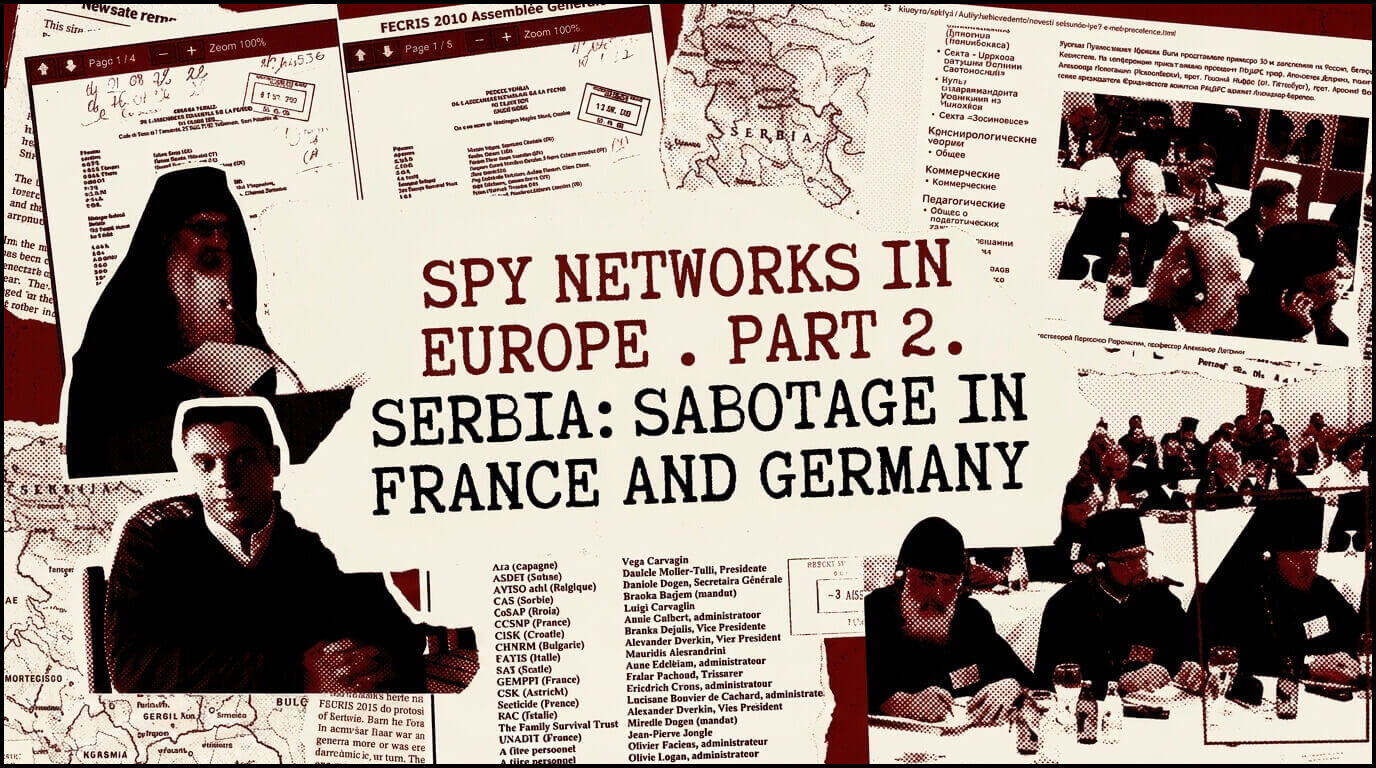
In the previous part of our investigation, “Spy Networks in Europe Under the Guise of Fighting “Cults.” Part 1. France,” we exposed the close, long-standing connections between French anticult organizations and a number of influential French politicians (including Jacques Myard, Rudy Salles, Georges Fenech, Thierry Mariani, and others). The collaboration among this group went beyond just fighting “cults” and “sects”; it also actively promoted an ideological agenda beneficial to Russian interests, both within France and across Europe as a whole. These individuals received funding from Russian sources and publicly supported the illegal annexation of Crimea.
Particular attention was paid to the activities of an underground criminal network of hitmen, the trial for which is still ongoing. The organizer of this underground network turned out to be a former French intelligence officer who headed the department for combating “sects and cults” in France. His unit closely collaborated and supplied materials and lists of undesirable persons to both French anticult structures (MIVILUDES, CCMM, UNADFI, FECRIS) and the aforementioned group of French politicians involved in anticult activities and pushing a pro-Russian agenda.
Continuing our study of the spy and hybrid networks operating in Europe under the cover of combating “cults and sects,” we turned our attention to another aspect of this well-established system. This time, we are looking at sabotage operations against France and Germany that took place in 2025, carried out by a Serbian group closely linked to Russian intelligence services – a fact confirmed by Serbian court records. Once again, anticultists – this time from Serbia – turned out to be the key intermediaries and organizers between the perpetrators and their clients.
This event came to light through materials published by Forum 18, a recognized independent human rights organization specializing in monitoring freedom of thought, conscience, and belief. 1 Forum 18 obtained and analyzed Serbian court rulings stating that Russian intelligence sponsored attacks on Jewish and Muslim places of worship in France in 2025. In the study published by this platform, we – the team of independent journalists at actfiles.org – were drawn to the mention of several names (see below). Yet while most media outlets referred to these individuals only as influential figures in the Serbian Orthodox Church, we happened to discover another side of their lives. Since the topic of the Serbian anticult movement is not new to us,* the names mentioned in this tangled spy story with a Russian trail emerged not merely as members of the Church clergy, but as long-time agents of an international anticult network run from Russia by the RACIRS organization, which operates in direct coordination with the FSB. This explained quite a lot. But first things first.
*Previously, the actfiles.org portal published a three-part investigation covering the decade-long period of the Balkan wars in the 1990s and the role played by Serbian anticultists in those conflicts. We invite you to read the following articles:
- “Künneth’s Legacy in the Bosnian War. Part 1”
- “Anticult Trail in the Yugoslav Wars. Part 2: Symphony of Church and State”
- “War in the Minds: Why Reconciliation in the Post-Yugoslav Space Remains Elusive. Part 3”
The Precedent for the Investigation: Acts of Vandalism in France and Germany; Verdicts of the Serbian Court in Smederevo
In December 2025, a Serbian court handed down verdicts that exposed one of the most cynical operations to destabilize Europe. Three Serbian citizens pleaded guilty to participating in a series of desecrations of synagogues and mosques in Paris and its suburbs. Court documents confirm that Russian intelligence was behind these acts, sponsoring and directing the group to incite religious and ethnic hatred between the Jewish and Muslim communities of France and Germany.
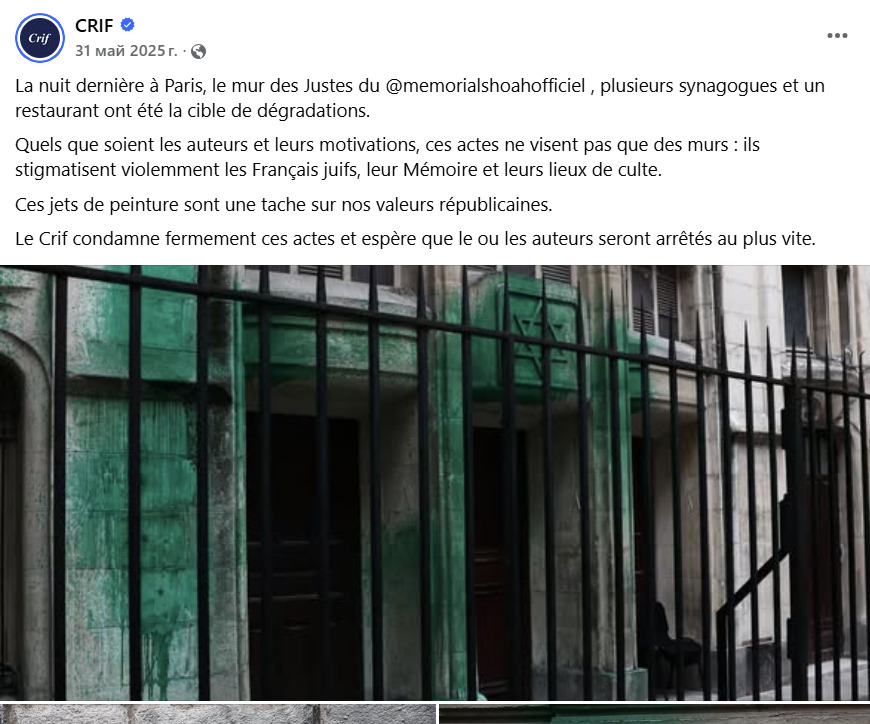
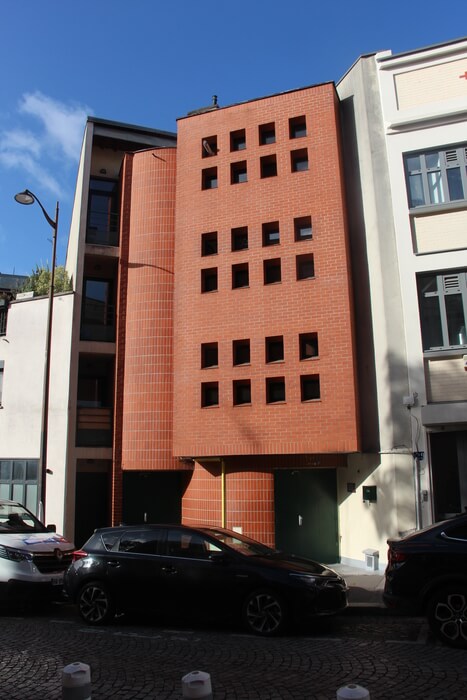
On the night of May 30-31, 2025, during the Jewish Sabbath, unidentified individuals splashed green paint across the facades of three Parisian synagogues: Grande Synagogue des Tournelles, Synagogue Agoudas Hakehilos, and Synagogue de Belleville. The green color, traditionally associated with Islam, was not chosen by chance. That same night, the Holocaust Memorial and a Jewish restaurant in the historic Le Marais district were also splashed with paint. As it turned out, the date of the attack was not random either. It was chosen to coincide with the Champions League final 2 because “a large number of people were expected on the streets” of Paris, aiming to achieve the maximum effect of crowd involvement and provocation.
The Representative Council of Jewish Institutions in France (CRIF) strongly condemned the attacks:
“Whoever the perpetrators may be and whatever their motives, these acts do not just target walls: they violently stigmatize French Jews, their Memory, and their places of worship.”
Four months later, on the night of September 8-9, 2025, the same group launched a mirror attack targeting Muslim sites. Severed pig heads appeared at the entrances of nine mosques in Paris and its suburbs (including the Anwar El-Madina mosque in Paris, as well as mosques in Malakoff, Montreuil, Montrouge, and Gentilly). In Islam, pigs are considered impure animals, so the act was designed to cause maximum offense to believers.
A representative of the Anwar El-Madina mosque was deeply shaken by the incident. He told BFM: “Every time an event like this occurs, the faithful wonder if they are truly safe when they come to pray.” 3
Thus, the exact same group first committed acts of vandalism against Jewish targets using green paint – a color traditionally associated with Islam – and then launched a mirror attack on Muslim shrines, leaving severed pig heads, which are deeply offensive to Muslims. The objective was obvious: to provoke religious and intercommunal hostility, heighten tensions between France’s Jewish and Muslim communities, and, more broadly, destabilize the country.
Serbian court documents reviewed by independent religious freedom monitors (specifically, Forum 18 1) reveal the following: the orders, instructions, and funding came from “the intelligence structures of the Russian Federation.” The perpetrators had their travel and lodging expenses covered and were promised €1,000 each for the spring attacks (targeting three synagogues) and €1,500 each for the September attacks (targeting nine mosques). They were required to take photographs of the results as proof.
Notably, the pig heads left outside the mosques were marked with the names of French politicians and the date “September 10” – the day mass protests against austerity measures had been announced, as reported by Balkan Insight (BIRN). This was apparently intended to amplify the provocations and incite public outcry 4, as well as spark massive public backlash and political scandal. Writing the names of French politicians ensured that the act would not remain “mere vandalism,” but would instead escalate into a political provocation aimed at the government. Additionally, it was an attempt to further inflame resentment among both Muslims and Jews, directing it not only at one another, but also at the French government, framing it as incapable of protecting its citizens. Overall, the political context aimed to deepen polarization across French society as a whole.
The Serbian group is also suspected of plastering between 600 and 700 stickers across the 18th arrondissement of Paris, an area home to a large Muslim community (including Turkish and North African populations). These stickers referenced the mass murder of Orthodox Armenians by Ottoman Turks during the First World War. 4 They featured a flower as a symbol and the text “I remember and demand” (“pamtim i zahtevam”) in English and Armenian. 2
As we can see, interethnic and interreligious hatred was artificially provoked between the Muslim and Jewish communities, as well as between the Muslim and Orthodox Christian communities in France. Both cases follow the exact same pattern: exploiting historical and religious pain points to pit the Islamic and non-Islamic worlds against each other.
Thus, Gajić’s Serbian group operated as an instrument of large-scale geopolitical provocation. For a relatively small, one-time payout, each action pursued multiple global and long-term objectives: dividing society, heightening overall tensions, and diverting the attention of European intelligence agencies – all funded by structures of the Russian intelligence service.
“Orders, instructions and money for actions were given to the group by ‘structures of the intelligence service of the Russian Federation’. The verdicts do not specify which Russian intelligence agency sponsored the attacks or identify the members of the Russian intelligence service who organised this group.” 1
Summarizing these events, the emerging overall picture is quite alarming. In recent years, we’ve seen artificial instigation of provocations designed to clash the Islamic and non-Islamic worlds across various countries, especially those where anticult players and their protégés have gained significant influence in the upper echelons of power.
The most prominent example of such a country is Russia, which is unsurprising given that the funding and orders for the Serbian group came from Russian intelligence services, and the attacks were “directly approved” by the Russian Presidential Administration (see below). In Russia today, key political and state figures in the Russian president’s inner circle are directly involved in anticult activities, serving as mouthpieces for the anticult ideological agenda in the country’s information space. Previously, the actfiles.org portal published an investigative piece on the so-called “Diveyevo Brotherhood” (https://actfiles.org/diveyevo-order-control-center-of-global-anticultism/) – a secret order ruling Russia – and the prerequisites (https://actfiles.org/victims-of-anticultism-the-silantyev-list/) for an impending global conflict: a civilizational war (https://actfiles.org/at-the-threshold-of-a-civilizational-war/) between the Islamic and non-Islamic worlds. But let us return to the sabotage acts committed by the Serbian group.
The provocations orchestrated by the Serbian group also extended to Germany. Sabotage operations in the German capital of Berlin occurred in July 2025, in the period between the spring and autumn acts of vandalism and desecration of places of worship in France.
On July 31, 2025, five plastic skeletons set in concrete inside plastic buckets appeared near the Brandenburg Gate in Berlin, adjacent to the Holocaust Memorial. Each bore a provocative inscription in German reading, “Warte immer noch auf meine Rente. Danke, Merz” (Still waiting for my pension. Thanks, Merz), addressed to Chancellor Friedrich Merz.
According to the court’s assessment, this installation aimed to destabilize the ethnic and political situation in Germany, representing another link in the chain of operations carried out by the Serbian group and sponsored by Russian intelligence.
The group’s actions were classified by the Serbian court as aimed at “inciting religious and ethnic intolerance, as well as destabilizing the situation in France and Germany.” 1 French intelligence services (according to the Paris-based publication Mediapart 5) obtained internal Kremlin documents confirming that the Russian Presidential Administration “directly approved” the desecration of Jewish sites in May 2025. As reported in December 2025 by Mediapart, which reviewed French intelligence files, Russian authorities deliberately sought to escalate tensions between the two communities, exploiting sensitive topics to sow division and weaken national solidarity in France.
Intermediaries Between the Serbian Group and Russian Intelligence: What Does the Serbian anticult Cell Have to Do with It?
The group that carried out these attacks consisted of three Serbs: Aleksandar Savić, Filip Petrović, and Nemanja Ćevap from the town of Velika Plana. In early June 2025, they were detained in Antibes while attempting to leave France. Serbian authorities later arrested eight more suspects.
On December 22-24, 2025, the High Court in Smederevo found all three guilty of espionage, incitement to racial discrimination, and criminal conspiracy. The other eight suspects are not in custody. The verdicts were first reported by Radio Free Europe. 2
This Serbian group of at least 11 members was led by two individuals: one was identified by the moniker “Hunter” (Serbian: Hanter), while the other, referred to as M.G., was likely a Serbian citizen. Over time, M.G.’s full name was revealed.
In March 2026, Balkan Insight (BIRN) – the leading Balkan investigative outlet – established that the alleged organizer and coordinator of the group, previously identified as M.G., was 29-year-old Momčilo Gajić (also known as Kaluđer / “The Monk”). BIRN managed to identify him and locate him in Moscow, where he had integrated into the local Serbian Orthodox community. 4 Media outlets later reported that Moscow had granted asylum to the leader of the Serbian group suspected in the Paris and Berlin incidents. He was located at the Church of Saints Peter and Paul, the Representation of the Serbian Orthodox Church in Moscow. We will return to this Serbian church community in Moscow later.
Jumping ahead, it is worth noting that he is far from the first exposed agent of Russian ideological and anticult circles to flee to Russia. In Latvia, a similar story involves Andrejs Mamikins (Andrey Mamykin), who continues to engage in active propaganda activities while living in Russia. In 2018, he opened the FECRIS anticult conference in Riga, the capital of Latvia, which brought together fighters against “cult and sect” from various countries, including Serbia, Russia, Italy, France, and the United States. Andrejs Mamikins was a member of the Latvian Russian Union political party, alongside other key figures of the Latvian anticult cell, which is the Latvian branch of FECRIS. Mamikins is currently wanted internationally for justifying crimes against humanity committed by Russia in Ukraine and is hiding from justice in Russia. There, he continues to actively participate in media activities, including those directed against Latvia’s interests, and runs his own YouTube channel. More detailed information about him can be found in our previous article on actfiles.org, “Russian Anticult Trail in Latvia. Part 1“.
Another example of a person deeply integrated into anticult activities – or, simply put, the “fight against sects” – who ended up in Moscow in 2013 6 is Pavel Broyde, a Ukrainian anticultist. The true aims of his activities, conducted under the guise of “combating totalitarian sects,” became clear after the release of leaked emails from Vladislav Surkov’s hacked inbox. 7
The destructive anti-Ukrainian activities of Pavel Broyde and his close cooperation with Alexander Dvorkin were previously detailed in the article on actfiles.org, “Europe, Open Your Eyes if You Don’t Want War“.
But let us return to the Serbian group that carried out the sabotage in Europe and its organizers, specifically the individual referred to as M.G., identified as Momčilo Gajić, who currently resides in Russia.
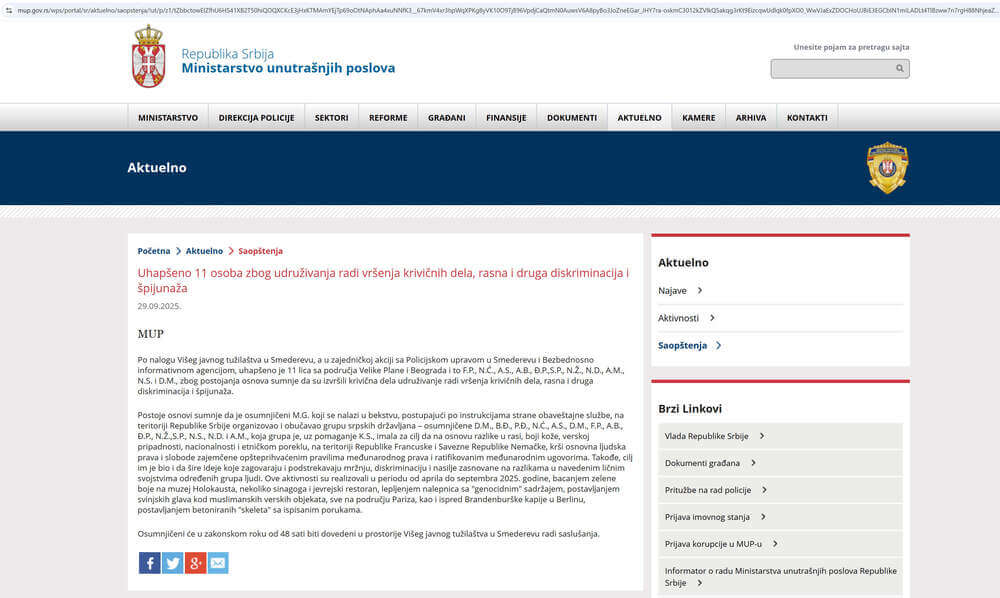
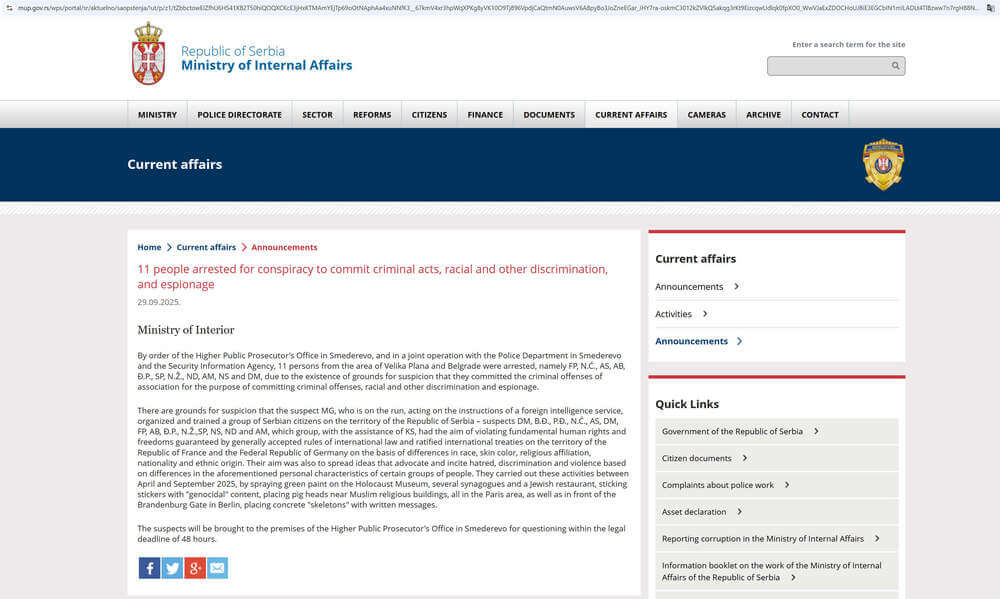
An official statement from the Ministry of Internal Affairs of the Republic of Serbia (MUP) dated September 29, 2025, states the following 8:
“There are grounds for suspicion that the suspect M.G., who is currently on the run, acting on the instructions of a foreign intelligence service, organized and trained a group of Serbian citizens on the territory of the Republic of Serbia – specifically suspects D.M., B.Đ., P.Đ., N.Ć., A.S., D.M., F.P., A.B., Đ.P., N.Ž., S.P., N.S., N.D. and A.M. This group, with the assistance of K.S., aimed to violate fundamental human rights and freedoms guaranteed by generally accepted rules of international law and ratified international treaties on the territory of the Republic of France and the Federal Republic of Germany, based on differences in race, skin color, religious affiliation, nationality, and ethnic origin. Furthermore, their goal was to spread ideas that advocate and incite hatred, discrimination, and violence based on differences in the aforementioned personal characteristics of certain groups of people. They carried out these activities between April and September 2025 by throwing green paint on the Holocaust Memorial, several synagogues, and a Jewish restaurant, pasting stickers with ‘genocidal’ content, and placing pig heads at Muslim religious sites, all in the Paris area, as well as in front of the Brandenburg Gate in Berlin by placing concrete-filled ‘skeletons’ with written messages.”
Commenting on these acts of sabotage and destabilization carried out by the Serbian group at the behest of Russian intelligence (according to the investigation), investigative journalist and Russian intelligence expert Andrei Soldatov explained the logic behind such actions. According to him, the goal of these operations is not only to inflict direct damage but also to impose an additional burden and financial strain on European states and their security agencies: “It’s costly, both in human resources and technology,” said Andrei Soldatov. 1
According to Andrei Soldatov, Russian intelligence targets sites like religious buildings and places of worship “to raise the costs of providing security for the European security agencies.”
“After such attacks, which are not very costly to organise (and they don’t need to be successful), the security agencies have no choice but to increase security measures, i.e. expand the lists of potential targets for attacks which need to be protected,” he stated in an interview with Forum 18. 1
Thus, according to Soldatov, Russian intelligence is using a highly effective asymmetrical tactic. An operation that costs them next to nothing forces European security agencies to spend significantly more resources on defensive countermeasures every single time. A single, relatively inexpensive strike automatically places entire categories of sites under heightened protection, dramatically increasing overall costs. This is a classic example of a war of attrition, where one side imposes a disproportionately high cost on the other for every step it takes. In this game, the international network of anticult agents with Russian handlers has found its place, successfully executing multiple methods of hybrid influence simultaneously.
The fact is that hybrid influence is exerted not only through overt military actions, cyberattacks, or classic intelligence operations. An equally critical component of hybrid strategy is the creation of artificial conflicts, especially internal ones (interethnic, interreligious, etc.), to divide countries from within. This forces democratic states to expend resources on dealing with the consequences of engineered instability.
These can be provocations against synagogues and mosques that breed fear and interreligious tension, as seen in this case. Alternatively, they can take the form of campaigns inciting public hostility against religious minorities and targeted organizations by using labels like “sects” and “cults” – terms employed by anticultists since the Nazi era (https://actfiles.org/the-fourth-reich-who-continues-hitlers-legacy/). Methods are selected based on the specific objectives, whether short-term or long-term. However, as this and other examples demonstrate, the perpetrators in both scenarios belong to the exact same international network, sometimes communicating with each other directly, and in some cases even turning out to be the very same people. In this regard, the anticult network provides a perfect infrastructure in terms of ideology, personnel, and media reach. It allows them to sow intolerance among the population while diverting the focus of security and law enforcement agencies from genuine channels of foreign influence toward artificially constructed “internal threats.” This is why the Serbian connection in this case is particularly telling.
The key figure, Momčilo Gajić (Kaluđer / “The Monk”), is deeply embedded within the Serbian Church structure. However, his interactions go beyond mere ties with the clergy of the Serbian Orthodox Church; he collaborates with key anticult actors who have been part of the international network of anticult agents for decades. This specific environment has developed for years in close coordination and interaction with Alexander Dvorkin and the Russian anticult movement as a whole, which works directly with the FSB (Ways of FSB Agents Infiltration in Europe. The Anticult Movement is Just One of Them: Part 3).
The Long Journey of “The Monk”: From Crime to Working for Serbian Anticultists and Russian Intelligence
“I started doing different things; by different things, I mean everything except drugs (…). I was never convicted, the police never caught me for anything I did (…).” – Momčilo Gajić. 9
While searching for Momčilo Gajić’s ties to Russian intelligence, many media outlets have focused on tracing direct links to Russian structures. Far less attention has been paid to another angle: his apparent connections to the ecclesiastical and anticult environment in Serbia, primarily to the Bačka Eparchy of the Serbian Orthodox Church (SOC), Metropolitan Irinej Bulović (the ruling bishop of the Bačka Eparchy), and the current SOC Patriarch Porfirije (Perić).
Yet it is here that we find an environment that has intersected for many years with Russian anticult structures and directly with Russian intelligence services. Let us examine this angle.
In a YouTube interview filmed in 2017, Momčilo Gajić shared that at the age of fifteen, he was sent to the church rehabilitation center “Land of the Living” (Zemlja živih), located at the Kovilj Monastery and operating under the SOC near the city of Novi Sad, to treat his gaming addiction.
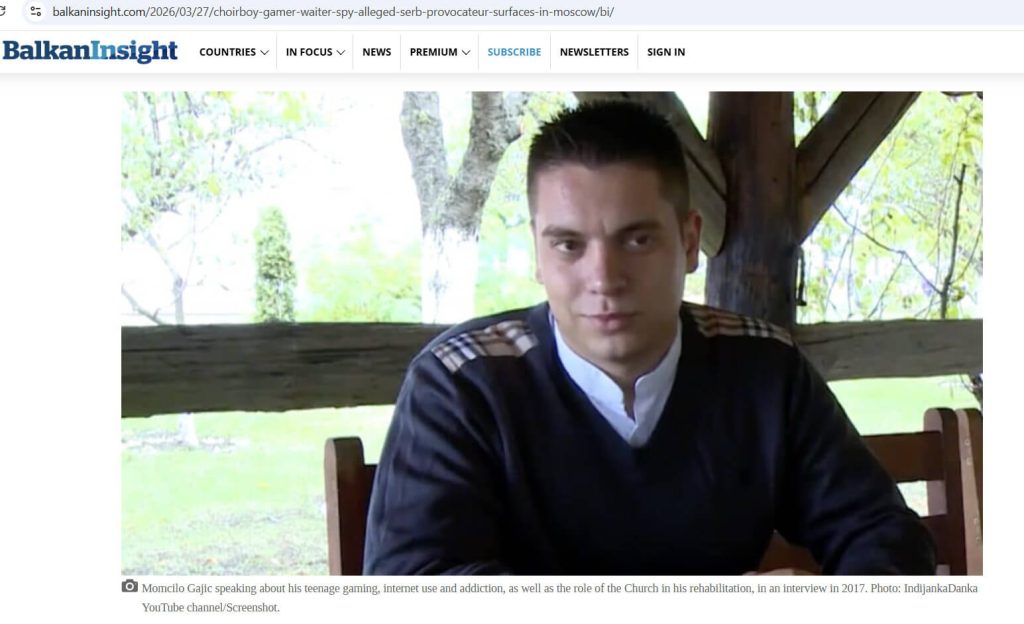
Prior to this, Momčilo Gajić had been mixing in criminal circles and decided to seek help after he was shot. The program in which he told this story was filmed on the grounds of the Kovilj Monastery of the Bačka Eparchy near Novi Sad, which is also where the rehab center is located.
The Kovilj Monastery is directly subordinate to the Bačka Eparchy of the SOC and its ruling bishop Irinej (Bulović). Gajić himself claimed that he was there undergoing rehabilitation in 2012-2013, spending time both at the Land of the Living center and the monastery itself.
The Land of the Living community was established with the blessing of Bishop Irinej of Bačka (Bulović), and the program was initiated by the then Bishop Porfirije (Perić), the current patriarch of the Serbian Orthodox Church. The first community was set up exactly there – in Kovilj, Novi Sad, Vojvodina.
Officially, the Land of the Living center is managed by a non-governmental organization, whose legal representatives are listed as 10 Porfirije Perić and priest Branko Ćurčin 11, a close confidant of Porfirije who has known him since childhood.
From 1998 to 2014, Porfirije served as the vicar Bishop of Bačka under Metropolitan Irinej Bulović and was the hegumen (abbot) of the Kovilj Monastery. The Land of the Living community experienced its greatest development precisely during this period of the then-Bishop Porfirije’s abbacy. Interestingly, during this time, Bishop Porfirije was not only heavily involved in fighting “sects” within his own country but also actively participated in international anticult conferences and forums (see below). Now as Patriarch, Porfirije continues to personally oversee the Land of the Living project. He personally consecrates new homes for the project (the most recent one being in January 2025). 12
The close cooperation between these two key ideological figures within the Serbian clergy – Irinej Bulović and Porfirije Perić – has spanned decades. It goes beyond their church service within the Eparchy of Bačka and the broader SOC, or their joint Land of the Living project. It also involves active and continuous anticult activities and connections to a network of anticult operatives in other countries. The Bačka Eparchy itself is a key location in both of their biographies, and it has also served as a venue for an international anticult conference.
On September 24, 2012, the Serbian city of Novi Sad hosted an anticult conference titled “The 5th Meeting of the Inter-Orthodox Initiative for Studying Religions and Destructive Cults.” The conference was opened by Metropolitan Irinej Bulović and Bishop Porfirije Perić. 13, 14
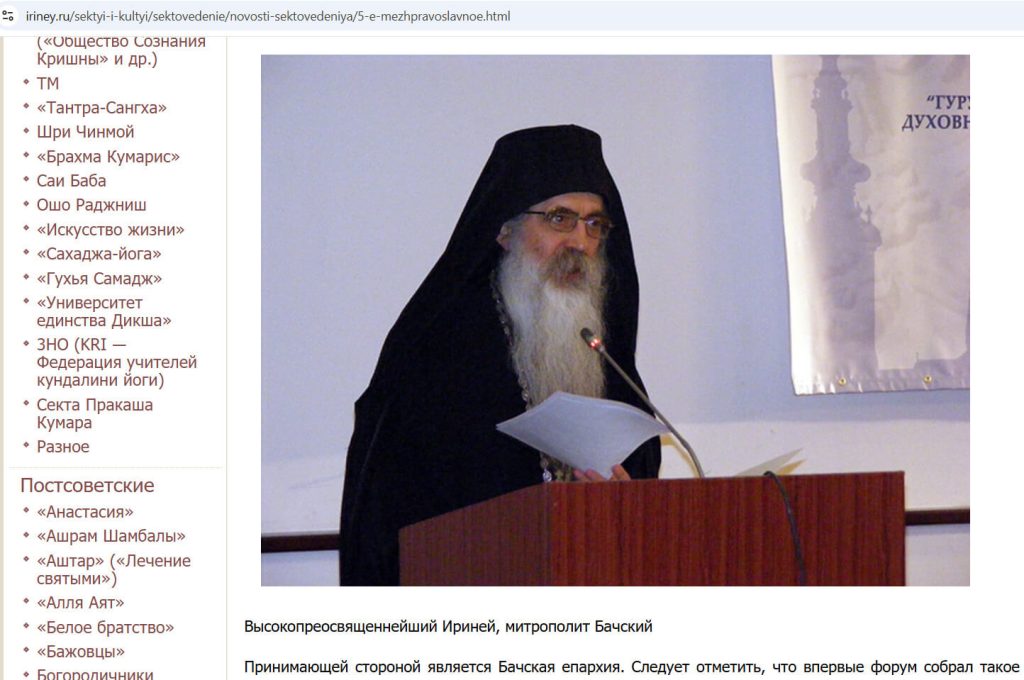
Among the main speakers were Alexander Dvorkin (president of RACIRS) and Alexander Novopashin (vice-president of RACIRS) (see below).
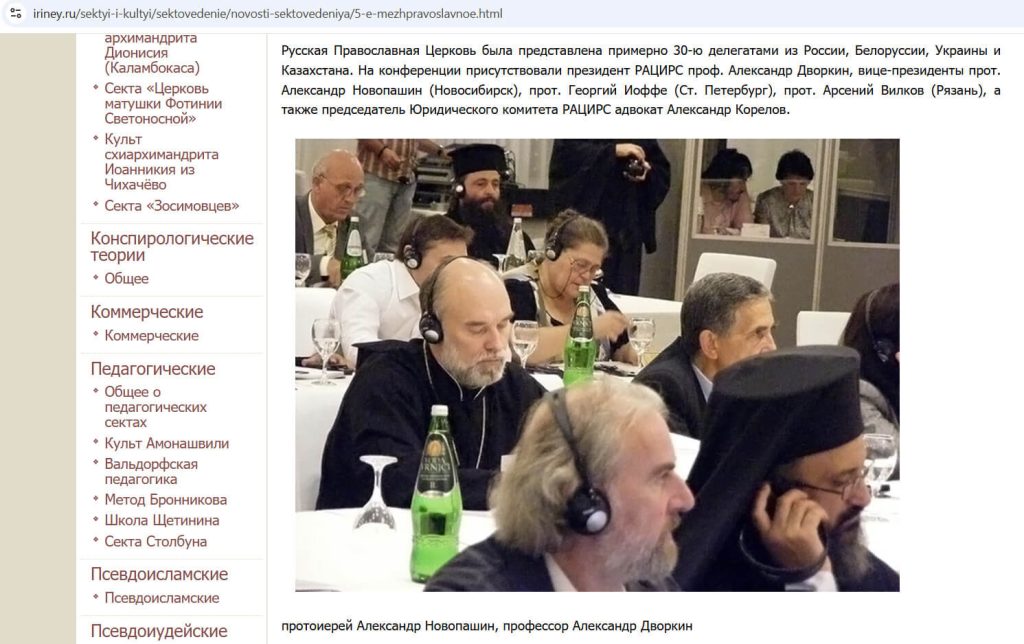
Notably, Alexander Dvorkin also spoke as an official representative of the Russian Orthodox Church (ROC). He delivered greetings from Metropolitan Hilarion of Volokolamsk, chairman of the Department for External Church Relations (DECR), written on behalf of His Holiness Patriarch Kirill of Moscow and All Russia. Given that around thirty ROC priests and clerics attended the conference alongside Dvorkin, who is essentially a layman, the choice of Dvorkin as the official representative of the ROC raises questions. Does the presidency of RACIRS hold more weight for the role of an official Church representative than holding holy orders?
This was in 2012. Recall that around this time, Momčilo Gajić was at the Kovilj Monastery of the Bačka Eparchy near Novi Sad. According to his own 2017 interview, it was from this point onward that he became deeply involved in the life of the monastery and the eparchy.
At the trial, one of the convicted men, Filip Petrović, stated directly about Gajić: “I know that Momčilo’s nickname is ‘Kaluđer’ (The Monk) and that he is closely connected to the Russian service. I don’t know if it is the intelligence service of the Russian Federation, but I understand that his goal is to destabilize the political situation in Europe.” 15
Thus, for many years, the Serbian ecclesiastical and anticult environment developed within the same ideological space as Russian anticultism, which is directly linked to the FSB. They shared conferences, platforms, and the very rhetoric surrounding “destructive cults,” “totalitarian sects,” and “spiritual security.”
To understand the role and influence that key figures in the Bačka Eparchy could have had on Momčilo Gajić, let’s take a closer look at the mentioned directors of the Land of the Living project: Branko Ćurčin and Porfirije Perić.
Branko Ćurčin
Mitred Archpriest Branko Ćurčin is Porfirije Perić’s closest confidant in the Bačka Eparchy. Porfirije has known him since their school days. They grew up together in the same town, Čurug, attended church together, and, as noted in church publications, were influenced by the spiritual legacy of Archimandrite Justin Popović.
It was this highly trusted confidant of Porfirije who took charge of managing the Land of the Living organization that Porfirije had founded, acting as the spiritual guide and interacting directly with the program’s participants undergoing rehab.
“Protopresbyter-Stavrophor Branko Ćurčin, a priest from Novi Sad and spiritual father to the residents of the Land of the Living therapeutic community for the treatment of addiction, has known the newly elected Patriarch Porfirije since their school days. They grew up together in Čurug, where they were nurtured in the Christian faith in the local church, although the decisive influence on them was the Ćelije Monastery, which they eagerly visited as students, inspired by the omnipresent spirit of Father Justin.” 16
Branko Ćurčin characterized Porfirije Perić as Patriarch of the Serbian Orthodox Church as follows:
“He is the right man in the right place.”
It is worth noting that the interaction between Momčilo Gajić and Branko Ćurčin did not end after Gajić finished his rehabilitation in the Land of the Living community. This involves the non-governmental organization “Ravničar”*, with which Protopresbyter-Stavrophor Branko Ćurčin was associated. In February 2018, he blessed one of the organization’s initiatives, which was officially aimed at preserving Serbian traditions. Momčilo Gajić led the NGO “Ravničar” from its founding until 2018. It is also known that since 2017, this NGO has received at least €36,000 from the city of Novi Sad to fund various projects.
*The official name of the organization is the Citizens’ Association “Center for Nurturing Regional Traditions – Ravničar” (Udruženje građana „Centar za negovanje tradicija podneblja – Ravničar“).
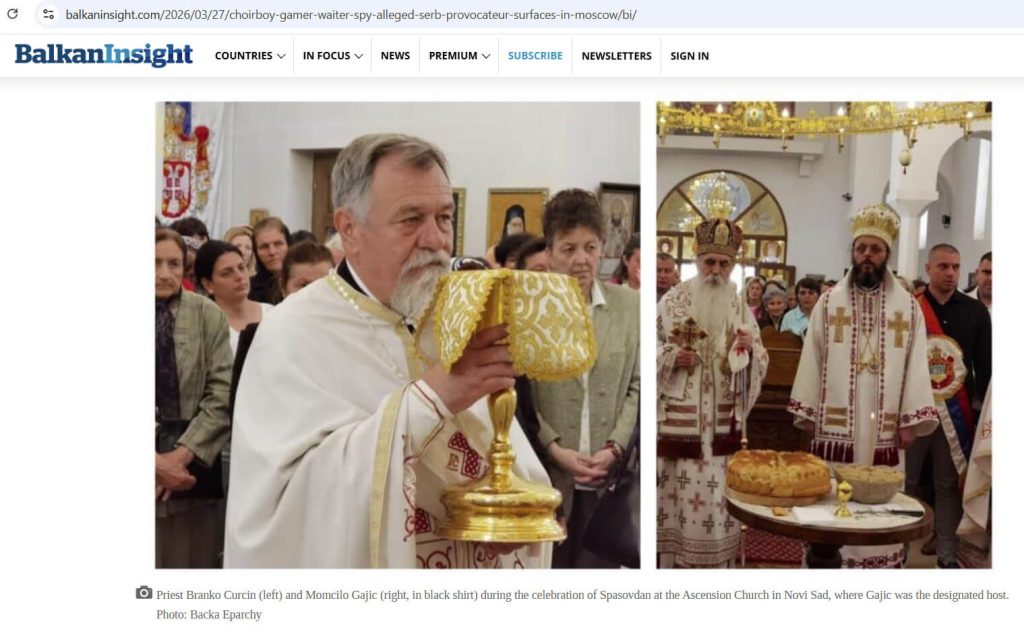
The connection between Momčilo Gajić and the Novi Sad priest Branko Ćurčin persisted in 2023 as well. That year, Gajić was given an honorary role in the church: serving as the host of the Ascension Day celebration at the Church of the Ascension in Novi Sad. This festive service was led by priest Branko Ćurčin. 4
Notably, Momčilo Gajić is set to perform this same role as host of this church celebration (or “godfather of glory” as it is also called) in Moscow on January 27, 2027, for St. Sava’s Day.
Porfirije Perić
The current Patriarch of the Serbian Orthodox Church, Porfirije (Perić), was elected to the patriarchal throne in 2021. For decades, he has been one of the most prominent representatives of the Serbian anticult movement, regularly interacting with European and Russian anti-sect structures. Notably, Porfirije’s election to the leadership of the SOC in 2021 did not separate him from the anticult scene – including in Russia – but rather elevated his status within this network.
On the day Bishop Porfirije was elected Patriarch of the SOC, the press service of RACIRS (Russia’s primary anticult association, which includes regional anti-sect centers from Russia and neighboring countries) released a congratulatory message, noting the newly elected patriarch’s long-standing, unwavering interest in anti-sect issues:
“Today, on February 18, 2021, the Serbian Orthodox Church has acquired a new Patriarch – Metropolitan Porfiry (Perić) of Zagreb and Ljubljana.
We have known His Holiness the Patriarch since the time when he was an Archimandrite and participated in various anti-sectarian conferences in Greece, Germany and other countries. These conferences were held by the Commission of the Synod of the Church of Greece on Combating Sectarianism, by the Dialogue Center International, and by FECRIS.”
“Then Archimandrite Porfiry became a vicar bishop, then Metropolitan. However, despite his busy schedule, his interest in anti-sectarian topics never waned. He participated in every annual conference of the Pan-Orthodox Anti-Sectarian Network and became the organizer of such a conference in his cathedral city of Ljubljana. Thus, Vladyka Porfiry became the first Orthodox patriarch who is personally well acquainted with anti-sectarian issues and understands the importance of this work.
We sincerely congratulate His Holiness on this fateful election and wish him many blessed and fruitful years!” 17, 18
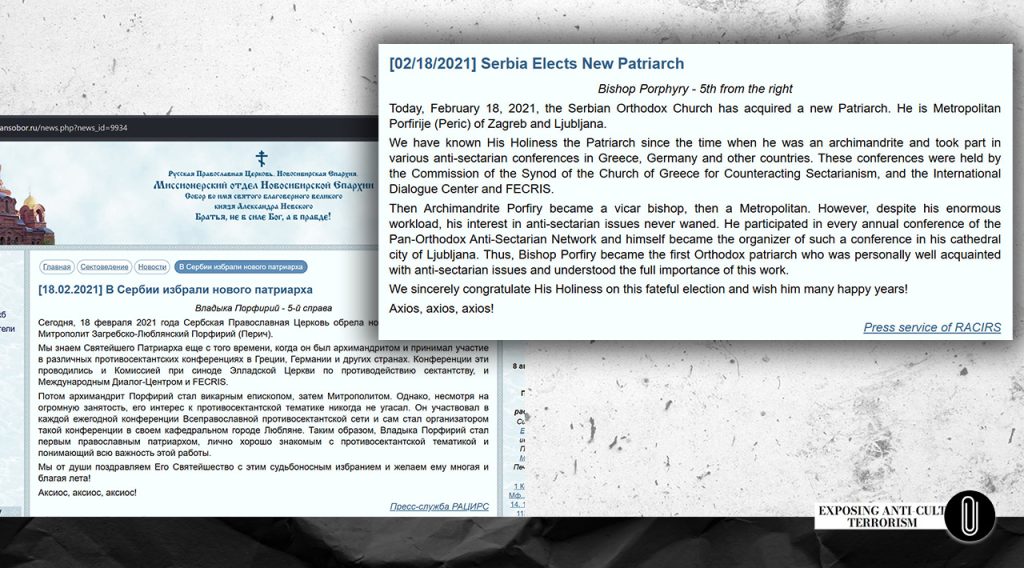
This congratulatory message was published on two key RACIRS websites: the official site of the Novosibirsk Eparchy, which is headed by Russian anticultist and RACIRS Vice President Archpriest Alexander Novopashin 17; and the website of the Saint Irenaeus of Lyons Center for Religious Studies – the main RACIRS center presided over by Alexander Dvorkin. 18
The only difference between these two publications is the accompanying illustrations. On the website of the Center for Religious Studies in the name of Hieromartyr Irenaeus, Bishop of Lyons, the congratulatory post for the newly elected Patriarch Porfirije features a 2017 photograph from Supraśl, Poland, where an anticult conference was held.
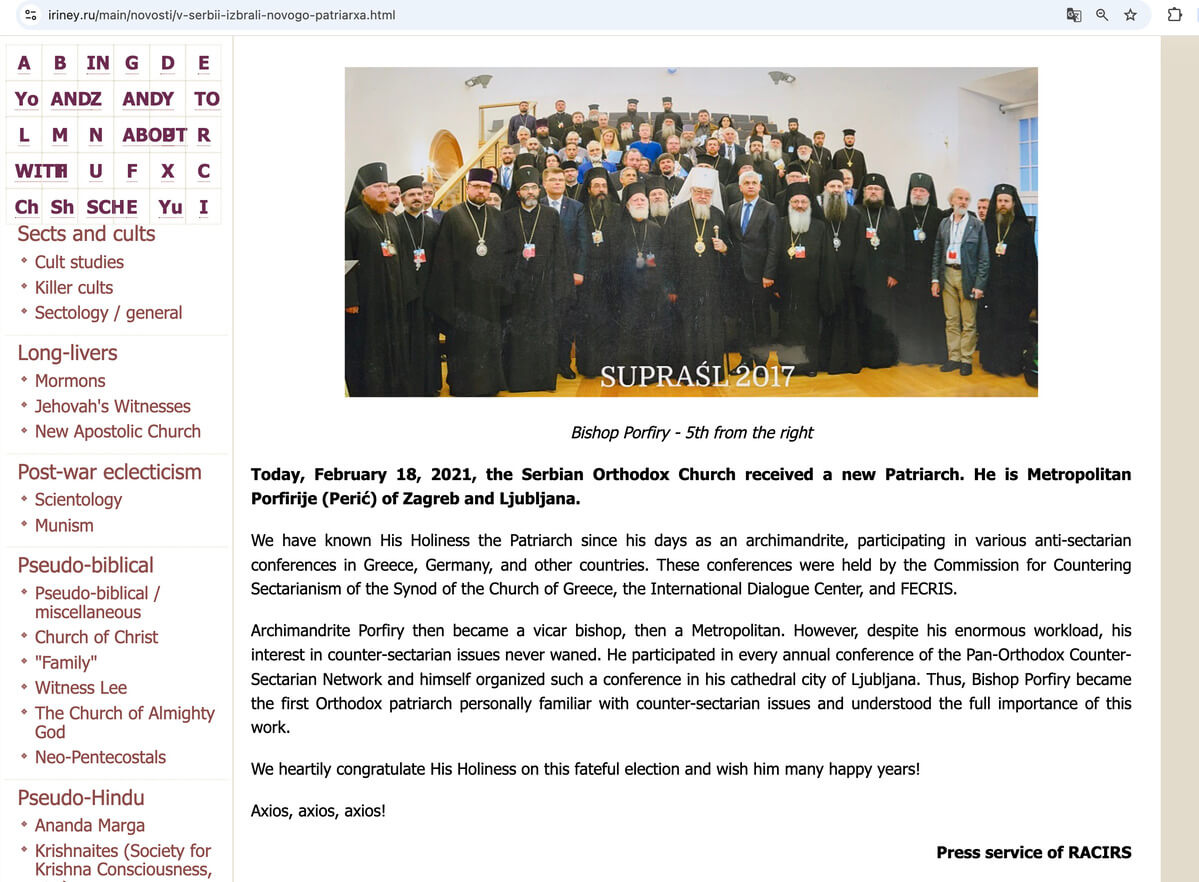
In addition to Dvorkin (front row, second from right) and Porfirije (front row, fifth from right), the photo of the conference participants includes Ukrainian anticultist Archbishop Iona (Cherepanov) (front row, first from left), one of the founders of the All-Ukrainian Apologetic Center (UAC) anticult organization in Kyiv (a RACIRS cell in Ukraine). Through this organization, he collaborated closely with the aforementioned Pavel Broyde and Alexander Dvorkin. The UAC anticult center operated directly at the Ioninsky Monastery under the direct supervision and blessing of Bishop Iona.
Notably, Metropolitan Luka (Kovalenko) of Zaporizhzhia – the closest colleague of Archbishop Iona (Cherepanov) and Pavel Broyde in the Ukrainian anticult organization UAC (a RACIRS branch) – traveled to Serbia in 2017, where he met with Serbian politician Aleksandar Vujić from Novi Sad, who is referred to as the “ataman of Vojvodina, cossack yesaul of the Embassy stanitsa in Serbia.” This yesaul and his subordinate cossacks traveled to Donbas to fight on the side of Russia. 19
Serbia also proved attractive to another individual close to Archbishop Iona, Metropolitan Luka, and Pavel Broyde: Ilya Bey, a lecturer at the Kyiv Theological Academy. On September 25, 2016, he visited Serbia 20:
“With the blessing of Metropolitan Luka of Zaporizhzhia and Melitopol and with the financial support of benefactor Oleksandr Bohuslayev, Ilya Bey, a parishioner of the Zaporizhzhia Eparchy and lecturer at the Kyiv Theological Academy, embarked on an academic trip to Macedonia and Serbia. From Ohrid, again via Skopje, he traveled to Belgrade for the 23rd International Congress of Byzantine Studies. From Belgrade, via Budapest, Chop, and Lviv, he returned to Zaporizhzhia.” 20
It is known that he met with the Patriarch of the Serbian Orthodox Church. It is also known that his route from Belgrade to Budapest lay through the capital of Vojvodina – the city of Novi Sad, which has been repeatedly mentioned in this article in connection with the investigation of the Serbian group and its organizer, Momčilo Gajić. Given that the coordinator of Ilya Bey’s trip to Serbia was Metropolitan Luka, who also visited Serbia in 2017, one cannot rule out possible informal meetings in Novi Sad – for instance, with the clergy of the Bačka Eparchy or with ataman Vujić, whose cossack unit fought in Donbas on the side of Russia.
Recall that the Serbian group that carried out the sabotage in Germany and France in 2025 has two organizers. One is Momčilo Gajić, and the other is known only by the nickname “Hunter” (Serbian: Hanter). According to statements by Radio Free Europe / Radio Liberty, published also on the independent Montenegrin news portal Vijesti.me, “Hunter” is also allegedly fighting in Donbas on the side of Russia. 15,21
“As the second organizer of the group, the case files refer to an unidentified person with the nickname ‘Hanter’ (‘Hunter‘).
According to court records, none of the group members had ever seen this person.
Aleksandar Savić stated that he only communicated with him via voice call.
He also said that the connection dropped the first time they spoke, which Hanter (‘Hunter‘) reportedly commented on with the sentence: ‘connections often drop when we are on the front lines.’
‘In my estimation, Hanter is on the battlefield in Ukraine. I have never seen his face. I assume that he and ‘Kaluđer’ (Momčilo Gajić) are best friends and associates,’ Savić said in his statement during his plea.
He added that Hanter ‘definitely has ties to the Russian service’ and that without him, ‘nothing can be done.’”
Archbishop Iona (Cherepanov) himself, as part of his anticult activities with the UAC, visited Serbia and specifically the city of Novi Sad for a conference in 2012 (he was still a bishop at the time). Other participants included Alexander Dvorkin, Alexander Novopashin, and Serbian anticultists: Porfirije Perić, Zoran Luković, and Irinej Bulović as the ruling bishop of the Bačka Eparchy. 13, 14
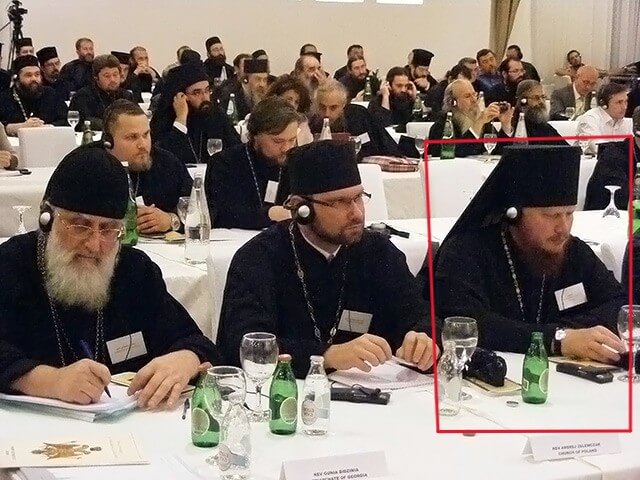
The focus of numerous articles on the actfiles.org portal is the investigation of anticult terrorism. Based on the Ukrainian-Serbian connection examined above, the international anticult network emerges as a potential transnational influence infrastructure managed from Russia, which uses the anticult agenda as a socially acceptable entry point into society. The data provided and its analysis reveal sufficient overlap to make such a network of interest to counterintelligence agencies and researchers of hybrid operations, and to be viewed as a threat to the national security of democratic countries. But let’s return to Serbia and Porfirij Perić.
While Ukrainian and Russian anticultists visited Serbia, Serbian anticultists visited Russia. In 2017, Bishop Porfirije visited Moscow, including Saint Tikhon’s Orthodox University (STOUH), where Alexander Dvorkin teaches. This meeting was mentioned in the Belarusian anticult journal Messenger of the Synodal Center for Sect Studies of the Belarusian Orthodox Church 22, 2017, Volume 2, No. 3, p. 8.
“STOUH Discusses the Creation of an Educational Program on Sectology
On June 22, 2017, the Main Building of STOUH hosted an international meeting dedicated to the creation of an inter-Orthodox educational program on sectology. Representatives of the Local Orthodox Churches, His Eminence Panteleimon, Bishop of Orekhovo-Zuyevo, and STOUH professors discussed current challenges facing Orthodox missionaries due to increased sectarian activity.
Participating in the discussion from St. Tikhon’s University were Bishop Panteleimon (Shatov) of Orekhovo-Zuyevo, vicar of His Holiness the Patriarch of Moscow and All Russia; Archpriest Alexander Shchelkachev; Professor Andrey Borisovich Efimov, deputy dean of the missionary faculty; Professor Alexander Leonidovich Dvorkin; and Irina Vladimirovna Shchelkacheva, assistant to the rector.
The Local Orthodox Churches were represented by Metropolitan Porfirije of Zagreb and Ljubljana (Serbia), Bishop Christoforos of Karpasia (Cyprus), Professor Ivan Zhelev Dimitrov (former Minister of Religious Affairs of Bulgaria), Professor Protodeacon Dragan Radić (Serbia), and Professor Christos Iakovou (Cyprus).”
This same event was featured on the main website of RACIRS – Center for Religious Studies in the name of Hieromartyr Irenaeus, Bishop of Lyons. 23
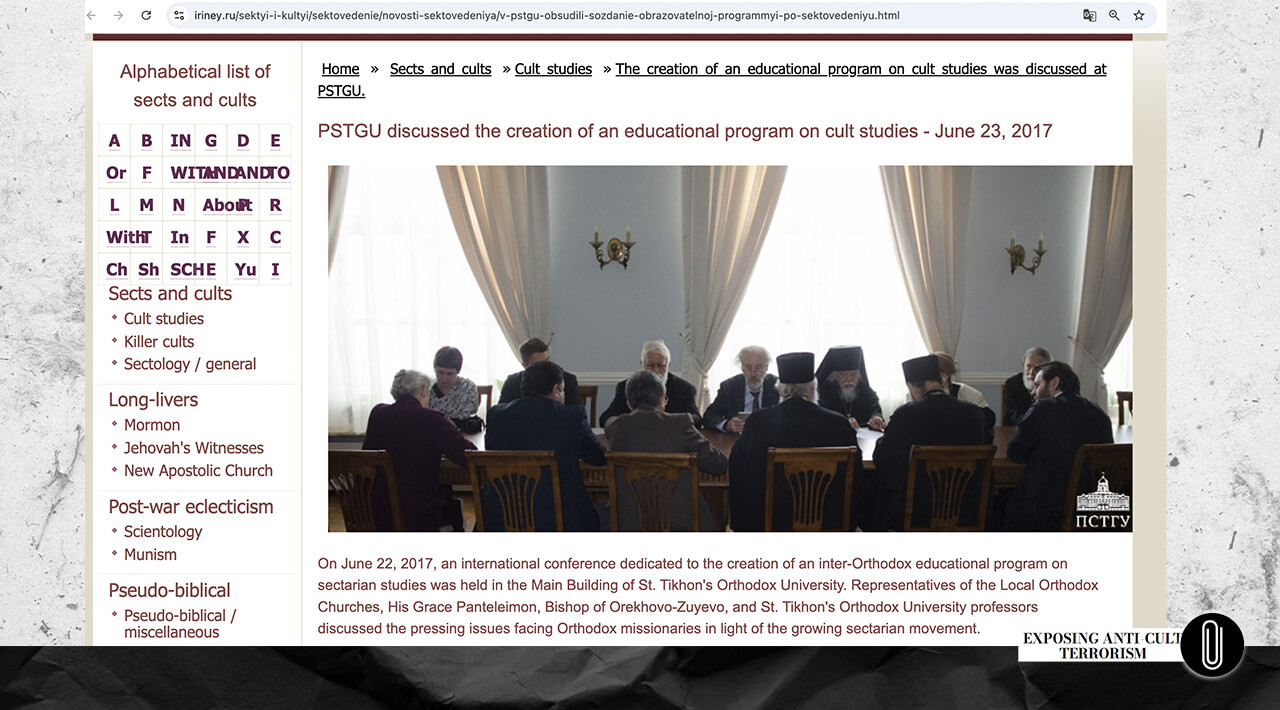
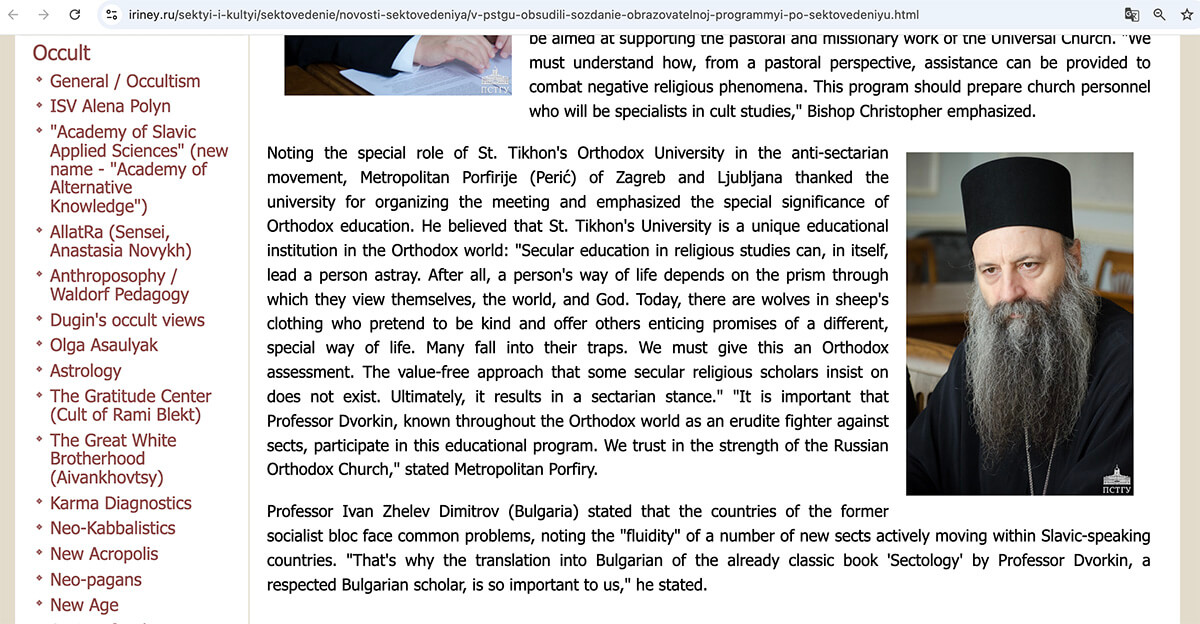
At this 2017 meeting at STOUH, Patriarch Porfirije personally emphasized the importance of Alexander Dvorkin’s work in the anti-sect field.
“It is important that Professor Dvorkin, whom the entire Orthodox world knows as an erudite fighter against sects, participates in this educational program. We rely on the strength of the Russian Orthodox Church,” Metropolitan Porfirije stated. 23
Anticult Conferences Attended by Porfirije Perić. CAS – the Serbian Branch of FECRIS – as a Bridge to Europe for RACIRS and the FSB
Documents from FECRIS – the European umbrella anticult organization – show that the future Patriarch Porfirije, then Bishop Porfirije Perić, participated for many years in the activities of the Serbian organization CAS, the FECRIS branch in Serbia, representing it at international anticult conferences. CAS inherited its anticult approach from its predecessor, “Belgrade Dialogue,” a branch of the Dialog Center International (DCI), where Alexander Dvorkin served as one of the vice presidents. From 2009 to 2021, Alexander Dvorkin also served as Vice President of FECRIS, after which he remained on its board of directors.
Below, we highlight a series of international conferences attended by Porfirije Perić and other Serbian anticultists.
In 2005, Porfirije Perić (then Bishop Porfirije) represented the Serbian anticult organization at a seminar on sect-related issues in Berlin, Germany. 24
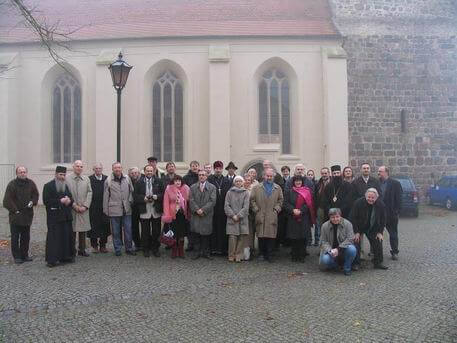
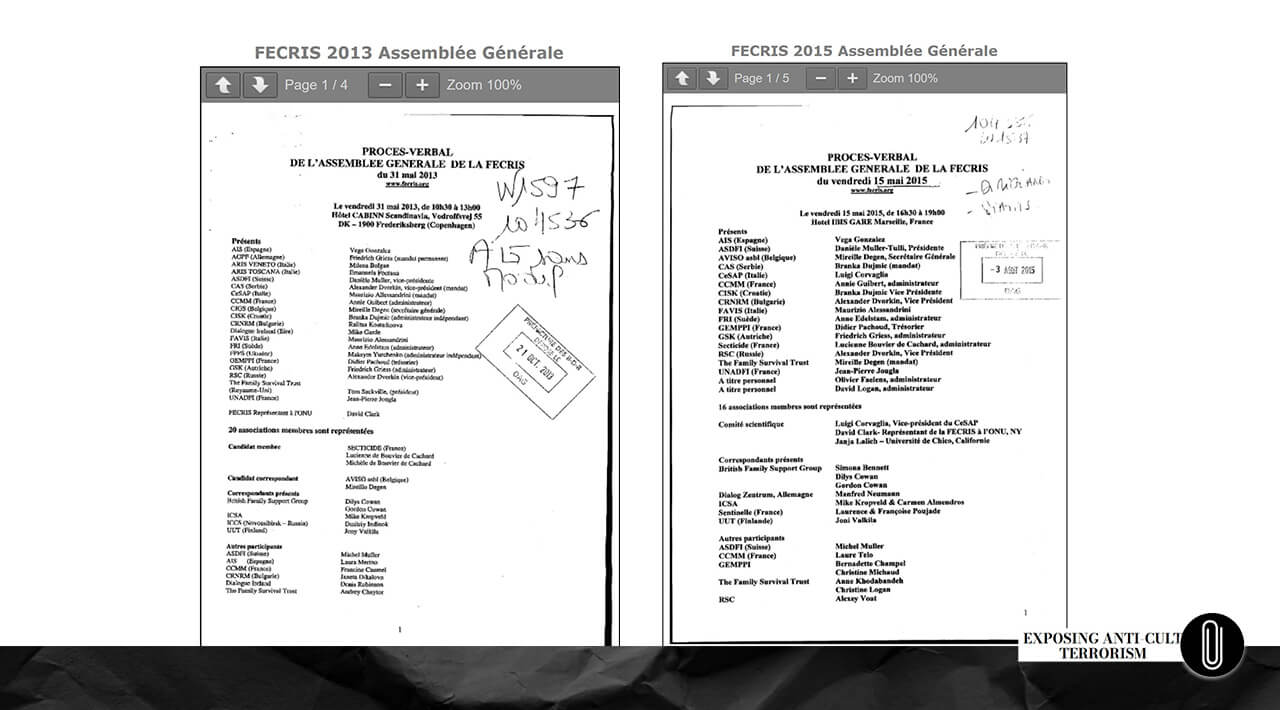
In 2006, according to screenshots of documents (see below), Slobodan Spasić and Zoran Luković spoke on behalf of CAS at the FECRIS international anticult conference, and in 2007, the representatives of the Serbian branch included Slobodan Spasić, Zoran Luković, Vlasko Panović, and Porfirije Perić – the current Patriarch of the SOC.
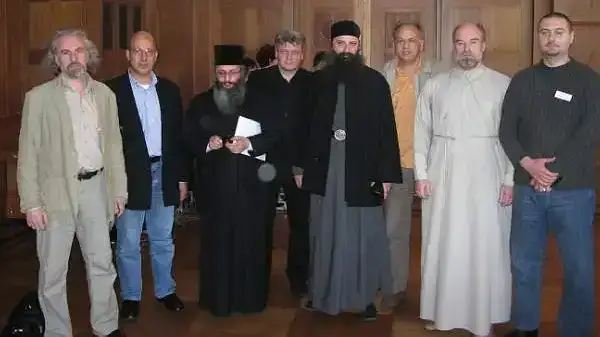
Later, in 2013, the Serbian CAS branch at FECRIS events was represented by Alexander Dvorkin himself, who was then serving as the vice president of this European umbrella federation. In 2015, the Serbian branch of sect fighters was represented at the FECRIS international conference by Branka Dujmić-Delcourt, an anticult activist from Croatia.
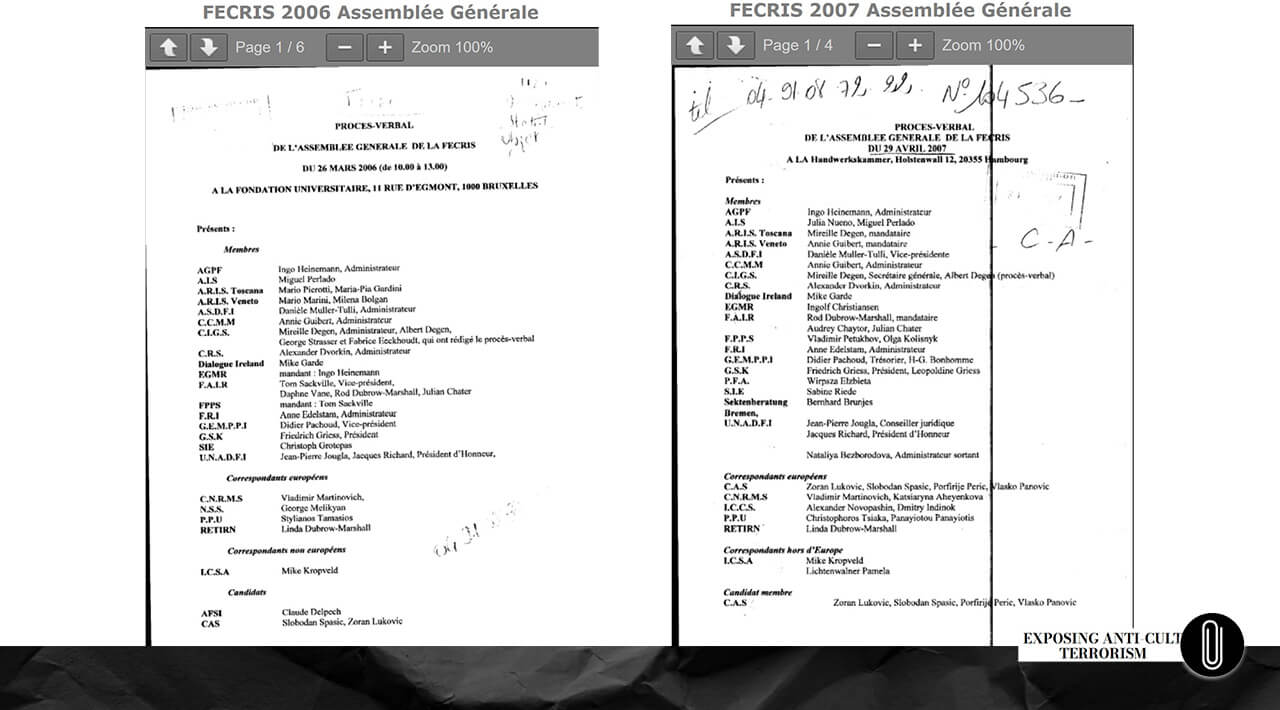
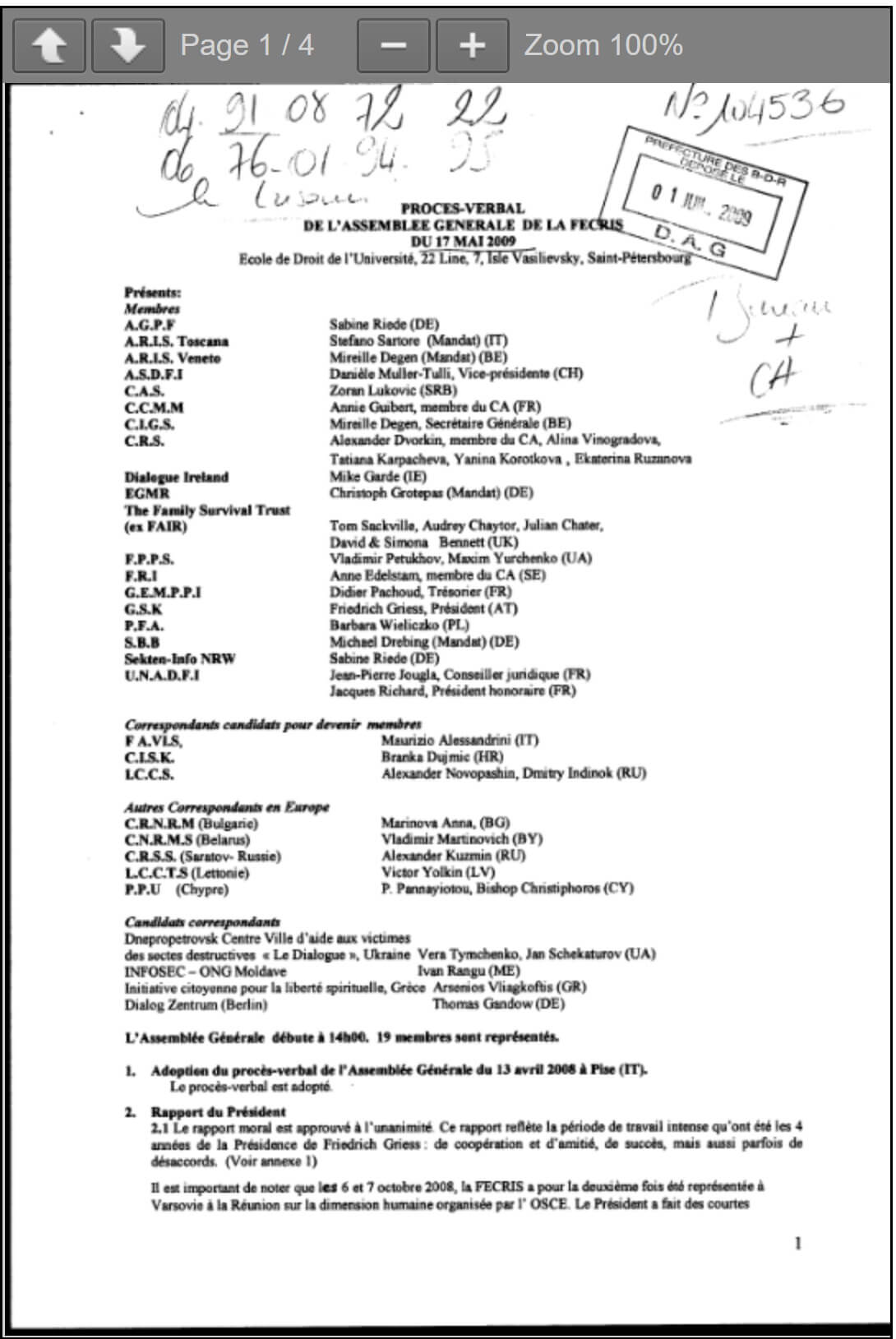
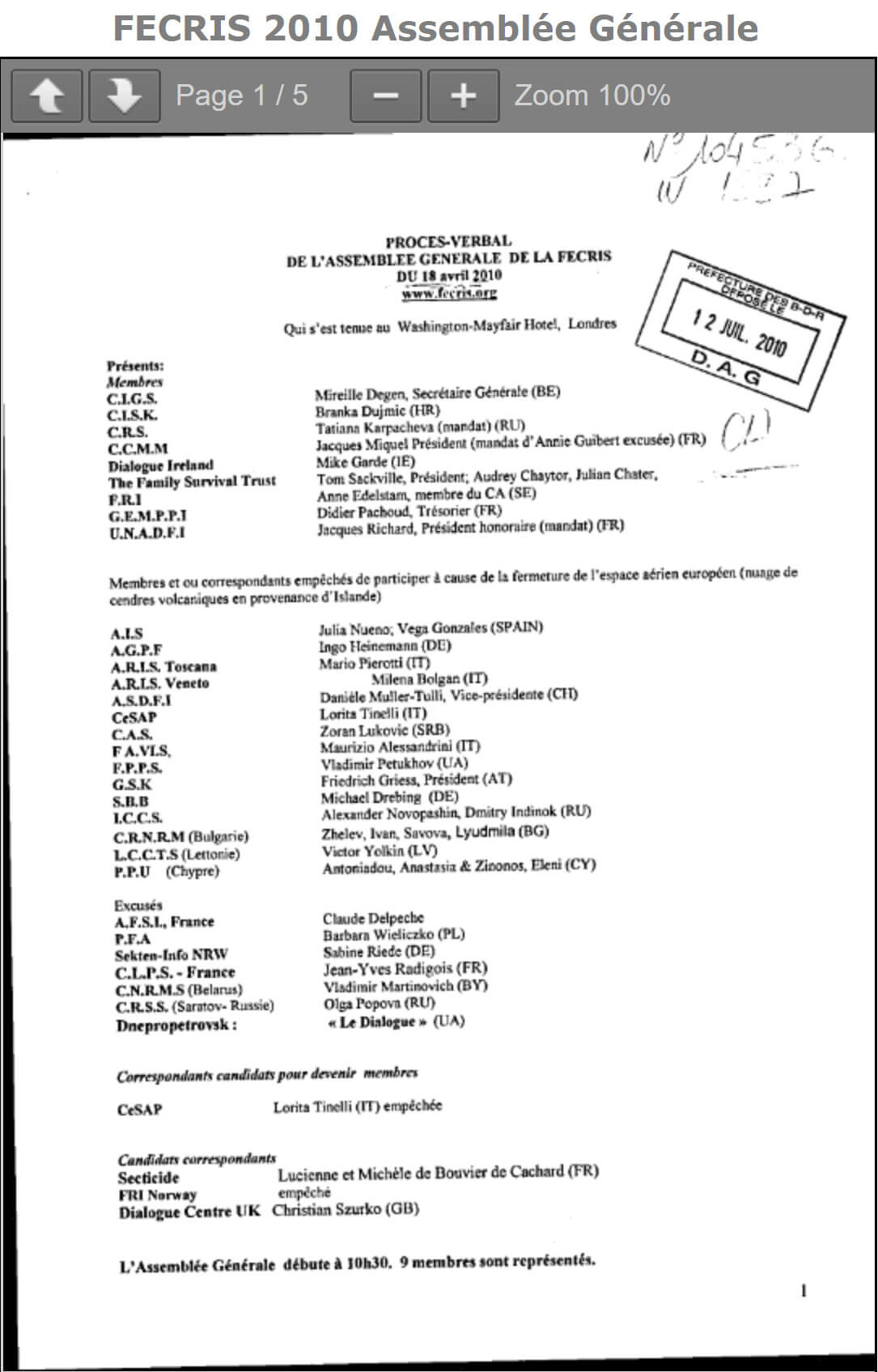
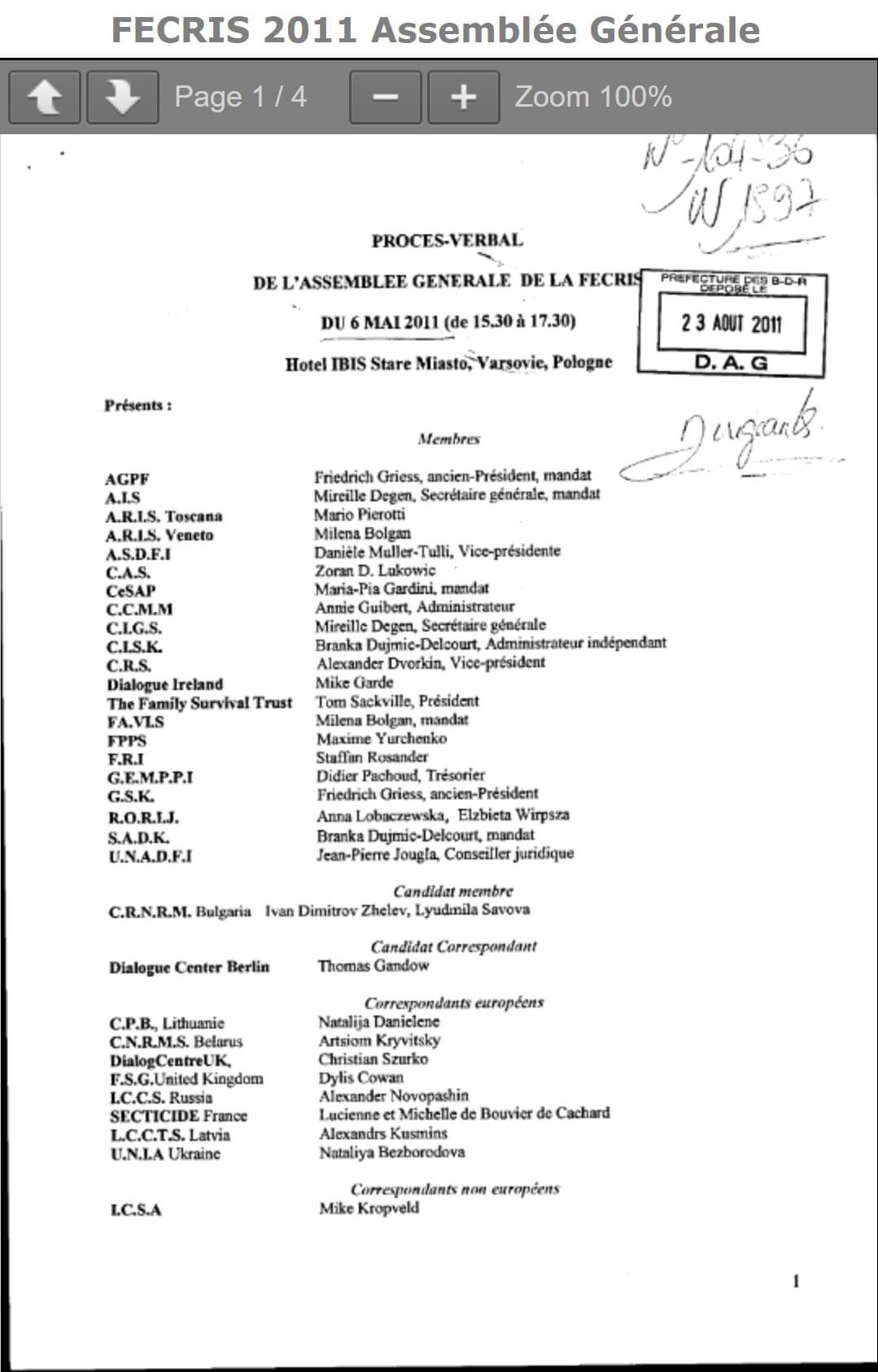
In 2024, FECRIS celebrated its 30th anniversary in Stuttgart, Germany. Representatives from CAS, including Slobodan Spasić and Zoran Luković, also attended this meeting. 25 As a reminder, these same individuals had previously attended FECRIS conferences, including alongside Porfirije Perić and Alexander Dvorkin.

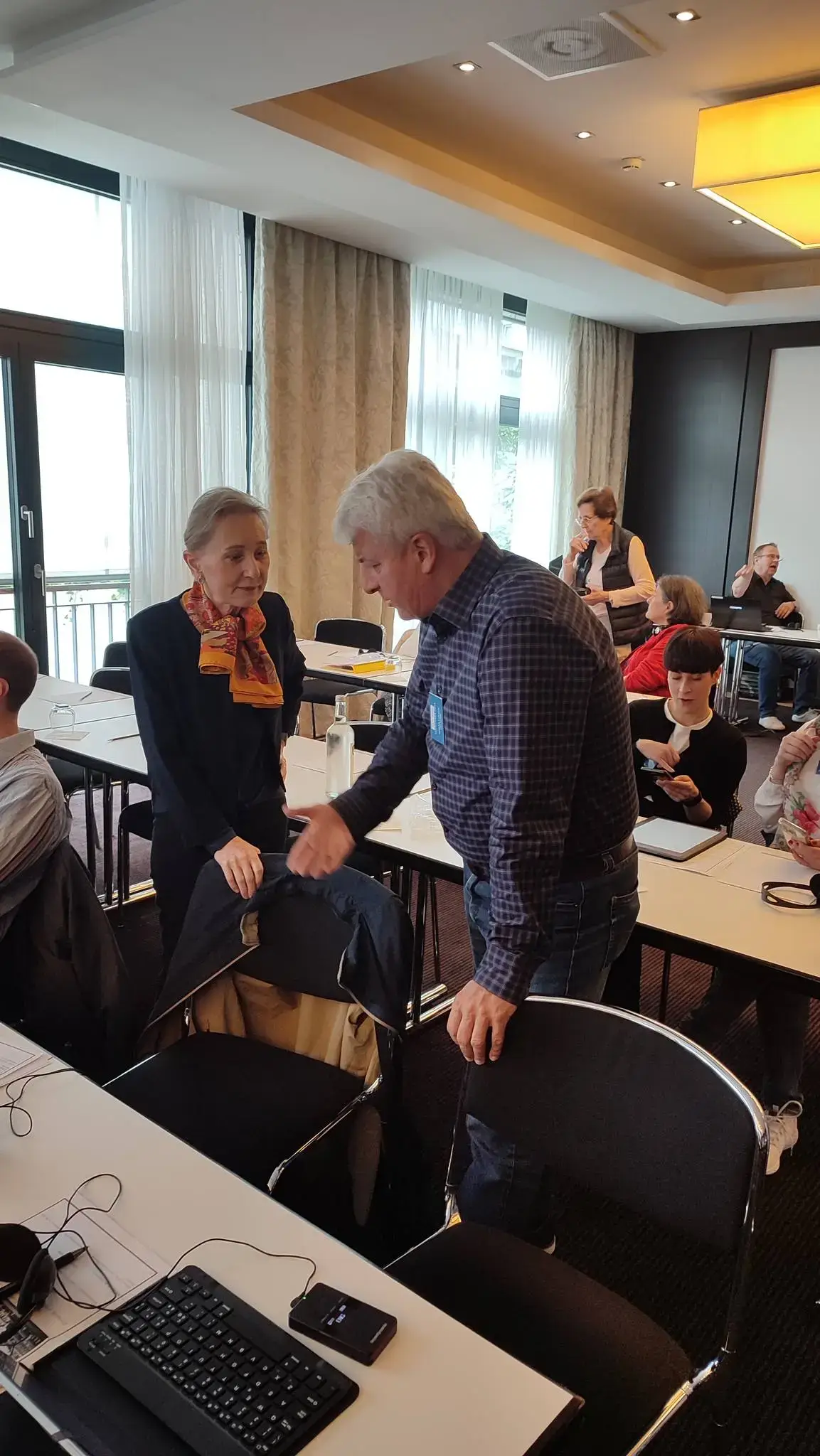
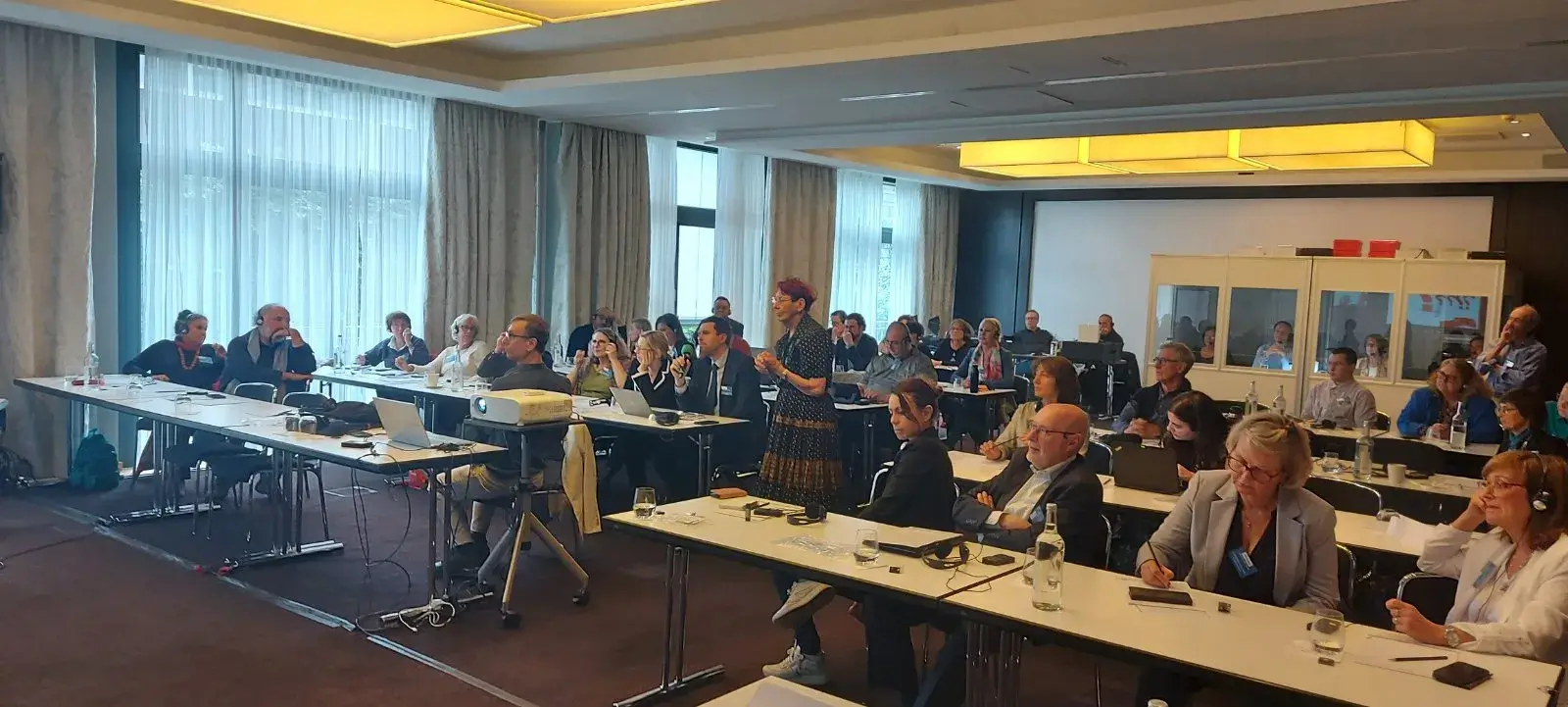
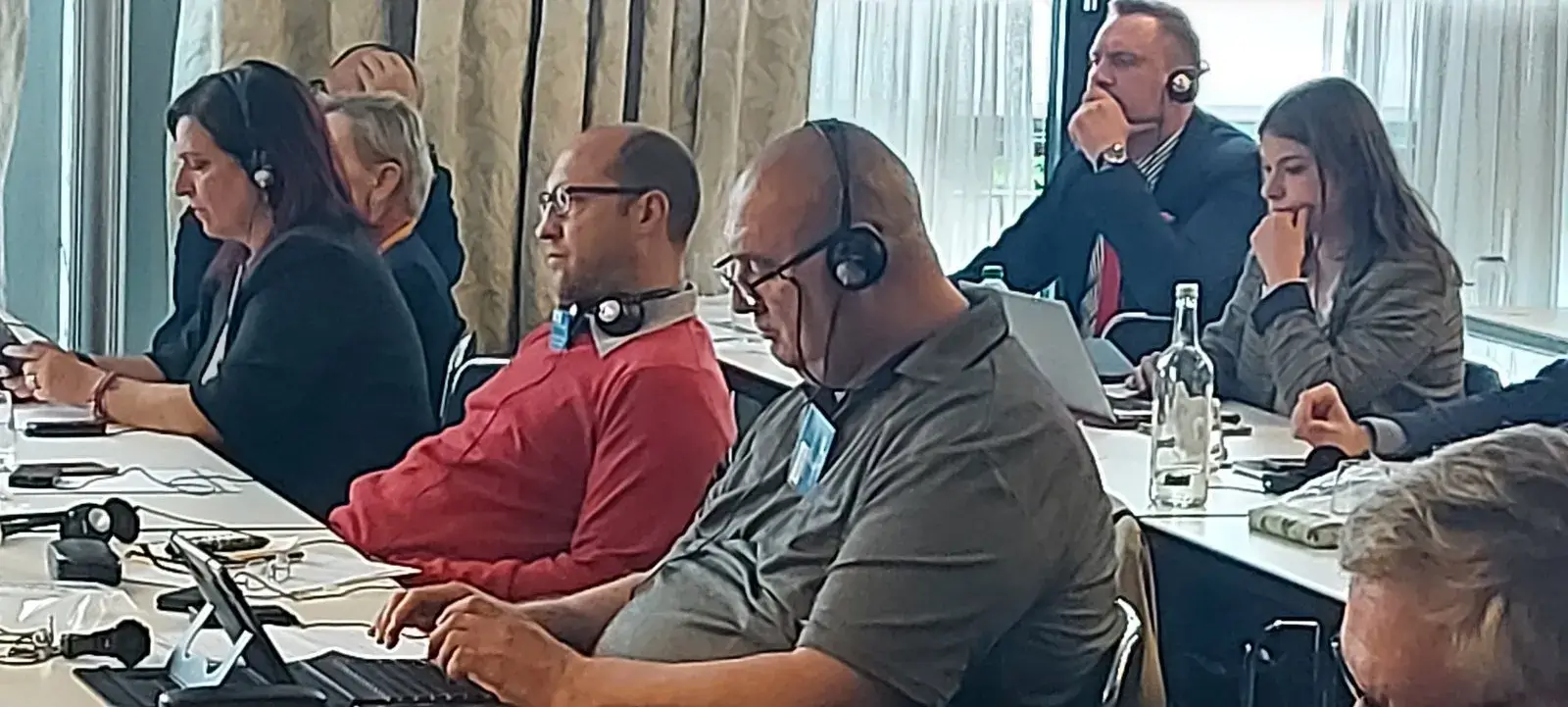
The coordination of the entire international anticult network by the Russian center has been ongoing for at least 30 years, regardless of whether Russian anticultists are physically present: shared conferences, shared rhetoric on “spiritual security” and “totalitarian sects,” mutual support, and a unified ideology originating from Russia.
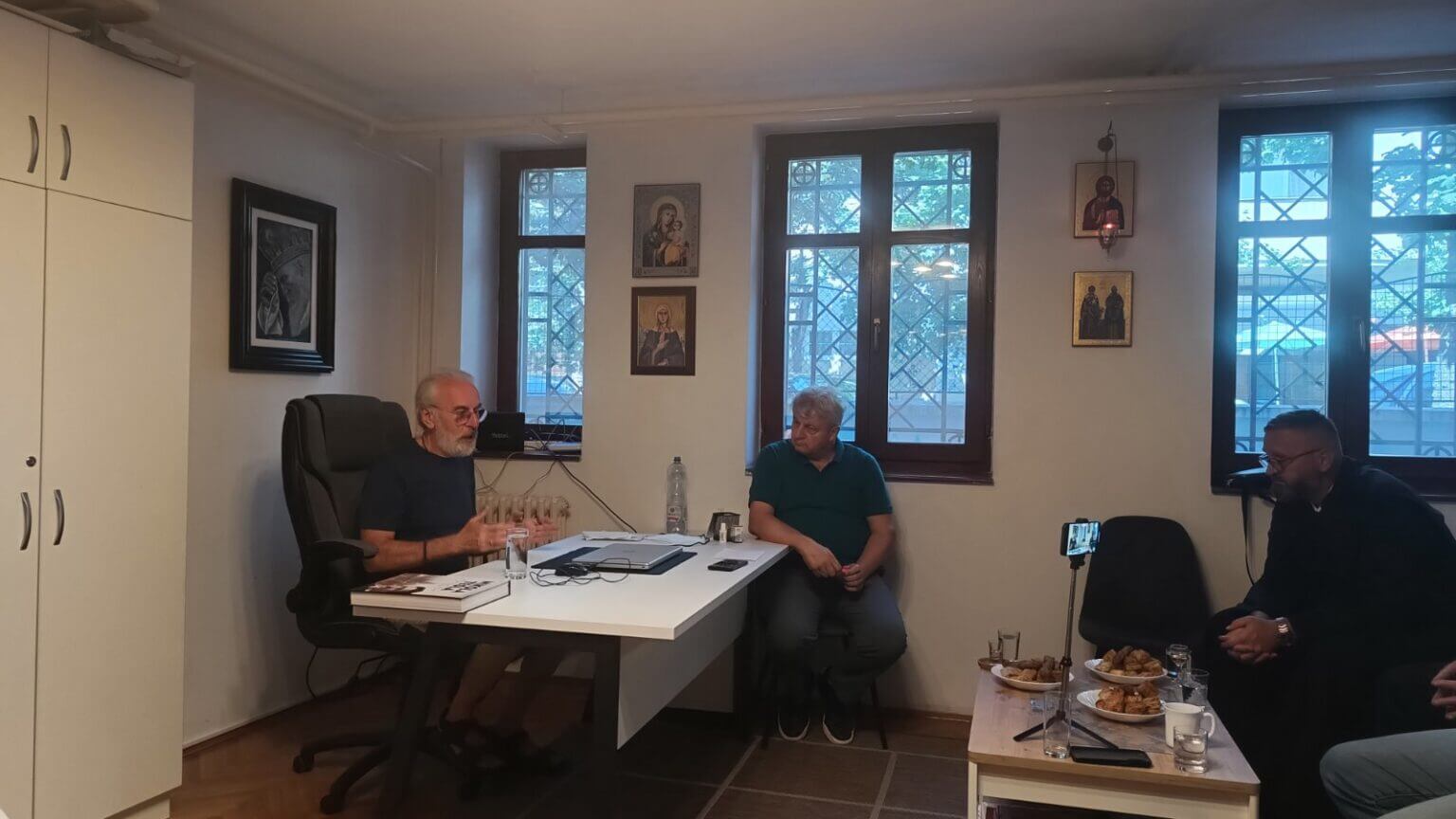
There is one more event worth noting. In August 2025, Alexander Dvorkin visited Serbia. 26, 27 He met with Serbian anticultists, specifically with Zoran Luković and other members of the missionary department of the Archdiocese of Belgrade-Karlovci.
As stated on “APOLOGETSKO SLOVO”, the website of the apologetic mission of the missionary department of the Archdiocese of Belgrade-Karlovci 26:
“On August 1, 2025, Professor Alexander Dvorkin, one of the world’s leading experts in the field of studying sects and cults, visited the Missionary Department of the Archdiocese of Belgrade-Karlovci.
Valuable experiences in the domain of sectarian and manipulative activities present in Russia and Serbia were exchanged with members of the Missionary Department. Professor Dvorkin shared some of his significant insights and proposed useful guidelines for further work in this field.”
“As part of a longer, informal and friendly conversation, possibilities of future cooperation between the Missionary Department of the Archdiocese of Belgrade-Karlovci (AEM) and Professor Dvorkin were also discussed.”
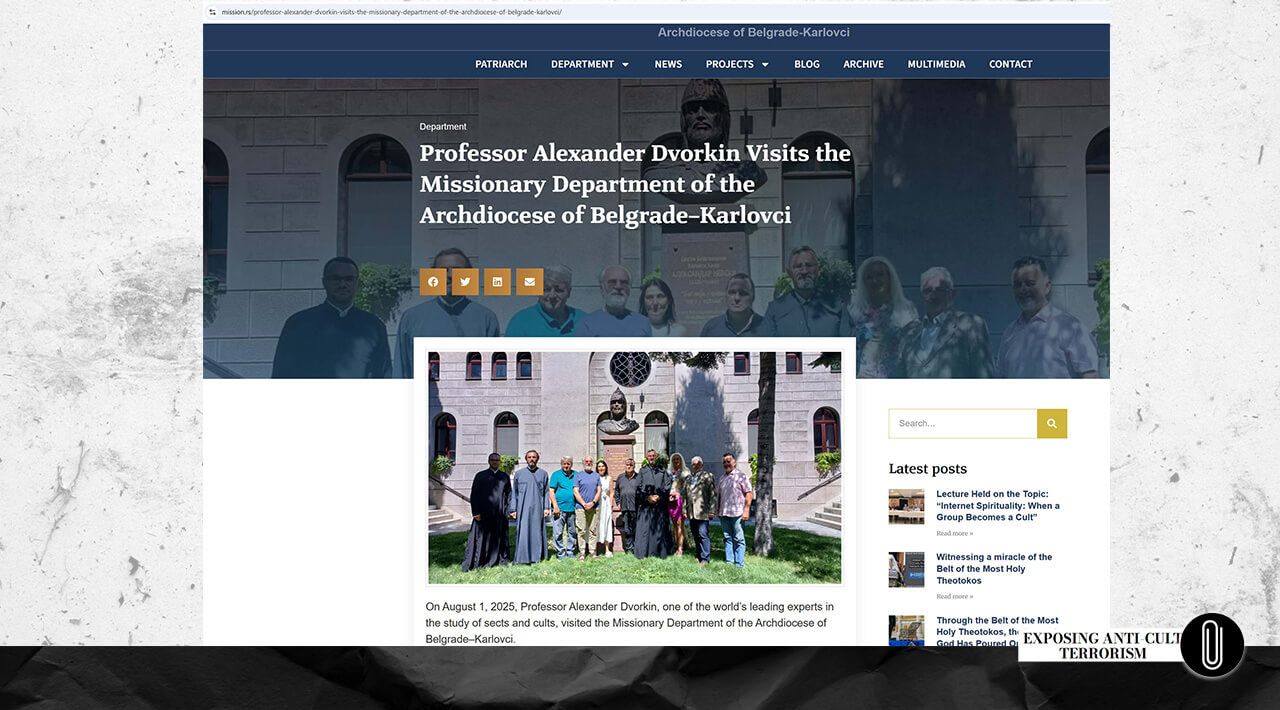
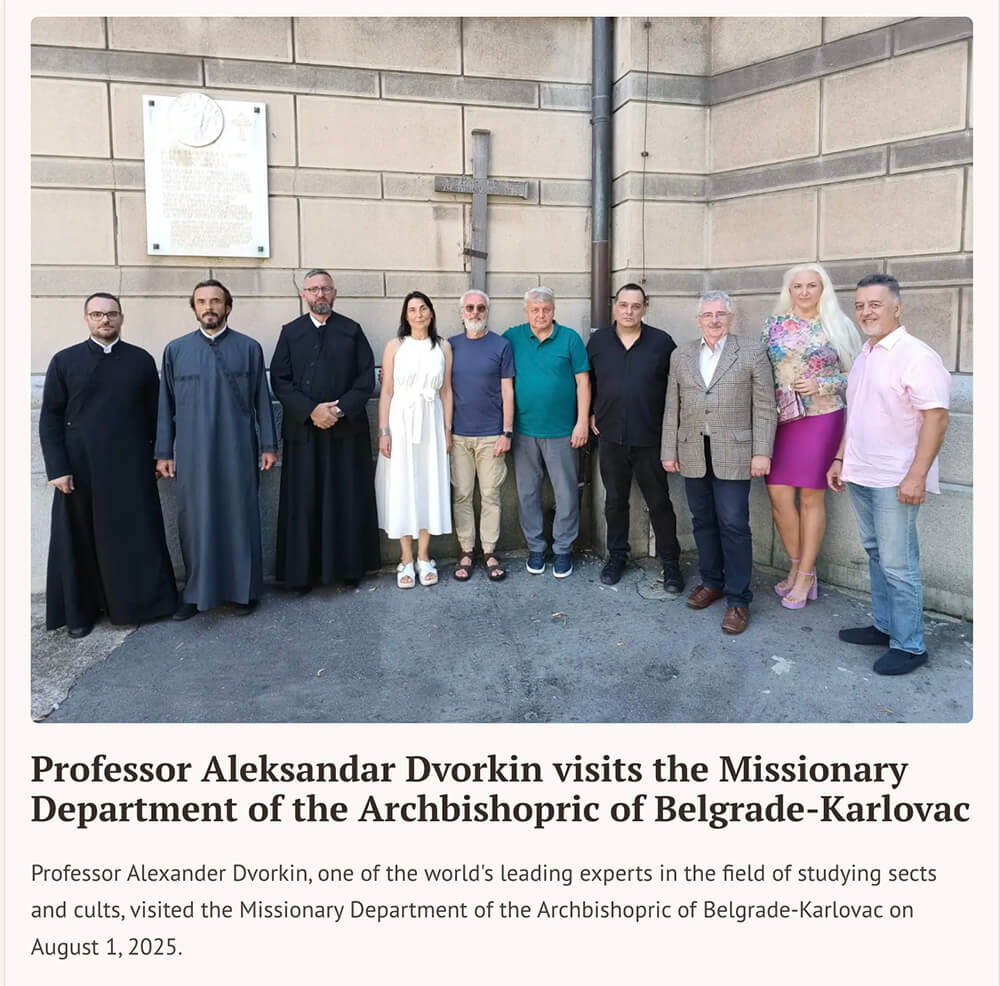
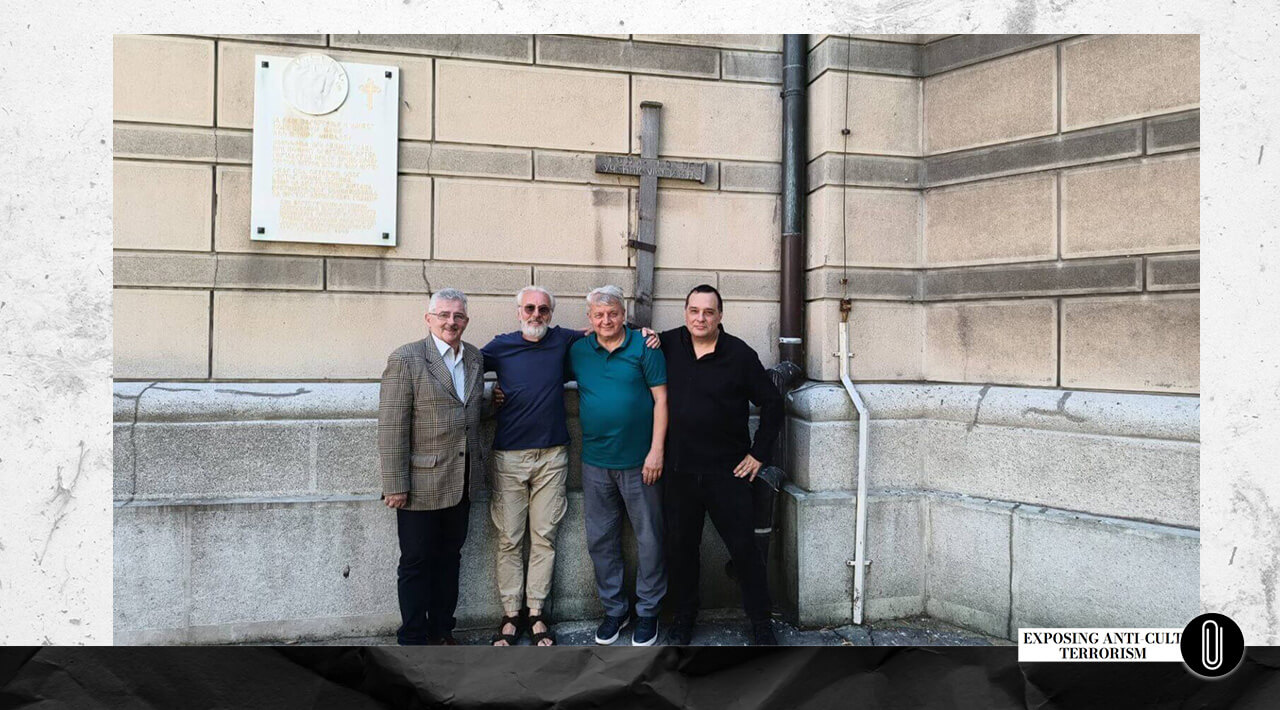
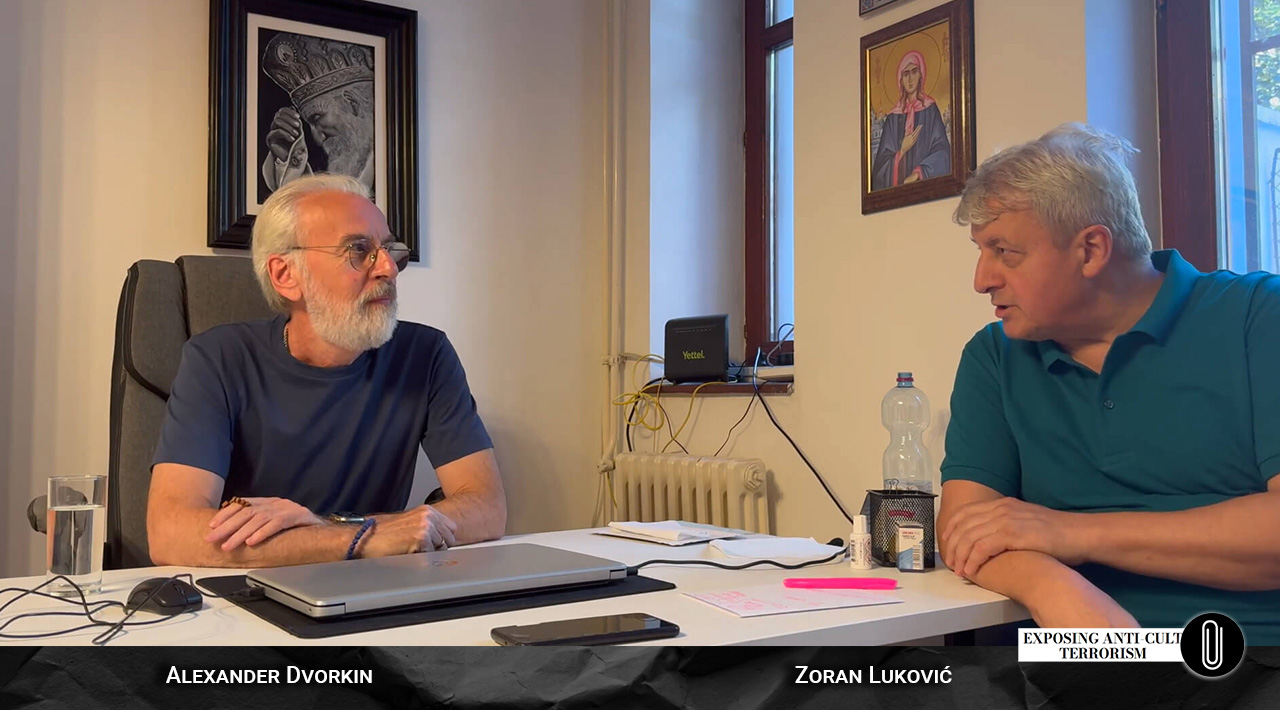
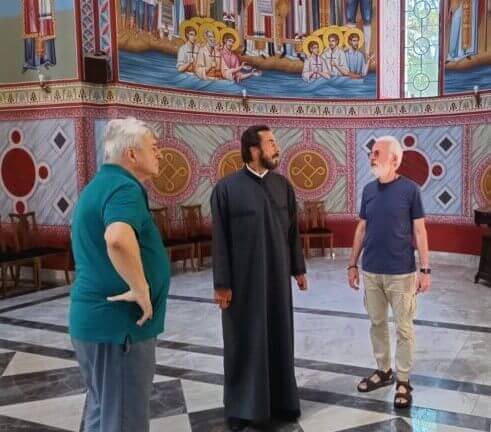
Remarkably, the Archdiocese of Belgrade-Karlovci, which Alexander Dvorkin visited, and the Belgrade-Karlovci Archdiocesan Fund (its primary organization) closely collaborate with the Land of the Living community established in the Bačka Eparchy.
This meeting, during which Alexander Dvorkin shared his experience and recommendations with Serbian “anticult activists,” took place on August 1, 2025 – the day after a Serbian group led by Momčilo Gajić, carried out sabotage attacks on July 31, 2025, in the German capital, Berlin, at the Brandenburg Gate, near the Holocaust memorial, at the behest of Russian intelligence agencies. While it is likely impossible to know the full context of the recommendations passed by Dvorkin during this informal meeting, one month later, on the night of September 8-9, 2025, the Serbian group – whose organizer Gajić has been linked for many years to the leaders of the Serbian anticult movement – carried out attacks on mosques in the French capital.
Thus, the leadership of the international anticult network of agents, directed by Alexander Dvorkin, has not ceased even today – a period in which the entire democratic world is attempting to counter Russian hybrid ideological influence and prevent agents of the Russian security services and their destructive activities from entering their territory.
The Serbian anticult cell has effectively become a bridge for the infiltration of Russian anticult circles, led by Dvorkin, into Europe — and with them, FSB manuals containing instructions from Russian intelligence. Even in 2024, with the full-scale war in Ukraine having gone on for over two years and peaceful Ukrainian citizens dying daily from Russian shelling, Russian intelligence continues to find ways to recruit and deploy foreign nationals through their controlled anticult channels to conduct covert sabotage and destabilization operations in European countries, particularly those actively helping Ukraine defend its sovereignty.
At the same time, European intelligence services seem oblivious to events taking place right under their noses, such as the 2024 anticult conference in Stuttgart, which brought together key figures from Dvorkin’s network – Serbian, Croatian, French, and other “sect fighters.” Nor do they see a direct connection in the fact that the day after a series of sabotage acts in Germany, Alexander Dvorkin arrived in Serbia to hand down recommendations. This lack of oversight makes the repetition of such incidents highly likely – as indeed occurred a month later in France.
The French-Serbian case reveals a two-layered structure. The first, visible layer is a direct Russian intelligence operation involving money, instructions, and specific tasks to incite hatred between communities and provoke a clash between the Islamic and non-Islamic worlds. The second, deeper layer involves the recruitment and cultivation of operatives through the anticult environment, including those operating under the cover of the Church (either the Serbian or Russian Orthodox Church), where Serbian and Russian figures have been intertwined for decades.
Today, Momčilo Gajić lives openly in Moscow. As established by Balkan Insight (BIRN), he actively participates in the life of the Serbian Orthodox Church of St. Peter and Paul – the representation of the Serbian Orthodox Church in Russia — occupying a prominent place in church ceremonies. Among his close associates is Bishop Stefan (Dragan) Šarić.
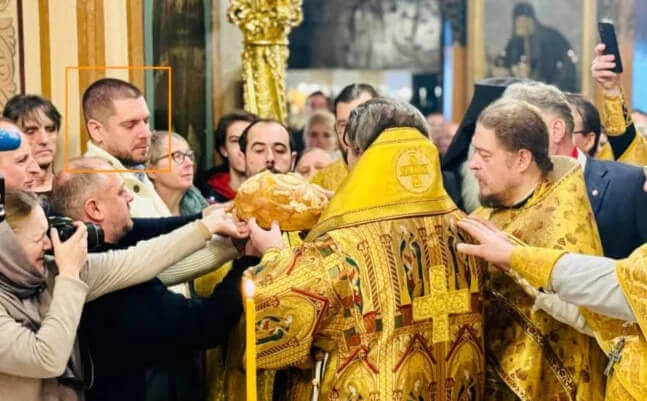
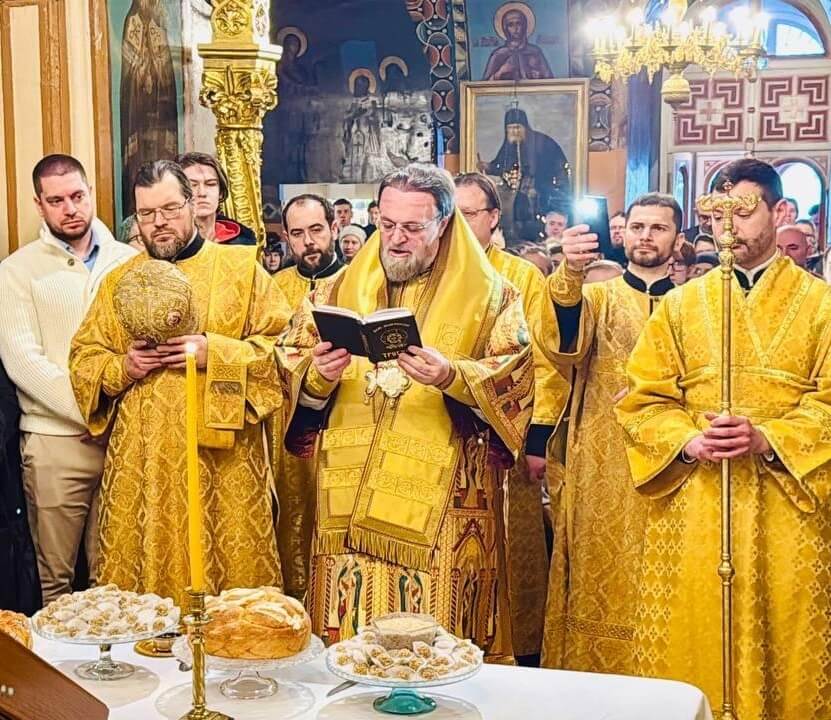
Bishop Stefan (Dragan) Šarić
The Representation of the Serbian Orthodox Church in Moscow is headed by Bishop Stefan (Dragan) Šarić. He is a vicar bishop of the head of the Serbian Orthodox Church.
Bishop Stefan Šarić holds the title of Bishop of Remesiana. As a vicar bishop, he does not head a separate diocese but plays a key role in representing the Serbian Orthodox Church in Moscow. A graduate of Russian theological schools in the 2000s, he previously managed Serbia’s largest church – the Temple of Saint Sava in Belgrade. It was he who personally received Vladimir Putin during the Russian president’s visit to Serbia in November 2019.
With the blessing of Bishop Stefan, Saint Tikhon’s Orthodox University (STOUH) – where the leader of the anticult network, Alexander Dvorkin, works – co-organized a scientific conference in late 2024 titled “Russian-Serbian Church Relations in the Past and Present.” The conference was organized by the Pilgrimage Center of the Moscow Patriarchate in cooperation with STOUH, and STOUH professors delivered presentations. 28
The connections of the SOC Bishop Stefan extend far beyond public church life. In April 2025, he attended a charity dinner at the Moscow restaurant “Subotica,” organized by the Saint Sava Fund. The fund was established by Serbian volunteers in the Russian army, Davor Savičić and Branko Basara. The dinner was also attended by Dejan Berić, a well-known recruiter of Serbian mercenaries, and two high-ranking Russian officers, including Eduard Shonov, a participant in the “Time of Heroes” program. 9
These facts are reminiscent of the experiences of members of the Ukrainian anticult cell UAC, who met with Serbian politician Aleksandar Vujić from Novi Sad, referred to as the “ataman of Vojvodina, cossack yesaul of the Embassy stanitsa in Serbia.” This yesaul and his cossacks went to fight in Donbas on the side of Russia. It should also be taken into account that the second leader of the Serbian group alongside Momčilo Gajić, known by the moniker “Hunter,” is also allegedly fighting on the front lines in Ukraine on the side of Russia.
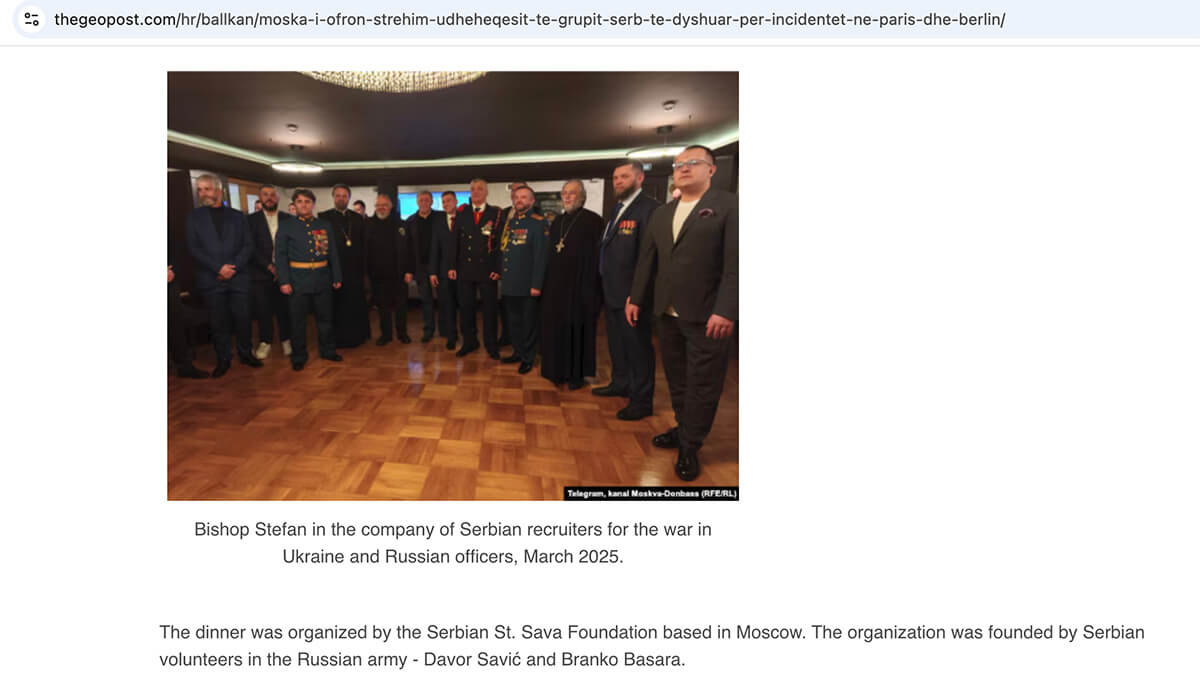
Particular attention should be paid to the figure of Davor Savičić, who was present alongside Bishop Stefan. Even before the full-scale invasion of Ukraine, this Bosnian Serb created the “Wolves” mercenary battalion and later received the rank of colonel in the Main Directorate of the General Staff of the Armed Forces of the Russian Federation (GRU).
A month later, in May 2025, Bishop Stefan hosted Milorad Dodik, the former President of Republika Srpska, at his Moscow representation. Davor Savičić was again present at the reception.
Thus, through the mission of the Serbian Orthodox Church in Moscow – and specifically through Bishop Stefan Šarić, Vicar of the Serbian Patriarchс – there is a close intertwining of professors at the St. Tikhon Orthodox Theological University, as well as church, political, and military circles linked to support for Russian aggression.
CONCLUSION
While the key organizers of the sabotage in Europe remain at large, along with the anticult intermediaries between them and the FSB, the key question remains open: how many more such Russian intelligence operations remain undetected, and how long will they continue?
Source:
1. https://www.forum18.org/archive.php?article_id=3043
2. https://www.slobodnaevropa.org/a/srbija-pariz-berlin-spijunaza-neredi-ruske-sluzbe/33697783.html
3. https://www.bfmtv.com/police-justice/tetes-de-porc-decapitees-devant-des-mosquees-ingerence-russe-ou-action-coordonnee-de-l-ultradroite_AV-202509100390.html
4. https://balkaninsight.com/2026/03/27/choirboy-gamer-waiter-spy-alleged-serb-provocateur-surfaces-in-moscow/bi/
5. https://www.mediapart.fr/journal/france/021225/des-documents-internes-au-kremlin-montrent-l-implication-de-la-russie-dans-des-operations-en-france-visant
6. https://risu.ua/ru/obnarodovany-podrobnosti-sotrudnichestva-pr-tehnologa-iz-otdela-po-delam-molodezhi-upc-s-komandoy-pomoshchnika-prezidenta-rf_n84013
7. https://www.religion.in.ua/news/vazhlivo/34549-izvestnyj-apologet-i-sektoborec-upc-pytalsya-privlech-cerkovnyj-aktiv-dlya-politicheskix-proektov-kremlya.html
8. https://mup.gov.rs/wps/portal/sr/aktuelno/saopstenja/!ut/p/z1/tZbbctowEIZfhU6HS41XB2T50hiQOQXCKcE3jHxKTMAmYEjTp69oOtNAphAa4xuNNfK3__67kmV4xr3hpWqXPKg8yVK10O9Tj896VpdjCaQtmN0AuwsV6A8pyBo3JoZneEGar_JHY7ra-oskmC3012kZVlkQ5akqg3rKt9EizcqwUdlqk0fpXO0_WwVJaExZDOCHoUJBiE3EGCbIN1mILADLt4TlBzww7n7rgH88NhjeaZnDzXo2GM6-d1SeGq1zq3XWyfz52bN1almaRz9y4_6S3D4EAAw2t6WAiiByYv5PgD_QNna4KyV0pNOsgG11mVut3VId4yLo-jHZqfeay0AAm2WYq3Sr1iVUmm_T0tsU5jgKfQhQXDEtxBQOkYgjgvS8FUNISRBFxylLXidg35pWrV0XVLjweXVn3DMvci_MnrbLKM0TnWu-Vnn0kMwj3U3eOblvC0413LkaT3XLmu8WmA1bL7C4S1q9Wzzmxt0uiV6McZqtl3qnDf_uCCpCVdHeIguLCLGK3gyKxgIFkRAmYdSinBla43GEgz4GTr8Y4QgPQ6kT5_WRbLeatHD8YQl6TbNYfG9S5Vp937HdXkfngYvFH3oveqxg9Z2aNocP-PBGar5DCi5to6rPEj5ySaM6BKBF48dY47v2oAekjoFVruk98KuWVo5OmPOpX9kZvHlVPL2ueoqvi7-uOa2CzZFOY79radvumALLk2cOERZRMUOhT0LECGXICphuUT0bmcwXIdAP6ptSq-eAm_02xzDixeKP1PfNa-JhRAvGd52qxks5IY6LgUPB3h-eOeOvqj–8xyWtkYuufMskzTZ5Gq9yXf6Wpqk8V5Snq1LWWmtwm1puV0hZayWS0FfkbxDnl9Z7Jb7kQ_cn9UbJB1fvIzi5deH15dvvwDWWFZQ/?1dmy&urile=wcm%3Apath%3A%2Fpublic_latin%2Fpocetna%2Faktuelno%2Fsaopstenja%2F868dbb75-34df-4576-8ace-d24907138387
9. https://thegeopost.com/hr/ballkan/moska-i-ofron-strehim-udheheqesit-te-grupit-serb-te-dyshuar-per-incidentet-ne-paris-dhe-berlin/
10. https://www.companywall.rs/firma/zemlja-zivih-udruzenje-gradana/MMl1hRR0
11. https://neprofitne.rs/organisation-info?org=2964
12. https://eparhijabacka.info/2025/01/10/patrijarh-osvestao-novu-kucu-zajednice-zemlja-zivih-prvu-na-podrucju-prestonog-beograda/
13. https://iriney.ru/sektyi-i-kultyi/sektovedenie/novosti-sektovedeniya/5-e-mezhpravoslavnoe.html
14. https://ansobor.ru/news.php?news_id=3341
15. https://www.slobodnaevropa.org/a/vodja-grupe-neredi-pariz-berlin-krije-se-u-moskvi/33717415.html
16. https://www.cudo.rs/%D0%BF%D1%80%D0%BE%D1%82%D0%B0-%D0%B1%D1%80%D0%B0%D0%BD%D0%BA%D0%BE-%D1%9B%D1%83%D1%80%D1%87%D0%B8%D0%BD-%D0%BE-%D0%BF%D0%B0%D1%82%D1%80%D0%B8%D1%98%D0%B0%D1%80%D1%85%D1%83-%D0%BF%D0%BE%D1%80%D1%84/
17. https://ansobor.ru/news.php?news_id=9934
18. https://iriney.ru/main/novosti/v-serbii-izbrali-novogo-patriarxa.html
19. https://newssky.com.ua/pakanat-iii-cerkovna-gebelsishhina-ta-tonki-naukovi-pr-tehnologii/
20. https://illyabey.livejournal.com/70562.html
21. https://en.vijesti.me/world-a/balkan/802381/Russia-Moscow-provides-refuge-to-leader-of-Serbian-group-suspected-of-incidents-in-Paris-and-Berlin
22. https://unrel.pravorg.ru/files/2018/11/Vestnik_SCS_2017_2-3.pdf
23. https://iriney.ru/sektyi-i-kultyi/sektovedenie/novosti-sektovedeniya/v-STOUH-obsudili-sozdanie-obrazovatelnoj-programmyi-po-sektovedeniyu.html
24. https://iriney.ru/raznoe/raznoe/v-berline-zavershilsya-seminar-po-sektam.html
25. https://apologetskoslovo.rs/%D1%84%D0%B5%D0%BA%D1%80%D0%B8%D1%81-%D0%BA%D0%BE%D0%BD%D1%84%D0%B5%D1%80%D0%B5%D0%BD%D1%86%D0%B8%D1%98%D0%B0-%D1%83-%D1%88%D1%82%D1%83%D1%82%D0%B3%D0%B0%D1%80%D1%82%D1%83-2024-%D0%B3%D0%BE%D0%B4/
26. https://apologetskoslovo.rs/%d0%bf%d1%80%d0%be%d1%84%d0%b5%d1%81%d0%be%d1%80-%d0%b0%d0%bb%d0%b5%d0%ba%d1%81%d0%b0%d0%bd%d0%b4%d0%b0%d1%80-%d0%b4%d0%b2%d0%be%d1%80%d0%ba%d0%b8%d0%bd-%d1%83-%d0%bf%d0%be%d1%81%d0%b5%d1%82%d0%b8/
27. https://mission.rs/professor-alexander-dvorkin-visits-the-missionary-department-of-the-archdiocese-of-belgrade-karlovci/
28. https://STOUH.ru/studlife/life/russko_serbskie_tserkovnye_svyazi_v_proshlom_i_nastoyashchem_sotrudniki_STOUH_prinyali_uchastie_v_na/